

In poker, the “3-bet” is one of the most important actions used by players from beginner to advanced. It is a preflop re-raise that puts pressure on your opponent, and how well you mix it into your game has a direct impact on your results. This article breaks down the meaning, purpose, sizing, and spot selection of the 3-bet in a simple, beginner-friendly way.
What Is a 3-Bet?
A 3-bet is the action of re-raising someone's raise preflop. The term is also used postflop for “a re-raise of the first bet,” but in poker, when people simply say “3-bet,” they almost always mean preflop.
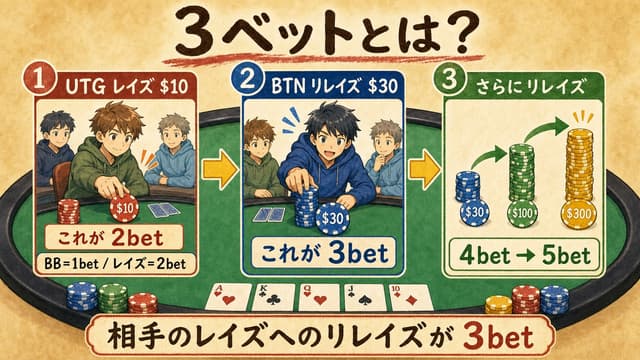
Why Is It Called a “3-Bet”?
Even though it is only the second raise, it is called a “3-bet” because the big blind counts as the first bet. Here is how it breaks down:
1-bet = big blind (forced bet)
2-bet = first raise (open-raise)
3-bet = the re-raise of that raise ← this is the 3-bet
4-bet = the re-raise of a 3-bet
5-bet = the re-raise of a 4-bet (in practice, usually an all-in)
It can be confusing at first, but if you remember to “count the BB as one of the bets,” everything falls into place. Reading our guide to open-raising alongside this article will also help you see the full preflop betting ladder.
What Is the Purpose of a 3-Bet?
There are three main reasons to 3-bet:
Value: profit from your opponent's raising range with a strong hand, by getting calls or 4-bets and building a bigger pot
Gaining fold equity: make your opponent fold and take the pot right there (= stealing)
Taking the initiative: put yourself in the position to be the aggressor from the flop onward
The key point is that you do not only 3-bet with strong hands — you also 3-bet when you want to force a fold. Because the action branches into three outcomes — call, 4-bet, or fold — it increases your opponent's options and creates pressure.
How Do You Choose Your 3-Bet Size?
Your 3-bet size changes depending on your opponent's open size and your position (IP / OOP).
IP (behind your opponent, position advantage): around 3x your opponent's raise is the benchmark. Since you can act later, a smaller size still works
OOP (in front of your opponent, position disadvantage): go bigger, around 4–5x your opponent's raise. Because postflop play is harder, size up to get folds right here
The other special case is the squeeze — a 3-bet made from behind when another player has already called your opponent's raise. Since there are more chips in the pot, the standard is to size up even further.
What Hands Should You 3-Bet?
s that suit a 3-bet can be thought of in two categories by purpose:
Value 3-bets: hands that dominate your opponent's raising range, such as premium pocket pairs or broadway hands
-oriented 3-bets: hands where the ideal outcome is a fold, but that can still play well postflop if called, such as suited connectors or suited hands containing an ace (Ax suited)
The important point is the latter: “can still play if called.” ed hands with an ace block your opponent's Ax hands, making them easier to fold, and if called, you keep nut-flush potential. s are less likely to be dominated by your opponent's strong hands and tend to flop strong draws.
Your exact range needs to be adjusted for each of your opponent's opening positions, and you can learn this step by step in PQ'z lessons such as “Learn 3-ting vs. CO / BTN” and “Learn 3-Betting vs. UTG / HJ”.
How Should You Respond to a 3-Bet?
When you face a 3-bet, your options are call, 4-bet, or fold. Here is the decision framework:
4-bet: hands well ahead of your opponent's 3-betting range (e.g., AA / KK / QQ / AKs). A size of about 2.2–2.5x their 3-bet is the benchmark
: middle-strength hands that are not strong enough to 4-bet but can profit postflop (e.g., middle pocket pairs, suited broadways)
: most hands that do not fit the above. Folding preflop is the right play
For beginners, keeping a baseline of “fold often, call cautiously, and only 4-bet with genuinely strong hands” will reduce costly mistakes. You can study detailed defending ranges in the PQ'z lesson “Learn How to Defend Against 3-Bets”.
What Is Different About 3-Betting From the BB?
3-betting from the BB is a special case that works a bit differently than from other positions.
The BB has already paid the blind, so the hurdle for calling is lower than from other positions
The BB is always OOP postflop, so calling too often leaves you at a disadvantage on the flop
As a result, the BB's 3-betting range tends to be more polarized, combining a wider set of callable hands with pressure-oriented 3-bets
BB strategy is a bit more specialized than other positions, so a good starting point is to think: “the BB can call a bit wider than other positions” and “3-bets should balance strong hands with bluff-oriented ones.”
Frequently Asked Questions About 3-Bets
Q. How often should I 3-bet?
A. It varies a lot by position and your opponent's range, but while you are still learning, it is best to start with strong hands only and gradually mix in more bluff-oriented 3-bets. If you 3-bet too much, you will get called or 4-bet more often, and the losses add up.
Q. Is it fine to use a fixed 3-bet size?
A. As a baseline, roughly 3x from IP and 4–5x from OOP, but you need to adjust when your opponent's open is larger or when you are squeezing.
Q. Where is the line between a 3-bet and a 4-bet?
A. It is the same counting system extended: a re-raise of a 3-bet is a 4-bet. Remember that continuing with a 4-bet is only sustainable with hands in the AA / KK / QQ / AKs class.
Q. Is it okay to 3-bet offsuit hands?
A. Strong offsuit hands (AKo / AQo) are value 3-bet candidates. But when 3-betting as a bluff, suited hands are overwhelmingly preferred (because of their extra potential when called).
Summary
The 3-bet is a star preflop action. Mixing it in well can take your preflop up a level. Here are the three essentials to remember:
Definition: counting the BB as a 1-bet, a re-raise of your opponent's raise is a 3-bet
Purpose: value / fold equity / initiative
Size: around 3x from IP, 4–5x from OOP as a benchmark
For concrete ranges and opponent-specific responses, try letting the lessons in the poker learning app “POKER Q'z”, such as “Learn 3-Betting vs. CO / BTN” and “Learn 3-Betting vs. UTG / HJ”, sink in step by step.