POKER Q'z Blog

Poker strategies, techniques, and the latest information to help you improve

Terms & Basics

View more →
Beginner Poker Learning Roadmap to Get Better From Fundamentals to Cash Games and TournamentsBasics

Beginner Poker Learning Roadmap to Get Better From Fundamentals to Cash Games and Tournaments

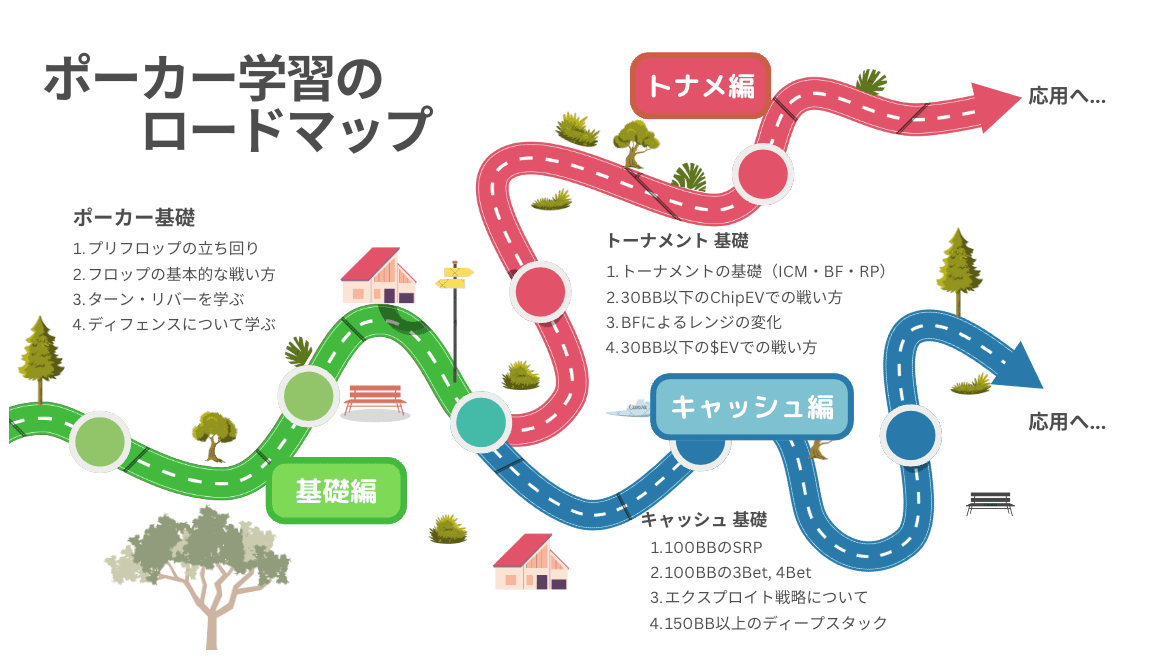
You’ve learned the rules of poker, but you’re not sure what to study to actually get better at cash games or tournaments. This article gives you a clear learning roadmap that shows what to learn and in what order, so you can improve efficiently. Follow this roadmap and you’ll build real skill without losing direction, whether you prefer cash games or tournaments.1. Fundamentals: Build a Strong Poker Foundation FirstCash games and tournaments follow different formats, but they share many core concepts. Start by mastering the fundamentals that apply to both.1.1 Learn PreflopYou play preflop every single hand, so it has a huge impact on your results. That’s why preflop is the first street you should prioritize. Here are the key points to learn first.When no one has entered the pot yet, open-raise instead of open-calling.The earlier your position, the more hands you should fold.Playing too many hands is a mistake.Many new players want to play lots of hands and end up losing money by entering pots with weak holdings. Start by studying which hands to play from each position. Once you understand your opening ranges, move on to how to respond when someone raises before you.1.2 Learn How to Play the FlopAfter you understand preflop, study flop strategy next. Preflop decisions depend only on your two hole cards, but on the flop your strategy changes dramatically depending on the board texture. That’s why learning to read boards is essential.To understand board texture, focus on these factors.The highest cardHow connected the ranks areThe suits on boardWhether the board is pairedUse these features to think about which player is more likely to have strong hands, and choose actions based on that.1.3 Learn How to Play Turn and RiverNext, study turn and river play. You reach these streets less often than preflop and flop, but the pot is usually larger, so one mistake can cost you a lot. Common turn and river mistakes include:Overestimating the strength of your handTrying to put your opponent on one exact handIn poker, you need to consider your opponent’s possible range and estimate how strong your hand is against that range. A small mindset shift helps you avoid overvaluing hands, value-betting too thin, and losing money in one-sided spots.1.4 Learn DefenseWhen you face a bet or raise and choose to continue by calling or raising (instead of folding), that’s defense. You must defend at the right frequency. If you defend too much, you lose money. If you fold too much, you also lose money. Study how your defense frequency and defending hands should change based on bet size and raise size.2. Cash Game TrackAfter you learn the fundamentals, you can branch into a cash game track or a tournament track. Here’s the cash game track. In cash games, you aim to make decisions that maximize the expected value of your chip stack at all times. Compared to tournaments, you often play with deeper stacks, so focus your study on those situations. We recommend learning in this order.100BB single-raised pots (SRP)Start with SRPs (spots where there is one preflop raise), because you’ll play them most often. Learn a solid, leak-free strategy based on GTO.100BB 3-bet and 4-bet potsNext, study 3-bet and 4-bet pots. Pots get bigger than in SRPs, so you need to plan more often with all-in scenarios in mind.Opponent-specific exploitsExploitative play means targeting weaknesses in your opponent’s strategy. Study how to adjust based on different player types. Classic examples include bluffing less against players who call too much, and bluffing more against players who fold too much.Deep stacks (150BB+)When stacks get deeper, you can win or lose a lot more in a single hand, which changes hand values and optimal lines. Study how your strategy should adapt.Recommended articles:https://japan.gtowizard.com/blog/principles-of-gto/https://japan.gtowizard.com/blog/exploitative-dynamics/3. Tournament TrackBecause tournament payouts depend on your finishing position, you need tournament-specific knowledge. This learning order works well.Tournament fundamentalsStudy these key concepts that matter in tournament play.ICMIn tournaments, your chip stack does not translate linearly into prize money EV. One model used to estimate prize money EV from chip stacks is ICM (Independent Chip Model). In late stages, you must choose actions while accounting for ICM.BFBF stands for Bubble Factor. It measures the gap between the downside of losing chips and the upside of gaining chips. A larger BF means losing chips hurts more.RPRP stands for Risk Premium. It indicates how much additional equity you need on top of chip-only requirements to justify taking a risk.It’s difficult to calculate these values precisely during play, but estimating them roughly helps you choose actions that increase your prize money EV.How to play 30BB and below in chipEVChipEV is the expected value of chips you gain from an action. In tournaments, chips and prize money EV don’t always align, but when you’re far from the money, making decisions based on chipEV often increases your long-term prize money EV. First, practice playing to maximize chips.How ranges change with BFWhen BF is high, optimal hand ranges change. Study how correct ranges shift based on your stack size and your opponent’s stack size.How to play 30BB and below in $EV$EV refers to how much an action changes your expected prize money. In late-stage tournaments, you’ll often see spots where chipEV is positive but $EV is negative. Study how to maximize prize money EV with the right decisions.Recommended article:https://note.com/gaku_btn/n/n42d355a709efWith POKER Q'z, you can study the poker fundamentals introduced here through quiz-style training. Build a strong foundation and level up your game.ConclusionThis article explained what to study first to become a stronger poker player. Poker is a game of incomplete information, so it’s not always easy to judge whether your play was correct. To choose the best actions consistently, you need solid fundamentals and logical thinking. Use this roadmap to train efficiently and keep improving.

2201
Are You Making Giant Bets? Bad Poker Habits You Should Fix Now Part 2Basics

Are You Making Giant Bets? Bad Poker Habits You Should Fix Now Part 2

Have you ever regretted a hand?Many players can follow preflop range charts, but once the board comes down they think, “I have no idea what to do postflop…”I was exactly the same when I started. And because the pot grows quickly postflop, one mistake can be costly. Maybe you’ve faced a big bet, tank-called, then immediately realized your hand was never good and thought, “Why did I call there if I’d just stayed calm?” If you study postflop in advance, you can reduce those painful, high-impact mistakes and keep more chips in your stack.In the previous article, we covered two bad preflop habits you should fix right now to move beyond the beginner stage. In this follow-up, we’ll look at two postflop bad habits beginners should fix first: “auto-calling” and “Gian betting.”Note: These are not standard poker terms. They are labels used only in this article.Fix these, and you’ll take a real first step toward becoming a stronger, more confident player.https://pokerqz.com/blog/poker-beginner-bad-habits-0011. Bad Habit 1: Auto-CallingYou’re in the big blind with As 5h. The button raises to 250 and you call. Including the small blind that folded, the pot is 550. You check, and the button bets 275 (half pot).Do you ever think, “I have an Ace, the strongest card. If an Ace hits, I can win, so I’ll just call for now”?Stop making that “auto-call.”Calling just because you have an Ace is a great way to bleed chips. Cut it out immediately.How often does an Ace actually hit the board? The answer is only about 12%. That means you’ll hit an Ace only around 1 time in 8. And even if you do hit, you can still lose to a better Ace kicker like Ac Tc, or to two pair or better like Ks 3s. In other words, even when you hit your Ace, it’s not automatically the “best hand.”Here’s a simple way to estimate the chance of improving your hand. It requires no difficult math, and even if you’re not confident with numbers, you can use it right away.The 2%–4% Rule for Quick Equity EstimatesOn the flop and turn, you can estimate the chance of hitting your outs by the river like this:Flop: (number of outs) × 4 (%)Turn: (number of outs) × 2 (%)Simple, right? This works because a standard deck has 52 cards. Now let’s apply it to the spot above. You hold As, so the remaining Aces are Ah Ad Ac, which gives you 3 outs. Since we’re on the flop:3 × 4 = 12 (%)So you’ll hit an Ace only about 12% of the time, or roughly 1 time in 8.Beginners often auto-call too much. Before you call, pause for a moment and think. The 2%–4% rule is extremely useful, so memorize it and start applying it in real hands.2. Bad Habit 2: Gian BettingThe unbeatable Gian vs. the helpless Nobita: bet when strong, check when weakImagine a poker table where Gian and Nobita are sitting in front of you. Gian always has the strongest possible hand, and Nobita always has no pair (just a high card). How would you play against them?1) When Gian bets, you know you’re always behind, so you fold every hand.2) When Nobita keeps checking, you know he’s extremely weak, so even with a weak hand you bluff and make him fold.That’s probably what you’d do. If you already know what they have, the decisions become easy. But then Gian never gets called, and Nobita always gets pushed off the pot, so neither of them wins chips.Now ask yourself this:Are your actions turning you into “Gian and Nobita” too?Let’s look at a similar spot. You’re in the big blind with 3s 3h. The button raises to 250 and you call. Including the small blind that folded, the pot is 550. Then you get lucky and the flop brings 3c, giving you three of a kind. You think, “This is super strong, I should bet big,” and you lead for 550 (a pot-sized bet). But here’s the truth:Stop making that “Gian bet.”If you bet huge only when you have a strong hand, you’re basically telling your opponent: “When I bet big, I’m strong. When I don’t, I’m weak.” That’s exactly the Gian and Nobita problem. Even though you flopped a powerful hand like trips, your opponent will often fold immediately and you won’t win much at all.To avoid falling into the Gian betting trap, keep these points in mind:• Consider checking sometimes even with strong hands• Consider bluffing when your hand is extremely weak (like no pair)Donk BettingA bet like the one above, where the caller bets into the preflop raiser, is called a donk bet. When beginners use donk bets, they often lose money, so in general, avoid donk betting.Remember: “If you call, then check.”If you want to understand why donk betting is usually a mistake and take your game to the next level, check out the article below for a detailed explanation.https://pokerqz.com/blog/donk

1202
What Does “Run It Twice” Mean in Poker? A Beginner-Friendly GuideTerms

What Does “Run It Twice” Mean in Poker? A Beginner-Friendly Guide

When you’re playing poker and someone goes all-in, you may hear the term “twice.” This is most common in cash games, so if you mainly play tournaments, you might not have come across it yet. In this article, we’ll explain what “twice” means in poker in a beginner-friendly way.1. What does “twice” mean?“Twice” is short for “run it twice.” It refers to an option where, when all players are all-in before the river, the remaining board is dealt two separate times and the pot is split based on the results. Players use it to reduce variance (swings caused by luck).This option is mainly used in cash games, and the most common rule is that the board is run twice only if every all-in player agrees. Depending on the casino or poker room, rules can vary, such as “only allowed in heads-up pots” or “you can run it three times or more.” It’s a good idea to confirm the house rules in advance.2. Example of running it twiceLet’s look at how running it twice works in practice. Consider the following situation.Two players are competing for the pot.One player goes all-in on the flop, and the other player calls.If both players agree to run it twice, the turn and river are dealt two separate times. Then the pot is split based on the outcome of each run. In the example image, the right player wins the first run, and the left player wins the second run, so the pot is chopped and each player receives half.3. Is running it twice good or bad?Does running it twice change your expected value in chips? Let’s use an example where players get all-in on the turn.In this spot, the right player is currently ahead. For the left player to win, they need to hit one of five outs on the river: Ah, Ad, Ac, Js, or Jc. Let’s calculate the left player’s expected chip return with and without running it twice.If you do not run it twiceThere is no possibility of a tie on this board. Out of the 44 unseen cards, the left player wins if one of the 5 outs appears, and loses if any of the other 39 cards appears. So the expected value is 5/44 of the pot.If you run it twiceNow let’s find the probability that the left player wins both boards, and the probability they win exactly one board.Winning both runsTo win both, you deal two cards from the remaining 44, and both must be outs. The probability is:(5×4)/(44×43) = 5/473Winning exactly one runTo win exactly one, one card must be an out and the other must not be an out. The probability is:(5×39×2)/(44×43) = 195/946When you win exactly one run, you only receive half the pot. So the expected value becomes:1×(5/473) + (1/2)×(195/946) = 5/44This shows the expected value is the same as not running it twice: 5/44 of the pot.We used a turn all-in example here, but it’s also known that if players get all-in preflop or on the flop, running it twice does not change equity.Running it twice does not change equity, but you do need to pay attention to rake. In some rooms, running it twice can increase the rake. Reducing variance is appealing, but depending on the rake structure, running it twice can actually cost you money. Check the rules beforehand.Key pointsRunning it twice does not change equity.Running it twice may increase rake and could be unprofitable.If you want to learn more about rake, see this article:https://pokerqz.com/blog/rakeConclusionIn this article, we explained what “twice” means in poker. Running it twice reduces swings and can make your results feel more stable, but you can also choose to decline and embrace higher-variance situations for the thrill. Pick the option that fits your style. We hope this guide helped.

1274
Tournament vs Ring Games: What’s the Difference in Poker Rules for Beginners?Basics

Tournament vs Ring Games: What’s the Difference in Poker Rules for Beginners?

Do you prefer tournaments or ring games? Tournaments are full of all-ins and fast-paced action, while ring games let you play deep-stacked poker and think through every street. Each format has its own appeal. In this article, we’ll clearly explain the key differences in rules and strategy so you can enjoy both tournament poker and cash games even more.1. What Are Tournaments and Ring Games?TournamentsA tournament is a battle-royale style poker format where players get eliminated as soon as they lose all of their chips. Even if you were the chip leader a moment ago, one lost all-in can knock you out immediately. As the tournament progresses, the blinds increase, so you often end up playing with a short stack except in the early stages. In addition, most tournaments include an “ante,” a forced contribution separate from the blinds, which encourages you to play more hands.Ring Games / Cash GamesThis is poker where the goal is simply to increase the chips (money) in front of you. Unlike tournaments, the blinds do not go up over time, so you can play deep-stacked and take your time. In many cash games, the casino also takes a “rake” from the pot. “Ring game” and “cash game” originally mean the same thing, but in Japan, “ring game” often refers specifically to games that do not involve real-money wagering.For more on “ante” and “rake,” check out these articles:https://pokerqz.com/blog/antehttps://pokerqz.com/blog/rake2. Difference 1: Stack DepthThe size of your stack (how many big blinds you have) is arguably the most important difference between tournaments and ring games. In tournaments, blinds keep rising, so you’ll often play with a short stack outside the early levels. Let’s look at what changes when stacks get shallow.2.1. All-ins Become Extremely PowerfulWhen stacks get shallow, your stack becomes relatively small compared to the pot. As a result, unlike deep-stack play, you need to go all-in much more often. If you fear elimination too much and hesitate to shove, you’ll miss profitable spots. Look for chances to apply pressure and get your chips in. Once you drop below 20bb, you should play with the possibility of open-shoving preflop in mind.2.2 Hand Values ChangeWith a short stack, even if you make a big hand, you can’t win that many chips. That’s why speculative hands that rely on making strong but low-frequency hands, such as 9h 8h, lose value. Since preflop all-ins happen more often, hands that are harder to play postflop but have relatively high preflop equity, such as small pocket pairs like 5s 5d and ace-x hands like Ah 4c, become much more valuable.3. Difference 2: The Value of ChipsIn a ring game, the size of your stack directly represents its value. A 1,000-chip stack is worth exactly twice as much as a 500-chip stack. In tournaments, however, that’s not always true. Even if you double your stack, your expected prize value does not necessarily double.Here’s an example.You are playing a tournament where the top 5 players win a seat to a major event (a “satellite tournament”), and there are 10 players left.The stacks are:Chip leader: 10,000You: 5,000The remaining 8 players: 1,000 each.In this tournament, 1st place and 5th place have exactly the same value. You just need to finish in the top 5. In other words, your stack’s value is determined by your “probability of finishing in the top 5.” The chip leader has twice as many chips as you, but do they really have twice the probability of finishing in the top 5? Of course not. Both the chip leader and you are very likely to finish in the top 5, probably well over 90%.This is why, in tournaments, you must play to maximize prize value, not just to accumulate chips. In this example, if the chip leader shoves on you, you should often fold even As Ad. As you get closer to the money or a seat, shift your focus away from building a bigger stack and toward maximizing the prizes you can realistically secure.ConclusionIn this article, we explained the differences in goals and strategy between tournaments and ring games/cash games. In summary:In tournaments, stacks get shallow, so all-ins become a key weaponIn tournaments, your goal is not simply to win more chips, but to maximize the prizes you can earnMany beginners in tournaments fold too much because they fear busting, and they slowly bleed chips to the blinds and antes. Have the courage to go all-in when the spot is right.If you’ve only played one format, use these ideas to try the other. You might discover a whole new side of poker that you enjoy.

753

Latest Articles

How EDGE POKER Inspired POKER Q’z’s Vision for the Ideal AI Poker AppColumn

How EDGE POKER Inspired POKER Q’z’s Vision for the Ideal AI Poker App

IntroductionAs an engineer working on the poker training app POKER Q’z, I spend my days building products and designing algorithms at the intersection of poker and AI.Over the past few years, Japan’s poker app market has grown rapidly. Apps like EDGE POKER, m HOLD'EM, Poker Chase, EARN POKER, and Poker Fate have made it easier than ever to play poker casually on a smartphone. As both a player and a developer, I’m genuinely happy to see this momentum.One of the most talked-about titles lately is EDGE POKER, which strongly positions itself around poker and AI. Its standout feature is a proprietary AI called EDGE AI. After trying it myself, I found parts that felt impressive, and other parts where I thought, “With a few changes, this could become even more interesting.”In this article, I’ll use EDGE POKER as a case study to organize, from a developer’s perspective, how poker apps can evolve going forward and what kind of technology we’re building at POKER Q’z.Note: This article is not written to criticize. I’m writing it because I want the entire industry to become more exciting.Note: To respect the terms of service, I’m not including EDGE POKER screenshots.Point of Concern 1: How AI Is UsedGOD's MOVEFirst, let’s talk about GOD's MOVE (a feature where AI automatically selects the optimal action). By using a paid item called “Crystals,” players can use this feature even in the rated mode, “Ranked Games.” In other words, it effectively supports or even replaces the player’s decision-making. If a feature like this is allowed in ranked play, results no longer reflect pure skill alone.In addition, pay-to-win advantages in ranked games aren’t limited to GOD's MOVE. The game also offers effects that directly influence rank movement, such as maintaining consecutive placement bonuses.When paid features create in-game advantages and disadvantages, rank starts to represent not “player strength,” but “how effectively someone used features and items.” As a result, the meaning of rank and competitive fairness can weaken.Poker is fundamentally a game where players compete in decision-making and strategy under the same conditions. Of course, using GOD's MOVE in a non-rated mode like “Single Game” can be a great learning and onboarding experience. But at least in ranked games, I believe a non-pay-to-win, skill-based design should be the baseline. If you use AI, it should not play for you during the hand. It should focus on post-game review and learning support, which aligns better with the essence of poker.One representative approach is an explanation feature, and at POKER Q’z we’ve continuously strengthened this as a core function. We develop systems that automatically generate explanations based on your decisions, and technologies that analyze your tendencies and play style from hand histories to deliver personalized feedback. These are our proprietary core technologies, and we are currently filing patents.Example explanation text in the POKER Q'z app (1)Example explanation text in the POKER Q'z app (2)BUDDY AIAnother feature that caught my attention is BUDDY AI (an AI that imitates your play). The concept itself is technically fascinating: it learns your tendencies and plays on your behalf. But from a user experience standpoint, I still have questions.Poker is, at its core, fun because you struggle, think, and choose for yourself. That’s why, rather than watching an AI play “instead of you,” I believe the experience of improving while you play has more value as a game.If you want to use AI on a player’s data, it may fit better as a coach that:automatically analyzes your tendenciespoints out your weaknessesexplains “this is a better action here” in natural languageIn terms of learning and growth, AI as a coach and explainer seems like a stronger match.Point of Concern 2: AI PerformanceBecause EDGE POKER positions poker and AI as its main strength, expectations naturally rise around AI accuracy and consistency. While the app includes many convenient features, I also noticed several behaviors that felt “potentially risky” when viewed as a learning tool.Three points stood out in particular.Mismatch Between In-Game Advice and Post-Game ReviewIn some cases, the action the AI recommended during play differed from the “best action” shown in the post-game review. Even though it was the same spot, the conclusion changed, which can cause issues such as:users not knowing which guidance to trustlearning becoming inconsistentdoubt about whether the AI is actually correctConsistency is critical for any learning-support AI. If real-time advice and review use different evaluation logic, the tool loses credibility as educational content.Recommendations That Are Clearly UnnaturalIn a few spots, the AI recommended actions that were clearly far from sound theory. For example, it suggested folding a completed straight, which is almost never a realistic decision in practice.This isn’t just a minor optimization gap. It can actively push players toward misunderstandings, which is fatal for a learning tool. For poker AI, being “strong” matters, but being “clearly not wrong” matters even more. Without basic strategic consistency, users can’t safely rely on the AI.Unclear Logic for Range Analysis and Hand ClassificationI also felt some friction with the range analysis feature. It doesn’t provide a clear, top-down view of overall range strategy, and the information it shows feels fragmented. On top of that, I noticed issues such as:unclear criteria for strong, medium, and weakno clustering based on hand propertiesFor example, a very strong draw like a gutshot plus a flush draw sometimes gets labeled as “one pair” because the board is paired, which doesn’t match real-world poker intuition.Range visualization isn’t just about “classifying hands in a plausible way.” It’s an information design problem that directly affects decision-making. If the display doesn’t align with intuition and practical play, users lose trust in the output and stop using the analysis features. Thinking in ranges is at the heart of poker study, so clarity in classification logic and practical consistency are essential.Thoughts on EDGE AIEDGE AI is designed to highlight the experience of “AI solving poker,” by recommending optimal actions during play and even making decisions automatically.Reference articlehttps://note.com/edge_poker/n/n97dbb01b7cd8Comparing the official explanation with the actual behavior, it seems likely that EDGE AI uses something close to an ML-based approximate solver model, such as:training a model on GTO strategies computed via CFR and similar algorithms as teacher dataextracting features from the current situation using rule-based logicfeeding those features into the model to predict EV for each action and selecting the highest-EV actionThis is a very standard approach and technically interesting. At the same time, after playing with it, I also felt the unique challenges that come with poker AI. Below are the key points that stood out to me.There Aren’t Nearly Enough Training SituationsThe first issue is a lack of training coverage. In poker, even small changes can dramatically shift the optimal strategy. Position, stack depth, bet sizing, board texture, ICM pressure, and many other factors matter, and the state space is effectively close to infinite. That makes “training sufficiently on every situation” an extremely difficult problem.Once the model enters an area not covered well by training, accuracy becomes unstable. This is less about whether the algorithm is good or bad, and more about a structural difficulty: poker is a game where training data coverage is inherently hard to achieve.Feature Design Doesn’t Match Real-World PokerAnother major point is the design of input features.Based on the behavior, it appears to use basic information such as table-wide stack conditions, current made hand category (high card, one pair, etc.), and whether draws exist. But in real poker, that’s not enough.In practice, decision-making depends heavily on context such as:hand strength that includes future potentialrange narrowing based on action historyblocker effectsproper defense frequenciesICMIn poker AI, feature design essentially determines the “resolution” of strategic understanding. If features remain too coarse, the model will struggle to reproduce decisions that feel accurate in real play, no matter how much training you do.You Can’t Build Poker AI with Engineering AloneThis was the strongest takeaway for me. Building poker AI isn’t just about machine learning or model accuracy. Many critical design decisions come earlier:what features to includewhich information truly matters for decisionshow far you can abstract while still expressing strategyYou can’t answer these well without deeply understanding poker itself. In other words, you need not only the ability to implement algorithms, but also real, practical poker knowledge. Only when both come together can you build a poker AI that’s actually useful.And at POKER Q’z, many team members bring both engineering and player perspectives. That’s why we can build products that directly improve the learning experience.The POKER Q’z PhilosophyLet me briefly share the mindset behind how we build POKER Q’z. Our goal is simple: use AI to deliver the best poker learning experience possible.We don’t just want to create “a poker app you can play.” We want to build a product where you naturally get stronger simply by playing. Poker is a deep, strategic, intellectually rewarding game. At the same time, it’s also true that the learning curve is steep.You don’t know what the correct play isYou don’t know why you lostYou don’t know what to fixThis vague uncertainty becomes the biggest barrier to improvement.That’s why we prioritize helping users improve as efficiently as possible. At the same time, we don’t want it to feel like studying. We want a learning experience where you’re having fun playing, and before you know it, you’ve improved.We want poker to become not “a difficult game,” but “a game where you got stronger without realizing it.” That’s the ideal we aim for at POKER Q’z.Strategic Accuracy That Supports LearningThe most important foundation is strategic accuracy. While we continue developing AI and algorithms, we’re building the infrastructure to present strategies that are as theoretically correct as possible in any given spot. Even the clearest explanation is meaningless if the underlying strategy is wrong. As a learning product, we believe the minimum requirement is being able to provide answers users can trust.AI as a Coach, and Natural-Language ExplanationsAnother key element is how we communicate. Simply showing the correct strategy doesn’t make players truly stronger. Players improve when they understand why an action is good and what thought process supports it.That’s why we treat AI not as something that plays for you, but as a coach that supports your thinking. We avoid dumping numbers and jargon. We explain in words that even beginners can grasp intuitively. We aim to communicate not only what happened, but also why it happened. By using generative AI and natural-language technology, we work toward an “explanation experience” that helps players internalize the thinking process.Inside the app, we also include an AI assistant that users can ask freely about strategy and specific plays. Many users have responded positively to it as a learning support feature. We continue improving it to provide more accurate answers and clearer explanations for beginners. We also offer exercise-style quizzes with explanations tied to each lesson theme, so users don’t just consume knowledge but reinforce it through practice.We don’t want AI to simply “give you the answer.” We aim to deliver a learning experience that helps you build the thinking process that makes you stronger.Example output from the in-app AI agentExample exercise question in the appExample exercise explanation in the appFinal ThoughtsWe want the poker industry in Japan and around the world to keep growing. We still have a lot to learn, but we’re seriously looking for partners who want to help grow the poker world.Companies and partners interested in collaborationInfluencers who want to work with usAnd we’re also actively recruiting people to join POKER Q’z, including interns, in areas such as:Business development (Japan and global marketing, creative production, and more)EngineeringAI and algorithm research“Poker can be even more fun.”“AI can create a better experience.”If those ideas excite you even a little, feel free to reach out.Let’s make Japan’s poker scene even more exciting together.

251
Poker Q’z Developer Shares Tournament Strategy Secrets: Top Features and Behind-the-Scenes Story of the New Tournament ModeColumn

Poker Q’z Developer Shares Tournament Strategy Secrets: Top Features and Behind-the-Scenes Story of the New Tournament Mode

Hello! I’m Shuhei from CLOViZ Inc.In November 2025, the poker training app POKER Q'z released a long-awaited new feature: the Tournament Mode.In addition to the existing Cash Game Mode, you can now learn tournament-specific skills such as ICM and short-stack strategy.For this article, we interviewed POKER Q'z developers Toshiki Ohata and Hayato Abe directly.What are the keys to tournament success? How do you actually get better at poker?We also asked them to speak from the perspective of poker players.We also dug into why they built the app, and how to use it to improve faster.They shared insights only developers can offer, including behind-the-scenes stories from development, so be sure to read to the end.The POKER Q'z Developers as Poker PlayersFirst, could you both introduce yourselves?Ohata:I’m Toshiki Ohata. I’m a master’s student in the Graduate School of Information Science and Technology at the University of Tokyo. I belong to a lab that researches game AI and natural language processing, and I’m currently on leave from school to focus on the business.https://pokerqz.com/ja/blog/interview01Abe:I’m Hayato Abe. I’m currently a third-year student in the Faculty of Agriculture at the University of Tokyo. I’ve studied poker thoroughly from both theory and real play, and I’ve been fully immersed in poker every day, in both tournaments and cash games.What roles do you each have on POKER Q'z?Abe:While researching poker, I decide what goes into the app’s content.I think about which hands to feature and what lessons will help users improve the most.Ohata:I help with some of the content, but I mainly handle development.I implement quizzes and lessons, and I write programs that calculate GTO strategies.At this point, what does the overall lesson structure in POKER Q'z look like?Abe:Broadly speaking, poker is divided into cash games and tournaments, and Levels 0–2 cover fundamentals that apply to both.From Level 3 onward, the paths split: the Cash Game Mode teaches core concepts like GTO, while the Tournament Mode focuses on tournament-specific thinking such as ICM.Thanks. This interview is about the new Tournament Mode, but before we dive in, do you have any memorable tournament stories from your own experience?Abe:This is from my first time playing a tournament. The top finishers received in-store points, so there was a clear “in the money” line. There were about 70 players, and I made it to the point where one more elimination would put me in the money.But I only had 2bb left, and somehow I picked up pocket eights UTG. I ended up jamming for 2bb, and a player behind me called with pocket nines.Ohata:That’s brutal (laughs).Abe:So I bubbled my first live tournament ever (laughs).And on the turn, we both picked up straight draws, and the outs flipped.Ohata:So the board had 6, 7, T on it?Abe:Exactly. So halfway through, I was the one yelling “Nine! Nine! Nine!” (laughs).Ohata:Did an eight come on the river?Abe:Nope, nothing on the river (laughs).Ohata:If the river was an eight, that would’ve been legendary (laughs).That’s an amazing story. And it’s perfect because the lessons cover bubble play a lot (laughs). Ohata, do you have a story too?Ohata:I’ve got a legendary one too (laughs).I had pocket fives in the BB and called a BTN open. The flop came 3, 3, 5, so I flopped a full house.The opponent was super aggressive, and we got it all-in on the flop. When we flipped, they had 64s. Boat vs open-ender is basically locked up, right?Then the turn was a 3, and the river was also a 3!Everyone:(laughter)Ohata:I lost to their 6-high because the board played (laughs).That’s insane (laughs).Ohata:The worst, most unbelievable bad beat of my life (laughs).In Tournaments, Preflop Is 90%Now that we’ve heard some great tournament stories, let’s talk about the app. What are the key points of the newly released Tournament Mode?Abe:The biggest thing is understanding the difference from cash games. There are two major points.First, tournaments have no rake, and they have antes. That means preflop ranges change dramatically. And because you have to play different ranges depending on the situation, preflop becomes far more complex than in cash games.Second, in tournaments, the goal isn’t simply to increase your chip count. You’re playing for placement. So even if a call is profitable in chips, it can be a mistake when you consider whether you cash or not. Near the bubble, for example, big stacks can apply pressure aggressively, while short stacks often have to fight to survive. That kind of structure doesn’t really exist in cash games.Right, concepts like “rake vs ante” and “cashing” don’t exist in cash games, and they create strategic differences.Abe:Exactly. And in tournaments, preflop carries an extremely high weight.I truly believe tournaments are 90% preflop.Even if you win a huge all-in early at blinds like 100/200, those chips might only be worth 1bb later. That’s tournament poker: you can build a stack early, then give it away later because of a small preflop mistake.That’s something that happens because blinds keep rising in tournaments.Abe:Yes. That’s why preflop accuracy is critical.And once you get down to 10bb late, you often don’t even reach postflop. If you make even a small mistake in a 10bb all-in call, you lose your entire stack and you’re out. So preflop mistakes are extremely costly.That’s true.Abe:The new Tournament Mode lessons organize these points and explain them in a simplified way.Within Tournament Mode, do you have a personal favorite lesson you’d recommend?Abe:For me, it’s the ICM explanation. I think we did a great job showing that your chip count and your payout value are not the same.We use an example tournament with a $100 prize pool and a $60 first-place prize. Total chips are 100 points, and the chip leader has 70 points. In that spot, the chip leader’s 70 points are not worth $70. You only get $60 if you win all the chips, so those 70 points are worth less than $60.That’s a very clear ICM example.Abe:It’s hard to grasp the value of a single chip point. In this example, even with 70 out of 100 points, first place only pays $60, so it can’t be worth $70. The key is that having more chips can actually be disadvantageous in terms of marginal value.On the other hand, if last place pays $10, then even if you only have 10 points right now, you still get $10 even if you drop to 0. That means those 10 points are worth more than $10.Ohata:It helps to imagine chips as a stack piling up. The chips at the bottom are high value, and the chips stacked on top are lower value.I see.Ohata:This also explains bubble factor. Short stacks mostly hold those high-value bottom chips, while deep stacks can gamble with lower-value top chips. That’s why short stacks are forced into tougher spots.Abe:People often say “short stacks are disadvantaged.” That’s true in a sense, but it’s because the chips you fought to survive with are so valuable, so you’re forced to fold more.Right, even with 2bb, it matters to hang on and cash.Abe:Exactly. That’s why this lesson focuses on learning the fundamentals so you can make decisions that are profitable in terms of expected prize value.We built this lesson hoping it helps everyone improve their tournament results.GTO Wizard Is a Dictionary. POKER Q'z Is a Textbook.Abe, you’ve created such strong lessons. How did you study to reach that level yourself?Abe:I studied relentlessly by running GTO Wizard over and over.For bubble factor, I learned by looking at charts and thinking, “Oh, it applies to two players here,” and so on.One thing surprised me. Intuitively, it feels like busting with 10bb is a bigger mistake than busting with 3bb, right?It does feel that way.Abe:But it’s actually the opposite. The player with 3bb has a higher bubble factor than the player with 10bb. In other words, the 10bb stack can call all-ins more easily.Ohata:That’s because if the 10bb stack calls and wins, they jump to a bit over 20bb and their expected prize value increases sharply. But if the 3bb stack calls and wins, they only get to a bit over 6bb, so the upside is much smaller.Abe:So in the past, when I still had 10bb, I would fold even strong hands, and when I had 3bb, I’d shove because I felt forced to. But it was backwards.So whether you have 10bb or 3bb, losing an all-in means you bust, but if you win and double, the 10bb stack’s expected prize value rises much more.Ohata:Exactly. A lot of players misunderstand this, so I really want people to learn it.Abe:That’s how I studied: staring at GTO Wizard and finding patterns across situations and putting them into words.Ohata:Honestly, it’s genius.Abe takes GTO Wizard’s endless, hard-to-interpret solutions and extracts the key features and condenses them into lessons.Abe:What I want to tell everyone is this: “GTO Wizard is a dictionary, and POKER Q'z is a textbook.” GTO Wizard is like a massive dictionary. If you just look at it, you often don’t really understand anything.So if you think, “I want to study bubble factor,” and you open a huge dictionary, it’s overwhelming. But with a textbook that extracts the essentials, you can learn naturally.Ohata:“GTO Wizard is a dictionary, POKER Q'z is a textbook” is a great tagline (laughs).It really is (laughs).Abe:I think it’s important to use GTO Wizard to search for new insights, but if you don’t understand the textbook basics and you jump straight into the dictionary, you’ll often end up completely lost.Also, you can easily fall into the trap of ending with analysis of a single hand, which is honestly pointless.Ohata:Getting excited like “The call frequency was there! I was right!” is the most meaningless way to use a GTO tool (laughs).That really is meaningless (laughs).Abe:For example, even if a solver says BTN is shoving their entire range so you can call with KTo, in real life the opponent might not shove that wide and might have a lot more Ax. In that case, calling with KTo becomes massively negative EV.Ohata:So when you use GTO Wizard, you must compare the GTO opponent strategy with the real opponent strategy.Abe:But only a small number of players can do that well. That’s why I want people to study with POKER Q'z first, and then look at solutions like GTO Wizard.By learning POKER Q'z lessons, you’ll be able to use solver tools effectively.You Alternate Between Input and OutputAbe:Another big advantage of POKER Q'z is that it gives you the feeling of actually playing poker.I turn common player mistakes into practical quizzes, so you can think about them as your own decisions.It’s also dialogue-based, so you move forward while being prompted with questions, and you can confirm your growth by solving practice problems and real-hand quizzes. I think it’s designed for active learning.Ohata:In other words, POKER Q'z is designed so you can alternate between input and output.With typical study, you mostly consume information and don’t get enough chances to apply it. But in POKER Q'z, it’s all contained in one place.Right. In POKER Q'z, Q-chan makes a mistake, Aria points it out and explains it, then you solve practice questions, then real-hand quizzes, and so on.Abe:And because everything is broken into short chapters, you can study in small chunks during spare time.Ohata:Yeah, being able to alternate input and output, and being able to do it in spare moments, are key strengths of POKER Q'z.One more thing: everything you’ve shared has been fascinating, so if you have any other quick story, I’d love to hear it.Abe:Okay, here’s a tricky spot (laughs).It’s a 6-max table. I’m in the BB as the shortest stack, UTG is the next shortest, and there are several deep stacks in between. In this situation, the BB can barely call a UTG 2bb open.That’s because UTG tightens their opening range since deep stacks are behind, and I have to tighten even more because I’m shorter than UTG. So I can only call with an extremely tight range.Ohata:So there are two separate reasons the range gets tighter.Abe:Exactly. So even though it’s “just” a 2bb open, I’m folding hands like T7s and KTo. It’s unbelievably tight. It felt like all-in or fold most of the time.When I discovered that, I was literally saying in the office, “You’ve got to be kidding me!” (laughs).Ohata:But what’s impressive is that Abe turned “You’ve got to be kidding me!” into an actual discovery: the idea that there are two separate tightening factors.Abe:That’s the struggle of building lessons…Ohata:Like we said, the real value is that we extract the essence from complex solutions and package it into lessons.And this is something unique to games of incomplete information: it’s hard to find clear “standard lines.” Even so, POKER Q'z can present something close to a practical guideline.Abe:I think we teach fundamental strategy very well. And once you have that foundation, you can observe opponents and adjust into opponent-specific strategy, which will help you improve even more. POKER Q'z can be the compass that guides you there.Final Question: The One Thing You Should Focus on in TournamentsTo close, if you could share just one thing readers should focus on in tournaments, what would it be?Abe:It has to be “tournaments are 90% preflop” (laughs).In the late stages, one small mistake in an all-in call can erase all your work. And compared to early-stage mistakes, the impact of a small preflop mistake late is literally on a different order of magnitude. Preflop matters that much. And late-stage spots are also affected by bubble factor, which makes them very difficult. If you reduce your preflop mistakes even a little, your tournament results will improve dramatically.If your preflop is correct, things usually won’t go that badly. I truly believe preflop skill strongly correlates with overall poker skill.You could even play postflop however you want, just check everything (laughs).Ohata:Don’t do that (laughs).Abe:That’s how strongly I want to emphasize how important preflop is (laughs).Ohata:The new Tournament Mode focuses mainly on preflop, while postflop is covered in depth in the Cash Game Mode.Abe:Yes. Cash Game Mode includes a lot of knowledge that helps in tournaments too. For example, c-bet strategy by flop texture translates directly to tournament play, so I’d love for people to study that as well.But first and foremost, preflop is everything.So the idea is: study tournament-specific preflop in Tournament Mode, then learn postflop strategy that applies to both formats in Cash Game Mode.Ohata:That’s the best approach. We’d be happy if you register for both while you’re here.

367
Tournament Study Methods With POKER Q’z to Improve From Beginner to Advanced Starting TodayTournament

Tournament Study Methods With POKER Q’z to Improve From Beginner to Advanced Starting Today

MTTs Aren’t “Just Luck”In tournaments, the blinds keep going up and your stack keeps shrinking.You stare at your dwindling chips, think “I guess I have to go all-in soon…,” shove reluctantly, and bust out. It happens a lot.“Yeah… tournaments are basically luck.”Is that what you’ve been thinking?Let me be clear.MTTs are never “just luck.”Now, take a moment to review your own play.Did you use an MTT-specific open range instead of your cash game ranges?Did you adjust your open range flexibly based on stack depth?Did you track how many players were left until the money and the stacks around you?Did you make decisions with ICM in mind?Did you navigate the bubble effectively?Did you make correct all-in decisions?If you don’t understand what these mean, that’s proof you haven’t studied tournaments enough.These are fundamental MTT concepts, so you can understand them quickly with a bit of study.There’s a huge gap between “knowing” and “not knowing,” so close that gap as soon as possible.And of course, there are many more factors beyond the list above.If you play tournaments the same way you play standard cash games, you won’t get the results you want.If you want to finish higher in MTTs,study specifically for tournamentsand do it properly.Key MTT Features: How Tournaments Differ from Cash GamesTournaments differ from cash games in several major ways. Let’s organize the key points first.1) Your goal is to survive and win prizesMTTs and cash games have different objectives. In cash games, the goal is simply to increase your chip stack. In tournaments, the goal is to survive as long as possible and earn prizes based on your finishing position.In other words, chip count and prize money are not the same thing.For example, in a 100-player tournament that pays the top 5, 6th through 100th are the same in one key way: they win nothing. That means there’s a massive difference between 5th and 6th.That’s why MTTs require position-based, payout-aware decision-making.2) Blinds increase over timeIn cash games, blinds usually stay the same. In tournaments, blinds rise as time passes.For example, you might start with blinds at 50/100 and a 20,000 stack, which is 200BB. But if blinds increase to 500/1,000, that same 20,000 stack becomes only 20BB.So when blinds go up, the value of your chips goes down. It’s crucial to accurately track your stack and your opponents’ stacks in big blinds and play accordingly.3) There is an anteUnlike cash games, tournaments include an ante. This is a forced contribution separate from the blinds that goes into the pot before the hand begins. Often, the big blind posts an ante equal to the BB (a big blind ante).That means each hand starts with SB (0.5BB) + BB (1BB) + ante (1BB) for a total of 2.5BB in the pot.Compared to 1.5BB in many cash games, the pot is larger, so the reward for entering pots increases.4) No rakeIn cash games, the house typically takes rake from the pot postflop. Tournaments do not take rake from individual pots.So just like the point above, because the pot doesn’t get reduced postflop, the reward for continuing postflop is larger.As you can see, even the basic rules differ significantly between tournaments and cash games.So naturally, strategy also differs dramatically.Keep this firmly in mind and study with a focus on how MTTs differ from cash games.Next, let’s look at what you should study first.Are MTTs 90% Preflop?When you start studying tournaments, you might wonder where to begin.Here’s the conclusion.By far, the answer is preflop.MTTs are 90% preflop.Stop overthinking it and start studying preflop.That might sound a bit extreme, so here’s why preflop matters so much in tournaments.As mentioned earlier, blinds keep rising in MTTs, which means you’ll often play with shorter stacks.As a result, preflop all-ins happen far more often.If you make the wrong decision in these preflop all-in spots, it becomes a fatal mistake.All your hard work can disappear instantly, and that’s brutal.MTT preflop strategy differs from cash game preflop strategy in many ways, and you must account for tournament-specific factors, which makes it complex.By studying preflop, you’ll learn the core fundamentals of tournament poker.Let’s look at three concrete examples.Example 1: All-in decision right before the moneyYou’re playing a satellite tournament, and if just one more player busts, you’ll be in the money (you’ll win a prize). You have 10BB, and you’re dealt Ah Kd in the big blind.The chip leader on the button shoves for 50BB, and everyone else folds.The remaining stacks are: UTG and CO have 20BB, SB has 10BB, and HJ has 2BB.Your options are call all-in or fold. What do you do?(This scenario is based on lesson content from POKER Q’z.)Correct answer: fold!“Wait, fold AK?”If that surprises you, you won’t win in tournaments. Calling all-in here is clearly a big mistake.Let’s break it down. You’re one bustout away from the money, and the HJ has only 2BB and is about to bust.In other words, you have a high chance to cash without doing anything.AK is a very strong hand, but against the button’s overall shove range, it still has only about 60% equity.When you’re likely to cash by waiting, taking a gamble where you bust about 40% of the time is obviously bad.If you were about to call, fix that mindset immediately.Example 2: Big blind defenseNow assume a normal situation where the money is still far away. You have 50BB and are dealt 9d 4d in the big blind.UTG, also with 50BB, opens to 2.3BB and everyone else folds. What do you do?Raise, call, or foldCorrect answer: call!“Isn’t 94 suited too weak?”In tournaments, antes are in play, so the big blind can defend with many more hands.Against a 2.3BB open like this, you only need to add 1.3BB to compete for a pot of 1.3BB × 2 + 2.5BB (blinds + ante) = 5.1BB.Here’s a surprising fact about suited hands in BB defense:When the open size is small, the big blind can call with every suited hand.Yes, every suited hand.Antes allow you to widen your BB defense range that much.That said, if the open size is larger, like 3BB, you should fold some of the weakest suited hands.To move up in tournaments, you must understand MTT-specific features and adjust flexibly to the situation.Example 3: Mid-stage all-in decision (advanced)Here’s one advanced example. If it feels difficult, feel free to skip it.You enter a tournament with 40,000 chips.You build your stack, and now it’s the mid stage: about one-third of the field remains, the average stack is 120,000, and blinds are 3,000/6,000.You have 120,000 (20BB), open from LJ to 14,000 (2.3BB), and the SB shoves for 120,000.Which offsuit Ax hands do you call with?AKo, AQo, AJo, ATo, A9o…Correct answer: AJo!According to EV calculated in GTO Wizard:Call with AJo: +1.32BBCall with ATo: about 0 (but it mostly folds)Call with A9o: -1.37BBSome people might think, “It’s only a little over 1BB. That’s not a big deal.”But in this spot, 1.3BB is roughly 10,000 chips.If you fold AJo or call A9o here, it’s like making a massive mistake worth 10,000 chips compared to your original 40,000 starting stack.As blinds rise over time in MTTs, one mistake becomes more and more costly.MTTs really are 90% preflopAfter these examples, the message is simple:MTTs are 90% preflop. Start studying preflop right now.Even so, you might be thinking,“That sounds hard.”Many players feel that way at first, including the author of this article.But there’s a recommended way to study efficiently.The Most Efficient Way to Study MTTsWe’ve covered a lot about tournaments, so now let’s talk about an efficient study method.How are you studying poker right now?Some people may not study at all.Others just play, then review afterward.Post-session review is important, but it often becomes inefficient because:You can’t play enough handsIt’s hard to know the correct answer on your ownYou can only practice a limited set of situationsThere are many ways to study on your own, like books and YouTube, but there’s one option I especially recommend:a poker training app.With a poker training app, you can:Study in small chunks during downtime, like on the trainPractice a large number of hands in a short timeAlways get the correct answerSo even by yourself, you can study efficiently.Poker training app: POKER Q'zHere’s an app I want to recommend:POKER Q'zPOKER Q'z - Poker Training and Skill Assessment AppPOKER Q'z uses the latest AI to help you learn poker in a fun, clear, and easy-to-understand way.The biggest reason I recommend it is that you can learn like you’re following a textbook.Don’t assume it’s sloppy just because it’s an app.The developers seriously focus on what actually makes you better at poker, and they’ve built a wide range of quizzes and lessons.There are also tournament-focused lessons, so you can learn MTTs step by step from the fundamentals.You can efficiently build skills for different situations like the bubble (right before the money), early stage, and mid stage through a “lesson → practice → explanation” flow. The content emphasizes the most important part of tournament poker, preflop strategy, and covers everything from basics to advanced concepts.It also includes features like:Fun quiz-based learningLevel-based lessons that teach fundamentals carefullyClear explanations from charactersAsk questions to an AIIt’s easy to use, so start by installing it and trying it out.For example, Example 1 above is explained clearly in the lessons like this:ConclusionIn this article, we covered tournament fundamentals and how to study efficiently.These are essential for winning in MTTs, so make sure you remember them.If you play tournaments the same way you play standard cash games, you won’t get the results you want.MTTs are 90% preflop.Use POKER Q'z to start learning tournament poker step by step from the basics.

405
What New Features Were Added in the Major Poker Q'z Update?Column

What New Features Were Added in the Major Poker Q'z Update?

On July 8, 2025, the quick-and-easy poker learning app “POKER Q’z” received a major update!In this article, we’ll walk you through the most exciting features added in this big update.Let’s make the most of POKER Q’z, including all the new tools and modes!1) New Lesson Mode: Learn From the BasicsIn Lesson Mode, you can learn everything from the rules and core fundamentals to advanced strategy.By following a step-by-step roadmap to higher levels and alternating between lessons and practice quizzes, you’ll build real poker theory in a structured way.2) 100,000+ Practical Training QuestionsWith over 100,000 practical questions available, you can review hand decisions and improve your action selection with incredible efficiency. Even if you miss an answer, you’ll get a clear explanation so you can fully understand and correct the mistake.3) Personalized Recommended QuestionsSituations and question types you tend to miss in lessons and practice are tracked, and the app recommends the best next questions and similar spots for you. This helps you focus on your weaknesses and improve faster.4) Identify Your Poker Type and Skill LevelThe app analyzes your player type and how balanced your actions are. It also reviews your overall tendencies and provides strategic suggestions. (This feature was updated on 7/15.)Now, let’s take a look at the current version of Poker Q’z with real in-app screens!A Learning Curriculum Tailored to Every User LevelFrom beginners to advanced players, you can level up efficiently with content that matches your skill.With the right curriculum for you, you’ll improve steadily without forcing it.To make learning fun even for complete beginners,Lesson → Practice Quiz → Related Practical Questions → Chapter Review Quiz → Next Lessonis the core flow. By alternating input and output, you can build poker knowledge and skills efficiently.In lessons, Aria (the teacher) and Q-chan (the student) explain poker concepts and strategies through easy-to-follow dialogue.You can learn step by step alongside Q-chan and progress with confidence.Lessons start with super basic topics like “Learn the hand rankings,” and each section ends with a quiz.If you already know the rules but have never studied poker properly, you can still learn by repeating input and output from fundamental strategy onward.With a unique curriculum and quizzes, you’ll develop the thinking process that makes you stronger over time.You won’t just choose an action—you’ll also learn the concepts and intentions behind why that action makes sense.From over 1,000,000+ situations, we selected 100,000+ high-value questions to create quizzes that help in real games.In actual play, you might only get one spot per hour that you truly want to review—but with POKER Q’z, you can study and review useful situations far more efficiently.Every Question Includes a Clear ExplanationEvery question comes with a detailed explanation. You won’t just learn the correct answer—you’ll understand why that play is correct.You get all the key information you need, including the current situation, your hand’s equity, and the reasoning behind each action.Ask the In-App AI Your Poker QuestionsResolve questions instantly while you study. Just ask the AI, and it will explain the strategy and decision-making in a clear, easy-to-understand way.Feel free to ask the AI casually, like you would ask a friend.You can also ask the AI directly while reading explanations to clear up confusion on the spot. If anything feels unclear, ask the AI and deepen your understanding step by step.Analyze Your Playing StyleYour player type is analyzed across four categories: Fish (loose-passive), Tiger (loose-aggressive), Turtle (tight-passive), and Hawk (tight-aggressive). By solving practical quizzes, you can quickly see your natural playing style.Based on your answer accuracy and your action balance from a GTO perspective, the app shows a Balance Score. This is an original metric created by POKER Q’z, making it easy to check your current skill level at a glance.Based on your style, the app provides improvement tips for your overall approach and specific strategy suggestions.Use this as a guide for how to structure your study and what to work on next.Master Preflop With a Simple Range ChartA range chart you can use anytime. Even tricky preflop decisions become simple, so you can quickly find the best play. This is an original range chart designed by POKER Q’z and created under supervision from poker experts.This single chart covers not only opens, but also 3-bets and vs 3-bet spots.Questions That Fit YouWe deliver questions that match your level and progress.Even if you’re not sure what to study, you can simply start solving questions and learn naturally.If you prefer to focus on specific topics, you can customize settings to your preferences and challenge a curated set of questions.If you want to “start with basic questions” or “practice a weak position or street,” you can focus your training exactly where you need it most.By repeatedly solving questions and reading explanations, you can learn efficiently.You can review questions you answered incorrectly from your play history. Keep revisiting mistakes to reinforce learning and improve faster.A Wide Range of Poker ArticlesYou can read articles covering poker terms, knowledge, and many other topics.They include deeper explanations and plenty of interesting content, so be sure to check them out.You’ll also find a wide selection of content, including interviews with top players and articles that explain poker theory in a simple, practical way.Useful Tools and Mini Games“Poker Q’z” includes a variety of helpful tools and mini games.You can calculate equity, odds, MDF, and more for the exact situation you want to study.Look it up instantly whenever you’re curious.There’s also a poker glossary you can use to look up key terms. Terms are organized by importance, so you can learn vocabulary that matches your current level.If you see a word you don’t know, you can quickly search it and build your knowledge.You can also play video poker and blackjack.Feel free to use them as a quick break or just for fun.SummaryThe major update on July 8, 2025 added a wide range of new features. POKER Q’z is designed to support efficient learning by focusing on each user’s weaknesses and questions. Use POKER Q’z to get better at poker and level up your game.

681
A Female Poker Player’s Journey Turning Her Passion Into a Career: Study Methods and Love for PokerColumn

A Female Poker Player’s Journey Turning Her Passion Into a Career: Study Methods and Love for Poker

Hello! I’m on the PR team at CLOViZ Inc.Today, we’re joined by Ao, a female poker player who competes in international tournaments and is also active as a poker influencer.She shared a lot with us, including how she chose poker as a career, how she studies away from the table, and the free-spirited love of the game behind her calm, analytical mindset.1. A Female Player Who Turned What She Loves Into a Career—First, could you introduce yourself?Ao:My name is Ao. I’m 24, and I work as a freelance web professional. I’ve been playing poker for about three and a half years. I started because I happened to discover it with friends, and now I play a lot of tournaments both in Japan and overseas. As for results, I won a daily tournament at Caesars Palace during last year’s WSOP, and I finished runner-up at APT Manila.—Can you tell us more about what got you into poker?Ao:It really started when a friend randomly took me to an amusement poker venue. I’ve always liked things like board games and Werewolf, so I thought poker would probably be fun too. I didn’t get super into cash games at first, but the second time I went, I jumped into a tournament and ran really deep. It was only about 30 players, but I finished around second place, and I mistakenly thought, “I’m actually good at poker.” That made it fun, and I got completely hooked.—You’re also doing influencer activities now. What was the turning point that boosted your visibility?Ao:I think it started with ABEMA’s Queen Of Poker.—Got it. I watched it too. How did you feel back then?Ao:It connects to my web work, but I’ve been freelancing in web since I was about 19, and my company has been incorporated for about four years now. At one point it grew to a pretty large scale, but I started feeling kind of empty about it. I began completely on my own without a clear goal. The business was probably going well, but I started thinking, “What’s next?”At the time, poker was purely a hobby. But I decided to change how I thought about work, and I wanted to make what I love into my job. That’s when I started thinking I wanted to work in poker.When I asked myself what I could do to make poker my career, going pro in cash games was one option. But I love tournaments, and I also wanted to help grow poker. So I thought, “I should be more public-facing,” and I strengthened my influencer efforts. Right then, I got an offer for Queen Of Poker and was able to appear. After that, more people evaluated my poker ability, and I started getting invited to more media opportunities.—How did people around you react once you became more well-known?Ao:My bluffs stopped working as much, honestly. Before, because of how I look, they worked pretty often, and I could use that. But not anymore.—That also means people respect your skill now.Ao:Yeah. So I’m happy about it.2. Over 30 Coaching Sessions With Top Players in Three Years—What was your thinking like when you first started playing?Ao:I started thinking I had natural talent, but by my third tournament or so, I was losing a lot. That’s normal, but it shocked me because I thought I was good. So I figured something had to be wrong and started watching poker videos.At first, I was just extremely aggressive. I kept thinking, “If I can make them fold, that’s profitable.” And I couldn’t stand not trying new ideas, so I’d do things like 5-bet jam everything, thinking they’d fold.—If you did that to me, I’d want to fold QQ.Ao:Right? If you can make someone fold QQ, that’s insanely profitable.—And you were also using your image well.Ao:Exactly. But I’d do it two or three times a day, so of course I’d get picked off. Then I’d think, “Why am I getting caught?” or “Maybe there’s a better hand selection.” I kept testing things in my head and then entering tournaments.But I was still just too bad, so I started paying for coaching. I think about 80% of the players I know have taken coaching at least once.—Really? Within three years?Ao:Yeah, I took a lot. Souzirou, Misawa, euro, and others. The best part of coaching is being able to ask about the exact things you’re unsure about.—There are different coaching styles. What worked best for you?Ao:I especially like Misawa’s coaching. I think I’ve taken it about 30 times.—30 times? That’s incredible.Ao:I took a ton over three years, yeah.As for the process, we often start from the very first hand. What’s great about Misawa’s coaching is that even with a one-street hand, he points out missing concepts. When you play, you’re convinced your line is correct, so you have a reason for it. When I explain, “I thought this, so I did this,” he’ll tell me, “That’s wrong.”Then we dig into what’s wrong, like:Equity estimationOpponent rangesPlanning future streetsPot mathOuts calculationImplied oddsIf implied odds are the issue, for example, he’ll say, “So what are implied odds?” and we’ll go into a lesson from there. That might be my favorite type of coaching. But I’ve tried all kinds, lecture-style and practical play-style.—From the beginning, did you see losing as a skill issue rather than just bad luck?Ao:Yes. I have a strong belief about this: there’s no point arguing about luck. What matters is whether you made the best play in that spot. As a beginner, you take each result too seriously, like “I called and lost.” But for that one hand, it’s a mistake. You face hands you didn’t expect, you can’t fold when you should, your bluffs get called. I saw those as my mistakes.—If you already think that way, it makes sense you’d quickly decide you should study off the table.3. Always Throwing “Pin” in Rock-Paper-Scissors: Studying GTO—Poker study is often divided into equilibrium understanding and exploitative play. How did you balance the two?Ao:Overwhelmingly, I focus on equilibrium understanding. I’m not that good at exploiting, and I don’t think I’m strong at it.—Why is that?Ao:It’s hard to explain, but I want to seriously enjoy poker as a game. And I genuinely like studying equilibrium. I don’t think I study only to get better. I study because I enjoy understanding equilibrium itself.—So you enjoy the process of working toward understanding equilibrium.Ao:Yes. Also, there’s a GTO analogy that really stuck with me. People say GTO is like trying to throw rock, paper, and scissors evenly. Someone once told me, “Ao, you keep throwing ‘pin.’” Like there’s a fourth option called “pin.”—How does “pin” work?Ao:It beats paper, but it loses in a tie. So it’s negative EV no matter what. That’s why you first need to be able to throw rock, paper, and scissors properly. And for that, you study GTO.—That makes sense. In poker, because hands have different strengths, there are clearly negative-EV plays.Ao:Exactly. And I think exploiting is something you do after you can already throw rock, paper, and scissors evenly.—So for you, the main reason GTO matters is to avoid making “pin” plays against anyone.Ao:Yes. Of course, I do exploit sometimes too.4. Putting Her Entire Bankroll on the Table in Las Vegas: Calm Mental Game—Next, I’d like to ask about mental game. How much experience do you have playing live cash games overseas?Ao:I think I played about 100 hours last year, mostly $2/$5.—Do you feel emotional swings while playing?Ao:I do have emotional swings, but I don’t think I feel them much about money. Maybe I just can’t really process the amounts. I understand feeling down because “the pot was big,” but I’ve never thought, “Because the dollar amount was big.”—Interesting. Do you tilt?Ao:I tilt a lot.—Really? When does it happen?Ao:Almost always when I misplay. If someone sucks out on the river, I don’t really feel anything. For example, I was playing $2/$5 in Las Vegas and lost a massive bomb pot. Someone kept calling with a draw that didn’t have the right odds, and they got there at the end. But I remember thinking, “It’s so good that they’re calling like this.”—Even after they hit?Ao:Yes. And because I thought it was so good, I put my entire bankroll for the trip on the table.—That’s wild.Ao:I’m not that attached to money, and I simply enjoy maximizing my chip stack. I also love no-money poker.—A lot of people tilt from getting sucked out on. Why can you stay so calm?Ao:That’s the game. Sometimes you hit, sometimes you get hit. What matters is making the best decision. And I genuinely trust poker as a game. I believe skill shows over time, and probability behaves like probability. So I don’t believe in ideas like “That guy always gets there.”—In Japan, games like mahjong have been popular for a long time, and people often bring in ideas like “flow” or “luck.” Poker might change too if more people study.Ao:Yes. I truly think studying is fun, so I want everyone to try it at least once.—It would be great if more people did.Ao:That’s actually one of my goals as an influencer. I want poker to feel more like a sport. I want it to be highly competitive.—Like a poker version of M-League?Ao:Yes, exactly. That’s what I want to create. That was also the goal with Queen Of Poker. Poker is cool, it’s fair, and it’s not gambling. I want to spread that message.5. Studying Even on a Deserted Island: Committing to a Life in Poker—What are your future goals in poker?Ao:I want to win a bigger title and become more well-known.—So it’s more about the title itself than prize money?Ao:Yes. It’s an honor, and it’s a goal. But even if I win one big title, I’ll probably challenge higher buy-in tournaments, so I think I’ll just keep playing poker forever.—How do you think about work going forward? Do you see a path to going full-time in poker?Ao:Yes. I want to go full-time. But not only as someone who lives off cash games. I want to be full-time in poker including influencer work, marketing, and things like that.—Have you learned any life lessons through poker?Ao:That’s hard… I guess I learned to think in terms of expected value. That helps in business too. But honestly, poker is my life now. Poker is the main thing.—So maybe what you gained from poker is deciding to live in the poker world.Ao:That might be true. I never thought my life would become this fun after finding poker.—You really love poker.Ao:I do. I’m pretty confident about that. I also often say, “If I could bring one thing to a deserted island, it would be a deck of cards.”—That’s intense. But you’d still want opponents, right?Ao:I might just study by myself.6. A Message for Everyone—What would you say to people who just started poker, or are about to start?Ao:First, I want to say, “You’re lucky you found poker.”—So just discovering it is a kind of happiness.Ao:Yes. And if you want to study, there are so many options now. You can watch YouTube, use tools like Wizard, and also things like PokerQ’z. If you study with those, you’ll discover a different kind of fun.—Any final words for our readers?Ao:I really want to become stronger and better at poker, and I’d be happy if everyone enjoyed poker in their own way. That’s why I truly hate real-money home games. I want people to stop gambling in Japan. I want us to protect poker and build it up together.—If gambling spreads, it can lead to regulation and hurt the entire poker scene.Ao:Exactly. I want people to enjoy poker purely as a game. Poker is interesting enough to be enjoyed that way. I want a culture where you can admire the winner as cool, and even if you get sucked out and lose a pot, you stay composed and walk away calmly. I want to be that kind of player too.

878
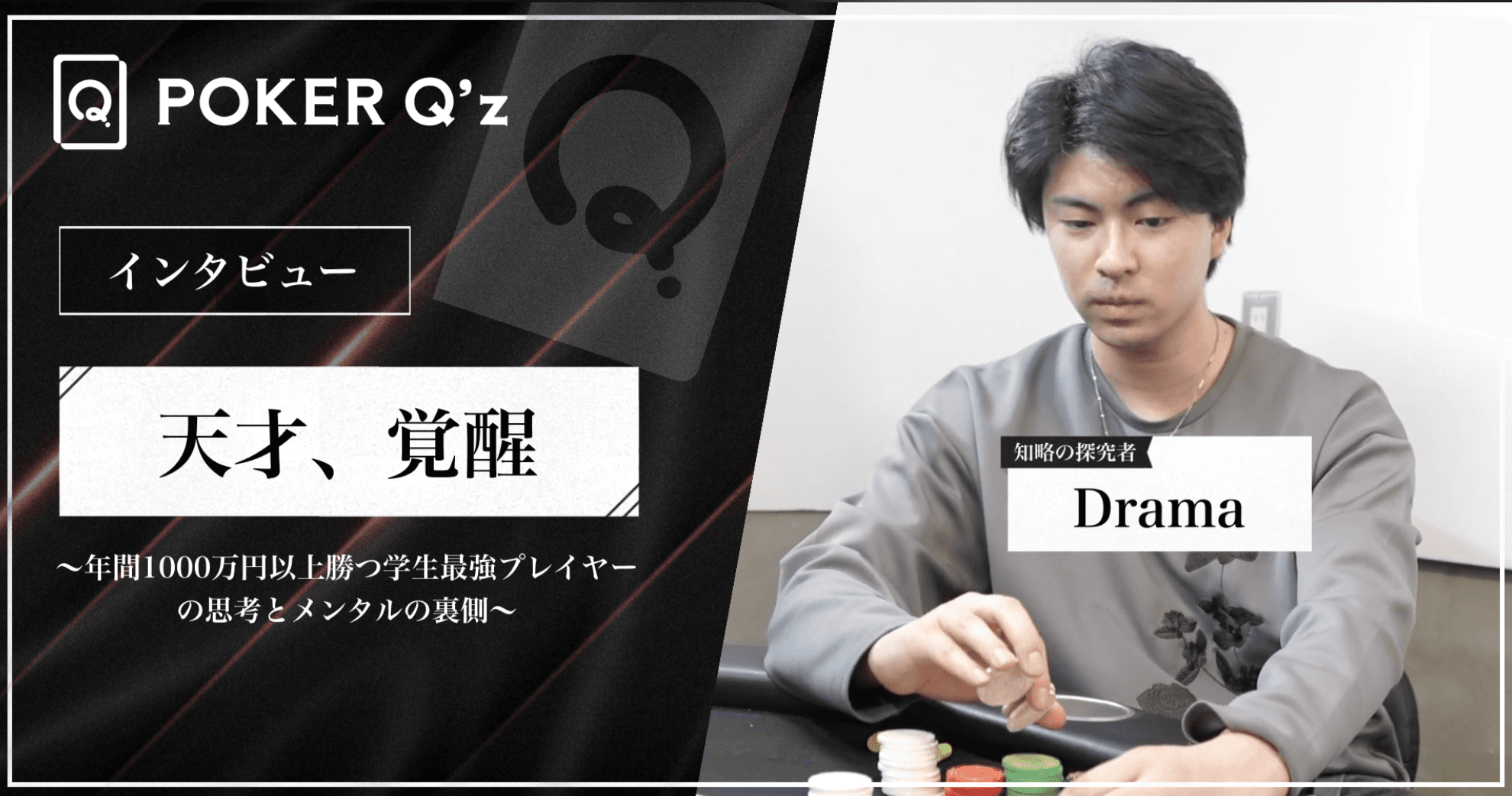
Genius Awakens: Inside the Mindset and Mental Game of a Student Poker Pro Winning Over 10 Million Yen a YearColumn

Genius Awakens: Inside the Mindset and Mental Game of a Student Poker Pro Winning Over 10 Million Yen a Year

Hello! I’m on the PR team at CLOViZ Inc.This time, we’re joined by Drama, a player who has won a total of 10 million yen in live cash games and is often called the strongest student player thanks to his strategy work and educational content.After deciding to take a leave of absence from university, he spent three years grinding across Korea, Cambodia, and the United States. In this interview, we’ll break down how he expanded both his skill set and perspective, plus the mindset and mental game habits behind his rapid improvement.1. A university player who took a leave of absence to sharpen his game overseas—First, could you introduce yourself?Drama:My name is Drama, and I’m a third-year student in the Department of Mathematics, Faculty of Science at Hokkaido University. I’ve been playing poker for about three years. I first learned the game from a friend during my high school graduation trip, and that’s what got me into poker. I was drawn to the depth of an imperfect information game, the satisfaction of outthinking an opponent, and the fun of constant mind games. After entering university, I became more obsessed with poker than math.In the winter of my second year, I decided to take a one-year leave of absence because I wanted to fully commit. I traveled and played in Las Vegas, Korea, and Cambodia. In Las Vegas, I joined a project called the “Amu Elite Squad,” and winning about 5 million yen in three months became a major source of confidence for me. Right now, I’m deeply focused on studying poker through the club I founded, Hokudai Poker Circle SECOND NUTS.2. What drove his rapid growth to “strongest student” in just three years—I’m sure you didn’t start out winning easily. What do you think allowed you to improve so quickly in about three years and earn a reputation as the strongest student player?Drama:The biggest factor was getting coaching from strong players. I’m not a “natural talent” type. When I started, I didn’t know how to build strategy, and I didn’t understand balance at all. About six months in, I began coaching with Peeeaje, and I became able to beat typical recreational players. Then about six months later, I started coaching with Amu. Amu not only has a deep understanding of equilibrium (GTO), but his thinking is extremely refined. I remember feeling he was the strongest player I’d ever met.In poker, you need to understand both equilibrium (GTO) and exploitative play. You can build the former through effort, but I think the latter is hard to learn unless you have great materials or a great mentor.—It seems difficult to identify strong players when you’re still inexperienced. How should someone judge who’s actually good?Drama:Realistically, the best way is to judge the logical consistency of what they say. Ideally, you’d measure a player’s skill by equity, but in practice you often don’t have enough sample size. So I start by filtering out people whose statements contain logical contradictions. Once you remove those, you’re mostly left with competent people. From there, I think the best approach is to choose someone you work well with and can trust.3. Three stages of thinking: from equilibrium understanding to exploitation—How has your in-game thinking evolved from when you first started to now?Drama:Right after I started, I had zero concept of balance and played based only on my own hand.On the river, my value bet sizing and bluff sizing were completely differentMy intentions were obvious to everyoneThat was my “weakest” stage.Next, I learned to balance across my entire range. More specifically:My value and bluff sizes became consistentI could include bluffs in every bet size and line, so my play became more equilibrium (GTO)-likeIn the final stage, I used equilibrium thinking as a foundation, but I could intentionally break balance to exploit opponents. More specifically:I choose bluff sizes that maximize bluff EVI choose value sizes that maximize value EVI choose lines that maximize EV for each optionAnd I still avoid letting opponents notice my imbalancesThat’s how my thinking evolved through these three stages.4. A workflow for training logical thinking—In your YouTube project “Headphone Poker”, you explain your thought process for each action. How do you decide on your final action, and do you have tips for training that process?Drama:First, I start by clearly putting into words what I’m unsure about. For example, I’ll say, “I’m deciding between checking and betting 33%.” Then I organize the pros and cons of those two options and think about how check EV and bet EV change compared to equilibrium (GTO). For example, if I have a marginal hand, I might explain it like this: “If I bet 33%, I’m likely to face a lot of raises, and I can’t call a raise with this hand, so that’s a negative point and lowers bet EV. If I check, I expect fewer probe bets on the turn, which is a positive point. So in this spot, check EV likely exceeds bet EV, so I choose check.”When I organize it into these three steps:List the optionsExplain how EV changes for each optionConclude which option you choosethe logic becomes instantly clearer.When explaining where a number like “33%” comes from, I make it explicit by saying, “This is the equilibrium sizing.” Then I’ll add that in this spot I’m choosing a size that deviates from equilibrium as an exploit. I think it helps a lot to build the habit of always stating whether you’re talking about an equilibrium strategy or an exploitative strategy.5. Mental game and live cash game habits—You mentioned winning about 5 million yen overseas, but live cash games have huge variance. How do you manage your mental game?Drama:I think mental game management is just as important as studying poker strategy. If you play live cash, it’s even more essential.The first thing I focus on is keeping a consistent daily routine.Poker players often struggle to leave a good table, so sleep schedules can get messy. But a strict rule for me is never playing while sleep-deprived. After a session, I sleep without an alarm until I feel like I truly slept well. I usually don’t eat breakfast, but on days I play, I always eat in the morning. Then I lift weights, take a shower, get ready, and head to the venue. That’s my basic routine.Strength training activates the brain and boosts self-confidence. A lazy lifestyle slows your thinking and hurts your mental state, so I strongly recommend aiming for an ideal, disciplined daily rhythm.—Do you tilt at all? And if you do, how do you handle it?Drama:I’ve heard some people almost never tilt, but I do. That said, it’s not when I lose in an unfair way. It hits me mentally when I realize I made a clear mistake. If I feel bad, I stand up immediately, take a walk outside, look at the scenery, or listen to music to reset. If I think I still can’t focus after coming back, I end the session and go home. But if the table is great, I weigh whether it’s worth continuing.I also take notes on every line. If I see a line that looks like an opponent leak, I record it immediately. I give each of the nine players at the table a nickname and write down the traits I observe. Under that, I write my own hand review, then revisit it the next morning. If my thinking doesn’t match what I wrote at the time, I store it as a mental-game-driven bias. That way, I can apply countermeasures during play that fit my personal tendencies.6. How taking a leave of absence broadened his perspective and his future vision—Looking back, was taking a one-year leave of absence to focus on poker a positive decision? How do you view poker now, and how do you want to continue with poker in the future?Drama:I’m really glad I took the leave. If there are student poker players who are unsure about taking time off, I want them to seriously consider it. When you’re young, have stamina, and your curiosity and desire to grow are high, being able to immerse yourself in poker for a full year is a huge advantage. Your skill improves dramatically, and in most cases it doesn’t become a fatal negative for job hunting.My skill improved a lot during that time, but my assumption that “I’ll probably get bored after a year” was wrong. If anything, poker became even more interesting. Right now, my goal is to surpass the players I look up to, and I’m even more committed than before. Of course, I plan to graduate, but my personal philosophy is to pursue what I enjoy most right now. Rather than betting my life on future security or saving all my enjoyment for retirement, I want to maximize the present because you never know when you’ll die.In the future, I’ll keep poker as a stage where I aim for the very top. I’ll also value time in Japan and time with friends, while playing overseas when needed.7. For people starting poker: GTO isn’t the answer, it’s the baseline—Finally, do you have advice for beginners, or for players who study but feel stuck?Drama:GTO is even more important than most people think, and you’ll never regret learning it, so I recommend studying it thoroughly.Saying “My opponents don’t play GTO, so studying it is pointless” is a major misunderstanding. If you don’t know the baseline, you can’t even identify what’s deviating. Learn the baseline first, then find your opponent’s tendencies, and intentionally break balance to exploit them. I think that’s the most reliable path to improvement.

1628
Learn Poker Theory 2: Finding the Mathematically Optimal Bet Sizing Split in the AKQJT9 Game考察

Learn Poker Theory 2: Finding the Mathematically Optimal Bet Sizing Split in the AKQJT9 Game

IntroductionThis article is a continuation of the previous one. If you haven’t read it yet, please start there first: https://pokerqz.com/blog/theoretical_poker_1This time, the topic is bet size splitting. In GTO, stronger value hands generally tend to use larger bet sizes. But why does that happen? In this article, we’ll explore that question from a mathematical perspective using a toy game called the AKQJT9 game.1. What is the AKQJT9 game?The AKQJT9 game is a toy game I created for this topic, and it’s a variation of the AKQ game introduced last time. Compared to AKQ, the only change is that the number of cards increases from 3 to 6, but let’s quickly review the rules.PlayersThis game is played heads-up between Hero and Villain.CardsThe deck consists of only six cards: As, Ks, Qs, Js, Ts, 9s. Hand strength is A > K > Q > J > T > 9. Each player is dealt one random card, and no two players can receive the same rank.PositionHero is always in position, and Villain is always out of position.ActionsThe game starts directly on the river, and Villain (OOP) acts first. Villain always checks.Then Hero (IP) can choose any bet size or check back.If Hero checks back in step 2, the hand goes straight to showdown.If Hero bets in step 2, Villain can only call or fold. Raising is not allowed.Pot sizeThe initial pot is 1.2. The GTO solution computed by an algorithmNext, we want to compute the optimal solution with formulas. But to make the intuition easier to grasp, let’s first look at a GTO solution computed using the CFR algorithm. (I’d like to cover CFR in more detail another time.)Figure 1 GTO solution on the river when the board is 2s 2h 2d 3s 3hFigure 1 visualizes the GTO solution using a tool I built. The range chart is styled similarly to GTO Wizard. This chart shows Hero’s full-range strategy in a real poker spot where the board is 2s 2h 2d 3s 3h (a board unrelated to A through 9 in this toy game) after Villain checks.However, both players’ hand ranges are restricted to six combos: AsAh, KsKh, ... , 9s9h (only the spade-heart pocket pair combos are used).Hand strength is AsAh > KsKh > ... > 9s9h, and since the players can’t hold the same hand, this situation is equivalent to the AKQJT9 game.This time, I included many bet size options from 15% to 160%. Red indicates large bets, orange indicates small bets, and green indicates checks.You can see that the nuts A uses a larger value bet size than the second nuts K, meaning the strategy splits bet sizes.Figure 2 Strategy for KsKh in Figure 1 (left column: frequency, right column: EV; EV is shown multiplied by 100)Figure 3 Strategy for AsAh in Figure 1 (left column: frequency, right column: EV; EV is shown multiplied by 100)Figures 2 and 3 show the detailed strategies when Hero holds KsKh and AsAh. For each hand, the best approach is to use the bet size that maximizes EV, and you can see that actions with higher EV get higher frequency.Here’s what we can summarize about the AKQJT9 game from Figures 1 through 3.Summary so farThe nuts A uses a pure large bet. The optimal size seems to be between 120% and 130% pot, slightly closer to 120%.The second nuts K uses a pure small bet. The optimal size seems to be between 25% and 30% pot, slightly closer to 30%.Marginal hands Q through T pure check.The weakest hand 9 uses the same sizes as A and K for value betting, and bluffs at the appropriate frequencies.Additional notesQ cannot value bet. If Hero bets Q, Villain will always call with A and K and always fold 9. Even if Villain bluff-catches with J and T at 100% frequency, Hero’s equity when called becomes 50%, so the bet does not function as a value bet.T never bluffs. From a combo-count perspective, 9 alone provides enough bluff combos (explained later).3. The optimal solution when the AKQJT9 game allows two arbitrary bet sizesNow let’s move into the mathematical analysis.Since this game features bet size splitting, let’s define the value bet size used with A as $b_{A}$, and the value bet size used with K as $b_{K}$.From the previous article, when you pure value bet a strong hand at size $b$, the bluffing frequency that makes Villain’s marginal hands indifferent between calling and folding is $\frac{b}{1+b}$. Because we use two bet sizes this time, Hero’s optimal strategy becomes the following.Hero’s strategyHero (IP) handFrequency of bet $b_{A}$Frequency of bet $b_{K}$Frequency of checkA100K010Q , J , T0019$\frac{b_{A}}{1+b_{A}}$$\frac{b_{K}}{1+b_{K}}$$1 - \frac{b_{A}}{1+b_{A}} -\frac{b_{K}}{1+b_{K}}$Against this strategy, Villain responds as follows. For now, let $f_{1}$ be the bluff-catch frequency of Villain’s marginal hands (K through T) versus bet $b_{A}$, and let $f_{2}$ be the bluff-catch frequency of Villain’s marginal hands (Q through T) versus bet $b_{K}$. (We will compute the exact values next.)Villain’s strategy versus Hero’s bet $b_{A}$Villain handFrequency of callFrequency of foldA (1 combo)10K , Q , J , T (4 combos)$f_{1}$$1 - f_{1}$9 (1 combo)01Villain’s strategy versus Hero’s bet $b_{K}$Villain handFrequency of callFrequency of foldA , K (2 combos)10Q , J , T (3 combos)$f_{2}$$1 - f_{2}$9 (1 combo)01From the previous article, Villain’s optimal bluff-catch frequency makes Hero’s weak hand indifferent between bluffing and giving up by checking. In other words, we want(EV of Hero’s 9 betting $b_{A}$) = (EV of Hero’s 9 betting $b_{K}$) = (EV of Hero’s 9 checking)So the following equation must hold:$$\frac{1 ・ (-b_{A}) + 4f_1 ・(-b_{A}) + 4(1-f_1) ・1 }{5} = \frac{2 ・ (-b_{K}) + 3f_2 ・(-b_{K}) + 3(1-f_2) ・1 }{5} = 0$$Solving this gives $f_1 = \frac{4-b_{A}}{4(1 + b_{A})}$ and $f_2 = \frac{3-2b_{K}}{3(1 + b_{K})}$.Also, $1 - f_1 = \frac{5b_{A}}{4(1 + b_{A})}$ and $1 - f_2 = \frac{5b_{K}}{3(1 + b_{K})}$. (We’ll use these later.)4. Which $b_{A}$ and $b_{K}$ maximize Hero’s overall range EV?Now that we know both players’ optimal strategies, let’s find $b_{A}$ and $b_{K}$ that maximize Hero’s overall range EV. In the previous article, we noted that the EV of marginal hands and weak hands does not depend on Hero’s bet size. Therefore, the optimal $b_{A}$ and $b_{K}$ can be found by focusing only on the EV of A and K (the value hands).Let’s compute the EV for A and K. We can compute A’s EV the same way as before, but K’s EV requires one important caution: K can value-own itself against Villain’s A. Keeping that in mind, let Hero’s EV with A be $E_{A}(b_{A})$ and with K be $E_{K}(b_{K})$. Then:$$E_{A}(b_{A}) = \frac{4f_1・(1 + b_{A}) + (4(1-f_1) + 1)・1}{5} = \frac{1}{5} ((4-b_{A}) + \frac{5b_{A}}{1 + b_{A}} + 1) = \frac{1}{5} (5 + \frac{5b_{A}}{1 + b_{A}} - b_{A})$$$$E_{K}(b_{K}) = \frac{1・(-b_{K}) + 3f_2・(1 + b_{K}) + (3(1-f_2) + 1)・1}{5} = \frac{1}{5} (-b_{K} + (3-2b_{K}) + \frac{5b_{K}}{1 + b_{K}} + 1) = \frac{1}{5} (4 + \frac{5b_{K}}{1 + b_{K}} - 3b_{K})$$Next, we find the $b_{A}$ that maximizes $E_{A}(b_{A})$ and the $b_{K}$ that maximizes $E_{K}(b_{K})$ by differentiating each function.Using the standard derivative rule for rational functions:$$\frac{d}{db_{A}} E_{A}(b_{A}) = \frac{1}{(1 + b_{A} )^2} - \frac{1}{5}$$$$\frac{d}{db_{K}} E_{K}(b_{K}) = \frac{1}{(1 + b_{K} )^2} - \frac{3}{5}$$Both $\frac{d}{db_{A}} E_{A}(b_{A})$ and $\frac{d}{db_{K}} E_{K}(b_{K})$ are monotonically decreasing, so the optimal bet sizes are the values of $b_{A}$ and $b_{K}$ that make these derivatives equal to 0.Solving gives $b_{A} =\sqrt{5} -1 \approx 1.236$ and $b_{K} = \sqrt{\frac{5}{3}} -1 \approx 0.291$.This means Hero’s optimal bet size is 123.6% pot with A, and 29.1% pot with K. Earlier, based on the algorithmic results, we predicted:The nuts A uses a pure large bet. The optimal size seems to be between 120% and 130% pot, slightly closer to 120%.The second nuts K uses a pure small bet. The optimal size seems to be between 25% and 30% pot, slightly closer to 30%.And the math matches perfectly. Also, the bluffing frequencies for 9 are:For 123.6% pot: $\frac{b_{A}}{1 +b_{A}} \approx \frac{1.236}{1 + 1.236} \approx 0.553$For 29.1% pot: $\frac{b_{K}}{1 +b_{K}} \approx \frac{0.291}{1 + 0.291} \approx 0.225$Even combined, they do not exceed 1. In other words, 9 alone provides enough bluff combos, so there’s no need to turn T into a bluff.5. A key warning when applying bet size splitting in real gamesSo far, we’ve discussed how bet size splitting can increase the EV of your range. But you need to be careful when applying this concept in real poker.In this toy game, Villain had no option to raise. But in real poker, your opponent can raise.If your small-bet range contains zero nut hands, and your opponent realizes it, they can exploit you by responding with a wide, polarized raising strategy.That can significantly reduce your range EV.So if your opponent is strong enough to raise properly, you should include some nut hands in your small-bet range to stay balanced (especially when you are out of position).ConclusionThis ended up being another advanced article, but thank you for reading all the way through. In this article, I explained that GTO bet size splitting is an effective strategy with solid mathematical justification.To summarize the key takeaways:When you split bet sizes, using larger bet sizes with stronger value hands increases EV.Select bluff hands from the weakest, lowest-equity hands, and bluff at the correct frequency for each bet size (in practice, hands with better blockers tend to choose larger bluff sizes; this toy game had no blocker effects).In real poker, opponents can raise, so even if you split bet sizes, you need to distribute some nut hands across sizes to avoid being exploited.

904
Learn Poker Theory 1: Finding the Mathematically Optimal Value Bet Sizing in the AKQ Game考察

Learn Poker Theory 1: Finding the Mathematically Optimal Value Bet Sizing in the AKQ Game

1. IntroductionIn poker, choosing the right value bet size is crucial for maximizing expected value (EV). In this article, we’ll use a simple AKQ game to take a deep dive into the optimal bet size for value hands.2. What Is the AKQ Game?The AKQ game is a simplified model designed to teach the fundamentals of poker strategy. There are several variations, but in this article we’ll use the following rules.PlayersThis game is played heads-up between Hero (you) and Villain (your opponent).CardsThe deck contains only three cards: As, Ks, Qs. Hand strength is A > K > Q. Each player is dealt one card at random, and no two players can receive the same rank (ignore suits).PositionHero is always in position (IP), and Villain is always out of position (OOP).ActionThe game starts directly on the river, and Villain (OOP) acts first. Villain always checks.Then Hero (IP) can choose any bet size or check back.If Hero checks back, the hand goes straight to showdown.If Hero bets, Villain can only call or fold. Raising is not allowed.Pot sizeThe initial pot is 1.This simple model helps you learn core ideas like betting strategy and range construction.3. Building Strategies by Hand and Pure StrategiesFirst, let’s summarize the optimal play for each hand for both Hero and Villain.Hero’s Optimal Strategy1. AsSince this is the strongest hand, you should always value bet to target Villain’s K.2. KsA always calls and beats you, and Q just folds, so betting loses EV. Always check.3. QsThis is the weakest hand, but you should mix it in as a bluff alongside your A value bets, bluffing at a frequency that makes Villain’s K indifferent.Villain’s Optimal Response After Facing a Bet4. AsVillain is always ahead, so they always call.5. KsVillain loses to Hero’s A, but to avoid folding too often versus Hero’s Q bluffs, Villain should bluff-catch at the correct frequency (call often enough that Hero is indifferent about bluffing with Q).6. QsVillain is always behind, so they always fold.Here, actions 1, 3, 4, and 6 are fixed at 100% frequency. If you deviate, you clearly lose EV for the reasons above.A strategy where an action is taken with 100% frequency is called a pure strategy. Getting a pure strategy wrong causes a large EV loss, so you need to be careful.Since you can’t change the pure strategies, the key to solving this game is determining:Hero’s Q bluff frequency (3), andVillain’s K calling frequency (5).For 3 and 5, the optimal approach is to balance both actions. This is called a mixed strategy. If you don’t balance properly and lean too far in one direction, your opponent can exploit you. Here’s what that looks like.If Hero bluffs too often with Q, Villain exploits by calling with K 100% of the time. If Hero bluffs too rarely with Q, Hero becomes too value-heavy with A, and Villain exploits by folding K 100% of the time.If Villain calls too often with K, Villain becomes too bluff-catch heavy, and Hero exploits by bluffing with Q 0% of the time. If Villain calls too rarely with K, Villain overfolds, and Hero exploits by bluffing with Q 100% of the time.So how do we find the correct frequencies for 3 and 5? We’ll cover that in the next section.4. Mixed Strategy Frequencies and IndifferenceTo find optimal mixed strategy frequencies, we need to define what it really means to “make the opponent unsure.” The key concept here is indifference.Indifference means a hand has the same EV between multiple actions.That definition can feel abstract, so here’s a concrete example. Suppose the pot is 100, and your opponent bets 100 (a pot-sized bet).You must call 100. If you call, the final pot becomes 100 (pot) + 100 (opponent bet) + 100 (your call) = 300. In other words, you pay 100 to compete for 300, so when your equity is exactly 100/300 = 1/3, calling and folding have the same EV (0).This situation is called call-fold indifference. In general, when a hand is indifferent, it tends to remain in a mixed strategy to maintain balance.In this AKQ game, the key to determining the mixed strategies in 3 and 5 is to adjust frequencies so that a specific opponent hand becomes indifferent.Specifically:3. Hero’s Q: choose a bluff frequency that makes Villain’s K call-fold indifferent.5. Villain’s K: choose a calling frequency that makes Hero’s Q bet-check indifferent.5. Solving the AKQ Game When the Only Bet Size Is 50% PotTo keep things simple, in this section we’ll restrict Hero’s bet size to 50% pot (0.5).Hero’s StrategyHero value bets A at frequency 1, bluffs with Q at an optimal frequency ($f_Q$), and chooses $f_Q$ so that Villain’s K has the same EV for calling and folding. If Villain holds K and calls, the payoff is:Hero has A (1 combo): -0.5 (Villain loses the 0.5 call)Hero has Q ($f_Q$ combos): 1 + 0.5 (Villain wins the pot 1 plus Hero’s bet 0.5)If Villain folds K, their stack doesn’t change, so the payoff is 0.Setting EV(call) = EV(fold), we get:$$\frac{1 ・ (-0.5) +f_Q ・(1 + 0.5)}{1+f_Q} = 0$$Solving gives $f_Q =\frac{1}{3}$.Villain’s StrategyVillain calls with K at an optimal frequency ($f_K$) and chooses $f_K$ so that Hero’s Q has the same EV for betting and checking.If Hero holds Q and bets, the payoff is:Villain has A (1 combo): -0.5 (Hero gets called and loses)Villain has K and calls ($f_K$ combos): -0.5 (Hero gets called and loses)Villain has K and folds ($1 - f_K$ combos): 1 (Hero wins the pot 1)If Hero checks Q, Hero always loses at showdown, so the payoff is 0.Setting EV(bet) = EV(check), we get:$$\frac{1 ・ (-0.5) +f_K ・(-0.5) + (1-f_K) ・1 }{2} = 0$$Solving gives $f_K =\frac{1}{3}$.Putting it all together, the optimal strategies are:Hero’s StrategyHero hand50% pot frequencyCheck frequencyA1 (100%)0 (0%)K0 (0%)1 (100%)Q0.3333 (33.33%)0.6667 (66.67%)Villain’s Strategy (vs Hero bet 0.5)Villain handCall frequencyFold frequencyA1 (100%)0 (0%)K0.3333 (33.33%)0.6667 (66.67%)Q0 (0%)1 (100%)6. Solving the AKQ Game With a Single Arbitrary Bet Size (b)In the previous section, we solved the game with a fixed bet size of 0.5. We can solve the same way for a single bet size of $b$ (a constant). Replacing 0.5 with $b$ in the two equations gives:$$\frac{1 ・ (-b) +f_Q ・(1 + b)}{1+f_Q} = 0$$$$\frac{1 ・ (-b) + f_K ・(-b) + (1-f_K) ・1 }{2} = 0$$Solving yields $f_Q = \frac{b}{1+b}$ and $f_K = \frac{1-b}{1+b}$.Summarizing the optimal strategies:Hero’s StrategyHero handBet $b$ frequencyCheck frequencyA10K01Q$\frac{b}{1+b}$$\frac{1}{1+b}$Villain’s Strategy (vs Hero bet $b$)Villain handCall frequencyFold frequencyA10K$\frac{1-b}{1+b}$$\frac{2b}{1+b}$Q01Now look at $f_K = \frac{1-b}{1+b}$. When $b$ is greater than 1 (a pot-sized overbet), $f_K$ becomes negative, which clearly makes no sense. What’s happening?In general, an overbet bluff requires a bluff success rate above 50%. When Hero bluffs with Q in this game, Villain holds either A or K. But Villain never folds A, so the bluff can never succeed more than 50% of the time.That leads to an important conclusion: in the AKQ game, Hero should not use overbet bluffs. And if bluffs don’t exist at that size, value bets can’t be balanced either, so Hero won’t use overbets in this game. Therefore, from here on we assume $0 < b \leq 1$.7. What Bet Size Maximizes EV for Hero’s Entire Range?So far, we’ve solved the game for any single bet size $b$. Now we get to the main point.In fact, Hero’s EV with K and Q does not change with the bet size $b$. Here’s why:Hero’s K: you always check, then lose to A and beat Q at showdown. You win the pot 1 with 50% probability, so EV is always 0.5.Hero’s Q: Villain’s K calling frequency makes Q indifferent between bluffing and giving up, so EV is always 0.That means only A’s EV changes with bet size. So Hero’s optimal bet size is the one that maximizes EV when Hero holds A. Let’s compute the EV of betting A with size $b$.$$(EV\text{ of Hero’s A}) = (P(\text{call}))・(1+b) + (P(\text{fold}))・1$$Villain calls when they hold K ($\frac{1}{2}$) and choose to call ($\frac{1-b}{1+b}$), so:$$P(\text{call}) = \frac{1}{2}\frac{1-b}{1+b}$$Let this be $P(b)$. Then:$$(EV\text{ of Hero’s A}) = P(b)・(1+b) + (1-P(b))・1 = bP(b) + 1 = \frac{1}{2}\frac{b(1-b)}{1+b} +1$$Ignoring the constant term, we just need to maximize $\frac{b(1-b)}{1+b}$.$$\frac{b(1-b)}{1+b} = \frac{-b(1+b) + 2(1+b) -2 }{1+b} = 2 -(b+ \frac{2}{1+b}) = 3 -((1+b) + \frac{2}{1+b})$$By the arithmetic-geometric mean inequality, $(1+b) + \frac{2}{1+b}$ is minimized when $1+b = \sqrt{2}$, meaning $b = \sqrt{2} -1 \approx 0.414$. At that point, $\frac{b(1-b)}{1+b}$ reaches its maximum value of $3-2\sqrt{2}$.This means Hero’s optimal bet size is 41.4% pot, because it maximizes the EV of A. We started with poker bet sizing, and somehow a square root appeared. Interesting.If we plug this maximum back into the original EV expression:$$(\text{Maximum EV of Hero’s A}) = \frac{1}{2} ・(3-2\sqrt{2}) +1 = \frac{5}{2} - \sqrt{2} \approx 1.086$$If Hero couldn’t bet, A’s EV would be 1. So being in position clearly increases the EV of Hero’s overall range.8. SummaryThanks for reading through a long and challenging article. Here, we analyzed how Hero’s bet size affects expected value (EV). The key takeaways are:The AKQ game is a simplified poker model, and studying it in detail helps you learn many theories used in real poker.When the opponent cannot raise, value hands can have an optimal bet size that maximizes EV.By analyzing the AKQ game, you can build a deeper understanding of bet sizing and GTO (Game Theory Optimal) strategy. In the next article, we’ll explore optimal bet sizing in more complex situations and how to apply these ideas in real games.https://pokerqz.com/blog/theoretical_poker_2

1803