
Hello! We're from the public relations team at CLOViZ Inc.
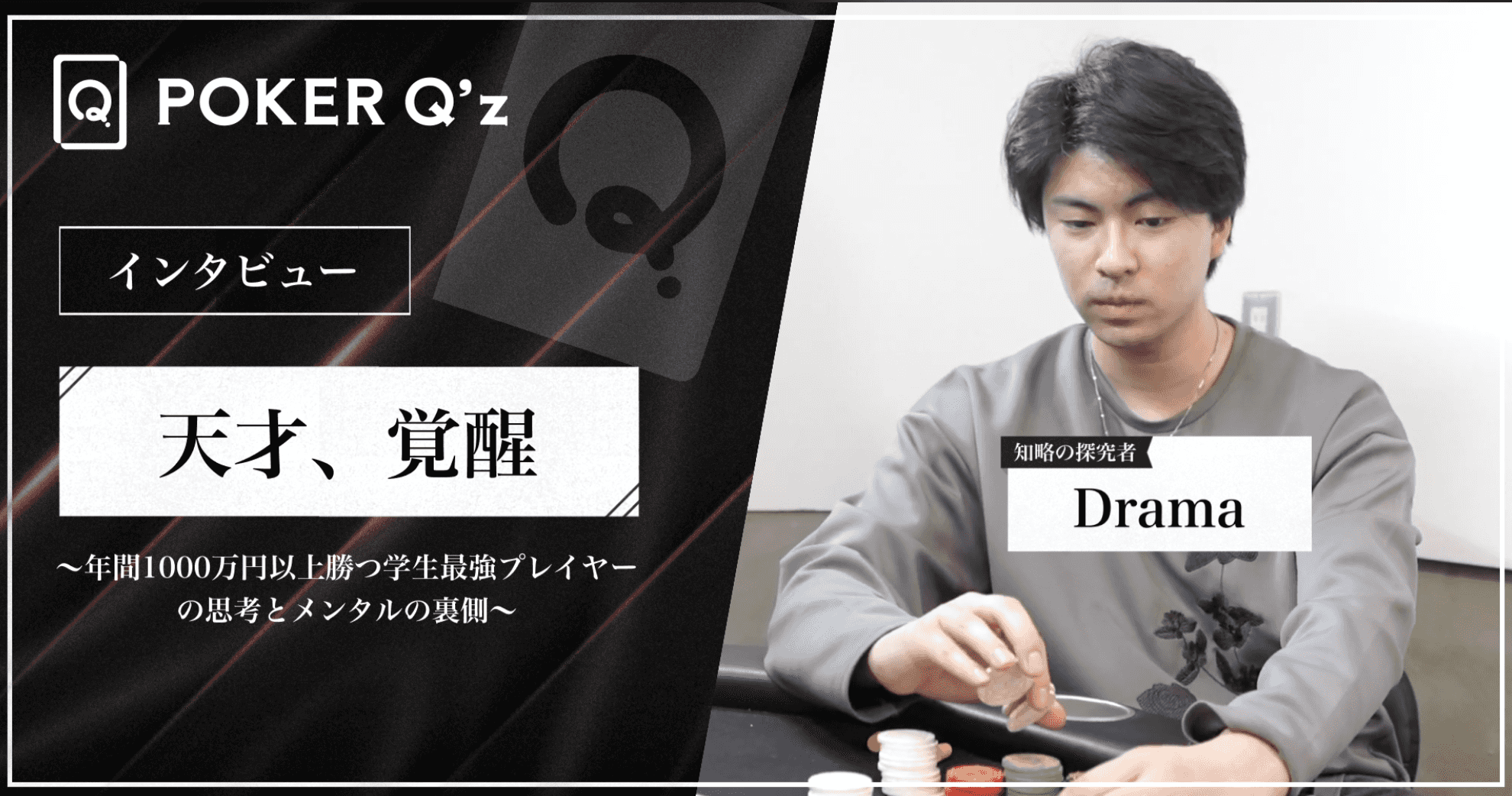
Today, we're joined by Drama, who has won over ¥10 million in total in live cash games and is called the “strongest student player” for his strategy research and the content he publishes!
Over three years spent playing in South Korea, Cambodia, and the United States after deciding to take a leave from university, how did he expand his skill and perspective? We'll share the thinking and mental-game methods behind his rapid growth!
1. The University Player Who Honed His Skills on Overseas Trips After Taking a Leave of Absence
First, could you introduce yourself?
Drama:
I'm Drama, a third-year student in the Department of Mathematics in the Faculty of Science at Hokkaido University. I've been playing poker for about three years; I first learned the game from a friend on a high school graduation trip. I was drawn in by the depth of imperfect-information games, the satisfaction of outthinking an opponent, and the fun of the mind games — and once I entered university, I got more hooked on poker than on mathematics.
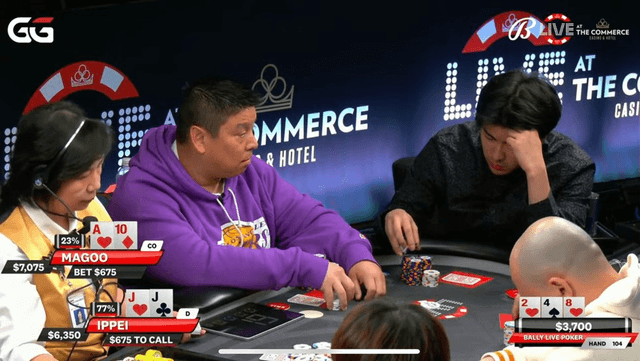
In the winter of my sophomore year, I decided to take a year off because I wanted to “go all in” on poker, and I played in Las Vegas, South Korea, and Cambodia. In Las Vegas, I took part in a program called the “Amu Elite Team” and won about ¥5 million in three months, which is the source of my confidence today. I'm currently immersed in poker study at the Hokkaido University poker club SECOND NUTS, which I founded myself.
2. The Keys to Rapid Growth: From Beginner to “Strongest Student” in Three Years
I assume you weren't winning easily from the very start, so what do you think allowed you to grow so quickly and be called the strongest student in about three years?
Drama:
The biggest factor was getting coaching from very strong players. I'm not the “natural talent” type — when I started, I had no framework for building strategy and no understanding of balance. About six months in, I began receiving coaching from Peeeaje and became able to beat typical recreational players. Six months after that, I was coached by Amu. I remember thinking Amu was the strongest player I'd ever met — not just because of his deep understanding of equilibrium (GTO), but because his thinking was incredibly refined.
In poker, it's essential to understand both equilibrium (GTO) and exploitation. The former can be acquired through effort, but I believe the latter is hard to develop without good study materials and a good mentor.
It seems hard to spot strong players while you're still weak yourself — how did you judge?
Drama:
In the end, judging by the logical consistency of what people say is the realistic approach. Ideally, I'd measure a player's skill by winrate, but in practice the sample is usually too small, so I first filter by whether their statements hold up logically. Once you eliminate the people whose logic contradicts itself, only serious players remain. From there, I think the best approach is to choose someone who fits you well and can be trusted.
3. Thinking in Three Stages: From Understanding Equilibrium to Exploitation
How has your thinking at the table evolved from when you first started poker to now?
Drama:
Right after I started playing, I had no concept of balance at all and played based only on my own hand.
- value bets and bluffs were sized completely differently on the river
- my intentions were completely transparent to opponents
That's the “weakest” state.
Next, I learned to balance across my entire range. Specifically:
- value and bluff sizes became unified
- with bluffs woven into every bet size and line, my play became GTO-like
In the final stage, I became able to deliberately break balance to exploit opponents while using equilibrium thinking as the foundation. Specifically:
- bluffs are sized to maximize bluff EV
- value bets are sized to maximize value EV
- betting lines are chosen to maximize each EV
- without ever letting opponents catch on to the bias
That's how my thinking evolved, in three stages.
4. A Workflow for Training Logical Thinking
In your YouTube series “Headphone Poker,” you explain your thinking for each action. What thought process leads you to your final decision, and do you have any tips for training that process?
Drama:
I start by clearly putting into words which action I'm stuck on — something like declaring, “I'm torn between checking and betting 33%.” Next, I organize the pros and cons of those two options and consider how the EV of checking and the EV of betting change compared with equilibrium (GTO). For example, if I hold a marginal hand, the explanation goes like this: “Betting 33% is likely to invite a lot of raises, and since I can't call a raise with this hand, that's a negative and bet EV drops. Checking, on the other hand, is a positive because I expect few probe bets on the turn. Since check EV looks higher than bet EV here, I'll check.”
- list the options
- explain the EV change for each option
- conclude which one to choose as a result
Organizing a decision with this three-step process makes the logic instantly clear.
When explaining where a number like the 33% check comes from, I'd recommend making it a habit to always state clearly whether you're talking about equilibrium or exploitation: say “this is the equilibrium size,” then explain that this time you're choosing a size off equilibrium as an exploit.
5. Mental Management and How to Navigate Live Cash Games
You mentioned winning about ¥5 million overseas — live cash games have huge variance, right? How do you manage your mental state?
Drama:
I consider mental management just as important as studying poker strategy — even more so when playing live cash.
The first thing I pay attention to is a regular daily routine.
When the game is good, poker players find it hard to leave the table, and their sleep schedules tend to fall apart. But my iron rule is never to play sleep-deprived. After a session, I sleep without setting an alarm until I feel I've “slept soundly.” I usually skip breakfast, but on working days I always eat in the morning, work out, shower, and head to the venue once I'm ready. That's my basic flow.
Working out activates the brain and boosts self-esteem. A lazy lifestyle slows your thinking and hurts your mental state, so I strongly recommend aiming for a “model daily rhythm.”
Do you actually tilt at all, Drama? And when you do, how do you deal with it?
Drama:
I hear some rare people never tilt, but I do. That said, it's not when I lose unfairly to an opponent that it hits me mentally — it's when I realize I made a clear misplay. The moment I feel bad, I leave the table, take a walk outside, look at the scenery or listen to music, and refresh myself. If I decide I still can't concentrate when I get back, I call it a day and head home. If the game is good, though, I weigh whether to keep going.
I also take notes on every play line. When I spot a line that could be an opponent's leak, I record it right away, give each of the nine players at the table a nickname, and note the tendencies I observe. Below that, I write my own hand review, then look it over the next morning — if it diverges from what I was thinking at the time, I file it away as a mental-state bias. That way, I can take measures against my own habits during play.
6. The Perspective a Leave of Absence Brought, and the Vision Ahead
Looking back now, was taking a year off to focus on poker a positive for you? How do you currently see poker in your life, and in what form do you want to keep playing it in the future?
Drama:
I'm really glad I took the leave. If there's a university player hesitating over taking one, I hope they seriously consider it. Being able to devote a year to poker while you're young, physically strong, curious, and eager to grow is a huge advantage. Your skill improves dramatically, and it's rarely a fatal negative in job hunting.
My skill improved substantially during the leave, but my assumption that “a year of playing would make me bored” was wrong — poker only got more interesting. I'm now even more absorbed, with the goal of surpassing the players I've set my sights on. I do plan to graduate, of course, but my life policy is to “go all the way with whatever is most fun right now.” Rather than staking my life on future security or post-retirement pleasures, I want to maximize the present, since none of us knows when we'll die.
In the future, I plan to treat poker as the “stage for aiming at the top of the top,” while cherishing time spent in Japan and with friends, and playing abroad as needed.
7. For Those Just Starting Poker: GTO Is Not the “Right Answer” but the Baseline
Finally, any advice for poker beginners, or for those who are studying but stuck in a rut?
Drama:
GTO is more important than you think, and you'll never regret studying it thoroughly, so I'd recommend doing exactly that.
“There's no point studying GTO because my opponents don't play GTO” is a big misconception. Without knowing the baseline, you can't even tell where the deviations are. Learn the baseline first, then find your opponents' biases and deliberately break balance to exploit them. I believe that's the surest path to improvement.