POKER Q'z Blog

Poker strategies, techniques, and the latest information to help you improve

コラム

Poker Q’z Developer Shares Tournament Strategy Secrets: Top Features and Behind-the-Scenes Story of the New Tournament ModeColumn

Poker Q’z Developer Shares Tournament Strategy Secrets: Top Features and Behind-the-Scenes Story of the New Tournament Mode

Hello! I’m Shuhei from CLOViZ Inc.In November 2025, the poker training app POKER Q'z released a long-awaited new feature: the Tournament Mode.In addition to the existing Cash Game Mode, you can now learn tournament-specific skills such as ICM and short-stack strategy.For this article, we interviewed POKER Q'z developers Toshiki Ohata and Hayato Abe directly.What are the keys to tournament success? How do you actually get better at poker?We also asked them to speak from the perspective of poker players.We also dug into why they built the app, and how to use it to improve faster.They shared insights only developers can offer, including behind-the-scenes stories from development, so be sure to read to the end.The POKER Q'z Developers as Poker PlayersFirst, could you both introduce yourselves?Ohata:I’m Toshiki Ohata. I’m a master’s student in the Graduate School of Information Science and Technology at the University of Tokyo. I belong to a lab that researches game AI and natural language processing, and I’m currently on leave from school to focus on the business.https://pokerqz.com/ja/blog/interview01Abe:I’m Hayato Abe. I’m currently a third-year student in the Faculty of Agriculture at the University of Tokyo. I’ve studied poker thoroughly from both theory and real play, and I’ve been fully immersed in poker every day, in both tournaments and cash games.What roles do you each have on POKER Q'z?Abe:While researching poker, I decide what goes into the app’s content.I think about which hands to feature and what lessons will help users improve the most.Ohata:I help with some of the content, but I mainly handle development.I implement quizzes and lessons, and I write programs that calculate GTO strategies.At this point, what does the overall lesson structure in POKER Q'z look like?Abe:Broadly speaking, poker is divided into cash games and tournaments, and Levels 0–2 cover fundamentals that apply to both.From Level 3 onward, the paths split: the Cash Game Mode teaches core concepts like GTO, while the Tournament Mode focuses on tournament-specific thinking such as ICM.Thanks. This interview is about the new Tournament Mode, but before we dive in, do you have any memorable tournament stories from your own experience?Abe:This is from my first time playing a tournament. The top finishers received in-store points, so there was a clear “in the money” line. There were about 70 players, and I made it to the point where one more elimination would put me in the money.But I only had 2bb left, and somehow I picked up pocket eights UTG. I ended up jamming for 2bb, and a player behind me called with pocket nines.Ohata:That’s brutal (laughs).Abe:So I bubbled my first live tournament ever (laughs).And on the turn, we both picked up straight draws, and the outs flipped.Ohata:So the board had 6, 7, T on it?Abe:Exactly. So halfway through, I was the one yelling “Nine! Nine! Nine!” (laughs).Ohata:Did an eight come on the river?Abe:Nope, nothing on the river (laughs).Ohata:If the river was an eight, that would’ve been legendary (laughs).That’s an amazing story. And it’s perfect because the lessons cover bubble play a lot (laughs). Ohata, do you have a story too?Ohata:I’ve got a legendary one too (laughs).I had pocket fives in the BB and called a BTN open. The flop came 3, 3, 5, so I flopped a full house.The opponent was super aggressive, and we got it all-in on the flop. When we flipped, they had 64s. Boat vs open-ender is basically locked up, right?Then the turn was a 3, and the river was also a 3!Everyone:(laughter)Ohata:I lost to their 6-high because the board played (laughs).That’s insane (laughs).Ohata:The worst, most unbelievable bad beat of my life (laughs).In Tournaments, Preflop Is 90%Now that we’ve heard some great tournament stories, let’s talk about the app. What are the key points of the newly released Tournament Mode?Abe:The biggest thing is understanding the difference from cash games. There are two major points.First, tournaments have no rake, and they have antes. That means preflop ranges change dramatically. And because you have to play different ranges depending on the situation, preflop becomes far more complex than in cash games.Second, in tournaments, the goal isn’t simply to increase your chip count. You’re playing for placement. So even if a call is profitable in chips, it can be a mistake when you consider whether you cash or not. Near the bubble, for example, big stacks can apply pressure aggressively, while short stacks often have to fight to survive. That kind of structure doesn’t really exist in cash games.Right, concepts like “rake vs ante” and “cashing” don’t exist in cash games, and they create strategic differences.Abe:Exactly. And in tournaments, preflop carries an extremely high weight.I truly believe tournaments are 90% preflop.Even if you win a huge all-in early at blinds like 100/200, those chips might only be worth 1bb later. That’s tournament poker: you can build a stack early, then give it away later because of a small preflop mistake.That’s something that happens because blinds keep rising in tournaments.Abe:Yes. That’s why preflop accuracy is critical.And once you get down to 10bb late, you often don’t even reach postflop. If you make even a small mistake in a 10bb all-in call, you lose your entire stack and you’re out. So preflop mistakes are extremely costly.That’s true.Abe:The new Tournament Mode lessons organize these points and explain them in a simplified way.Within Tournament Mode, do you have a personal favorite lesson you’d recommend?Abe:For me, it’s the ICM explanation. I think we did a great job showing that your chip count and your payout value are not the same.We use an example tournament with a $100 prize pool and a $60 first-place prize. Total chips are 100 points, and the chip leader has 70 points. In that spot, the chip leader’s 70 points are not worth $70. You only get $60 if you win all the chips, so those 70 points are worth less than $60.That’s a very clear ICM example.Abe:It’s hard to grasp the value of a single chip point. In this example, even with 70 out of 100 points, first place only pays $60, so it can’t be worth $70. The key is that having more chips can actually be disadvantageous in terms of marginal value.On the other hand, if last place pays $10, then even if you only have 10 points right now, you still get $10 even if you drop to 0. That means those 10 points are worth more than $10.Ohata:It helps to imagine chips as a stack piling up. The chips at the bottom are high value, and the chips stacked on top are lower value.I see.Ohata:This also explains bubble factor. Short stacks mostly hold those high-value bottom chips, while deep stacks can gamble with lower-value top chips. That’s why short stacks are forced into tougher spots.Abe:People often say “short stacks are disadvantaged.” That’s true in a sense, but it’s because the chips you fought to survive with are so valuable, so you’re forced to fold more.Right, even with 2bb, it matters to hang on and cash.Abe:Exactly. That’s why this lesson focuses on learning the fundamentals so you can make decisions that are profitable in terms of expected prize value.We built this lesson hoping it helps everyone improve their tournament results.GTO Wizard Is a Dictionary. POKER Q'z Is a Textbook.Abe, you’ve created such strong lessons. How did you study to reach that level yourself?Abe:I studied relentlessly by running GTO Wizard over and over.For bubble factor, I learned by looking at charts and thinking, “Oh, it applies to two players here,” and so on.One thing surprised me. Intuitively, it feels like busting with 10bb is a bigger mistake than busting with 3bb, right?It does feel that way.Abe:But it’s actually the opposite. The player with 3bb has a higher bubble factor than the player with 10bb. In other words, the 10bb stack can call all-ins more easily.Ohata:That’s because if the 10bb stack calls and wins, they jump to a bit over 20bb and their expected prize value increases sharply. But if the 3bb stack calls and wins, they only get to a bit over 6bb, so the upside is much smaller.Abe:So in the past, when I still had 10bb, I would fold even strong hands, and when I had 3bb, I’d shove because I felt forced to. But it was backwards.So whether you have 10bb or 3bb, losing an all-in means you bust, but if you win and double, the 10bb stack’s expected prize value rises much more.Ohata:Exactly. A lot of players misunderstand this, so I really want people to learn it.Abe:That’s how I studied: staring at GTO Wizard and finding patterns across situations and putting them into words.Ohata:Honestly, it’s genius.Abe takes GTO Wizard’s endless, hard-to-interpret solutions and extracts the key features and condenses them into lessons.Abe:What I want to tell everyone is this: “GTO Wizard is a dictionary, and POKER Q'z is a textbook.” GTO Wizard is like a massive dictionary. If you just look at it, you often don’t really understand anything.So if you think, “I want to study bubble factor,” and you open a huge dictionary, it’s overwhelming. But with a textbook that extracts the essentials, you can learn naturally.Ohata:“GTO Wizard is a dictionary, POKER Q'z is a textbook” is a great tagline (laughs).It really is (laughs).Abe:I think it’s important to use GTO Wizard to search for new insights, but if you don’t understand the textbook basics and you jump straight into the dictionary, you’ll often end up completely lost.Also, you can easily fall into the trap of ending with analysis of a single hand, which is honestly pointless.Ohata:Getting excited like “The call frequency was there! I was right!” is the most meaningless way to use a GTO tool (laughs).That really is meaningless (laughs).Abe:For example, even if a solver says BTN is shoving their entire range so you can call with KTo, in real life the opponent might not shove that wide and might have a lot more Ax. In that case, calling with KTo becomes massively negative EV.Ohata:So when you use GTO Wizard, you must compare the GTO opponent strategy with the real opponent strategy.Abe:But only a small number of players can do that well. That’s why I want people to study with POKER Q'z first, and then look at solutions like GTO Wizard.By learning POKER Q'z lessons, you’ll be able to use solver tools effectively.You Alternate Between Input and OutputAbe:Another big advantage of POKER Q'z is that it gives you the feeling of actually playing poker.I turn common player mistakes into practical quizzes, so you can think about them as your own decisions.It’s also dialogue-based, so you move forward while being prompted with questions, and you can confirm your growth by solving practice problems and real-hand quizzes. I think it’s designed for active learning.Ohata:In other words, POKER Q'z is designed so you can alternate between input and output.With typical study, you mostly consume information and don’t get enough chances to apply it. But in POKER Q'z, it’s all contained in one place.Right. In POKER Q'z, Q-chan makes a mistake, Aria points it out and explains it, then you solve practice questions, then real-hand quizzes, and so on.Abe:And because everything is broken into short chapters, you can study in small chunks during spare time.Ohata:Yeah, being able to alternate input and output, and being able to do it in spare moments, are key strengths of POKER Q'z.One more thing: everything you’ve shared has been fascinating, so if you have any other quick story, I’d love to hear it.Abe:Okay, here’s a tricky spot (laughs).It’s a 6-max table. I’m in the BB as the shortest stack, UTG is the next shortest, and there are several deep stacks in between. In this situation, the BB can barely call a UTG 2bb open.That’s because UTG tightens their opening range since deep stacks are behind, and I have to tighten even more because I’m shorter than UTG. So I can only call with an extremely tight range.Ohata:So there are two separate reasons the range gets tighter.Abe:Exactly. So even though it’s “just” a 2bb open, I’m folding hands like T7s and KTo. It’s unbelievably tight. It felt like all-in or fold most of the time.When I discovered that, I was literally saying in the office, “You’ve got to be kidding me!” (laughs).Ohata:But what’s impressive is that Abe turned “You’ve got to be kidding me!” into an actual discovery: the idea that there are two separate tightening factors.Abe:That’s the struggle of building lessons…Ohata:Like we said, the real value is that we extract the essence from complex solutions and package it into lessons.And this is something unique to games of incomplete information: it’s hard to find clear “standard lines.” Even so, POKER Q'z can present something close to a practical guideline.Abe:I think we teach fundamental strategy very well. And once you have that foundation, you can observe opponents and adjust into opponent-specific strategy, which will help you improve even more. POKER Q'z can be the compass that guides you there.Final Question: The One Thing You Should Focus on in TournamentsTo close, if you could share just one thing readers should focus on in tournaments, what would it be?Abe:It has to be “tournaments are 90% preflop” (laughs).In the late stages, one small mistake in an all-in call can erase all your work. And compared to early-stage mistakes, the impact of a small preflop mistake late is literally on a different order of magnitude. Preflop matters that much. And late-stage spots are also affected by bubble factor, which makes them very difficult. If you reduce your preflop mistakes even a little, your tournament results will improve dramatically.If your preflop is correct, things usually won’t go that badly. I truly believe preflop skill strongly correlates with overall poker skill.You could even play postflop however you want, just check everything (laughs).Ohata:Don’t do that (laughs).Abe:That’s how strongly I want to emphasize how important preflop is (laughs).Ohata:The new Tournament Mode focuses mainly on preflop, while postflop is covered in depth in the Cash Game Mode.Abe:Yes. Cash Game Mode includes a lot of knowledge that helps in tournaments too. For example, c-bet strategy by flop texture translates directly to tournament play, so I’d love for people to study that as well.But first and foremost, preflop is everything.So the idea is: study tournament-specific preflop in Tournament Mode, then learn postflop strategy that applies to both formats in Cash Game Mode.Ohata:That’s the best approach. We’d be happy if you register for both while you’re here.

263
What New Features Were Added in the Major Poker Q'z Update?Column

What New Features Were Added in the Major Poker Q'z Update?

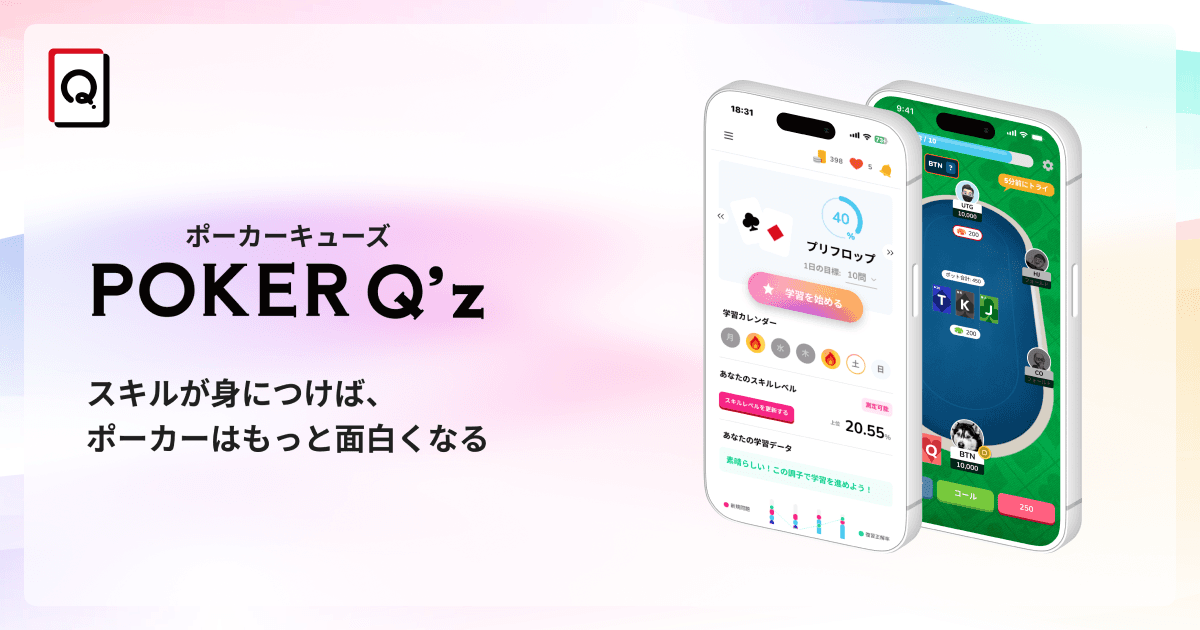
On July 8, 2025, the quick-and-easy poker learning app “POKER Q’z” received a major update!In this article, we’ll walk you through the most exciting features added in this big update.Let’s make the most of POKER Q’z, including all the new tools and modes!1) New Lesson Mode: Learn From the BasicsIn Lesson Mode, you can learn everything from the rules and core fundamentals to advanced strategy.By following a step-by-step roadmap to higher levels and alternating between lessons and practice quizzes, you’ll build real poker theory in a structured way.2) 100,000+ Practical Training QuestionsWith over 100,000 practical questions available, you can review hand decisions and improve your action selection with incredible efficiency. Even if you miss an answer, you’ll get a clear explanation so you can fully understand and correct the mistake.3) Personalized Recommended QuestionsSituations and question types you tend to miss in lessons and practice are tracked, and the app recommends the best next questions and similar spots for you. This helps you focus on your weaknesses and improve faster.4) Identify Your Poker Type and Skill LevelThe app analyzes your player type and how balanced your actions are. It also reviews your overall tendencies and provides strategic suggestions. (This feature was updated on 7/15.)Now, let’s take a look at the current version of Poker Q’z with real in-app screens!A Learning Curriculum Tailored to Every User LevelFrom beginners to advanced players, you can level up efficiently with content that matches your skill.With the right curriculum for you, you’ll improve steadily without forcing it.To make learning fun even for complete beginners,Lesson → Practice Quiz → Related Practical Questions → Chapter Review Quiz → Next Lessonis the core flow. By alternating input and output, you can build poker knowledge and skills efficiently.In lessons, Aria (the teacher) and Q-chan (the student) explain poker concepts and strategies through easy-to-follow dialogue.You can learn step by step alongside Q-chan and progress with confidence.Lessons start with super basic topics like “Learn the hand rankings,” and each section ends with a quiz.If you already know the rules but have never studied poker properly, you can still learn by repeating input and output from fundamental strategy onward.With a unique curriculum and quizzes, you’ll develop the thinking process that makes you stronger over time.You won’t just choose an action—you’ll also learn the concepts and intentions behind why that action makes sense.From over 1,000,000+ situations, we selected 100,000+ high-value questions to create quizzes that help in real games.In actual play, you might only get one spot per hour that you truly want to review—but with POKER Q’z, you can study and review useful situations far more efficiently.Every Question Includes a Clear ExplanationEvery question comes with a detailed explanation. You won’t just learn the correct answer—you’ll understand why that play is correct.You get all the key information you need, including the current situation, your hand’s equity, and the reasoning behind each action.Ask the In-App AI Your Poker QuestionsResolve questions instantly while you study. Just ask the AI, and it will explain the strategy and decision-making in a clear, easy-to-understand way.Feel free to ask the AI casually, like you would ask a friend.You can also ask the AI directly while reading explanations to clear up confusion on the spot. If anything feels unclear, ask the AI and deepen your understanding step by step.Analyze Your Playing StyleYour player type is analyzed across four categories: Fish (loose-passive), Tiger (loose-aggressive), Turtle (tight-passive), and Hawk (tight-aggressive). By solving practical quizzes, you can quickly see your natural playing style.Based on your answer accuracy and your action balance from a GTO perspective, the app shows a Balance Score. This is an original metric created by POKER Q’z, making it easy to check your current skill level at a glance.Based on your style, the app provides improvement tips for your overall approach and specific strategy suggestions.Use this as a guide for how to structure your study and what to work on next.Master Preflop With a Simple Range ChartA range chart you can use anytime. Even tricky preflop decisions become simple, so you can quickly find the best play. This is an original range chart designed by POKER Q’z and created under supervision from poker experts.This single chart covers not only opens, but also 3-bets and vs 3-bet spots.Questions That Fit YouWe deliver questions that match your level and progress.Even if you’re not sure what to study, you can simply start solving questions and learn naturally.If you prefer to focus on specific topics, you can customize settings to your preferences and challenge a curated set of questions.If you want to “start with basic questions” or “practice a weak position or street,” you can focus your training exactly where you need it most.By repeatedly solving questions and reading explanations, you can learn efficiently.You can review questions you answered incorrectly from your play history. Keep revisiting mistakes to reinforce learning and improve faster.A Wide Range of Poker ArticlesYou can read articles covering poker terms, knowledge, and many other topics.They include deeper explanations and plenty of interesting content, so be sure to check them out.You’ll also find a wide selection of content, including interviews with top players and articles that explain poker theory in a simple, practical way.Useful Tools and Mini Games“Poker Q’z” includes a variety of helpful tools and mini games.You can calculate equity, odds, MDF, and more for the exact situation you want to study.Look it up instantly whenever you’re curious.There’s also a poker glossary you can use to look up key terms. Terms are organized by importance, so you can learn vocabulary that matches your current level.If you see a word you don’t know, you can quickly search it and build your knowledge.You can also play video poker and blackjack.Feel free to use them as a quick break or just for fun.SummaryThe major update on July 8, 2025 added a wide range of new features. POKER Q’z is designed to support efficient learning by focusing on each user’s weaknesses and questions. Use POKER Q’z to get better at poker and level up your game.

595
A Female Poker Player’s Journey Turning Her Passion Into a Career: Study Methods and Love for PokerColumn

A Female Poker Player’s Journey Turning Her Passion Into a Career: Study Methods and Love for Poker

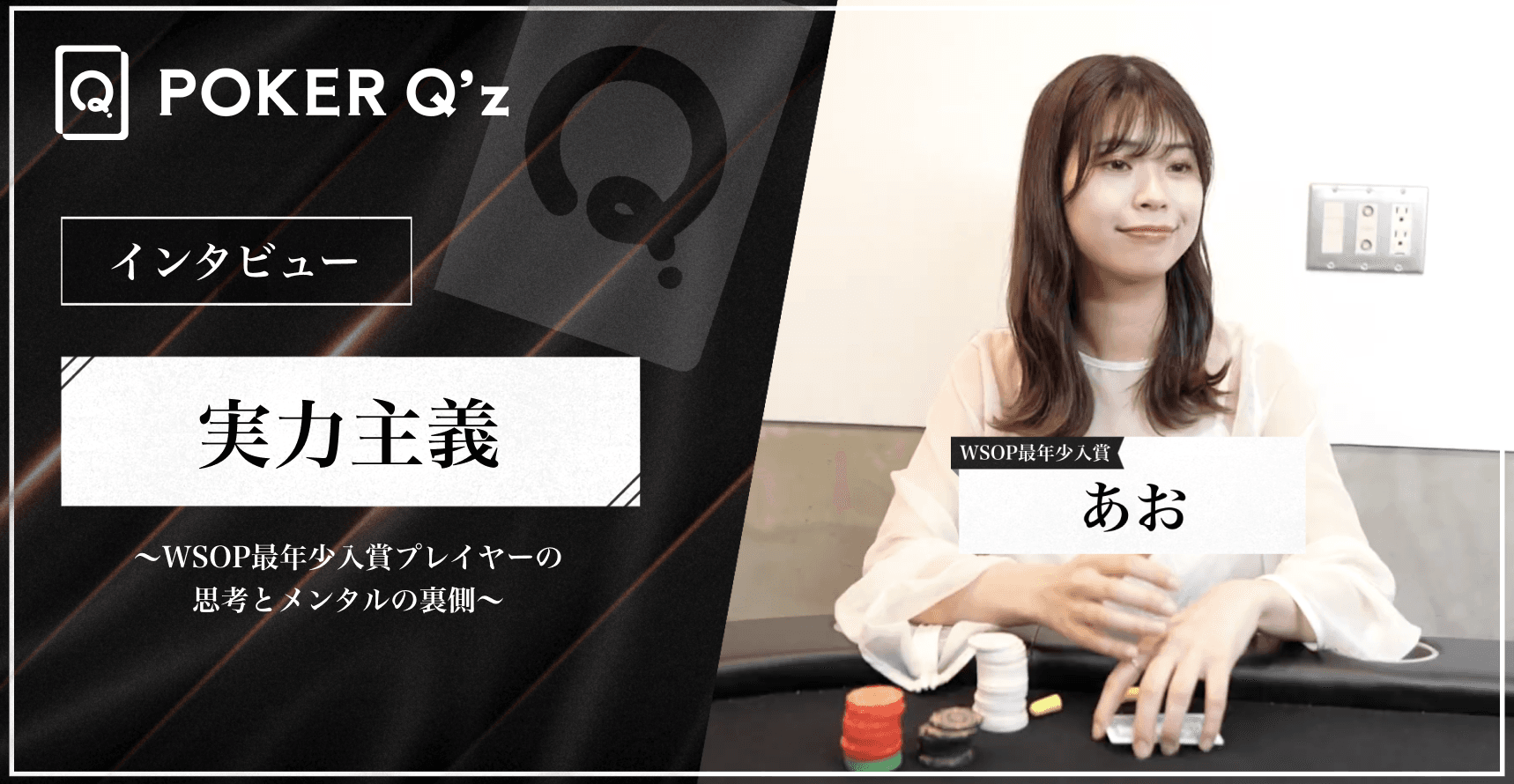
Hello! I’m on the PR team at CLOViZ Inc.Today, we’re joined by Ao, a female poker player who competes in international tournaments and is also active as a poker influencer.She shared a lot with us, including how she chose poker as a career, how she studies away from the table, and the free-spirited love of the game behind her calm, analytical mindset.1. A Female Player Who Turned What She Loves Into a Career—First, could you introduce yourself?Ao:My name is Ao. I’m 24, and I work as a freelance web professional. I’ve been playing poker for about three and a half years. I started because I happened to discover it with friends, and now I play a lot of tournaments both in Japan and overseas. As for results, I won a daily tournament at Caesars Palace during last year’s WSOP, and I finished runner-up at APT Manila.—Can you tell us more about what got you into poker?Ao:It really started when a friend randomly took me to an amusement poker venue. I’ve always liked things like board games and Werewolf, so I thought poker would probably be fun too. I didn’t get super into cash games at first, but the second time I went, I jumped into a tournament and ran really deep. It was only about 30 players, but I finished around second place, and I mistakenly thought, “I’m actually good at poker.” That made it fun, and I got completely hooked.—You’re also doing influencer activities now. What was the turning point that boosted your visibility?Ao:I think it started with ABEMA’s Queen Of Poker.—Got it. I watched it too. How did you feel back then?Ao:It connects to my web work, but I’ve been freelancing in web since I was about 19, and my company has been incorporated for about four years now. At one point it grew to a pretty large scale, but I started feeling kind of empty about it. I began completely on my own without a clear goal. The business was probably going well, but I started thinking, “What’s next?”At the time, poker was purely a hobby. But I decided to change how I thought about work, and I wanted to make what I love into my job. That’s when I started thinking I wanted to work in poker.When I asked myself what I could do to make poker my career, going pro in cash games was one option. But I love tournaments, and I also wanted to help grow poker. So I thought, “I should be more public-facing,” and I strengthened my influencer efforts. Right then, I got an offer for Queen Of Poker and was able to appear. After that, more people evaluated my poker ability, and I started getting invited to more media opportunities.—How did people around you react once you became more well-known?Ao:My bluffs stopped working as much, honestly. Before, because of how I look, they worked pretty often, and I could use that. But not anymore.—That also means people respect your skill now.Ao:Yeah. So I’m happy about it.2. Over 30 Coaching Sessions With Top Players in Three Years—What was your thinking like when you first started playing?Ao:I started thinking I had natural talent, but by my third tournament or so, I was losing a lot. That’s normal, but it shocked me because I thought I was good. So I figured something had to be wrong and started watching poker videos.At first, I was just extremely aggressive. I kept thinking, “If I can make them fold, that’s profitable.” And I couldn’t stand not trying new ideas, so I’d do things like 5-bet jam everything, thinking they’d fold.—If you did that to me, I’d want to fold QQ.Ao:Right? If you can make someone fold QQ, that’s insanely profitable.—And you were also using your image well.Ao:Exactly. But I’d do it two or three times a day, so of course I’d get picked off. Then I’d think, “Why am I getting caught?” or “Maybe there’s a better hand selection.” I kept testing things in my head and then entering tournaments.But I was still just too bad, so I started paying for coaching. I think about 80% of the players I know have taken coaching at least once.—Really? Within three years?Ao:Yeah, I took a lot. Souzirou, Misawa, euro, and others. The best part of coaching is being able to ask about the exact things you’re unsure about.—There are different coaching styles. What worked best for you?Ao:I especially like Misawa’s coaching. I think I’ve taken it about 30 times.—30 times? That’s incredible.Ao:I took a ton over three years, yeah.As for the process, we often start from the very first hand. What’s great about Misawa’s coaching is that even with a one-street hand, he points out missing concepts. When you play, you’re convinced your line is correct, so you have a reason for it. When I explain, “I thought this, so I did this,” he’ll tell me, “That’s wrong.”Then we dig into what’s wrong, like:Equity estimationOpponent rangesPlanning future streetsPot mathOuts calculationImplied oddsIf implied odds are the issue, for example, he’ll say, “So what are implied odds?” and we’ll go into a lesson from there. That might be my favorite type of coaching. But I’ve tried all kinds, lecture-style and practical play-style.—From the beginning, did you see losing as a skill issue rather than just bad luck?Ao:Yes. I have a strong belief about this: there’s no point arguing about luck. What matters is whether you made the best play in that spot. As a beginner, you take each result too seriously, like “I called and lost.” But for that one hand, it’s a mistake. You face hands you didn’t expect, you can’t fold when you should, your bluffs get called. I saw those as my mistakes.—If you already think that way, it makes sense you’d quickly decide you should study off the table.3. Always Throwing “Pin” in Rock-Paper-Scissors: Studying GTO—Poker study is often divided into equilibrium understanding and exploitative play. How did you balance the two?Ao:Overwhelmingly, I focus on equilibrium understanding. I’m not that good at exploiting, and I don’t think I’m strong at it.—Why is that?Ao:It’s hard to explain, but I want to seriously enjoy poker as a game. And I genuinely like studying equilibrium. I don’t think I study only to get better. I study because I enjoy understanding equilibrium itself.—So you enjoy the process of working toward understanding equilibrium.Ao:Yes. Also, there’s a GTO analogy that really stuck with me. People say GTO is like trying to throw rock, paper, and scissors evenly. Someone once told me, “Ao, you keep throwing ‘pin.’” Like there’s a fourth option called “pin.”—How does “pin” work?Ao:It beats paper, but it loses in a tie. So it’s negative EV no matter what. That’s why you first need to be able to throw rock, paper, and scissors properly. And for that, you study GTO.—That makes sense. In poker, because hands have different strengths, there are clearly negative-EV plays.Ao:Exactly. And I think exploiting is something you do after you can already throw rock, paper, and scissors evenly.—So for you, the main reason GTO matters is to avoid making “pin” plays against anyone.Ao:Yes. Of course, I do exploit sometimes too.4. Putting Her Entire Bankroll on the Table in Las Vegas: Calm Mental Game—Next, I’d like to ask about mental game. How much experience do you have playing live cash games overseas?Ao:I think I played about 100 hours last year, mostly $2/$5.—Do you feel emotional swings while playing?Ao:I do have emotional swings, but I don’t think I feel them much about money. Maybe I just can’t really process the amounts. I understand feeling down because “the pot was big,” but I’ve never thought, “Because the dollar amount was big.”—Interesting. Do you tilt?Ao:I tilt a lot.—Really? When does it happen?Ao:Almost always when I misplay. If someone sucks out on the river, I don’t really feel anything. For example, I was playing $2/$5 in Las Vegas and lost a massive bomb pot. Someone kept calling with a draw that didn’t have the right odds, and they got there at the end. But I remember thinking, “It’s so good that they’re calling like this.”—Even after they hit?Ao:Yes. And because I thought it was so good, I put my entire bankroll for the trip on the table.—That’s wild.Ao:I’m not that attached to money, and I simply enjoy maximizing my chip stack. I also love no-money poker.—A lot of people tilt from getting sucked out on. Why can you stay so calm?Ao:That’s the game. Sometimes you hit, sometimes you get hit. What matters is making the best decision. And I genuinely trust poker as a game. I believe skill shows over time, and probability behaves like probability. So I don’t believe in ideas like “That guy always gets there.”—In Japan, games like mahjong have been popular for a long time, and people often bring in ideas like “flow” or “luck.” Poker might change too if more people study.Ao:Yes. I truly think studying is fun, so I want everyone to try it at least once.—It would be great if more people did.Ao:That’s actually one of my goals as an influencer. I want poker to feel more like a sport. I want it to be highly competitive.—Like a poker version of M-League?Ao:Yes, exactly. That’s what I want to create. That was also the goal with Queen Of Poker. Poker is cool, it’s fair, and it’s not gambling. I want to spread that message.5. Studying Even on a Deserted Island: Committing to a Life in Poker—What are your future goals in poker?Ao:I want to win a bigger title and become more well-known.—So it’s more about the title itself than prize money?Ao:Yes. It’s an honor, and it’s a goal. But even if I win one big title, I’ll probably challenge higher buy-in tournaments, so I think I’ll just keep playing poker forever.—How do you think about work going forward? Do you see a path to going full-time in poker?Ao:Yes. I want to go full-time. But not only as someone who lives off cash games. I want to be full-time in poker including influencer work, marketing, and things like that.—Have you learned any life lessons through poker?Ao:That’s hard… I guess I learned to think in terms of expected value. That helps in business too. But honestly, poker is my life now. Poker is the main thing.—So maybe what you gained from poker is deciding to live in the poker world.Ao:That might be true. I never thought my life would become this fun after finding poker.—You really love poker.Ao:I do. I’m pretty confident about that. I also often say, “If I could bring one thing to a deserted island, it would be a deck of cards.”—That’s intense. But you’d still want opponents, right?Ao:I might just study by myself.6. A Message for Everyone—What would you say to people who just started poker, or are about to start?Ao:First, I want to say, “You’re lucky you found poker.”—So just discovering it is a kind of happiness.Ao:Yes. And if you want to study, there are so many options now. You can watch YouTube, use tools like Wizard, and also things like PokerQ’z. If you study with those, you’ll discover a different kind of fun.—Any final words for our readers?Ao:I really want to become stronger and better at poker, and I’d be happy if everyone enjoyed poker in their own way. That’s why I truly hate real-money home games. I want people to stop gambling in Japan. I want us to protect poker and build it up together.—If gambling spreads, it can lead to regulation and hurt the entire poker scene.Ao:Exactly. I want people to enjoy poker purely as a game. Poker is interesting enough to be enjoyed that way. I want a culture where you can admire the winner as cool, and even if you get sucked out and lose a pot, you stay composed and walk away calmly. I want to be that kind of player too.

795
Genius Awakens: Inside the Mindset and Mental Game of a Student Poker Pro Winning Over 10 Million Yen a YearColumn

Genius Awakens: Inside the Mindset and Mental Game of a Student Poker Pro Winning Over 10 Million Yen a Year

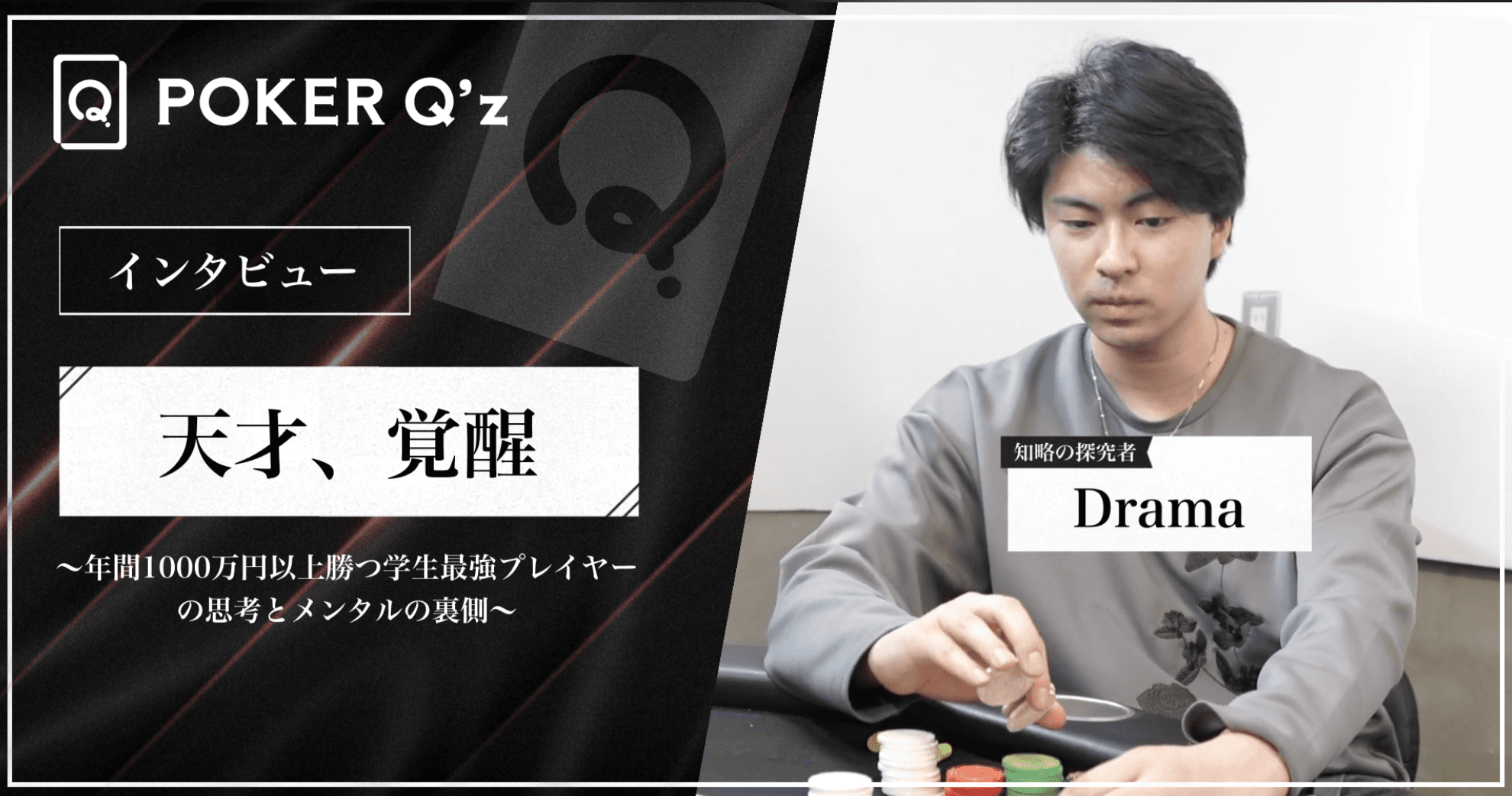
Hello! I’m on the PR team at CLOViZ Inc.This time, we’re joined by Drama, a player who has won a total of 10 million yen in live cash games and is often called the strongest student player thanks to his strategy work and educational content.After deciding to take a leave of absence from university, he spent three years grinding across Korea, Cambodia, and the United States. In this interview, we’ll break down how he expanded both his skill set and perspective, plus the mindset and mental game habits behind his rapid improvement.1. A university player who took a leave of absence to sharpen his game overseas—First, could you introduce yourself?Drama:My name is Drama, and I’m a third-year student in the Department of Mathematics, Faculty of Science at Hokkaido University. I’ve been playing poker for about three years. I first learned the game from a friend during my high school graduation trip, and that’s what got me into poker. I was drawn to the depth of an imperfect information game, the satisfaction of outthinking an opponent, and the fun of constant mind games. After entering university, I became more obsessed with poker than math.In the winter of my second year, I decided to take a one-year leave of absence because I wanted to fully commit. I traveled and played in Las Vegas, Korea, and Cambodia. In Las Vegas, I joined a project called the “Amu Elite Squad,” and winning about 5 million yen in three months became a major source of confidence for me. Right now, I’m deeply focused on studying poker through the club I founded, Hokudai Poker Circle SECOND NUTS.2. What drove his rapid growth to “strongest student” in just three years—I’m sure you didn’t start out winning easily. What do you think allowed you to improve so quickly in about three years and earn a reputation as the strongest student player?Drama:The biggest factor was getting coaching from strong players. I’m not a “natural talent” type. When I started, I didn’t know how to build strategy, and I didn’t understand balance at all. About six months in, I began coaching with Peeeaje, and I became able to beat typical recreational players. Then about six months later, I started coaching with Amu. Amu not only has a deep understanding of equilibrium (GTO), but his thinking is extremely refined. I remember feeling he was the strongest player I’d ever met.In poker, you need to understand both equilibrium (GTO) and exploitative play. You can build the former through effort, but I think the latter is hard to learn unless you have great materials or a great mentor.—It seems difficult to identify strong players when you’re still inexperienced. How should someone judge who’s actually good?Drama:Realistically, the best way is to judge the logical consistency of what they say. Ideally, you’d measure a player’s skill by equity, but in practice you often don’t have enough sample size. So I start by filtering out people whose statements contain logical contradictions. Once you remove those, you’re mostly left with competent people. From there, I think the best approach is to choose someone you work well with and can trust.3. Three stages of thinking: from equilibrium understanding to exploitation—How has your in-game thinking evolved from when you first started to now?Drama:Right after I started, I had zero concept of balance and played based only on my own hand.On the river, my value bet sizing and bluff sizing were completely differentMy intentions were obvious to everyoneThat was my “weakest” stage.Next, I learned to balance across my entire range. More specifically:My value and bluff sizes became consistentI could include bluffs in every bet size and line, so my play became more equilibrium (GTO)-likeIn the final stage, I used equilibrium thinking as a foundation, but I could intentionally break balance to exploit opponents. More specifically:I choose bluff sizes that maximize bluff EVI choose value sizes that maximize value EVI choose lines that maximize EV for each optionAnd I still avoid letting opponents notice my imbalancesThat’s how my thinking evolved through these three stages.4. A workflow for training logical thinking—In your YouTube project “Headphone Poker”, you explain your thought process for each action. How do you decide on your final action, and do you have tips for training that process?Drama:First, I start by clearly putting into words what I’m unsure about. For example, I’ll say, “I’m deciding between checking and betting 33%.” Then I organize the pros and cons of those two options and think about how check EV and bet EV change compared to equilibrium (GTO). For example, if I have a marginal hand, I might explain it like this: “If I bet 33%, I’m likely to face a lot of raises, and I can’t call a raise with this hand, so that’s a negative point and lowers bet EV. If I check, I expect fewer probe bets on the turn, which is a positive point. So in this spot, check EV likely exceeds bet EV, so I choose check.”When I organize it into these three steps:List the optionsExplain how EV changes for each optionConclude which option you choosethe logic becomes instantly clearer.When explaining where a number like “33%” comes from, I make it explicit by saying, “This is the equilibrium sizing.” Then I’ll add that in this spot I’m choosing a size that deviates from equilibrium as an exploit. I think it helps a lot to build the habit of always stating whether you’re talking about an equilibrium strategy or an exploitative strategy.5. Mental game and live cash game habits—You mentioned winning about 5 million yen overseas, but live cash games have huge variance. How do you manage your mental game?Drama:I think mental game management is just as important as studying poker strategy. If you play live cash, it’s even more essential.The first thing I focus on is keeping a consistent daily routine.Poker players often struggle to leave a good table, so sleep schedules can get messy. But a strict rule for me is never playing while sleep-deprived. After a session, I sleep without an alarm until I feel like I truly slept well. I usually don’t eat breakfast, but on days I play, I always eat in the morning. Then I lift weights, take a shower, get ready, and head to the venue. That’s my basic routine.Strength training activates the brain and boosts self-confidence. A lazy lifestyle slows your thinking and hurts your mental state, so I strongly recommend aiming for an ideal, disciplined daily rhythm.—Do you tilt at all? And if you do, how do you handle it?Drama:I’ve heard some people almost never tilt, but I do. That said, it’s not when I lose in an unfair way. It hits me mentally when I realize I made a clear mistake. If I feel bad, I stand up immediately, take a walk outside, look at the scenery, or listen to music to reset. If I think I still can’t focus after coming back, I end the session and go home. But if the table is great, I weigh whether it’s worth continuing.I also take notes on every line. If I see a line that looks like an opponent leak, I record it immediately. I give each of the nine players at the table a nickname and write down the traits I observe. Under that, I write my own hand review, then revisit it the next morning. If my thinking doesn’t match what I wrote at the time, I store it as a mental-game-driven bias. That way, I can apply countermeasures during play that fit my personal tendencies.6. How taking a leave of absence broadened his perspective and his future vision—Looking back, was taking a one-year leave of absence to focus on poker a positive decision? How do you view poker now, and how do you want to continue with poker in the future?Drama:I’m really glad I took the leave. If there are student poker players who are unsure about taking time off, I want them to seriously consider it. When you’re young, have stamina, and your curiosity and desire to grow are high, being able to immerse yourself in poker for a full year is a huge advantage. Your skill improves dramatically, and in most cases it doesn’t become a fatal negative for job hunting.My skill improved a lot during that time, but my assumption that “I’ll probably get bored after a year” was wrong. If anything, poker became even more interesting. Right now, my goal is to surpass the players I look up to, and I’m even more committed than before. Of course, I plan to graduate, but my personal philosophy is to pursue what I enjoy most right now. Rather than betting my life on future security or saving all my enjoyment for retirement, I want to maximize the present because you never know when you’ll die.In the future, I’ll keep poker as a stage where I aim for the very top. I’ll also value time in Japan and time with friends, while playing overseas when needed.7. For people starting poker: GTO isn’t the answer, it’s the baseline—Finally, do you have advice for beginners, or for players who study but feel stuck?Drama:GTO is even more important than most people think, and you’ll never regret learning it, so I recommend studying it thoroughly.Saying “My opponents don’t play GTO, so studying it is pointless” is a major misunderstanding. If you don’t know the baseline, you can’t even identify what’s deviating. Learn the baseline first, then find your opponent’s tendencies, and intentionally break balance to exploit them. I think that’s the most reliable path to improvement.

1532
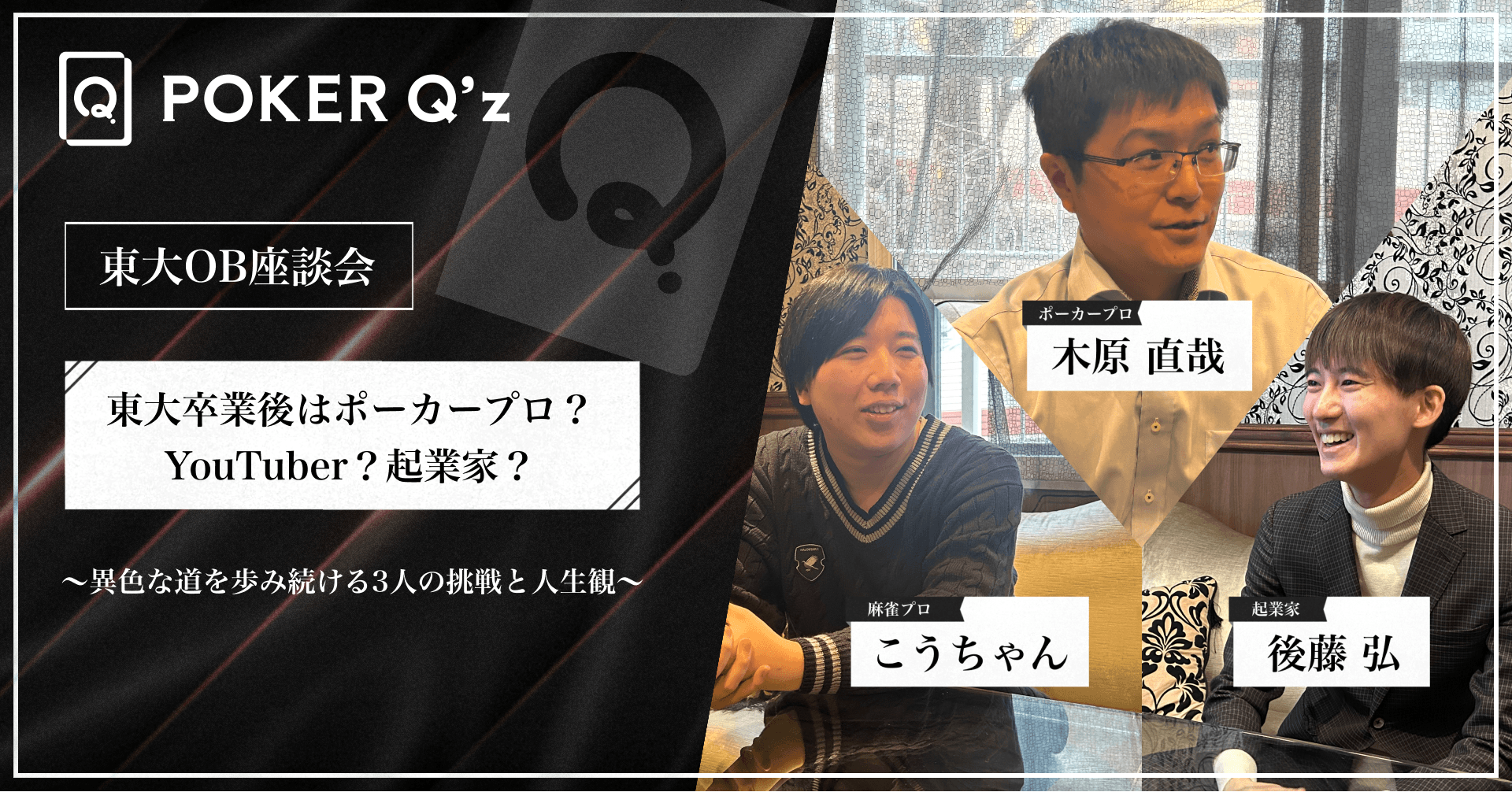
Poker Pro After Tokyo University Graduation? YouTuber? Entrepreneur? Three Unique Poker Journeys and Life Philosophies With Naoya Kihara, Ko-chan, and Hiroshi GotoColumn

Poker Pro After Tokyo University Graduation? YouTuber? Entrepreneur? Three Unique Poker Journeys and Life Philosophies With Naoya Kihara, Ko-chan, and Hiroshi Goto

Hello! I’m on the PR team at CLOViZ Inc.This time, we’re joined by three University of Tokyo graduates who deliberately chose “unconventional paths” after graduation: Naoya Kihara, a professional poker player; Kochan, a YouTuber and professional mahjong player; and Hiroshi Goto, an entrepreneur.In this roundtable discussion, we’ll share their challenges, motivations, and views on life after choosing a path that prioritizes “challenge” over “stability.”1. Why Choose an Unconventional Path? — “Challenge” Over “Stability”Goto:— Kihara, why did you become a professional poker player?Kihara:To begin with, I was in a situation where I could barely graduate, and I was planning to drop out. But then I discovered poker, and once I could make a living from it, I was able to finish my degree. So it wasn’t so much that I “chose not to take a normal job,” but more that “a normal job was never really an option for me from the start.”Goto:— Why did poker help you graduate?Kihara:I was working as a cram school tutor, but when you consider the hours and the pay, it was tough to return to university. People often imagine “University of Tokyo tutors make great money,” but in reality it’s not like that at all. Even just covering living expenses is hard, and you have to work long hours.Since I’m from a science background, I also needed time for research and other work. Realistically, graduating while holding a regular job was basically impossible. But with poker, it was possible. So I thought, if I can do it, I might as well go back and graduate, and I did.Goto:— Did your family oppose you becoming a professional poker player?Kihara:If I had been living with my parents or relying on them for work, it might have been different. But I lived alone and didn’t receive money from them, so there wasn’t any real opposition. I told them everything after the fact. And even if they had opposed it, I wasn’t going to change my mind, so it never became an issue.Goto:— Kochan, why didn’t you go into a regular job?Kochan:Quick intro: after graduating, I worked at QuizKnock for about three to four years, then went independent. About six months later, I became a professional mahjong player. Now I do a mix of things like writing quiz questions, appearing on TV, and playing mahjong.Unlike Kihara, I graduated right away. I also earned a junior high and high school teaching license, and up until around my third year, I thought, “I’ll become a teacher.” I was planning to apply to private high schools in Tokyo. I’ve always liked teaching, so that felt like the right path.But around that time, QuizKnock started getting popular, and I thought, “Since I have this opportunity, I’ll work here for a while.” If I ever want to become a teacher again in the future, I’ll think about it then.Kihara said he told his parents after the fact, and I’m the same. We’re close and talk about a lot, but when it comes to career decisions, I always reported afterward. My parents did say things like, “Why not work at a big company?” but I just brushed it off (laughs). They suggested things, but they never forced me.Kochan:— Goto, why didn’t you take a corporate job?Goto:Quick intro: while I was in university, I appeared on a quiz TV show called Todai-O for about three and a half years. Since last year, I’ve been running a company whose main business is a private tutoring service. I’m also a board member at CLOViZ, the company developing POKER Q’z.I started a business because I found a high-variance life more appealing than joining a big company and living a stable life.Also, my father told me from middle school, “Take risks while you’re young.” His idea was that once you have a family, it becomes harder to take risks, so you should do it early.My mother is more conservative and said, “Isn’t a big company better?” But in the end, she respected my decision.I live with my parents and they provide housing, but they’ve never forced anything on me, and I’m very grateful. That’s why I want to take risks now, challenge myself, and if I succeed, repay them properly.2. What Are the Benefits of Working at a Big Company? — Doing Work at a Scale Individuals Can’t MatchGoto:— What do you think are the advantages of working at a large corporation?Kihara:The biggest advantage is being able to move businesses worth tens of billions of yen. It’s hard for an individual to operate at that scale, and it’s even harder to build up to it. In a big company, even if you generate profit, some of it gets absorbed by the company rather than becoming your salary. Still, the chance to work on massive projects is very appealing.3. The Real Downsides of Being a Pro Poker Player or Pro Mahjong Player — “Low Credibility” and “Unstable Income”Goto:— With the way we work, we can have lower social credibility and it can be harder to borrow money. Have you ever felt that downside?Kihara:Absolutely. I couldn’t pass the screening for the rental guarantor company where I live now, so the lease is under my wife’s name. At my previous place, it was under my name, but when I moved, the guarantor company changed and I didn’t pass. That said, I did get approved for a home loan even as a pro poker player (laughs).Goto:Are there other downsides you’ve felt because you chose this path, like pro poker, pro mahjong, or media work?Kochan:My income changes a lot month to month, so sometimes I think, “This month is going to be tight.” I wouldn’t say it’s completely unstable, but nothing guarantees a fixed paycheck, so it’s definitely a downside.Kihara:In my case, it’s not just that money doesn’t come in. Some months my net results are negative. That can happen with stock prices dropping, and in poker you can run negative over several months in total. Losing money while you’re “working” is very different from a normal job. But if you can win at a certain level, your long-term hourly rate is still high.That said, as the global skill level keeps rising, you can lose ability as you get older, or your improvement slows down. If you can’t keep up, you might not be able to make a living anymore. That’s the biggest downside.Goto:— You’ve been investing seriously for the last two to three years, right? Is that also preparation for the future?Kihara:Not at all. I just treat it like a fun game.4. Being Strong Isn’t Enough to Make a Living — What It Takes to Survive as a ProGoto:— What do you think about working as a pro mahjong player and appearing on shows? A lot of people are interested, but many hesitate because of long-term instability.Kihara:Basically, I think being a “pro mahjong player” is closer to a certification than a job. It’s like a hobby circle with a skill cutoff to join. If you reach the very top, it can become a real career, but for most people, “pro mahjong” isn’t actually a profession.In that sense, it’s a world where you can chase a dream, but it’s not easy to make a living in a realistic way.Kochan:I agree. Making a living as a pro mahjong player isn’t just about “being strong.” You have to think about how you’re going to build your activities and career.For pro shogi or pro go, dedicating yourself to the game is itself a viable path. If you win, your income increases, and the competition functions as a profession. But in mahjong, even if you’re “pretty good,” it’s hard to live on that alone. That’s why how you brand and produce yourself becomes important.That said, recently the value of teaching mahjong has been rising, pay has improved, and the barrier to entry has gotten lower.Goto:Entrepreneurship is similar. In the past, it was like, “You need 10 million yen in capital,” or “If your company fails, people will judge you forever.” But those hurdles have dropped a lot.Capital requirements have been relaxed, and even if your first startup fails, society is more open to you trying again. In fact, more companies now value the experience of having started a business and failed.The worlds of pro mahjong and pro poker are the same. Compared to the past, the environment keeps changing. It feels like we’re in an era where it’s easier to challenge what you want to do.Kochan:In the past, people who lived freely like us were often seen coldly as “unstable.” But recently, I think the mood has shifted to “This is also a valid way to live.”At the same time, the relative value of getting a job at a decent company has gone down, and more people think, “Even if you get hired, there’s still risk.” Maybe we’re entering an era where no path guarantees safety.5. Advice for People Who Want to Go Pro in Poker, Go Pro in Mahjong, or Start a Business — “If You’re Hesitating, Should You Stop? Or Just Start Moving?”Goto:— Finally, do you have any advice for people who want to become a pro poker player like you but hesitate, or people who want to become a pro mahjong player or do on-camera work but can’t take the first step?Kihara:Honestly, if you’re already hesitating, I think you should stop.I’ve said that poker is something like “one in a thousand” can make a living from, but even if you can make a living now, that doesn’t mean it will last forever. Even if you can do it at 25, you still need to be able to do it at 50 or 60. For that, you need both a reserve of skill and a reserve of money.When you think about it that way, I don’t think it’s enough to be in the top one in a thousand. You probably need to be in the top one in ten thousand. And that level isn’t something you reach through effort alone. People who think, “I need to work hard,” generally aren’t suited for it. If you’re conscious of “trying hard,” you’re usually done for. So if you’re hesitating, it might be better not to do it.Kochan:As a pro mahjong player, I’d be genuinely happy if more people played mahjong, so I want everyone to try it.But “making a living from it” is a different story. I think what matters is the confidence at the foundation of how you live.For example, even if I completely stopped appearing in media in the future and quit pro mahjong activities, I’m confident I could still live. That confidence comes from what I’ve studied and the experience I’ve built up.So instead of asking, “Can I live off this?” if you have the confidence that “I can survive no matter what happens,” then I think it’s worth trying.For instance, I have a teaching license, so if things get tough, I can work as a teacher. Skills and strengths like that build confidence. Even if someone asks me for advice, I can’t guarantee, “You’ll be fine.” So I think it’s important to have an honest conversation with yourself and decide.That said, I’m truly having fun in this world, and if I hadn’t become a pro mahjong player, I don’t think I would have met Goto or Kihara. Because I happened to choose this path, I met people I wouldn’t have otherwise. That makes me feel like I’m living a really good life. So yes, I think trying it is a valid option.Goto:As for starting a business, like I said earlier, the environment makes it easier to take risks than it used to. So if you’re hesitating, I think it’s best to try once, ideally while you’re still young.Even if you fail, you can start over. If you realize it’s not for you, you can choose to get a job at a company. And more companies now value the experience of failing at a startup, so you can use that experience in your career.Personally, I work almost seven days a week right now, and whenever I have free time, I’m basically working. But I’m still enjoying it. I’m glad I did it.So if you’re hesitating, I think you should take action that very day and start moving.

458
The Evolution of Game Theory Through Poker: Von Neumann, Nash, and the Rise of AIColumn

The Evolution of Game Theory Through Poker: Von Neumann, Nash, and the Rise of AI

IntroductionWhen you play poker, you’ve probably heard terms like “GTO” and “game theory.” Because poker is a game where players compete for chips, it has a deep connection to game theory. In this article, we’ll look at how game theory was born, how it developed, and why it matters in poker. Whether this is your first time encountering game theory or you became curious through poker, we hope this helps you build a solid foundation.1. What Is Game Theory?From the name “game theory,” many people imagine recreational games like cards or board games. But in academia, the “games” studied in game theory cover a much wider range. A “game” refers to any situation where multiple players make decisions while considering each other’s actions, aiming to gain some kind of “payoff” (such as points or profit). As a result, game theory applies not only to entertainment like board games and card games, but also to competitive bidding, price competition between companies, international negotiations, and even biological evolution.Game theory mathematically models these strategic situations. It expresses players’ strategies and payoffs using formulas, then searches for optimal strategies and equilibrium states. While it uses advanced mathematical tools, the theory itself was built by brilliant mathematicians in the early 20th century. Two names you can’t avoid in the history of game theory are John von Neumann and John Nash, giants who shaped many fields.2. The Early Days: von Neumann’s 1928 PaperWhen you trace the history of game theory, the first name that comes up is John von Neumann. In 1928, von Neumann published a groundbreaking paper in German titled “On the Theory of Parlor Games,” where he used mathematical analysis to model situations in which multiple players exchange points. Von Neumann was a true 20th-century genius: he helped formalize the mathematical foundations of quantum mechanics, conceptualized modern computer architecture, and even contributed to nuclear weapons development. Among his many achievements, he also established the foundations of game theory.In 1928, von Neumann organized probabilistic games (like roulette or rock-paper-scissors, and even simple card games) into a mathematical framework and clarified key terminology and concepts. Terms like “strategy” and “payoff,” which remain fundamental in game theory today, were already being discussed at this stage. However, his ideas were so far ahead of their time that they didn’t attract much attention in academia. Some say that simply hearing “studying games with mathematics” made many researchers dismiss it as not worth serious effort. The fact that the paper was written in German also limited its spread, especially in the English-speaking world.3. Theory of Games and Economic Behavior: The Landmark 1944 BookMore than a decade after von Neumann’s initial insights, game theory reached a major turning point in 1944 with the publication of Theory of Games and Economic Behavior, co-authored with economist Oskar Morgenstern. This massive work exceeded 600 pages, and von Neumann and Morgenstern argued that problems of interaction in economics can be analyzed mathematically through the lens of game theory.Economists had already tried to express markets and competition using equations, but those approaches struggled to directly handle “strategic interaction,” where players influence each other’s decisions. In contrast, von Neumann and Morgenstern presented a systematic framework that began with a simple model called a “zero-sum game,” where two or more players compete over points or money, and then expanded the discussion to “non-zero-sum games.” Terms and theorems still used today, such as “zero-sum game,” the “minimax principle,” and “expected payoff,” appeared at this stage. As a result, game theory rapidly spread through economics and established itself as a major academic field.4. Nash and the Rise of “Nash Equilibrium”When people think of game theory, many immediately think of “Nash equilibrium.” This concept was established by John Forbes Nash in a 1950 paper. Nash, a young mathematical prodigy, proved during his PhD studies that in any finite game with any number of players, at least one equilibrium point must exist as a combination of strategies for all players. This is what we now call a Nash equilibrium. In a Nash equilibrium, if each player assumes the others’ strategies are fixed, no one can improve their expected payoff by changing their own strategy. In other words, everyone is simultaneously playing a best response, and no one has an incentive to deviate.What made Nash’s achievement revolutionary was that he proved an existence theorem: an equilibrium always exists. Even in simple games like rock-paper-scissors, where outcomes can be perfectly balanced, it’s a separate and difficult question whether you can mathematically claim that “every game has some equilibrium.” Nash solved this challenge by using an advanced tool called a fixed-point theorem. This theorem is often associated with major contributions by Japanese mathematician Shizuo Kakutani, and it’s said that Nash realized he could complete the proof if such a theorem were available, and Kakutani’s work provided it.5. Applications in Evolutionary Biology and Deeper Economic TheoryAs game theory gained attention in economics, researchers began applying it across many other fields. One especially notable area is biology. From around the 1970s, scientists increasingly used game theory to analyze conflict and cooperation among organisms, as well as strategies among males competing for mates. This field became known as “evolutionary game theory,” and it introduced new concepts such as the Evolutionarily Stable Strategy (ESS). An ESS describes a form of evolutionary stability: when a population mostly adopts one strategy, a small number of mutants using a different strategy cannot defeat it. Organisms don’t act rationally in the human sense, but game theory fit extremely well as a way to mathematically model how “strategies” become refined under selection pressure.Meanwhile, economics continued to develop around Nash equilibrium and non-cooperative game theory, building tools to analyze complex market competition and design auction mechanisms. Researchers who won the Nobel Prize in Economics for auction theory relied heavily on game theory at its core. It’s no exaggeration to say that game theory also powers modern systems like e-commerce bidding and online advertising auctions.6. Poker and Game Theory: The Keyword “GTO”When you hear “game theory,” you might also think of games like chess or shogi. These are “perfect information games,” where both players share full knowledge of the board state and build strategies from complete information. Poker, on the other hand, is an “imperfect information game.” You can see your own hole cards, but you can’t see your opponent’s. This information asymmetry forces you to infer ranges, predict actions, and choose bet and raise sizes accordingly. Players bluff, counter-bluff, and calculate expected value using probability, which creates a much wider strategic landscape.In imperfect information games, one major mathematical goal is to find a strategy that cannot be exploited. In poker, players often call this GTO (Game Theory Optimal). Strictly speaking, “GTO” is not a formal game theory term. Instead, poker players use it as a practical label for “Nash equilibrium strategy” in a two-player zero-sum setting, from the player’s perspective: a strategy that an opponent cannot exploit.The Foundation of GTO: Two-Player Zero-Sum GamesIn poker theory, “mastering GTO” ultimately resembles “internalizing Nash equilibrium as your own strategy.” If you assume poker is a zero-sum game where two players fight over chips, then a Nash equilibrium strategy profile must exist. And if one player follows it, the opponent cannot increase expected value by deviating. However, real poker often involves multiple players, such as 6-max or 9-handed games, where Nash equilibrium analysis becomes far more complex. Many aspects of two-player zero-sum theory do not transfer directly. Still, in practice, understanding heads-up (one-on-one) GTO provides a strong foundation that you can often apply approximately in three-player or multiway situations.7. The Rise of CFR: A Practical Way to Compute Nash EquilibriaAfter Nash proved that Nash equilibria exist in the 1950s, many mathematicians spent decades tackling a different problem: how do you actually compute a Nash equilibrium? As games become more complex, with more players or an enormous number of possible actions, finding the equilibrium becomes extremely difficult even if you know it exists in theory.A major breakthrough came around 2007 with a method called CFR (Counterfactual Regret Minimization). CFR is an iterative algorithm that looks back at each decision point and asks, “What if I had taken a different action?” (this is the “counterfactual” part). It then improves the strategy in the direction that reduces regret over time. A key advantage of CFR is that in two-player zero-sum games, it is theoretically guaranteed to converge toward an “epsilon Nash equilibrium” (a Nash equilibrium with a small error). This made CFR extremely useful for fast poker simulations, especially in heads-up scenarios, and it became a critical ingredient in poker AIs that could beat human players.8. Advances in AI: Libratus and PluribusThe Shock of LibratusIn 2017, the poker AI “Libratus,” developed by researchers at Carnegie Mellon University, drew major attention. In heads-up no-limit Texas Hold’em, it faced top human poker pros and won. AI had already surpassed humans in perfect information games like chess, shogi, and Go, but creating an AI that could defeat professionals in poker, an imperfect information game, was a landmark achievement for both game theory and AI research.Libratus built on CFR-style methods and used massive computational resources while gradually abstracting the strategy space. Poker includes an almost infinite number of bet sizes and situations, so Libratus grouped together spots where fine-grained differences had little impact on expected value, reducing computational load. At the same time, it calculated key situations in greater detail. This approach allowed it to search through an enormous game tree and produce strategies closer to Nash equilibrium within limited time.The Evolution of PluribusThen in 2019, the same research group introduced “Pluribus,” which played 6-max no-limit Texas Hold’em and dominated professional players. Six-player poker is far more complex than heads-up. The theoretical guarantees of two-player zero-sum games no longer apply, and even running CFR extensively does not guarantee strict convergence. Despite that, Pluribus demonstrated experimentally that it could outperform top human pros. Some poker players argued that the opponents were not truly the absolute best, but the impact was still enormous: it showed that even in multiplayer poker, applying existing AI methods could surpass human performance. In fact, many pros began to believe that humans might no longer be able to beat AI.9. Game Theory Is Still an “Unfinished” FieldAs you’ve seen, game theory has already produced many results and has been applied widely, from poker and chess to economics, auctions, and evolutionary biology. But that doesn’t mean game theory has explained everything. Modern game theory still faces major challenges, including the following.The nature of Nash equilibrium in multiplayer gamesIn two-player zero-sum games, once you find a Nash equilibrium, playing it protects you from being exploited and guarantees a certain baseline expected value. But with three or more players, Nash equilibrium becomes much more complicated. Multiple equilibria may exist, and comparing which one is “better” can be difficult. Many aspects remain theoretically unresolved, and computing equilibria in practice requires enormous effort.Fully solving imperfect information games is extremely hardPoker is a flagship example of an imperfect information game, and the rise of CFR-based AI might make it feel “solved.” In reality, researchers analyzed it step by step under constraints such as heads-up formats, limit betting, or fixed stack sizes. The more constraints you remove, the harder computation becomes. And as Pluribus illustrates, when non-zero-sum elements and multiplayer interactions enter the picture, we still lack strong theoretical guarantees. In many cases, we are simply producing AIs that are “empirically strong” without full theoretical backing.Humans are not always rationalGame theory assumes that each player acts rationally to maximize payoff. But real humans do not always behave rationally. Psychological biases, loss aversion, and other non-rational factors often shape decisions. These elements may sit outside classical game theory, but in recent years, behavioral economics has advanced efforts to quantify how people deviate from rational behavior.10. Summary and OutlookThe history of game theory began with von Neumann’s 1928 paper and expanded dramatically with the 1944 publication of Theory of Games and Economic Behavior. In 1950, John Nash proved the existence of Nash equilibrium, creating a powerful foundation for mathematically analyzing strategic decision-making among multiple players. After that, applications spread beyond economics into evolutionary biology, political science, and more. In the 21st century, game theory merged with AI, leading to computers that can beat top human pros even in imperfect information games like poker. Behind these breakthroughs are algorithms like CFR and implementation techniques that cleverly manage large-scale computational resources.Even so, game theory is not a universal tool that solves every strategic problem. As the number of players increases, as cooperation enters the picture, and as human irrationality becomes more important, the theory grows more complex and computational difficulty rises sharply. That’s why many researchers still push forward, asking how to solve larger games faster and more accurately.In the poker world, interest in learning and applying GTO strategy has spread widely, and many top players use solvers or CFR-based study tools in some form. This is especially true in online poker, where high-stakes situations often resemble heads-up play or short-handed formats, making AI-style study increasingly essential. In real games, players also adjust based on opponent skill: they mix in exploitative lines to target weaknesses, or they shift closer to GTO to avoid being exploited themselves. Perfect GTO play requires massive computation and repetition, so humans can’t reproduce it 100%, but GTO has clearly become a practical learning framework.This trend is a strong example of how game theory has moved beyond academia into real-world use. It applies not only to gambling and casinos, but also to everyday life. Price competition between companies, bidding systems, daily negotiations, and even social media behavior can all create “game-like situations” where multiple players pursue payoffs. In a sense, we may be using game theory intuitively more often than we realize.Final Thoughts: How to Use Game TheoryLooking back at the history of game theory, it started with insights from a small number of genius mathematicians, then transformed economics, advanced biological theory, and even reshaped poker and AI research. What began as classical theory has now entered an era where supercomputers refine strategies through massive simulations. But humans don’t only play “games that theory can fully describe.” Where theory is incomplete, there is often the greatest room for research and innovation. As AI continues to advance, it may open new frontiers we can’t yet predict. For example, AI could intervene in situations shaped by psychological bias, or in imperfect information environments where multiple conflicting interests overlap, potentially creating new strategies for multiplayer games.Even within poker, many open questions remain: How far can we compute in games with 6+ players? Could approaches beyond Nash equilibrium produce even stronger strategies? If supercomputers become more powerful or new mathematical breakthroughs emerge, we may eventually compute precise equilibrium strategies quickly even in larger multiplayer imperfect information games.Some people may find “game theory” sounds unusual or overly academic. But at its core, it reflects a simple mindset: trying to understand mathematically a world where multiple players influence each other. In business, politics, social issues, and ecosystems, you can view countless situations as “games.” Applying game theory can reveal surprising insights and help you appreciate the depth of human strategy and interaction.If learning about game theory sparked your interest in poker, consider giving poker a try. Poker isn’t just about luck. It’s full of human dynamics, strategic thinking, and probability-based decision-making. At first, learning hand strength and basic bet sizing is already fun. As you start to understand bluffing frequency and the core ideas behind GTO, the game becomes even deeper.If you want to explore game theory academically, you can also read original works by Nash and von Neumann and challenge yourself with textbooks used in university economics or mathematics courses. You may see pages of abstract equations, but once you understand them, you’ll likely feel inspired by how mathematics can model real strategic interactions across society.Game theory remains an evolving, unfinished field. But by following its history, you can see how much of our world is shaped by strategy and interaction. You might even start noticing moments in daily life where you think, “This feels like a game theory situation.” When that happens, simply recalling something like “What does Nash equilibrium mean again?” can broaden your perspective and make the world more interesting. That’s one of the real pleasures of game theory.

792
Mahjong and Poker Hybrid Thinking Game Junpo Rules GuideColumn

Mahjong and Poker Hybrid Thinking Game Junpo Rules Guide

What Is “Jan-Po”?“Jan-Po” is an innovative game created by “Toshiki,” the developer at Poker Q’z. It’s a groundbreaking hybrid that combines Mahjong and Poker (Texas Hold’em).Players hold both a Mahjong hand and a poker hand at the same time, and on each turn they choose whether to prioritize a Mahjong discard or a poker action.Because of this choice, you must constantly decide whether Mahjong or poker matters more in the current situation. You need to build strategy while balancing both games, making Jan-Po a fresh, highly strategic experience full of mind games and decision-making.Basic RulesStarting pointsBoth Mahjong and poker start at 25,000 points.Managing pointsAll points are managed as a single chip stack for poker. You can also use Mahjong point sticks instead of chips.Action restrictionsOn each turn, you can do only one of the following: a Mahjong discard from the hand or a poker chip-committing action.In other words:① If you take a poker action of call or higher, you must discard in Mahjong by discarding the drawn tile.② If you discard from your hand in Mahjong, you must check or fold in poker.The game proceeds in Mahjong turn order. That means poker action goes in the opposite direction from usual.When it’s not your turn to act in poker, you only discard in Mahjong (commonly called Tada-Jan Time).PokerFormatTexas Hold’em.BlindsFixed at 200-500.DealerYou need one PD (Playing Dealer). Ask the person who seems best suited to run the game.Required equipmentPlaying cards and chips. Chips can be replaced with Mahjong point sticks.MahjongRulesFour-player Mahjong based on M.League rules. (East-only is recommended. A hanchan will take a very long time.)Dealer repeatsNone. Since it’s East-only, the match always ends after 4 hands.Required equipmentMahjong tiles and a table. You may use an automatic table, but we take no responsibility if cards or chips fall into the table.If you don’t mind longer sessions, you can freely adjust the Mahjong rules.How the Game ProgressesAt the Start of Each HandDealing the Mahjong TilesDeal 13 tiles to each player. We recommend building the dead wall at the dealer’s shimocha’s “Zi 7” position (so it’s easier to reveal the poker board).If you use an automatic-dealing table, we recommend turning off the auto-deal function.Note: The dealer does not take the first drawn tile during the initial deal. Treat the 14th tile as the first draw.Poker HandPlace the button so that the Mahjong dealer becomes the first player to act in poker (cutoff).After the Mahjong dealer completes the first draw, deal poker hands to everyone.Note: Because of the poker action order, even when you can only play Mahjong, you generally discard after hands are dealt.During the HandYour Choice on Your Draw TurnOn your turn, follow the basic rules and handle both a Mahjong discard and a poker action at the same time.(In poker, you act only when it’s your turn in the betting order. Otherwise, it’s Tada-Jan Time.)Calling TilesMahjong calls (open melds) work the same as in standard Mahjong.However, if you choose to call, you cannot take a poker action on that turn.Since poker actions only happen on Mahjong draw turns, Tada-Jan Time may continue until the player with poker action rights reaches their draw turn.When a Poker Hand EndsIf the Mahjong hand has not ended, the next poker hand starts immediately.When a new poker hand begins, make sure action always starts from the cutoff. Players before the cutoff only play Mahjong at that moment.Handling a Mahjong WinIf someone wins in Mahjong, pause poker and pay points as in normal Mahjong.On a self-draw win: you must check or fold in the poker hand. If you want to take an action of call or higher, you must discard the winning tile (discard the drawn tile).On a win by discard: there are no special restrictions. It does not affect poker action order.When the Mahjong Hand EndsA Mahjong hand ends when a win occurs or the hand is drawn. In that case, treat the currently running poker hand as the last hand, then move to the next Mahjong hand. During this time, do not play Mahjong and keep your tiles face down.Special CasesIf your points drop to 0 or belowYou are considered busted in poker, and from then on you only play Mahjong.If three players drop to 0 or below, that Mahjong hand becomes the final hand and the match ends.If you lose points in Mahjong while holding a poker hand and your points drop to 0 or below, treat your last chip-committing action as an all-in.All-inAn all-in is defined as betting your entire stack so your points become 0. If you gain points from a Mahjong win while all-in, treat your last chip-committing action as a bet or raise of that new amount.End of the Match and Winning ConditionsThe match ends after East 4 finishes and the final poker hand is completed.The player with the highest total raw points wins.Mahjong placement bonuses do not apply.Important NotesIf a foul occurs in poker or Mahjong and the situation can be restored, treat it as no action and revert.For fouls that significantly affect gameplay, the PD should make an on-the-spot ruling.Strategy and Decision-MakingIn Jan-Po, the key is deciding whether to focus more on Mahjong or poker. Here are examples of Jan-Po-specific decisions and strategies.1) Useful Mahjong tiles vs. a strong poker handShould you chase poker EV even if it means discarding a useful Mahjong tile?Or should you prioritize Mahjong efficiency and give up a strong poker hand?2) A dead draw in Mahjong vs. a poker hand you should foldShould you use a “wasted” Mahjong draw to open a poker hand you normally wouldn’t play?If you let opponents draw useful Mahjong tiles, will they be more likely to fold in poker, making your bluff more effective?3) When your Mahjong starting hand is hopelessShould you abandon Mahjong and specialize in poker to profit there instead?As you can see, you must optimize your actions across two games. An action in one game often affects the other. Among advanced players, you’ll frequently see high-level reads and counterplays using many factors on both boards.Whether you balance both games or commit heavily to one can have a major impact on the outcome.Summary“Jan-Po” is a new hybrid game that lets you enjoy the different strategic depth of Mahjong and poker at the same time.Mahjong skill: reading hands, tracking opponents’ tendencies.Poker skill: evaluating EV, understanding opponents’ play.Beyond testing each skill set, Jan-Po demands choices that balance both games and create synergy.Enjoy this new challenge.

738
Member Interview 5: Exploring the World of Poker Through Statistics - Kazuki TakaoColumn

Member Interview 5: Exploring the World of Poker Through Statistics - Kazuki Takao

Hello! I’m from the PR team at CLOViZ Inc.A lot of people are probably wondering what CLOViZ actually is, and what kind of team members we have. In this blog series, we introduce CLOViZ members in an interview format. Along the way, we’ll share our vision and values, each member’s role and skill set, and what makes both the team and the individuals so compelling.In this fifth installment, we’re featuring Mr. Takao, who works as a poker coach and helps create content.1. A University Poker Player Using Statistics as a Weapon—First, could you briefly introduce yourself?My name is Kazuki Takao, and I’m in the Faculty of Business Administration at Hosei University. At university, I study statistics and econometrics.I first encountered poker at a middle school cultural festival. I started taking it seriously in April 2022, when I joined the University of Tokyo poker circle. That’s where I became obsessed with the appeal of imperfect information. Back then, I was thinking about poker from morning to night. I even remember counting combos while taking a bath.As for results, I won a JOPT side event in January 2024, and won a SPADIE side event in February. More recently, I’ve also been studying games beyond No-Limit Hold’em, and I placed 7th in the JOPT PL-BigO event in January 2025.At CLOViZ, I work as a poker coach and also help create content, such as deciding what kinds of questions to include in our poker learning app, POKER Q’z.2. Beyond Correlation to Causation: What Poker and Crypto Trading Have in Common—Could you tell us more about your university research and your interest in crypto trading?Right now, I’m researching causal inference at university. It’s about identifying and quantitatively evaluating how an intervention or factor affects an outcome, and it’s used for things like measuring the impact of marketing initiatives.For example, in video advertising, you can analyze how different elements, such as the actor’s gender, video length, or how long the company name is displayed, influence consumer purchasing behavior. By thinking in terms of causality, you can propose more effective ad strategies.I think the causal inference mindset also helps when studying poker strategy. One representative example is using a method called clustering, which groups similar features together, to classify flops. This can simplify equilibrium strategies into a form that’s easier for humans to apply.Since October 2023, I’ve also been working on crypto trading research. The goal is to generate consistent profits by running trades through a bot, a program that automatically executes currency trades. I’m still a beginner in that space, but I want to take it more seriously going forward.What’s especially interesting is the structural similarity between poker and crypto trading. Both are zero-sum markets, both require strong mental control, the ability to handle money pressure, and statistical thinking.Finding the market’s sources of profit, which in poker you could also call an opponent’s leaks, and exploiting them feels very similar to the environment of high-stakes online poker.3. A New Perspective Through Poker: Statistical Thinking and Global Connections—It’s great that your research and hobbies connect to poker. What have you learned from poker, and what do you find appealing about it?The biggest thing I’ve gained through poker is statistical thinking. I’ve started viewing many everyday situations as probabilistic events. For example, if my favorite drink is sold out at a vending machine, I now think about whether it’s worth walking to the next one in terms of expected value.I’ve also learned to control emotional reactions, what poker players call tilt, and to make calm decisions hand by hand. Even highly skilled players can lose in the short term. Learning to live with that variance is both what makes poker difficult and what makes it fascinating.Another major appeal is that communication naturally happens because you’re sitting at the same table for long periods of time. When I played in Vietnam recently, I was able to connect with other players through poker even with the language barrier.4. Looking Ahead: Playing Abroad and an Ideal Future for Poker—That’s true, thinking in expected value really changes how you see everyday choices. How do you want to stay involved with poker going forward, and what do you hope for the poker industry?I plan to keep playing more for enjoyment than for money. In my fourth year of university, I’ll have more free time, so I’d like to stay abroad and challenge myself in cash games. My top destination is the Philippines, since it’s English-speaking and the cost of living is low. My second choice is Las Vegas.For the industry to grow, I hope the legal environment improves. I don’t feel the current approach to prize payouts is ideal, so I’d like to see things become cleaner and more sustainable, potentially in coordination with Japan’s IR projects.5. The Real Value of Late Registration: A Short-Stack Specialist’s Perspective—If the legal side improves, it could really open things up. What kind of playing style are you best at?In No-Limit Hold’em tournaments, I’m confident in short-stack strategy at 30BB or less. On the other hand, I’m relatively not as strong when deep-stacked, so I often enter right near the end of late registration. In general, late reg can also be higher EV.That said, in tournaments common in Japan with very poor payout structures, it may not be rational to play purely for money in the first place. In those cases, registering from the start and simply enjoying poker is also a good option.6. “GTO in Human Language”: How POKER Q’z Is Changing Poker Study—So late registration is part of the strategy too. How do you think people should study poker?In my case, I started by studying from books. Now I learn by discussing hands with members of the University of Tokyo poker circle and other strong players, and by using GTO Wizard.Balancing theory and practice is a never-ending topic, but I think beginners should prioritize playing first and get enough experience to start forming hypotheses. After that, the phase of learning theory becomes important. Many people struggle to interpret and understand GTO Wizard outputs during this process, so we’re developing POKER Q’z as a tool to bridge that gap.In Japan, more players are learning basic strategies, like not open-limping. However, only a limited number of players can apply GTO concepts and GTO Wizard results in real games. For most people, understanding and applying them takes time, or feels difficult. POKER Q’z aims to interpret solver outputs in clear, human language. We hope this makes the complex concept of GTO easier for beginners to understand.Poker can feel intimidating because of its mathematical complexity, but it’s also a powerful communication tool. If POKER Q’z can remove those barriers and help more people enjoy poker, that would make me very happy.—Mr. Takao, thank you very much for your time today!Thank you as well. If you’re interested in what we’re doing and would like to get involved in developing our services, please contact us via the link below.

497
Executive Roundtable Part 2: Our Vision for POKER Q'zColumn

Executive Roundtable Part 2: Our Vision for POKER Q'z

Hello! I’m on the PR team at CLOViZ Inc.A lot of people are probably wondering what CLOViZ actually is and what kind of members we have on the team.In this blog, we’ll introduce CLOViZ members through an interview format. While touching on the vision and values CLOViZ aims for, as well as each member’s role and skill set, we’ll highlight the strength of the team as a whole and the unique appeal of each individual.In this article, we’ll focus on CEO Masaki and introduce the University of Tokyo-born poker learning app, POKER Q'z!Director roundtable discussion: Part 1 is here1. Level-based learning and making your leaks visibleーーCould you tell us what POKER Q'z aims to achieve and what makes it unique?Masaki:Of course, we’re targeting people who can study proactively, but more than that, we want to reach the people who struggle to do so. I used to be in that camp myself, so I really understand how it feels. There are many players who have been playing poker for a long time but have never studied, people who don’t know how to learn, people who aren’t sure where they stand, and people who feel that advanced analysis tools are too intimidating.For those players, we want to provide a learning environment that feels close to real play. You get to think from the perspective of “What would I do here?”, and then you can see whether your result was good or bad and where you rank among everyone else. That’s the kind of learning experience we want to offer.We also want to deliver this not only in Japan, but to poker players around the world.Kitsugi:I feel that many existing poker learning services are positioned closer to “research” than “studying.” That’s because users have to interpret the information on their own. In that format, it’s extremely difficult for beginners who don’t know what to do to understand everything from scratch, and the barrier to entry is high.With our service, POKER Q'z, we explain things carefully based on specific situations, including points like “How should you think to navigate this spot well?” and “Why is that choice incorrect?” A major feature is that when you face a similar situation again, you naturally learn how to make the right decision.Goto:Exactly. For someone who doesn’t play poker, it’s like being told, “If you miss a question that 70% of people get right on a practice exam, that’s bad,” but no one tells you which materials will help you get to the point where you can solve it. That’s how traditional services have been. With POKER Q'z, you can learn in a consistent way all the way through to “If you master this material, you’ll be able to solve that type of problem.”Also, in poker study you might ask others for advice, but you often get incorrect information, and choosing the right training materials can be full of pitfalls. At CLOViZ, the content is created by people with proven tournament results and by those who have studied theory properly, so reliability is built in. With YouTube, learning can be one-way and you may feel a skill gap, but with our service you can get learning that matches your current situation.Masaki:Making your leaks visible is another key point. For example, in fitness, when your body fat percentage and where you’re carrying fat are recorded and shown over time, it helps you stay motivated.Kitsugi:That’s right. POKER Q'z runs a complex system behind the scenes, but from the user’s perspective, it naturally makes your leaks visible. For example, if you frequently make mistakes with decisions in a specific hand range, we’ve implemented a feature that prioritizes and recommends learning content for that area. As a result, it’s an app you can keep using without stress and without losing motivation.2. The future of POKER Q'z: human-like CPU (AI), global expansion, and building a communityーーIt’s true that when you can see your leaks and see yourself improving, it boosts motivation. Finally, could you share your long-term vision?Masaki:Right now, the app is based on theoretical results, but in real poker, each player has their own tendencies and habits. In the future, we want to build a learning system that can adapt to a wide range of play styles. For example, we’re considering ways to support counter-strategies against aggressive opponents, and systems that work not only for cash games but also for tournament formats.One especially interesting idea is developing a CPU (AI) that can reproduce a specific player’s style. If we can make that happen, it would help you objectively understand how your own play style appears to other players. And if you could play against a CPU modeled after famous international players, it would add even more ways to learn while having fun.The importance of GTO, the game theory optimal strategy, won’t change. But by combining it with matches against a human-like AI, we want to broaden what players can learn.Fortunately, our team includes members who are deeply knowledgeable in both poker and engineering, so we’re confident we can deliver unique value that hasn’t existed before. We’ve also received investment from one of the world’s top five poker social app game companies, which is downloaded widely across the US and Europe, and we plan to expand globally in the future. Considering that the player base is growing not only in traditional poker markets but also in regions like South America and Asia, we feel the timing is excellent.Ultimately, we want to build a community both online and offline, creating an environment where players can learn from each other.ーーMasaki, Kitsugi, and Goto, thank you very much for the interview today!Thank you as well. If you’re interested in what we’re doing or feel like you’d like to work with us on service development, please contact us via the link below!

373
Executive Roundtable Part 1: The Vision Behind CLOViZ Poker StartupColumn

Executive Roundtable Part 1: The Vision Behind CLOViZ Poker Startup

Hello! I’m part of the PR team at CLOViZ Inc.A lot of people are probably wondering what CLOViZ actually is and what kind of team we have. In this blog series, we’ll introduce CLOViZ members in an interview format. Along the way, we’ll share our vision and values, each member’s role and skill set, and what makes both the team and the individuals behind it stand out.In this article, we’ll introduce CLOViZ Inc., the company driving POKER Q’z, with a focus on our CEO, Masaki.1. Backgrounds of the CLOViZ founding teamーーーFirst, could you tell us about your backgrounds?Masaki (CEO):X profileUntil this July, I worked in the entertainment industry at Nippon Television Network Corporation. I joined because I was strongly interested not just in producing shows, but in how to make a program work as a business. In practice, I had many opportunities to work on new IP production and non-broadcast revenue projects such as live events. Some of the IP development projects I was involved in include audition programs like “Nizi Project,” “BISH THE NEXT,” and “XY.”I’ve also been involved in an education business for elementary school students that my mother founded, which now operates in more than 20 locations across Japan.Our founding philosophy, “When you’re playing, you’re learning,” comes from my experiences in both entertainment and education.Kitsugi (Director, COO):X profileI originally worked at a global consulting firm, where I mainly supported large companies with digital transformation and building data analytics platforms. Through that work, I became deeply interested in solving business problems with technology, so I taught myself programming and also gained broad experience in areas like business operations and product management at a blockchain startup.Over time, I became even more interested in the potential of B2C products and started wanting to build products myself. During that process, I reconnected with Masaki, whom I already knew. With the recent AI boom, we discussed a business plan around education and AI, and that led to the idea: what if we applied it to poker? That was the spark that led to CLOViZ.Goto (Director):X profileI joined after Masaki asked me for advice on setting up the company and invited me to appear on the YouTube show “POKER ROYALE.” Unlike the other two, I come from the perspective of someone who takes poker seriously as a player. My role includes giving player-focused feedback to improve the app and leveraging my connections in the poker community to bring in supporters.Masaki:I met Kitsugi while I was helping out at a blockchain startup. A few years later, we met again and decided to start a business together. He comes from consulting but can also do engineering, so he supports the company from both angles.Goto is truly exceptional. He graduated top of his class from Kaisei High School, was selected as Mr. Todai during his time at the University of Tokyo, and has also appeared on “Todai-Oh.” But it’s not just his resume—his character is outstanding too, which makes him an invaluable presence. Simply being involved with the company gives people around us a positive impression.As a poker player, Goto also deeply understands what challenges players face and what they actually need. It’s incredibly reassuring that he can connect those insights to education and business.Although they’re not here today, another major strength of our company is that we’ve brought together members with top-tier AI research expertise and deep poker knowledge. For example, we have members at the University of Tokyo researching game AI and natural language algorithms, the president and members of a University of Tokyo poker organization, and players active in overseas poker cash games and tournaments. Their expertise plays a major role in the app’s design and technical development.2. Entertainment x EducationーーIt’s impressive that you’ve gathered a team with both poker and technical expertise. Can you tell us what led you to start CLOViZ, and what you want to achieve with POKER Q’z?Masaki:To be honest, CLOViZ isn’t only about poker. Looking ahead, we want to build businesses at the intersection of entertainment and education. Poker is simply our first theme.Two main experiences led me to this idea. The first came from my time in the entertainment industry. When we produced audition shows, we heard from many viewers not only that they enjoyed the content as entertainment, but also that it made them feel motivated to work harder themselves. It can be pure fun, but it can also energize people for tomorrow. I saw huge potential in combining entertainment and education, and it became one of the themes I want to pursue for life.The second came from discoveries in the education business my family runs. There, an AI-powered, gamified math learning tool delivered major results. Compared to traditional paper-and-pencil study, data showed study time increased by eight times. Kids feel like they’re playing, but they naturally keep learning—and knowledge sticks through the process. On top of that, the admin dashboard visualizes each student’s strengths and weaknesses, making personalized learning possible.I believed we could apply this model to poker, a market with strong growth potential.POKER Q’z is built on three core goals. First, we want to make poker study more accessible to more people. If you’re highly analytical and self-motivated, you can already use existing analysis tools. But from my own experience, many people have played poker for a long time without ever studying, or they simply don’t know how to learn. For those players, we want to create an environment that feels close to real play: you think through what you would do, see whether that decision was good or bad, and understand where your judgment sits compared to the overall field.Second is democratizing knowledge. Like shogi or go, valuable insights have traditionally been shared only in local study groups or closed communities. We want to make that knowledge accessible to far more people. By creating a place where anyone in the world can access high-quality learning—not just those with the right connections—we believe the entire community can level up.Third is building a community that accelerates the cycle of learning and execution. We believe that while playing is an individual battle, preparation doesn’t have to be. By creating a space where members share knowledge and discuss wins and losses from real play, we can support more consistent and effective growth than studying alone.ーーTo be continued in Part 2...

357
Member Interview 4: How Data Science Is Changing the Way We Learn Poker - Tatsuki OtaColumn

Member Interview 4: How Data Science Is Changing the Way We Learn Poker - Tatsuki Ota

Hello! I’m part of the PR team at CLOViZ Inc.A lot of people are probably wondering what CLOViZ actually is and what kind of members we have on the team. In this note, we’ll introduce CLOViZ members in an interview format. While touching on the vision and values CLOViZ aims for, as well as each member’s role and skill set, we’ll highlight the strength of the team as a whole and the unique appeal of each individual.For Part 4, we’re featuring Mr. Ota, who works on content creation!1. Turning Probability Theory into a Weapon: A Graduate Student Takes on the World of Poker— First, could you briefly introduce yourself?My name is Tatsuki Ota, and I’m in the Graduate School of Science and Engineering at Hosei University. At university, I research mathematical finance and machine learning. More specifically, I work with areas like finance and probability theory, which are closely related to poker.I’ve been playing poker for four years, and I’ve explored a wide range of formats. I first discovered poker in my first year of university, starting with casual Texas Hold’em games with friends. Later, I began attending Pot-Limit Omaha workshops at an amusement casino in Tokyo, and I got completely hooked on PLO for a while. The instructor was truly excellent, and that’s where I learned the fundamentals. In my third year, I had the chance to learn mixed games like Deuce-to-Seven and Badugi through workshops at the same venue, and I especially got into 2-7 and Badugi. In my fourth year, influenced by friends, I shifted my focus to studying tournaments. Recently, I’ve gone back to my roots with Texas Hold’em ring games and have been concentrating on researching GTO strategy.As for results, I placed 16th in the JOPT Main Event, finished runner-up twice in side events, and won a Badugi tournament in Korea.At CLOViZ, I’m responsible for content creation for the poker learning app POKER Q'z, including deciding what kinds of questions to publish. I also create workshop materials, design curricula, and produce slides.Mr. Ota doing research2. Flexible Strategy That Goes Beyond GTO— You’ve played a lot of different formats. What do you focus on in your playing style?This is basic, but from an exploitative perspective, rather than looking for physical tells, I focus on observing how opponents play and exploiting the areas where they seem to deviate from GTO.Especially in tournaments, ranges change depending on the situation, so I think opponents often enter hands or fold hands in ways that differ from GTO. In spots where a GTO-based strategy should shift, I try to respond flexibly and choose actions that fit the opponent.For example, all-in ranges and decisions in high bubble-factor situations that are unique to tournaments should change depending on the opponent. I believe these preflop decisions are the most important factor in tournament poker.Mr. Ota after winning a tournament3. The Depth of a Player-vs-Player Game: The Appeal of Mind Games and Connection— So tournament poker has its own unique approach. What do you find most appealing about poker?First, I’m drawn to the mind-game element.I’ve always liked head-to-head games that involve psychological battles, and poker fits that perfectly, so I naturally came to love it.Beyond gameplay, another big appeal is meeting people you’d never normally encounter. I find real value in building connections with others.In university life, you don’t get many chances to interact with students from other universities unless you join an intercollegiate club, but poker helped me build those connections. Also, in everyday campus life, you rarely spend time with older people, but through poker I met people about a decade older than me. Hearing stories from people with professional experience was incredibly refreshing.4. A Poker World That Expands Across Borders: Lessons and Inspiration from the APT— The psychological battle really is deep. Do you have any experiences that made you glad you play poker, or moments that really stood out?When I joined the APT (Asian Poker Tour) held on Jeju Island in Korea, I realized how valuable it was that I’d played games beyond Texas Hold’em. The APT has a lot of mixed games, and the buy-ins are relatively affordable, which makes them easy to enter. I also noticed that when you play mixed games in cash games, you naturally end up socializing with international players, and it becomes a really enjoyable experience. In live poker, Texas Hold’em is the main format, but tournaments often offer plenty of chances to enjoy mixed games. Overseas, if players agree, you can also play mixed games in cash games.The most memorable experience was when I entered a Badugi tournament. I made it to heads-up and was in a desperate spot where I was forced all-in, but then a series of lucky outcomes let me come back and win. I think that captures what makes poker so interesting. Skill is absolutely necessary, but the fact that luck can allow you to beat stronger players is also part of what makes poker unique.5. POKER Q'z Supporting Beginners and the Challenges Facing the Poker Industry— “Luck is part of skill,” as they say. Are there any challenges in the poker industry that you feel strongly about?First, I think a major issue is that beginners don’t know which information they should trust. Even if many people share accurate content, it’s still difficult for someone who just started playing poker to find it. That’s why we want to build an environment in POKER Q'z where beginners can learn with confidence.POKER Q'z is designed so players can learn step by step in the right order based on their level.Another key strength is that it evaluates whether your action is GTO-correct and explains the reasoning. By solving similar problems repeatedly, reading explanations for mistakes, and making adjustments, we believe players can improve quickly.In addition to being a learning app, we’re also focusing on building a community, aiming to create an environment where users can play together and teach each other.Another challenge is that cash games aren’t available in Japan.There are legal constraints, so it’s understandable, but in the current amusement tournament scene, entry fees are structured as a “gift” payment, and beginners sometimes don’t fully understand that. From the perspective of giving value back to players, boosting motivation, and growing the scene, I hope regulations in Japan will gradually ease in the future so cash games and prize tournaments on the same scale as overseas can be held.— Mr. Ota, thank you for your time today!Thank you as well. If you’re interested in what we’re building and want to get involved in developing the service with us, please contact us through the link below!

419
Schrodinger’s Card: Viewing Poker Through a Quantum LensColumn

Schrodinger’s Card: Viewing Poker Through a Quantum Lens

Quantum mechanics and poker might sound like a completely random pairing, but it can actually offer some surprisingly useful insights. When you hear “quantum mechanics,” you might think of subatomic particles, wave–particle duality, or Schrödinger’s cat, the famous thought experiment where “alive” and “dead” exist at the same time. It’s the kind of physics that can make your head spin.But if you step back, poker and quantum mechanics share an unexpected similarity: both deal with a world where you don’t know the “certain answer” until observation happens.So why not look at poker through a slightly strange, “quantum” lens?1. Poker as a game of uncertaintyWhen you play poker, you know your own hand and you can see the chips in front of you. But you don’t know which cards remain in the deck, or what two-card combination your opponent is holding. Outside of the visible community cards, everything becomes a matter of inference and probability.In Texas Hold’em, the community cards are revealed step by step: the flop (first three cards), the turn (fourth), and the river (fifth). Each time a new card appears, you update your expectations, like “I might get there with a straight,” or “That opponent could be trapping with a strong hand.” The cards you haven’t seen yet are essentially a bundle of overlapping possibilities.In quantum mechanics, physicists describe electrons and photons as existing like probability waves until you observe them, not as fixed objects with a single definite position or state. In poker, from the player’s perspective, the unseen cards also exist in an “unresolved” state. Of course, the cards physically exist as pieces of paper, but in your mental model, “any card could still be out there.” That feeling makes uncertainty in poker a great metaphor for quantum uncertainty.2. Opponent reactions as “observation”: collapsing your strategic wave functionIn the quantum world, nothing feels “decided” until measurement. But once you measure a quantum system, its state snaps into a clear outcome. In poker, your opponent’s action can function like that kind of “observation.” Do they fold, call, or raise aggressively? That decision reveals information.For example, if you make a medium-sized bet and your opponent instantly folds, the cloud of possibilities in your mind, “They might be strong,” “They might be bluffing,” “They might be floating,” suddenly collapses into a simpler interpretation: “They probably didn’t have much.” On a psychological level, it resembles the quantum idea of wave function collapse.The key point is that poker involves information updates, not actual quantum effects. Still, as an analogy, the moment an opponent’s action sharply narrows your range assumptions can feel strangely similar to the “measurement” vibe people associate with quantum mechanics.3. Information and correlation: quantum entanglement and strategic networksOne of the most famous concepts in quantum mechanics is quantum entanglement. It describes two quantum states that remain deeply connected across distance, so that measuring one seems to instantly affect the other.Nothing like that happens in real poker. You can’t change your strategy in your head and magically force an immediate change in your opponent’s strategy before you even see their cards. But if you imagine a world where poker used “quantum strategies,” you could picture a strange relationship where your strategic shift instantly links to the opponent’s side.This is purely speculative, but entanglement suggests a scenario where strategies could be mysteriously connected even before observation. In this article, though, we’re focused on real poker. In practice, you observe an opponent’s action first, then adjust. That’s why it’s difficult to apply entanglement directly to poker decision-making. In other words, real poker doesn’t allow entanglement-like direct influence, so this stays in the realm of metaphor and theoretical extension.4. What if poker became a quantum game?Playing poker in a real casino while holding qubits still isn’t realistic. But in theoretical physics and mathematical game theory, researchers study a field called quantum game theory. In these “quantum games,” players can use quantum operations as strategies. By leveraging superposition and quantum correlations, the game can produce new equilibria and strategic patterns that don’t exist in classical models.For example, in non-zero-sum games, where total payoff can increase or decrease based on player choices and Pareto improvements are possible, quantum strategies may help stabilize outcomes that are better for everyone. In cases like the Prisoner’s Dilemma, quantum strategies can sometimes break the classic dilemma structure and produce higher total payoffs.Poker, however, is fundamentally a zero-sum game. One player’s gain equals another player’s loss. Because of that payoff structure, even if you introduced quantum strategies, you shouldn’t expect a magical improvement where everyone profits. Even if you could “superpose” multiple bluff states, the total payoff in the system wouldn’t change. You might just end up exploring a more complex strategy space for no net benefit.Still, asking “What if strategy itself fluctuated at a quantum level?” can expand the way you think. It may not help you at the table, but as a thought experiment it adds another layer of abstraction to probabilistic strategy and pushes you to re-examine what “strategy” really means.Quantum game theory works as a conceptual tool that forces you to rethink the nature of games and decision-making. Poker may not gain obvious practical advantages from it because it’s zero-sum, but the mindset can refresh your thinking and open the door to strategic possibilities you wouldn’t reach through conventional logic alone.5. Quantum computing and the future of poker analysisPoker strategy analysis runs deep. Simulations and GTO (Game Theory Optimal) approaches have become standard tools. But poker remains extremely complex, and as an imperfect information game, it’s notoriously difficult to solve.That’s where quantum computing enters the conversation as a new computing paradigm. It still faces major practical challenges, but if large-scale quantum computers become common in the future, they might explore massive strategy spaces far faster and produce strong approximate solutions.If quantum algorithms ever revolutionize poker research, they could change what we mean by “hand reading” and “bluffing.” This isn’t about quantum mechanics directly affecting poker. It’s more about quantum computing dramatically improving our ability to solve problems under uncertainty.6. Quantum theory as a psychological metaphorQuantum theory is famous for defying intuition. Phrases like “the state isn’t decided until observation” or “a particle is both a wave and a particle” confuse beginners and challenge common sense. But that sense of “it doesn’t fit into intuition” can offer a useful hint for how humans handle uncertainty.In poker, your opponent’s hole cards and future runouts aren’t determined for you until observation, either by seeing the cards or by watching actions unfold. With that in mind, a quantum-style mindset, not rushing to a single conclusion and holding multiple possibilities at once, can be genuinely useful.If you treat quantum theory as a psychological metaphor, it supports a flexible approach: keep multiple scenarios alive before the outcome becomes clear. Instead of feeling overwhelmed by uncertainty, you can use uncertainty as a reason to keep thinking.Conclusion: swimming through uncertainty with a quantum mindsetQuantum mechanics and poker may not be directly connected. But when you compare uncertainty, information updates, and the process of observing a situation while narrowing down possibilities, you start to see surprising parallels.Quantum theory suggests that the world contains far more “undecided” states than we like to admit. Poker asks a practical question: how do you choose actions with limited information and constant uncertainty? Putting them side by side can expand your thinking and spark more creativity and intuition in decision-making and strategy building under uncertainty.Next time you sit down at the table and pick up your cards, try picturing Schrödinger’s cat or a mysterious wave function in the back of your mind. Uncertainty might start to feel like a strangely satisfying spice.

380