
Hello! We're the PR team at CLOViZ Inc.!
Many of you are probably wondering what CLOViZ actually is and what kind of people work here. In this blog, we introduce CLOViZ members through interviews. Touching on the vision and values CLOViZ is working toward, along with each member's role and skill set, we showcase the strength of the team as a whole and the appeal of each individual.
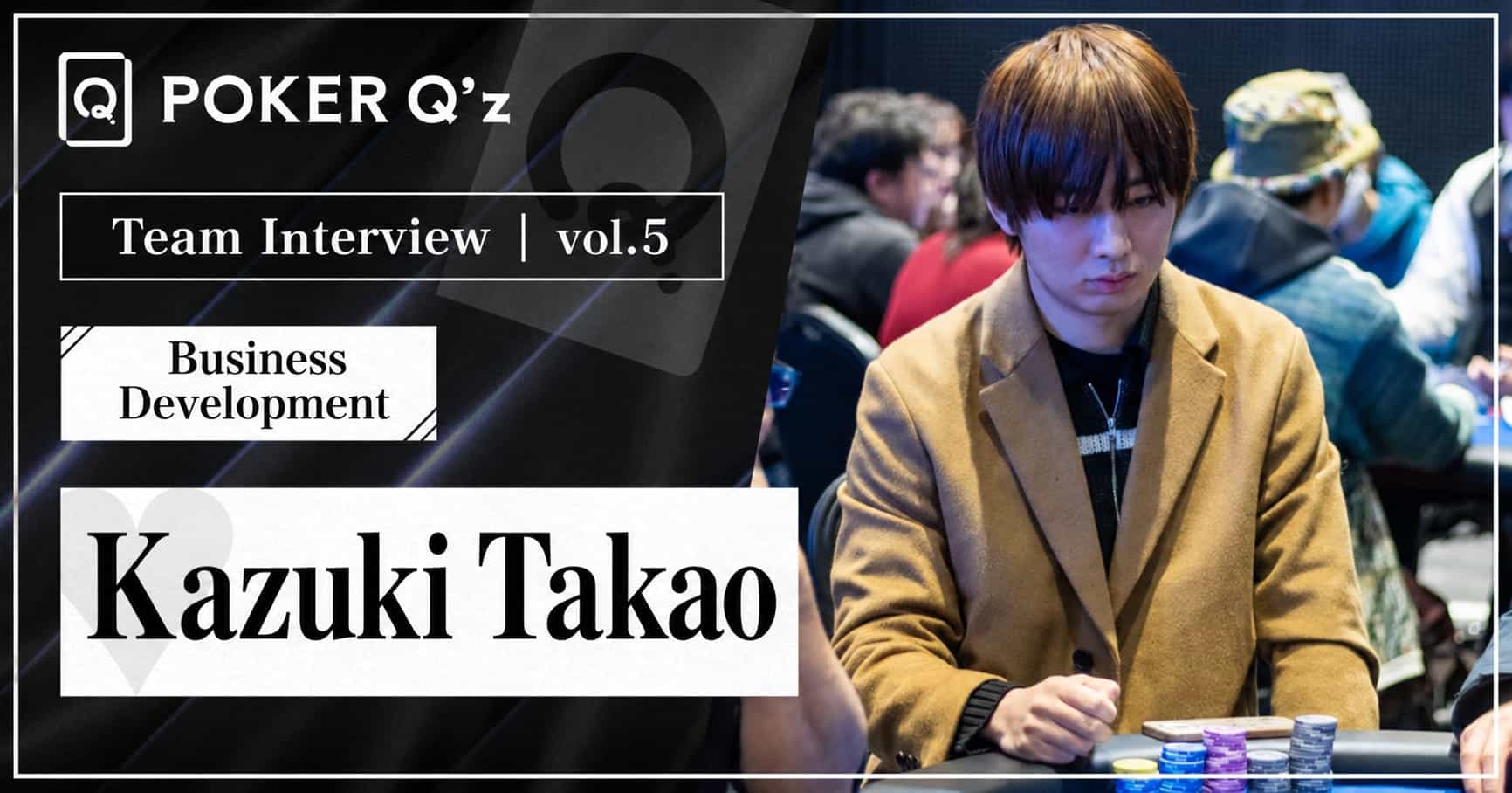
For the fifth installment, we'd like to introduce Mr. Takao, who works on poker instruction and content creation!
1. A University Student Poker Player Armed with Statistics
—First, could you tell us a little about yourself?
My name is Kazuki Takao, and I'm a student in the Faculty of Business Administration at Hosei University. At university, I do research in statistics and econometrics.
My first encounter with poker was at a cultural festival at my junior high school. I started playing seriously in April 2022, when I joined the University of Tokyo Poker Circle. That's where I became hooked on the appeal of incomplete information — back then, I was thinking about poker from morning until night. I remember being so absorbed that I'd even count combos in the bath.
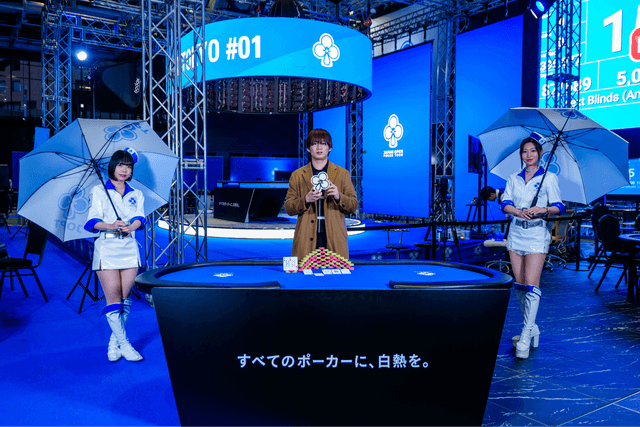
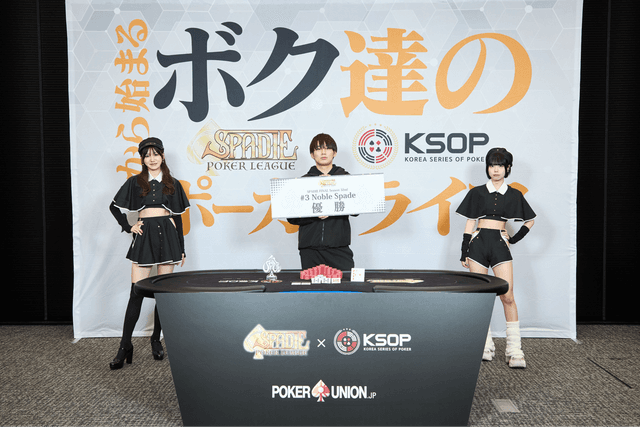
As for results, I won a JOPT side event in January 2024 and a SPADIE side event in February of the same year. I've also been studying games other than No-Limit Hold'em lately — most recently, I placed 7th in the JOPT PL-BigO tournament in January 2025.
At CLOViZ, I work as a poker instructor and handle content creation, such as deciding what kinds of questions to include in the poker learning app POKER Q'z.
2. Beyond Correlation to Causation: What Poker and Crypto Trading Have in Common
—Could you tell us more about your university research and your research into crypto trading as a hobby?
At university, I currently research causal inference. It identifies and quantitatively evaluates the effect that an intervention or factor has on an outcome — in other words, a causal relationship — and it's used for things like measuring the effectiveness of marketing campaigns.
For example, by analyzing how each element of a video ad (the presenter's gender, the video length, how long the company name is shown, and so on) influences consumers' purchasing behavior, and thinking in terms of cause and effect, you can propose more effective advertising strategies.
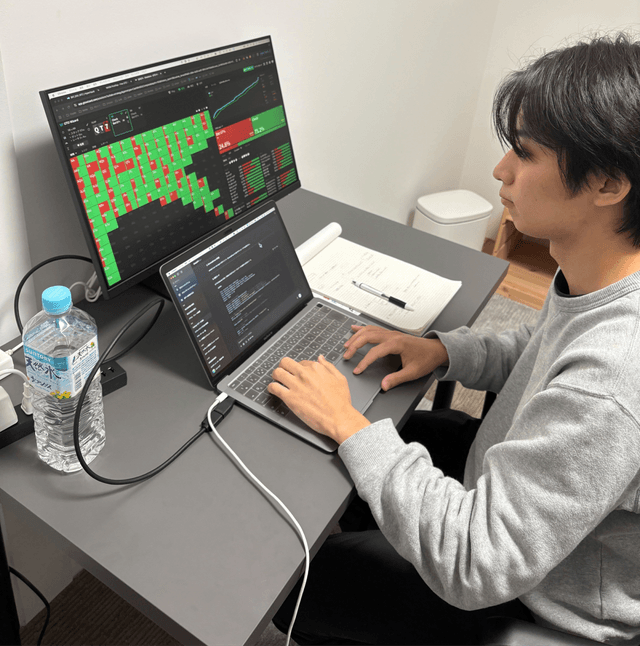
I believe this way of thinking also applies to studying poker strategy. A typical example is classifying flops using a technique called clustering, which groups things with similar features, to simplify equilibrium strategies into a form that's easy for humans to use.
Since October 2023, I've also been researching crypto trading. I'm aiming to generate steady profits by trading with bots — programs that automatically execute trades. I'm still a beginner in that community, but I'd like to throw myself into it seriously from here on.
What I find particularly interesting is the structural similarity between poker and crypto trading. Both are zero-sum markets that demand mental control, the ability to handle money pressure, and statistical thinking.
Finding the market's source of profit — which in poker could also be described as your opponent's leak — and exploiting it looks very much like the situation in high-stakes online poker.
3. A New Perspective from Poker: Statistical Thinking and International Exchange
—So your research and hobbies carry over into poker too! What did poker teach you, and what do you find appealing about it?
What poker taught me most of all is a statistical way of thinking. I've come to view all sorts of everyday occurrences as probabilistic events. For example, when a vending machine is sold out of my favorite drink, I now think about whether to walk to the next one from the perspective of expected value.
I've also learned to keep my emotions in check — what poker players call "tilt" — and to judge each hand calmly. Even strong, skilled players can lose in the short run. Learning to live with those swings, or variance, is what makes poker both difficult and fascinating.
Another big appeal is that playing around a single table for hours naturally gives rise to communication. When I played in Vietnam recently, poker let me connect with the other players across the language barrier.
4. Vision for the Future: Playing Abroad and an Ideal for the Poker Industry
————Indeed, thinking in terms of expected value really changes how everyday choices look! Could you tell us how you plan to engage with poker going forward, and what you hope for the poker industry?
I plan to play for enjoyment rather than for money. Once I'm in my fourth year of university, I'll have more free time, so I'd like to stay abroad and take on cash games. My first choice of destination is the Philippines — an English-speaking country with a low cost of living — with Las Vegas as my second choice.
For the industry to develop, I hope the legal side improves. I feel the way tournament prizes are offered isn't ideal, so I'd like to see it become a clean form of operation, working together with the country's IR (integrated resort) business.
5. The Real Value of Late Registration: A Small-Stack Specialist's Perspective
—Better legal footing would certainly open things up! What playing style are you particularly good at?
In No-Limit Hold'em tournaments, I'm confident in my small-stack strategy at 30BB or less. Conversely, I'm relatively less comfortable with deep stacks, so I often enter right at the late-registration cutoff. Generally speaking, late registration also tends to have higher expected value.
That said, when it comes to the tournaments with very poor payout rates that are common in Japan, playing for money doesn't make sense in the first place — so entering from the start and simply enjoying the poker is a viable option too.
6. "GTO in Human Words": How POKER Q’z Is Changing the Way People Learn Poker
—So late registration was part of your strategy too! How do you think people should study poker?
In my case, I started by studying books. These days, I study by discussing with members of the University of Tokyo Poker Circle and with strong players, and by using GTO Wizard.
Balancing theory and practice is an eternal theme, but I think beginners should put practice first and play until they're able to form hypotheses of their own. The phase of learning theory comes after that. Many people struggle to understand GTO Wizard's results during that process, and we're developing POKER Q'z as a tool to bridge that gap.
In Japan, more and more players are learning basic strategies such as not limping. However, only a limited number of players can apply GTO concepts and GTO Wizard's results in actual play — for many people, understanding and applying them takes time or proves difficult. POKER Q'z aims to interpret the results in plain human words, and we hope this will make the complex concept of GTO easier for beginners to grasp.
Poker's mathematical difficulty can make it feel intimidating, but at the same time, it has an appeal as a communication tool. I'd be delighted if POKER Q'z removes the barriers and gives more people a reason to enjoy poker.
—Mr. Takao, thank you for the interview today!
Thank you as well. If you're interested in what we're working on and would like to help build our services together, please reach out through the link below!