
Introduction
As an engineer involved in developing the poker learning app POKER Q'z, I work every day on product development and algorithm design in the poker x AI space.
Over the past few years, Japan's poker app market has grown rapidly, and the number of ways to casually play poker on your smartphone keeps expanding: EDGE POKER, m HOLD'EM, Poker Chase, EARN POKER, Poker Fate, and many more. As both a player and a developer, this is a trend I'm genuinely happy to see.
Among these, the one generating the most buzz recently is EDGE POKER, which puts poker x AI front and center. Its defining feature is the proprietary AI called "EDGE AI," and after actually trying it, I found parts that made me think "this is impressive" alongside parts that felt like "with a bit more work, this could be even more interesting."
In this article, using EDGE POKER as one example, I'd like to share a developer's perspective on how poker apps can evolve from here and the technology we at POKER Q'z are working on in that context.
※This article is not meant as criticism; it's written out of a hope that the industry as a whole becomes even more exciting.
※Out of respect for the terms of service, we've refrained from including screen captures of EDGE POKER.
Observation 1: How the AI Is Used
GOD's MOVE
First, let's look at GOD's MOVE (a feature that automatically selects the optimal action with AI). By using a purchasable item called "Crystals," this feature is also available in "Ranked Games," the game's rating mode. In effect, this means the feature is assisting, or even replacing, the player's decision-making itself. When such a feature is available in ranked play, results are no longer determined purely by skill.
Moreover, pay-to-win mechanics in ranked games are not limited to GOD's MOVE alone. Effects that directly influence rank movement, such as maintaining consecutive-win bonuses, are also offered.
When the design creates advantages or disadvantages tied to spending, ranks stop reflecting "how strong a player is" and start reflecting "how well they used features and items." As a result, I felt that the original meaning of rank, and its fairness as a competitive metric, is diluted.
Poker is fundamentally a game where judgment and strategy are contested under equal conditions. Of course, being able to use GOD's MOVE in non-rated environments like "Single Games" seems like a very good mechanism for learning and experience. However, I believe that at least in ranked games, a skill-based, non-pay-to-win design should be the baseline. When leveraging AI, rather than having it play in your place during a hand, limiting it to "learning support" such as post-hand review and analysis seems far more aligned with the essence of poker as a game.
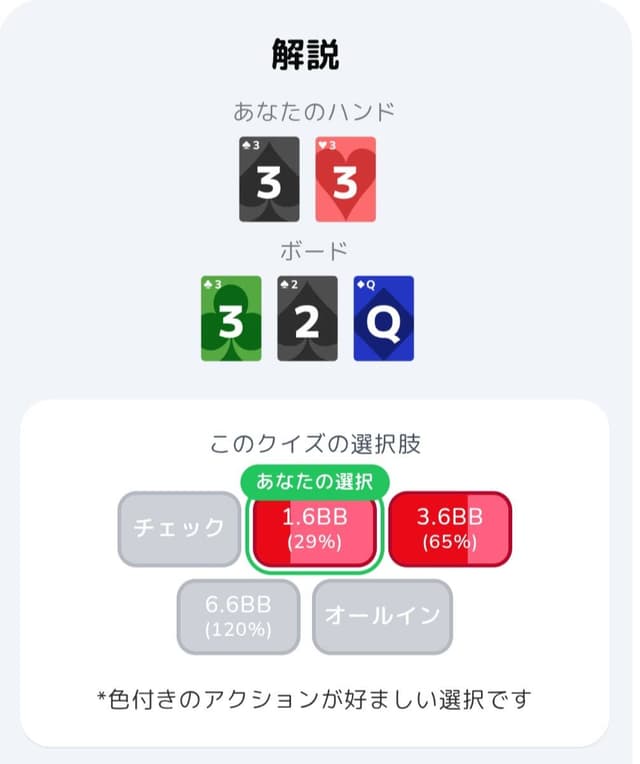
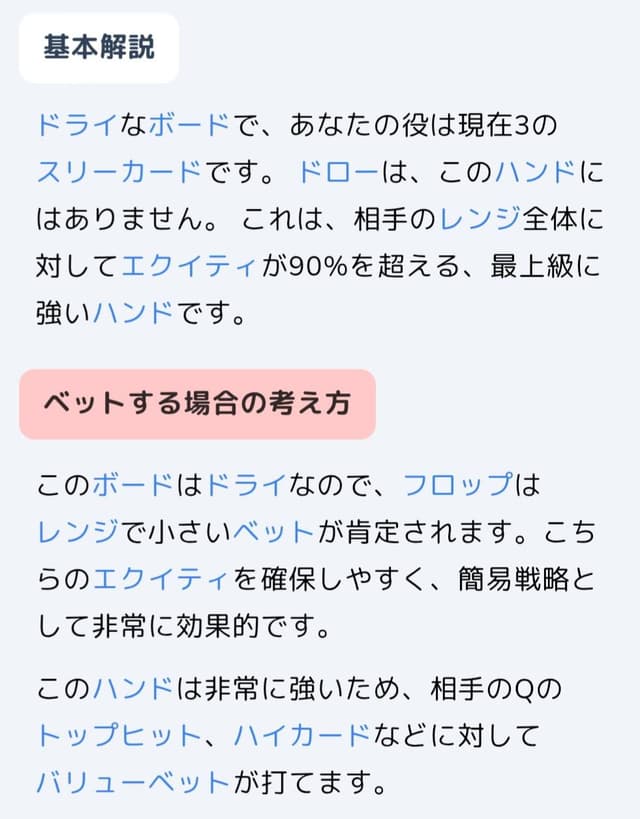
For example, hand-explanation features are a representative approach to this, and at POKER Q'z we have continuously strengthened this area as a core feature. We're developing mechanisms to improve learning outcomes, such as automatically generating explanations tailored to each play, and technology that analyzes thinking tendencies and play style from play history to deliver feedback optimized for each user. These technologies are our proprietary core technology, and patents are currently pending.
BUDDY AI
The other point that caught my attention is BUDDY AI (an AI that imitates your play). The concept of learning a user's play tendencies and playing on their behalf is, technically, a very interesting endeavor. That said, thinking about it from an experience standpoint, I was left with some questions.
Poker is inherently a game where the fun lies in struggling, thinking, and making choices yourself. For that reason, rather than watching "an AI play in your place," I felt that
the process of playing yourself and gradually improving is more valuable as a game experience.
If AI is going to be applied to user play data,
- automatically analyzing your own play tendencies
- pointing out your weaknesses
- explaining in natural language what the best action would be in a given spot
an AI that plays the role of a coach or commentator along these lines seems like a much better fit for learning and growth.
Observation 2: AI Performance
Precisely because EDGE POKER is a title that promotes poker x AI as its strength, expectations naturally run high for the AI's accuracy and consistency. While actually playing, I found plenty of useful features, but I also observed several behaviors that made me think, "from a learning-tool perspective, this could be a bit risky."
The three points that stood out to me in particular were the following.
Inconsistency between in-game advice and post-hand review results
There were cases where the action the AI suggested as "recommended" during play differed from the "best action" shown in the post-hand review. When conclusions change even though the situation is the same, it leads to problems like:
- users not knowing which one to trust
- the learning foundation becoming unstable
- distrust arising over whether the AI is truly right
Consistency is extremely important for a learning-support AI. If the evaluation logic differs between real-time play and review, I felt that its credibility as an educational tool drops significantly.
Recommendations of clearly unnatural actions
In some spots, actions that were clearly far from theory were recommended. For example, there were scenes where the app suggested something almost impossible in practice, such as "folding a made straight."
These kinds of mistakes are not mere optimization errors; they can lead players' understanding in the wrong direction, which is quite damaging for a learning tool. In poker AI, I felt that being "clearly not wrong" matters more than being "strong." Unless a minimum level of strategic soundness is guaranteed, users cannot confidently rely on the AI.
Unclear logic in range analysis and hand classification
The range analysis feature also had some aspects of its display logic that felt off. To begin with, the overall strategy for the range was not presented in a way that could be viewed at a glance, and the information shown was fragmentary. Additionally,
- the criteria for strong / medium / weak were unclear
- the classification was not based on the nature of the hands
These points stood out to me. For example, draw hands that are quite strong in practice, such as a gutshot plus a flush draw, were sometimes labeled as "one pair" because the paired board took priority, a classification clearly out of step with real-world feel.
Range visualization is not merely a feature for "sorting hands in a plausible-looking way"; it is important information design that directly connects to player decision-making. When it doesn't align with intuition and real-world feel, trust in the display itself is lost, and even a well-intentioned analysis feature ends up unused. Thinking in terms of ranges is a core part of the poker learning experience. That is precisely why I felt there is a strong need for clear classification logic and consistency grounded in real-world play.
Thoughts on EDGE AI
EDGE AI is designed to push the "AI solving poker" experience to the forefront, presenting optimal actions during play and even making decisions automatically.
Reference article
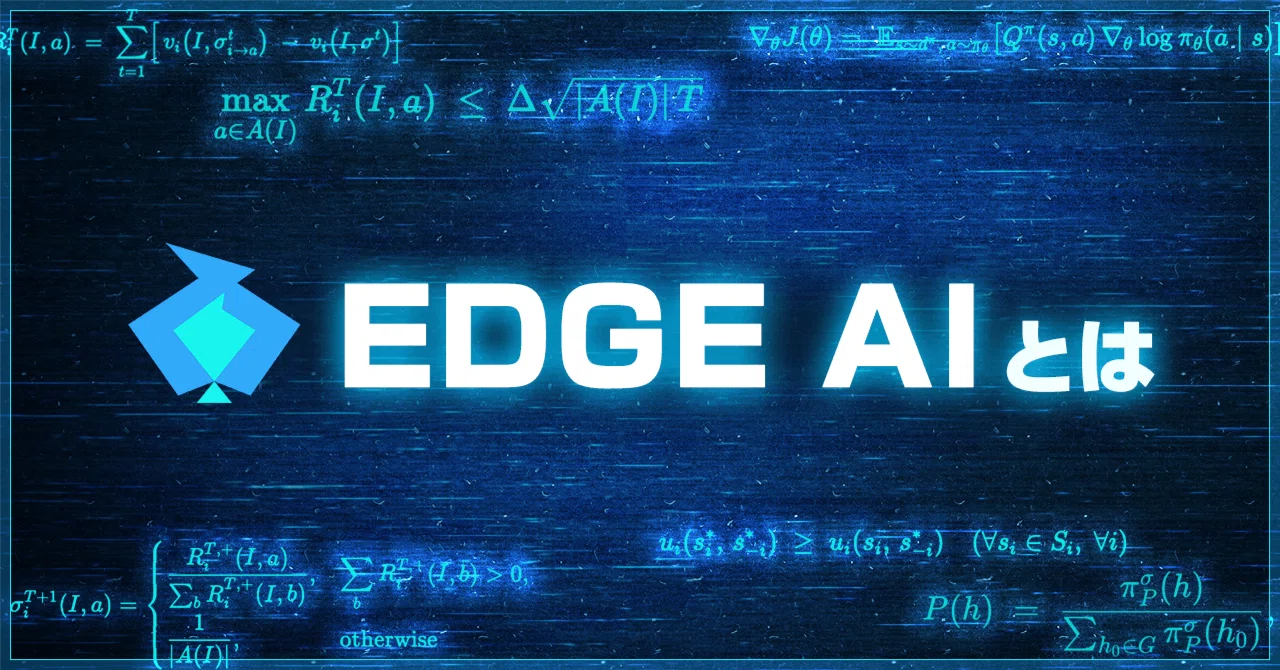
Cross-referencing the official article's explanation with the actual behavior,
- a model trained using GTO strategies derived from algorithms such as CFR as teacher data
- rule-based extraction of features from the situation at hand, which are then fed into the model
- the model predicts the EV of each action from those features and selects the action with the highest EV
it appears to be close in structure to a machine-learning-based approximate solver model along these lines.
As an approach, it's very orthodox, and I found it technically interesting. At the same time, actually playing it made me feel the difficulties unique to poker AI. Let me organize a few of the points that stood out.
The training situations are overwhelmingly insufficient
The first thing I noticed was the lack of training situations. Poker is a game where the optimal strategy changes dramatically with even the slightest change in conditions. Position, stack depth, bet sizing, board texture, ICM situations, and many other factors must be considered, making the state space nearly infinite in scope. Because of that, "fully training every situation" is itself an extremely difficult problem.
The moment the model enters a region its training did not cover, accuracy inevitably becomes unstable. This isn't a matter of whether the algorithm is good or bad; I felt it stems from a structural difficulty: poker is, by nature, a game where training data is overwhelmingly easy to fall short.
Feature design that doesn't line up with real play
Another point I considered important is the design of the input features.
Judging from the behavior, basic information such as the stack situation at the table, the current hand strength (high card, one pair, etc.), and the presence or absence of draws appears to be used. In real poker, however, that is not enough.
In practice,
- strength evaluation that includes the hand's future potential
- range narrowing based on the action history
- blocker effects
- proper defense frequencies
- ICM
and much other contextual information strongly influences decision-making.
In poker AI, I believe feature design is the very "resolution of strategic understanding." If it remains coarse, no amount of training will make it easy to reproduce judgments that feel like real-world play.
Poker AI can't be built with engineering skill alone
This is the point I personally felt most strongly during my hands-on experience this time. Developing poker AI is not merely a matter of machine learning or model accuracy; I felt there are many things to think through at the design stage.
- What should be included as features?
- Which information is essential to decision-making?
- How far should things be abstracted to be expressible as strategy?
These questions cannot be answered properly without a deep understanding of poker itself. In other words, what is required is not just algorithm implementation skill, but poker understanding at a real-play level. Only when these two come together do I believe a practical poker AI becomes possible.
And POKER Q'z has many members who bring both an engineer's and a player's perspective. That is why I feel we're able to deliver product development that is directly connected to the learning experience.
The POKER Q'z Philosophy
Allow me to share a little about the philosophy behind how we at POKER Q'z build our product. What we're aiming for is leveraging AI to deliver the best possible poker learning experience.
Rather than simply making "a poker app you can play," we genuinely want to create a product where you naturally get stronger just by playing. Poker is inherently a deep, strategic game full of intellectual appeal. At the same time, it's true that the barrier to improvement is high.
- You don't know what the right play is
- You don't know why you lost
- You don't know where to improve
This vague sense of "not knowing" is the biggest obstacle to learning.
That is why we design everything with the top priority of helping users improve as efficiently as possible. At the same time, we want to deliver a natural, positive learning experience that doesn't feel like "studying" — where you find yourself improving almost before you notice it, just by having fun while playing.
Our ideal at POKER Q'z is for poker to stop being "a hard game" and become "a game you get stronger at without realizing it as you play."
Strategic accuracy that underpins the learning experience
As a foundation for that, the most important thing is "strategic accuracy." As we continue developing our AI and algorithms, we are building a foundation that can present the theoretically correct strategy as far as possible for any given spot. No matter how clear the explanation is, it means nothing if the underlying strategy is wrong. First and foremost, we consider "being able to deliver trustworthy answers" the minimum requirement for a learning product.
AI as a coach, with explanations in natural language
Another thing we consider important is the experience design of "how we communicate." Simply presenting the correct strategy doesn't make players truly stronger. Only by understanding why an action is good and what thought process it's based on does it stick as learning.
That is why we emphasize using AI not as "something that plays in your place" but as a coach that supports the player's thinking. Rather than lining up numbers and jargon, we explain in words that even beginners can intuitively understand. We aim to convey not just "what happened" but also "why it happens." By leveraging generative AI and natural language technology, we're working toward an "explanation experience that builds your thinking itself."
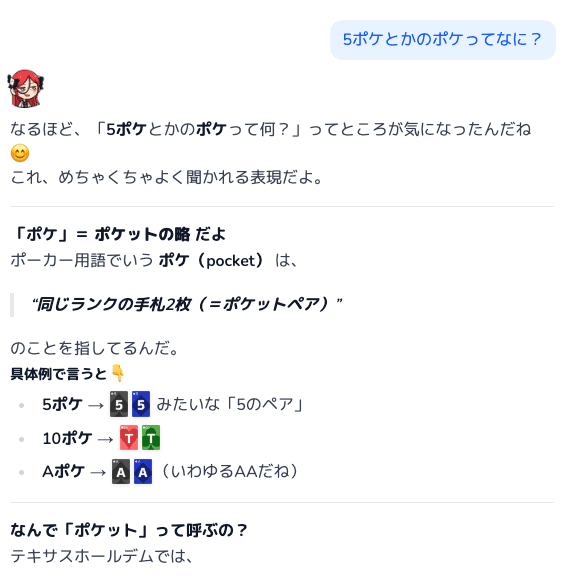
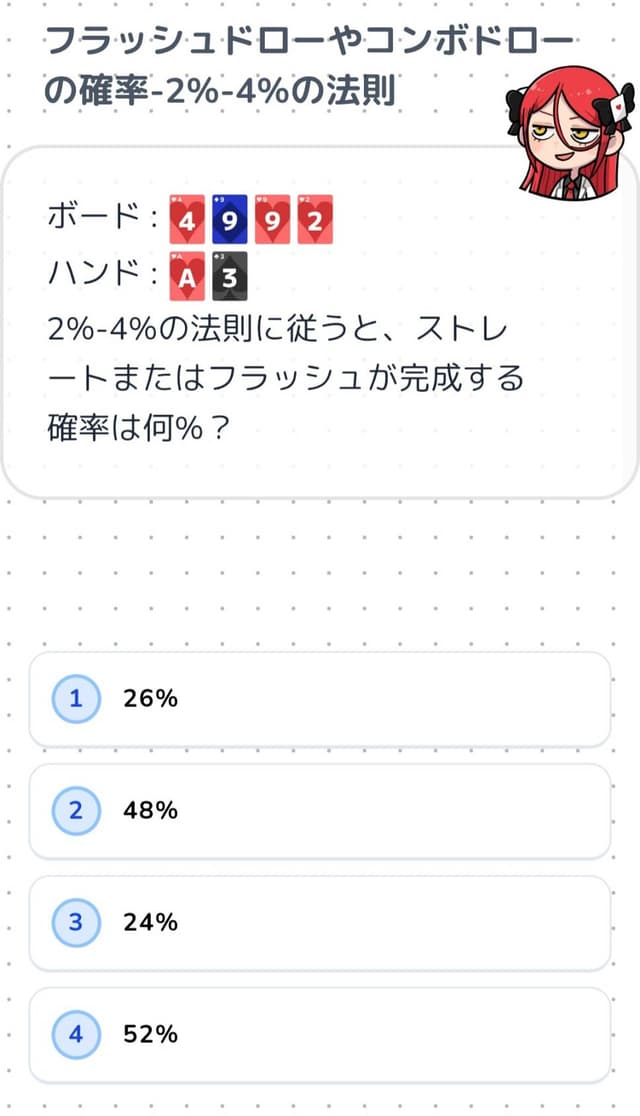
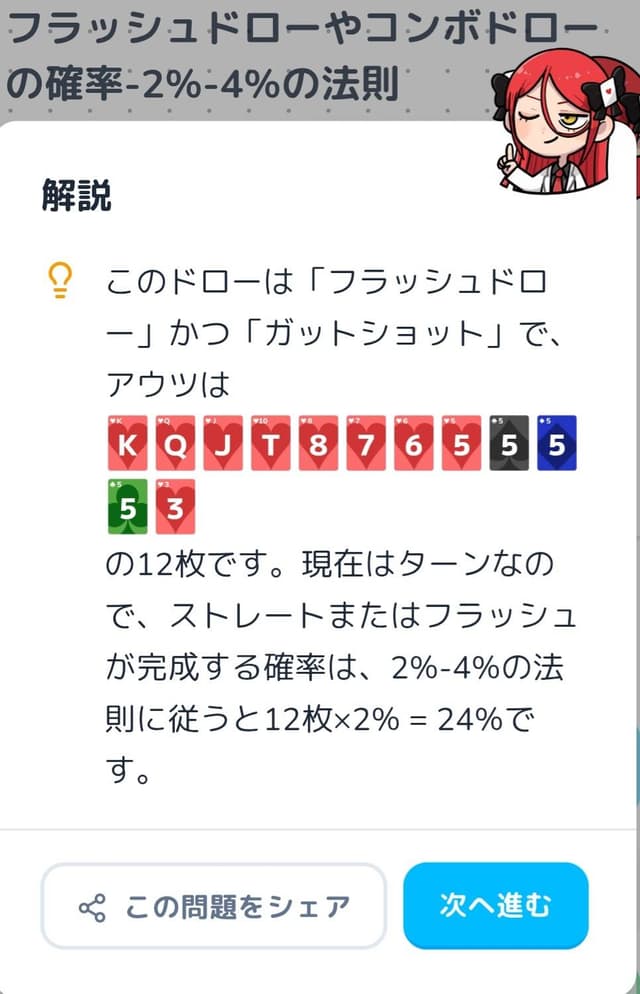
In fact, the app includes an AI assistant where users can freely ask questions about strategy and play, and it has received positive feedback from many users as a learning-support feature. We continue to improve it, working toward higher-accuracy answers and explanations that are easy for beginners to understand. In addition, we offer explained exercises tied to each lesson topic, structured so users don't just take in knowledge but deepen their understanding by putting it into practice in a quiz format.
Instead of AI "teaching the answers," we're aiming to realize "a learning experience that builds the thought process for getting stronger."
In Closing
We hope to see the poker industry thrive in Japan and around the world. We're still a young team, but we're looking for partners who are serious about growing the poker world.
- Companies and partners interested in collaborating with us
- Influencers willing to support us
and, of course, we're also actively recruiting people (internships included) to join POKER Q'z as
- Business development (domestic and international marketing, creative production, etc.)
- Engineers
- AI / algorithm research
members.
"Poker could be made more fun" "AI could create an even better experience"
If these themes excite you even a little, please don't hesitate to reach out!
Let's make the poker world in Japan even more exciting together!