
Introduction
If you play poker, you may have come across terms like "GTO" or "game theory." Poker, in which players battle to take each other's chips, is inseparable from game theory. Below, let's trace the birth and development of game theory and its connection to poker. Whether you are new to game theory or became interested in it through poker, we hope this article serves as a useful reference.
1. What Is Game Theory?
The name "game theory" may bring to mind "games for fun," such as card games or board games. In academia, however, the "games" that game theory deals with extend far more broadly. Any situation in which multiple players make decisions while taking one another's actions into account, each seeking some "payoff" (points, profits, or the like), is called a "game." Its applications therefore reach far beyond entertainment such as board games and card games — to competitive bidding, price competition among companies, maneuvering in international relations, and even the process of biological evolution.
Game theory mathematically models such "game-like" situations, expressing players' strategies and payoffs in formulas to seek optimal strategies and equilibrium states. Sophisticated mathematical methods are used, and the theory was originally built by brilliant mathematicians of the early 20th century. The giants who laid the foundations of many fields — John von Neumann and John Nash — are indispensable names in the context of game theory as well.
2. The Dawn of Game Theory — von Neumann's 1928 Paper
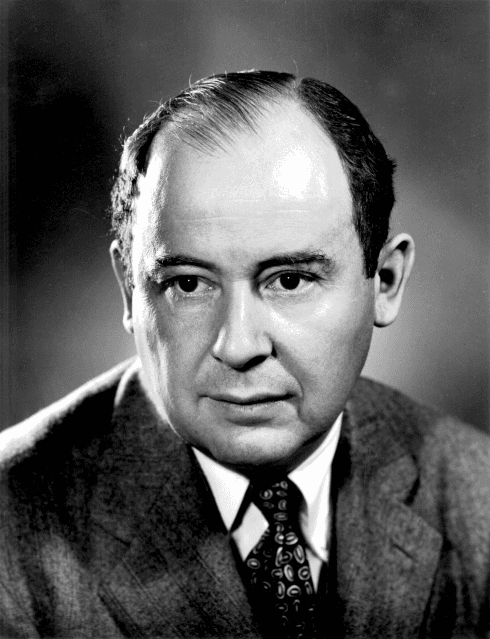
When tracing the history of game theory, the first name that comes up is John von Neumann. In 1928, von Neumann published a groundbreaking paper in German titled "On the Theory of Social Games," in which he modeled situations where multiple players exchange points using mathematical methods of analysis. Von Neumann was a "super-genius" whose name appears throughout the science and technology of the 20th century: the mathematical foundations of quantum mechanics, the conceptualization of modern computer architecture, and even involvement in the development of nuclear weapons. He left an extraordinary range of achievements — and the establishment of game theory was among them.
At the time, in 1928, von Neumann organized probabilistic games (things like roulette, rock-paper-scissors, or simple card games) mathematically and consolidated the terminology and concepts involved. Words that remain foundational in game theory today — such as "strategy" and "payoff" — were already being considered in this period. Yet precisely because of its advanced nature, von Neumann's ideas attracted little attention from the academic community of the day. It is said that few researchers even judged "studying games with mathematics" as something worth taking seriously. The fact that the paper was written in German also hindered its international spread, particularly in the English-speaking world.
3. Theory of Games and Economic Behavior — The 1944 Masterwork
More than a decade after von Neumann first conceived the idea, 1944 brought the turning point in which game theory finally leapt forward: the publication of Theory of Games and Economic Behavior, co-authored with the economist Oskar Morgenstern. This monumental work of more than 600 pages argued that "the problems of interaction in economics can be analyzed mathematically through game theory."
In economics, there had previously been efforts to formalize markets and competition in mathematical form, but they were insufficient to directly address the "strategic interaction" in which players influence one another. Von Neumann and Morgenstern's masterwork, by contrast, presented a systematic framework that started with the simple model of a "zero-sum game," in which two or more players compete for points or money, then extended the discussion to "non-zero-sum games." Terms and theorems still used today — such as "zero-sum game," the "minimax principle," and "expected payoff" — had already appeared by this point. This allowed game theory to spread rapidly through the world of economics and establish a firm position as an academic discipline.
4. The Arrival of Nash and the "Nash Equilibrium"

When it comes to game theory, many people will think of the term "Nash equilibrium." This is a concept established in a paper published by John Forbes Nash in 1950. Nash was a young mathematical genius who, while still a doctoral student, proved that "in any finite game, at least one equilibrium point always exists among the combinations of all players' strategies." This is the so-called "Nash equilibrium." In a Nash equilibrium, given that each player assumes the other players' strategies are fixed, a state holds in which no one can improve their expected payoff even if they consider changing their strategy. It can be described as a balanced point resulting from all players simultaneously playing best responses, where no one has an incentive to change their strategy.
What made Nash's achievement groundbreaking was proving the existence theorem: that an equilibrium "always exists." For example, even in a simple game like rock-paper-scissors, where any move gives an equal chance of winning, it is a separate question whether one can say mathematically that "every game has some equilibrium point." Nash cleared this difficult hurdle brilliantly, and to do so he used a sophisticated tool called the "fixed-point theorem." This theorem is said to owe a major contribution to the Japanese mathematician Shizuo Kakutani; the story goes that Nash realized "with a theorem like this, I can prove it," and that it was Kakutani who provided it.
5. Applications in Evolutionary Biology and the Deepening of Economics
Once game theory came into the spotlight in economics, its applications expanded into many other fields. Most noteworthy is its application to biology. From around the 1970s, efforts to analyze conflicts and cooperative behavior among organisms — or the strategies of males competing over females — using game theory became active. This field is called "evolutionary game theory," and it gave rise to new concepts such as the Evolutionarily Stable Strategy (ESS). An ESS indicates evolutionary stability: once individuals adopting a certain strategy become the majority in a population, a small number of mutant strategies cannot defeat the majority strategy. Organisms do not act through rational deliberation, but game theory proved highly compatible with mathematically modeling the process by which "strategies" are naturally refined under selective pressure.
Meanwhile, in economics, theories centered on the "Nash equilibrium" and "non-cooperative game theory" developed, including the design of complex market competition and auction mechanisms. The researchers who won the Nobel Prize in Economics for auction theory drew on game theory at the very core of their work. It is no exaggeration to say that the bidding systems behind today's e-commerce and ad delivery are powered by game-theoretic thinking.
6. Poker and Game Theory — The Keyword GTO
Hearing "game theory" may also bring to mind shogi or chess. Those are "perfect-information games," in which each side builds its strategy with complete knowledge of the board. Poker, by contrast, is classified as an "imperfect-information game": you can see your own hand but not your opponent's, creating an asymmetry of information. In imperfect-information games, you have to decide the timing and size of bets and raises while reading the opponent's hand and tendencies. Both sides bluff each other and wield probability theory to calculate expected value — the range of strategies is dramatically wider.
For such imperfect-information games, one strategic goal — being mathematically "not exploited (cracked) any further" — is called "GTO" (Game Theory Optimal). Strictly speaking, it is not a precise game-theory term; rather, poker players came to use the word GTO for a "Nash equilibrium strategy" in two-player zero-sum games, viewed from a player's perspective, in the sense that "the strategy you take is itself one that cannot be cracked by the opponent."
The Background of GTO — Two-Player Zero-Sum Games
In poker theory, "mastering GTO" is, when you get down to it, close to "embodying the Nash equilibrium as your own strategy." If we assume poker is a zero-sum game in which two players compete for chips, then a "set of strategies that form a Nash equilibrium" is guaranteed to exist, and if one player executes it, the opponent cannot increase their expected value. However, when poker is actually played with multiple players — six, nine, or more — the Nash equilibrium discussion becomes dramatically more complex, and there are many cases where two-player zero-sum theory cannot be applied directly. In practice, though, understanding GTO in heads-up (one-on-one) situations allows it to be applied approximately even in games with three or more players.
7. The Arrival of CFR — Attempts to Compute the Nash Equilibrium
After Nash demonstrated the "existence of Nash equilibria" in the 1950s, many mathematicians up to the present day have tackled the question of "how to actually compute a Nash equilibrium." Yet the more complex a game becomes — more players, vastly more choices — the harder it is to actually find an equilibrium point in practice, even when its existence is theoretically known.
What made a major impact here was the method "CFR" (Counterfactual Regret Minimization), proposed around 2007. In Japanese it is sometimes translated as "counterfactual regret minimization algorithm" (反事実的後悔最小化アルゴリズム). It is an iterative algorithm that looks back at each situation in the game and asks "what if I had taken a different action?" (this is the counterfactual), then improves the strategy in the direction that reduces that "regret". A major advantage of CFR is that in two-player zero-sum games it is theoretically guaranteed to approach an "epsilon-Nash equilibrium" (a Nash equilibrium with a small margin of error). It proved extremely useful for rapidly simulating poker — especially heads-up situations — and became the key to AI defeating poker players.
8. Advances in AI — Libratus and Pluribus

The Impact of Libratus
In 2017, "Libratus," a poker AI developed by researchers at Carnegie Mellon University, attracted major attention. In heads-up no-limit hold'em, it played against top-tier human poker professionals and won. AI had already surpassed humans in perfect-information games such as shogi, chess, and Go, but the birth of "an AI that defeats professional players" in poker — an imperfect-information game — was a landmark event for both game theory and AI research.
Libratus advanced CFR-based methods, pouring in vast computing resources while adopting a mechanism that progressively abstracts the strategy. Poker has a near-infinite number of bet sizes and situations, but Libratus grouped together spots judged to "have little (expected-value) impact in the finer details" to reduce the computational load, while computing important spots in detail. As a result, it became able to search enormous numbers of situations and derive strategies closer to the Nash equilibrium more accurately within limited time.
The Evolution of Pluribus
Then, in 2019, "Pluribus," developed by the same research group, took on professional players in six-player no-limit hold'em and won decisively. Six-player poker has a far more complex game structure than simple heads-up play. The theoretical guarantees of two-player zero-sum games do not apply, and no matter how much CFR is run, exact convergence is not guaranteed. Even so, it showed, experimentally, strength surpassing the top human professionals. Among poker players there was debate that "the chosen lineup wasn't the true top pros," but the fact that "even in multi-player poker, simply applying existing AI methods can surpass humans" had a tremendous impact. Indeed, many professionals came to think "we may no longer be able to beat AI."
9. Game Theory Is Still an "Unfinished Science"
As we have seen, game theory has already achieved many results and is applied to an extremely wide range of fields — poker and shogi, economics and auctions, evolutionary biology, and more. That doesn't mean, however, that game theory has revealed everything. Current game theory faces the following challenges.
- The nature of Nash equilibria in multi-player games
In a two-player zero-sum game, once a Nash equilibrium is found, adopting that strategy means no worry of being cracked by the opponent, and it secures at least a certain level of winnings (expected value). With three or more players, however, the properties of Nash equilibria become far more complex. Multiple Nash equilibria may exist, and comparing which is superior can be difficult. Much of this remains theoretically unresolved, and computing it in practice requires enormous effort. - Fully analyzing imperfect-information games in general is extremely difficult
Poker is a representative imperfect-information game in which hands cannot be seen, and with the arrival of CFR-based AI you might think it has been "cleared." In reality, however, analyses have been carried out by adding constraints step by step — "heads-up," "limit," "fixed stack size," and so on — and the more constraints you remove, the more dramatically the computation grows. Moreover, as the Pluribus example shows, when it comes to non-zero-sum elements and multi-player interactions, we are still merely producing "empirically strong AI" without sufficient theoretical guarantees. - Humans are not always rational
Game theory assumes that each player "acts rationally to maximize their payoff." In reality, however, humans do not always act rationally. Irrational elements such as psychological biases and loss aversion often enter into decision-making. Such elements may be said to lie outside the framework of game theory, but in recent years, with the development of behavioral economics, attempts to quantify "in what ways we are irrational" are also advancing.
10. Summary and Outlook
The history of game theory began with the paper von Neumann published in 1928 and expanded dramatically with Theory of Games and Economic Behavior in 1944. In 1950, John Nash proved the existence of the "Nash equilibrium," building a powerful foundation for treating multi-player strategic decision-making mathematically. Since then, applications advanced not only in economics but also in evolutionary biology and political science, and in the 21st century, combined with AI technology, computers were born that defeat top human professionals even in imperfect-information games such as poker. Behind them lie algorithms such as "CFR" and implementation techniques that skillfully marshal massive computing resources.
That said, game theory is not a "universal theory that can solve all strategic problems." The more players are involved, the more cooperative elements between players are mixed in, and the more human irrationality comes into play, the more complex the theory becomes, and computational difficulty increases dramatically as well. This is why many researchers continue to take on the challenge of "how to solve bigger games faster and more accurately."
Meanwhile, in the poker community, the movement to "understand and practice GTO strategy" has spread, and many top players use solvers and CFR-based research tools in some form. Particularly in online poker, heads-up-like situations and high-stakes short-handed (few-player) games are common, making it increasingly essential to study AI-driven approaches. On top of that, in actual play, players flexibly switch between approaches — mixing in "exploit" (strategies that attack the opponent's weaknesses) according to the opponent's level, or conversely playing more defensively, "closer to GTO so as not to be exploited yourself." Perfect GTO play requires enormous trials and computation by computers, making it difficult for human players to reproduce 100 percent — but GTO has certainly taken root as a learning guideline.
This situation is a fine example of game theory being applied to real society beyond academic fields. Game theory is used not only in the world of gambling such as casinos, but also in our everyday surroundings. Price competition and bidding systems between companies are obvious examples, and everyday maneuvering or information-sharing on social media are also "game-like situations" in which multiple players seek payoffs. In fact, we may be unconsciously engaging in game-theoretic maneuvering in our daily lives.
In Closing: How to Make Use of Game Theory
Looking back over the history of game theory, it began with the ideas of a handful of genius mathematicians, transformed economics, evolved theories in biology, and even changed the worlds of poker and AI research. Starting from classical theory, we have now entered an era in which supercomputers refine strategies through vast simulations. Humans, however, are not playing only "games that can be described by theory." It is precisely where theory is insufficient that there is great room for research and innovation. With further advances in AI, entirely unforeseen new frontiers may open up. For example, AI may intervene in "human psychological biases" and "situations under imperfect information where multiple conflicting interests are interwoven," and new strategies could emerge in multi-player simultaneous games.
Even looking at poker alone, much research remains — such as "how far computation is possible with six or more players" and "whether an approach other than the Nash equilibrium could create even stronger strategies." If supercomputer performance rises further, or a new mathematical breakthrough occurs, it may become possible to rapidly derive exact equilibrium strategies even in multi-player imperfect-information games.
Some people may get the impression that game theory is something of a gimmick at first glance. At its core, however, it is "an attitude of trying to mathematically understand a world in which multiple players influence one another." In business, politics, social issues, ecosystems — in every imaginable field — we are, in a sense, playing countless "games." Apply game-theoretic thinking to them, and unexpected facts will surface, letting you notice the subtleties of human behavior and strategy.
If learning about game theory has made you interested in poker, we hope you will give poker a try. Beyond the element of luck, it is rich with interpersonal maneuvering and strategic thinking backed by probability calculations. Even just learning the basics of hand strength and bet sizing is plenty of fun, and as you gradually come to understand bluff timing and the essence of GTO strategy, an even deeper world opens up.
If, on the other hand, you want to seriously delve into game theory from an academic angle, try reading the original works by Nash and von Neumann, or take on the theory texts covered in university economics and mathematics courses. Abstract formulas may line the pages, but once you peel back the veil, you should be moved by how the full range of maneuvering in real human society is modeled using the tool of mathematics.
Game theory remains an "unfinished science" that continues to evolve. Yet tracing its history makes you see anew how full our world is of "strategy" and "interaction." You, reading this article right now, may find yourself feeling "this might be a game-theory-like situation" more and more in your daily life from tomorrow on. In such moments, simply recalling "what did Nash equilibrium mean again?" can broaden your perspective a little and make the world more interesting — that, one might say, is the real pleasure of game theory.