
Hello! We're the PR team at CLOViZ Inc.!
Many of you are probably curious about what CLOViZ actually is and who the people behind it are.
In this blog, we introduce the members of CLOViZ in interview format, covering the vision and values we're pursuing, each member's role and skill set, and the strength of the team as a whole along with the appeal of each individual.
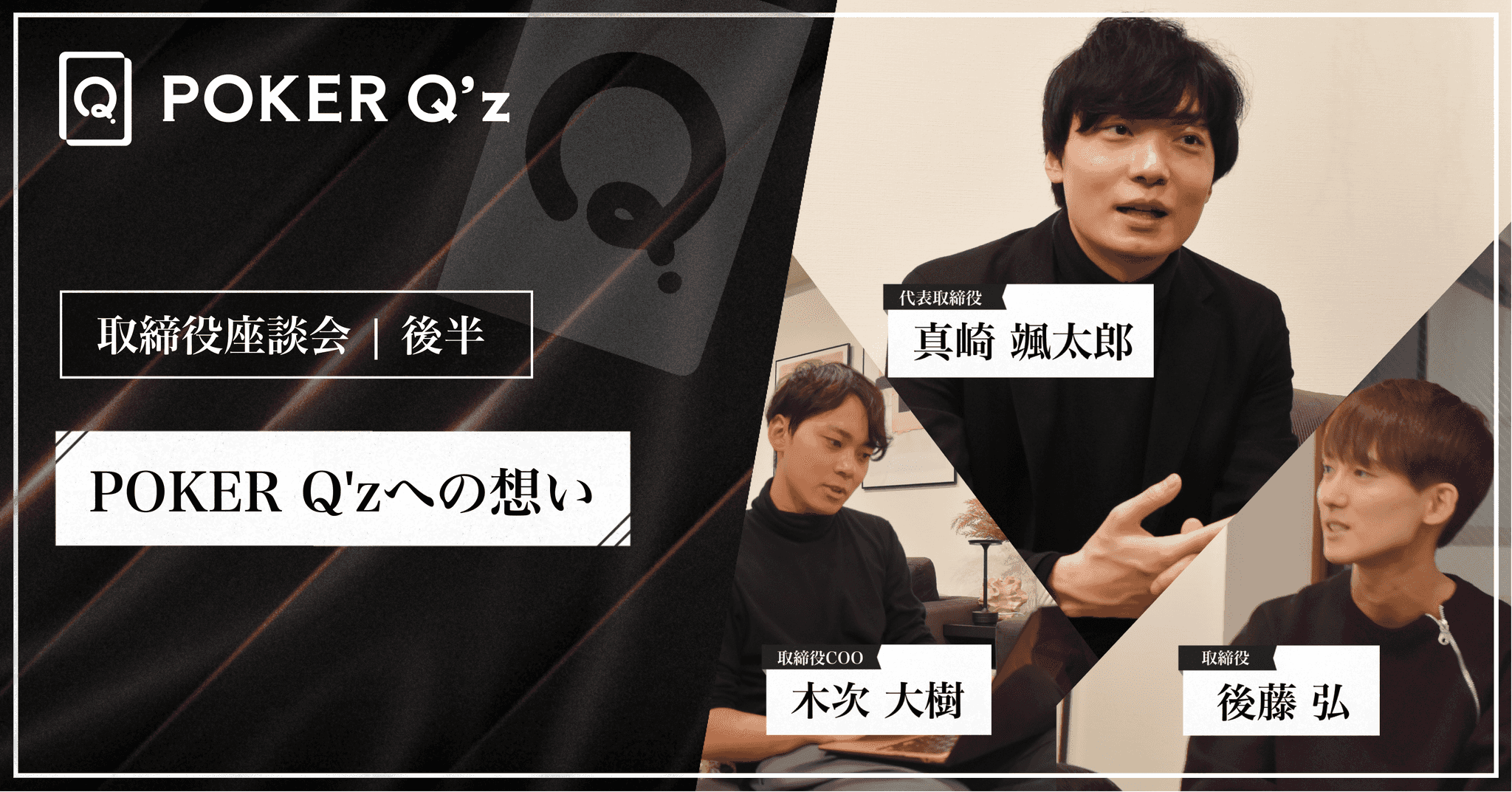
In this article, we take a closer look at POKER Q'z, a poker learning app born at the University of Tokyo, centering on our CEO, Masaki!
Click here for Part 1 of the directors' roundtable
1. Level-Based Learning and Visualizing Your Weaknesses
—Could you tell us what POKER Q'z aims to achieve and what makes it unique?
Masaki:
People who can study independently are certainly part of our target audience, but we want to reach those who can't even more. I was on that side myself, so I think I understand that feeling well. There are probably many people who have played poker for years but never studied it, who don't know how to go about learning, who have no idea where they stand, or who find advanced analysis tools intimidating.
For those people, we want to provide opportunities to think from a close-to-real-play perspective—“What would you do here?”—and then see whether what they tried actually works and where they stand among everyone else. That's the kind of learning environment we want to offer.
We also want to reach poker players not just in Japan, but around the world.
Kitsugi:
I feel that many existing poker learning services are closer to “research” than “study.” That's because users have to interpret the information themselves. With that format, it's extremely difficult for a complete beginner to understand things from the ground up, and the barrier to entry is high.
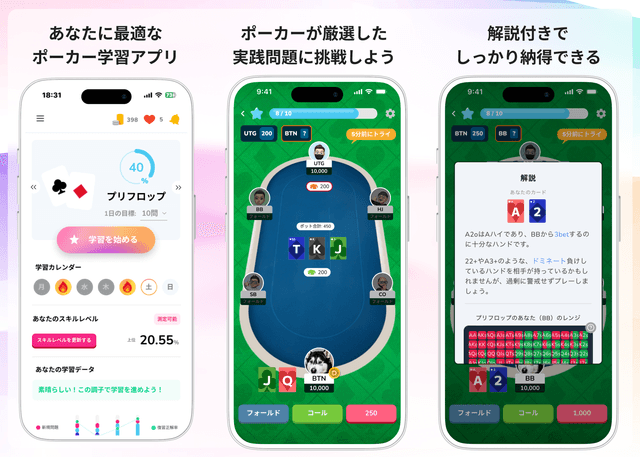
POKER Q'z, on the other hand, explains things carefully based on concrete situations, down to points like how to think in order to play well and why a given choice is wrong. As a result, one of its biggest strengths is that you naturally learn how to make the right decision the next time you face a similar situation.
Goto:
Exactly. For someone who doesn't play poker, it's like being told, “You really shouldn't miss a question that 70% of test-takers get right on a practice exam,” but no one tells you which materials you should use to get there. That's what traditional services were like. With POKER Q'z, you can learn in one consistent flow, all the way to “master this material and you'll be able to solve this problem.”
Also, when learning poker, there are plenty of chances to ask others for advice, but you're often taught incorrect information, and I think there are many pitfalls in choosing materials. At CLOViZ, content is created by people with proven tournament results and a solid grounding in theory, so reliability is assured. On YouTube and similar platforms, learning can become one-way or make you feel the gap in skill level, but our service lets you learn in a way that fits your own situation.
Masaki:
Visualizing weaknesses is another important point. In fitness, for example, your chart shows your body fat percentage and where fat is stored, and when those issues are recorded and presented through regular checkpoints, it helps keep your motivation up.
Kitsugi:
Exactly. A complex system runs behind the scenes in POKER Q'z, but from the user's perspective, weaknesses are visualized naturally. For example, if you frequently make mistakes in a particular hand range, the app presents that area as priority learning content. I think that's what makes the app easy to keep using without stress or a loss of motivation.
2. The Future of POKER Q'z: Human-like CPU (AI), Global Expansion, and Community Building
—Seeing your weaknesses and watching them improve definitely boosts motivation! Finally, could you share your vision for the future?
Masaki:
The current app is based on theoretical results, but in real poker, every player has their own personality and tendencies. In the future, we want to realize a learning system that accommodates these various play styles. For example, we're considering mechanisms that help you deal with aggressive opponents and that support tournament play as well as cash games.
One idea we find especially interesting is developing CPUs (AIs) that reproduce a specific player's style. If that becomes a reality, it will help you objectively understand how your own play style looks to other players. And if you could practice against CPUs modeled after famous international players, the fun of learning would expand even further.
The importance of GTO (game theory optimal strategy) as the theoretically optimal solution never changes, but by combining it with battles against AI that has human-like traits, we want to broaden the scope of learning.
Fortunately, our team includes members who are highly skilled in both poker and engineering, so I'm confident we can offer unique value that has never existed before. We've also received investment from a poker social app game company that ranks among the top five in the world by downloads, mainly in the U.S. and Europe, and we plan to expand globally in the future. Given that player populations are growing outside the traditional poker powerhouses, especially in South America and Asia, we feel the timing is very good.
Ultimately, we want to build communities both online and offline, creating an environment where players can learn from one another.
—Masaki, Kitsugi, and Goto, thank you very much for joining us today!
Thank you as well. If anyone is interested in what we're working on, or feels they'd like to be part of developing the service with us, please don't hesitate to reach out through the link below!