Hello! I'm Shuhei from CLOViZ Inc.!
In November 2025, the poker learning app POKER Q'z released its long-awaited new feature: the Tournament Mode.
In addition to the existing Cash Game Mode, you can now learn tournament-specific skills such as ICM and how to navigate a short stack.
In this article, we sat down directly with the POKER Q'z developers, Toshiki Ohata and Hayato Abe.
What are the secrets of tournament play? How do you get stronger at poker?
We also had them speak "as poker players."
We also asked what they had in mind when building the app, and how to use it to get stronger.
They shared their unique perspective as developers.
There are also behind-the-scenes stories only the developers could tell, so please read all the way to the end.
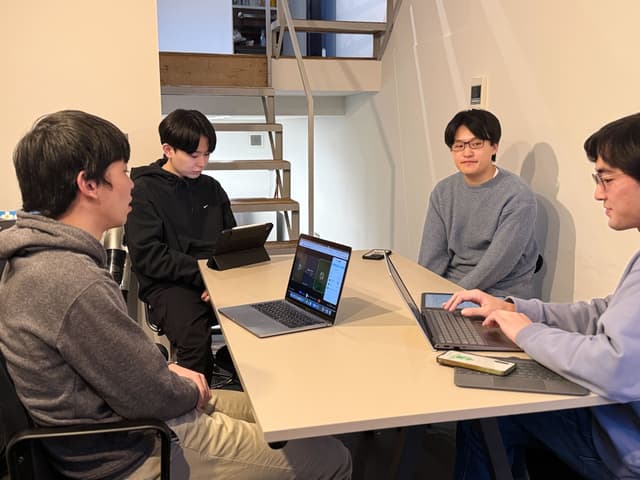
The POKER Q'z Developers' "Poker Player" Side
First, could you both introduce yourselves?
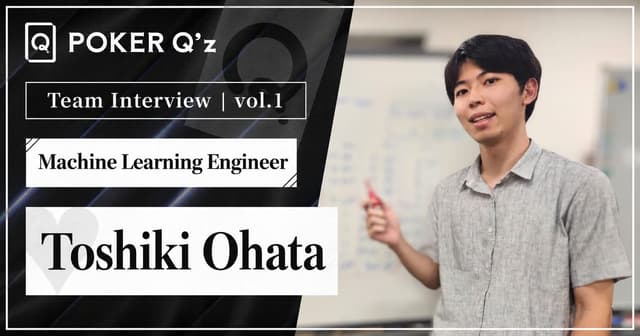
Ohata:
I'm Toshiki Ohata, a master's student in the Graduate School of Information Science and Technology at the University of Tokyo. I belong to a lab that researches game AI and natural language processing, and I'm currently taking a break from school to focus on the business.
Abe:
I'm Hayato Abe, a third-year student in the Faculty of Agriculture at the University of Tokyo. I've studied poker thoroughly from both theory and live play, and I've been immersed in poker every day, in tournaments and cash games alike.
What roles do you two play in POKER Q'z?
Abe:
I research poker and use that to decide what goes into the app's content.
I think about which hands to feature and what lessons to teach so that users can get stronger.
Ohata:
I'm involved in part of the content too, but I mainly handle development.
I implement the quizzes and lessons, and write programs that calculate GTO strategies.
Roughly speaking, what does the lesson lineup in POKER Q'z look like right now?
Abe:
Poker is broadly divided into cash games and tournaments, and in the Lv.0~2 lessons you can study the fundamentals common to both.
From Lv.3 and above, the two paths split: the original Cash Game Mode covers the essence of poker such as GTO, while the Tournament Mode focuses on tournament-specific concepts like ICM.
Thank you. This interview is about the new Tournament Mode, but before we get into the main topic — as poker players, do you have any tournament stories that left a strong impression?
Abe:
This is from my first tournament. The top few finishers received points usable in the venue, so there was a real "cashing" line, and in a tournament of about 70 players I got to the point where one more elimination would put me in the money.
Then, with only 2bb left, of all things I picked up pocket eights UTG. I had no choice but to go all-in for my 2bb, and a player behind me caught me with pocket nines.
Ohata:
That's brutal (laughs).
Abe:
So I bubbled my very first live tournament (laughs).
And on the turn we both had straight draws, and our outs flipped.
Ohata:
So the board had 6, 7, T on it.
Abe:
Exactly. That's why from midway I was the one with pocket eights shouting "9! 9! 9!" (laughs).
Ohata:
Did an 8 come on the river?
Abe:
No, the river was nothing (laughs).
Ohata:
An 8 would have made it legendary (laughs).
That's a hilarious story. And it's fitting since the lessons cover the bubble quite a lot (laughs). Ohata, do you have a story too?
Ohata:
I have a legendary story of my own as well (laughs).
I had pocket fives in the BB and called the button's open from the BB. Then the flop came 3, 3, 5, completing my full house.
The opponent was an ultra-aggressive player, and we ended up all-in on the flop. When we turned over the cards, their hand was 64s. A full house vs. an open-ended straight draw — that's a lock, right?
But then the turn was a 3, and the river was a 3 too!
Everyone:
(roaring laughter)
Ohata:
I lost to the board — his 6-high (laughs).
That's insane (laughs).
Ohata:
It was the most unbelievable bad beat of my life (laughs).
Tournaments Are 90% Preflop
Now that we've heard your hilarious tournament stories, let's talk about the app. First, what are the key points of the newly released Tournament Mode?
Abe:
The most important thing is the difference from regular cash games, and in that sense there are two big points.
First, in tournaments "there's no rake, but there are antes." That's why preflop ranges change dramatically. And since you have to fight with "different ranges depending on the situation," preflop becomes far more complex than in cash games.
The second point is that a tournament is not simply a game of growing your chip count — you're playing for your final ranking. So even when a call looks profitable in chips alone, there are cases where it becomes unprofitable once you consider "whether you get paid or not." Near the bubble, for example, players with lots of chips attack aggressively while short-stacked players grit their teeth to avoid busting — a dynamic you never see in cash games.
Right — concepts like "rake and antes" and "cashing" don't exist in cash games, and that's what creates the strategic difference.
Abe:
Exactly. And a tournament is a game where preflop carries an extremely heavy weight.
I truly believe tournaments are 90% preflop.
For example, even if you win a big all-in early at blinds of 100-200, those chips are only worth about 1bb once the blinds go up, and tournaments are full of cases where you give away the chips you worked hard to build early through one small preflop mistake late.
That's something that happens precisely because tournament blinds keep rising.
Abe:
Yes. That's why preflop accuracy is so important.
Besides, once you're down to 10bb or so in the late stages, you often don't even get to postflop. And if you're even slightly wrong on a 10bb all-in call, you lose everything and it's over, so preflop mistakes really carry a heavy price.
That's true.
Abe:
The newly released Tournament Mode lessons take all of these points and present them in simplified form.
Next, among the Tournament Mode lessons, is there one you'd personally recommend most as a creator?
Abe:
For me, it's the ICM explanation — I think the example showing that the chips you hold and the prize money you receive are different things came out really well.
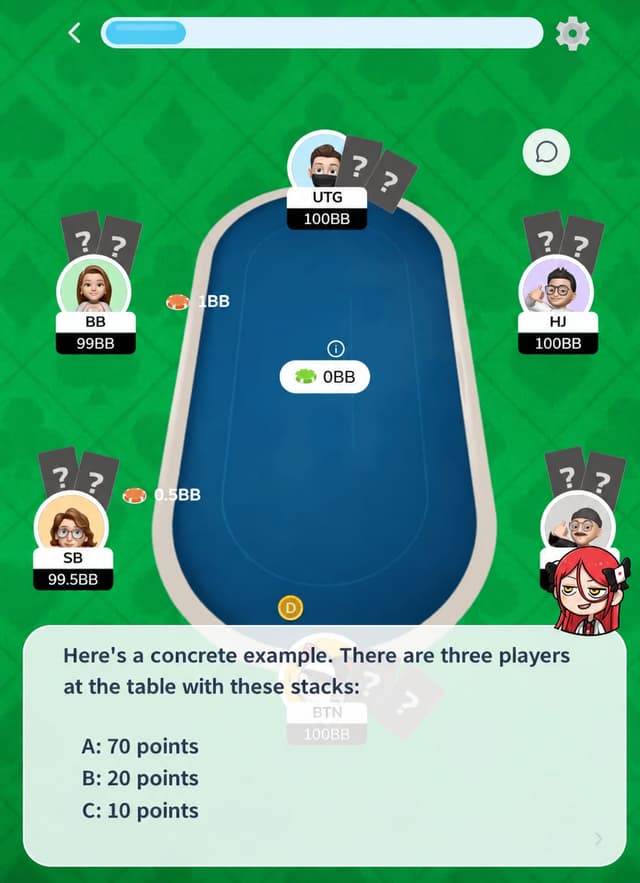
I used a tournament with a 100 USD total prize pool and a 60 USD first prize, where the total chips are 100 and the leader has 70. In this case, the leader's 70 chips don't equal 70 USD. You only get the 60 USD by taking all 100 chips, so those 70 chips are worth less than 60 USD.
That really is an easy-to-understand ICM example.
Abe:
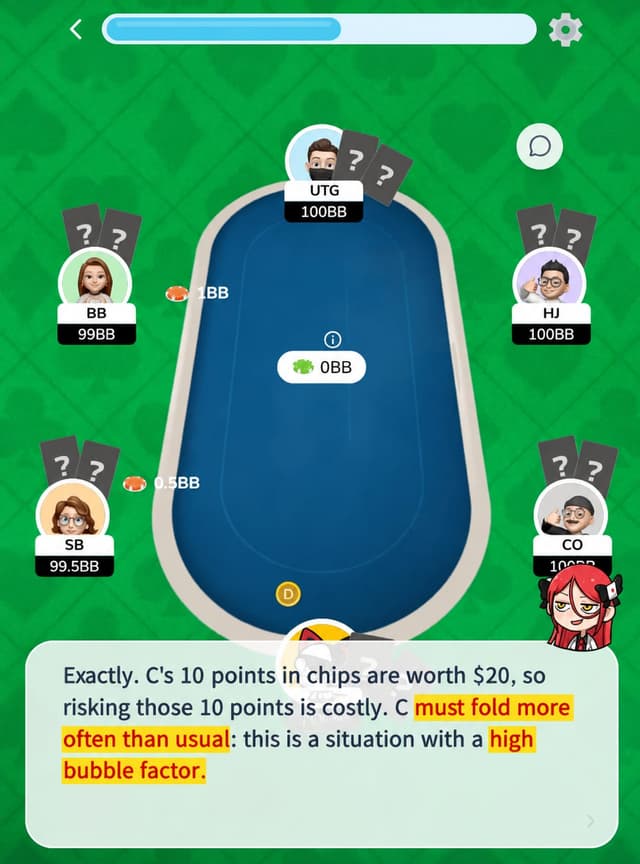
Figuring out how much a single chip is worth is quite hard. The key point in this example is that even with 70 of 100 chips, since first prize is 60 USD of the 100 USD pool, they can't be worth 70 USD — so in a sense having more chips can actually work against you. Conversely, if last place pays 10 USD, then even if you have only 10 chips now, you still get the 10 USD even if your stack goes to zero, so those 10 chips are worth more than 10 USD.
Ohata:
It's easy to understand if you picture chips piling up: the chips at the bottom, the foundation, are high in value, and the chips stacked on top are low in value.
I see.
Ohata:
It gets a bit more advanced, but this also explains bubble factor. The short stacks are effectively holding only the high-value chips from the bottom of the pile, while the deep stacks get to gamble with the low-value chips from the top. That's why short stacks are forced into such a difficult fight.
Abe:
People often say "short stacks are at a disadvantage," and sure, they are — but it's because the value of surviving with so few chips is so important that you have to fold a lot.
Right — even with 2bb, hanging in there and cashing matters.
Abe:
Absolutely. So this lesson is about learning the fundamental strategy for that, so you can make decisions that are profitable in terms of expected prize value.
I made this lesson hoping it would improve everyone's tournament results.
GTO Wizard Is a Dictionary, POKER Q'z Is a Textbook
You've built such great lessons, Abe — how did you study to get there yourself?
Abe:
I studied thoroughly by running GTO Wizard over and over.
For bubble factor and the like, I'd look at the charts and learn things like "oh, so it applies to two players here."
One thing in particular surprised me and I'd like to share it: intuitively, busting with 10bb seems like a bigger sin than busting with 3bb, doesn't it?
It does seem that way.
Abe:
But it's actually the opposite: the 3bb player has a heavier bubble factor than the 10bb player. In other words, the 10bb player can call an all-in more easily.
Ohata:
That's because when the 10bb player calls and wins, they get to just over 20bb and their expected prize value jumps. In contrast, even if the 3bb player calls and wins, they only reach a little over 6bb, so the benefit is small.
Abe:
So in the past, I'd fold even strong hands when I still had 10bb, and reluctantly shove when I had only 3bb — but it was the opposite.
In other words, with 10bb or 3bb, losing an all-in busts you either way, but when you call and double up, the 10bb player's expected prize value shoots up.
Ohata:
Exactly. I suspect a lot of people get this wrong, so I really hope readers will learn it.
Abe:
This is how I've studied: staring at GTO Wizard, finding the common patterns across situations and putting them into words.
Ohata:
Man, you really are a genius.
Abe takes GTO Wizard's endlessly sprawling, hard-to-interpret solutions and turns them into lessons by extracting the characteristic elements and distilling the essence.
Abe:
What I want to tell everyone is this: "GTO Wizard is a dictionary, and POKER Q'z is a textbook." GTO Wizard is a thick dictionary, like the Kōjien, and just looking at it doesn't get you very far.
So if you think, "I want to study bubble factor," and open a thick dictionary, you'll get nowhere. But with a textbook that distills the essence from it, you can study naturally.
Ohata:
"GTO Wizard is a dictionary, POKER Q'z is a textbook" — that's a great tagline (laughs).
It really is (laughs).
Abe:
I think using GTO Wizard to go out and find new insights is very important, but if someone who can't even handle a textbook jumps straight to the dictionary, they often end up understanding nothing at all, so I wouldn't really recommend it.
Also, it often ends in mere analysis of a specific hand, which is truly meaningless.
Ohata:
Getting all excited like "the call frequency was there! Yay, I got it right!" is the single most meaningless way to use a GTO tool in the world (laughs).
That really is meaningless (laughs).
Abe:
Also, even if the BTN is shoving their whole range so you can call with KTo, in reality the actual opponent often isn't shoving anywhere near that much and has a range packed with Ax-type hands. Calling with KTo in that spot becomes massively negative EV.
Ohata:
So when you use GTO Wizard, you must always compare the GTO opponent strategy with the actual opponent's strategy.
Abe:
But very few players can do that. That's why I want people to study with POKER Q'z first, and then look at solutions like GTO Wizard.
By learning POKER Q'z's lessons, you'll be able to use these solutions with confidence.
Alternating Input and Output
Abe:
Another major point of POKER Q'z is that you get the "feeling of actually playing poker yourself."
I turn the kinds of problems players are likely to get wrong into practical quizzes, so you can really think of them as your own.
It's also dialogue-based: you move forward while being questioned, and you can confirm your growth by solving practical quizzes, so I think it's content you can learn actively.
Ohata:
In other words, POKER Q'z is designed so that input and output alternate.
With ordinary studying, input tends to dominate and there's rarely a place for output, but the whole cycle is self-contained in POKER Q'z.
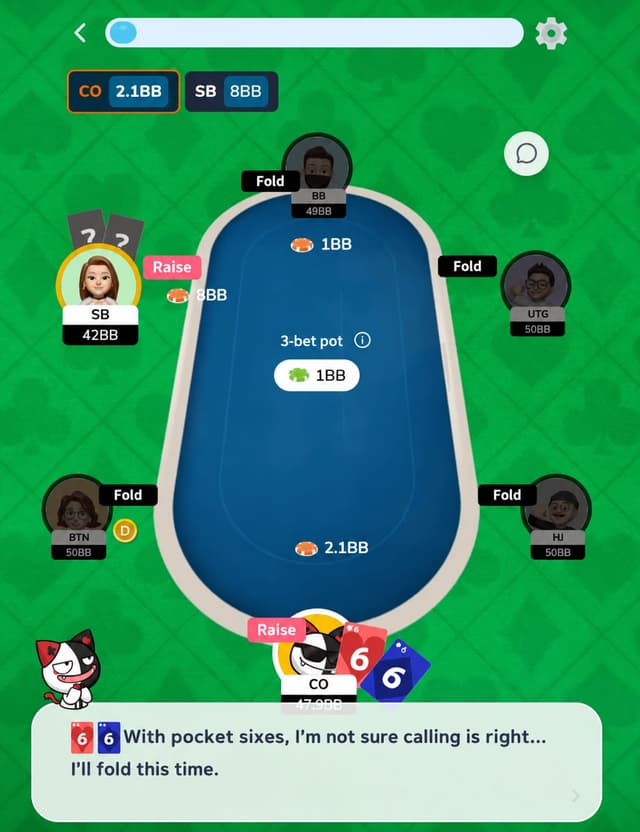
Right — in POKER Q'z, for example, Q-chan makes a bad play first, Aria points it out and explains it, then you solve practice problems, then practical quizzes, and so on.
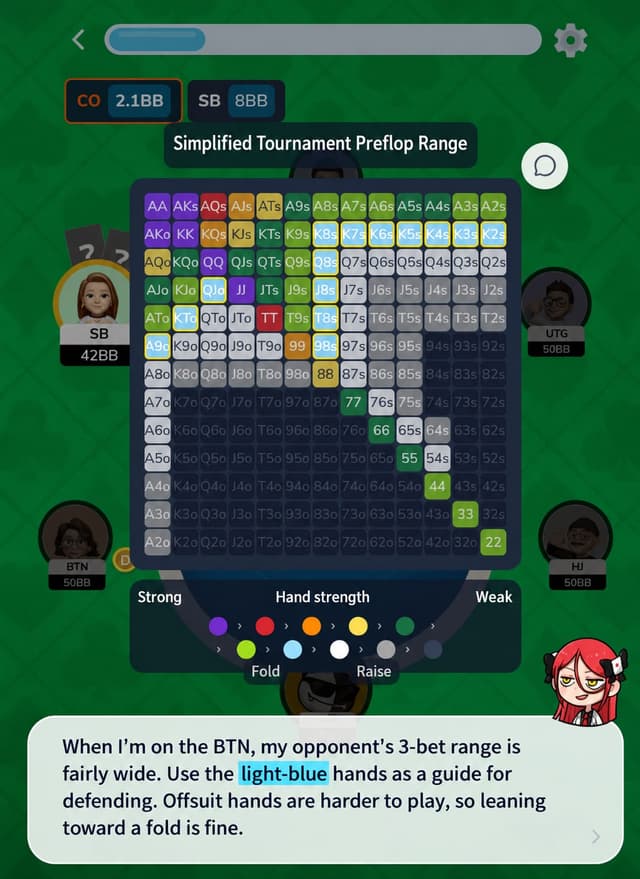
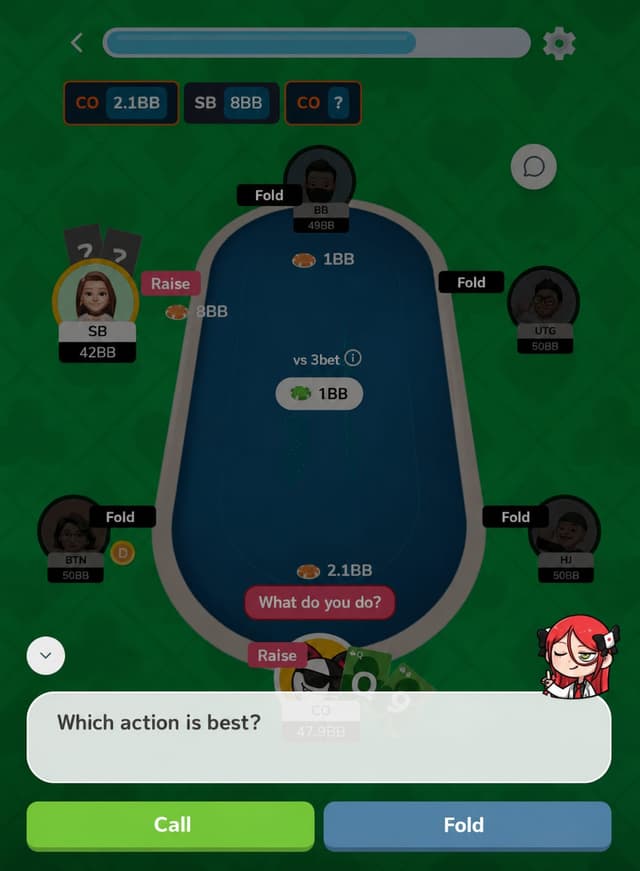
Abe:
And since everything is broken up into short chapters, being able to study bit by bit in spare moments is another feature.
Ohata:
Exactly — alternating input and output, and being able to do it in spare moments, are real strengths of POKER Q'z.
Right. Next — everything so far has been fascinating, so if you have one more anecdote, I'd love to hear it...
Abe:
Then let me tell you about a tricky situation (laughs).
At a six-handed table, I'm in the BB as the shortest stack, UTG is the next shortest, and there are a lot of deep stacks in between. In this situation, the BB basically cannot call a 2bb UTG open at all.
In other words, UTG is tightening their opening range because deep stacks lurk behind, and I have to tighten my range even more because I'm shorter than UTG, so I can only call with an extremely narrow range.
Ohata:
So there are two factors making it doubly narrow.
Abe:
Right. So even for a plain 2bb open, I was folding hands like T7s and KTo — absurdly narrow, almost all-in or fold.
When I discovered this, I was shouting "You've got to be kidding me!" in the office (laughs).
Ohata:
But what's impressive is that Abe went from "You've got to be kidding me!" to discovering that there were two factors making it doubly narrow.
Abe:
This is the kind of struggle that goes into building lessons...
Ohata:
To repeat myself, I think extracting the essence from complex solutions and packaging it into lessons is where the real value is.
And this part is unique to games of incomplete information: it's very hard to pin down guidelines you could almost call "joseki" — standard lines of play. Even so, I think POKER Q'z manages to present something close to that: a "guide."
Abe:
I think we teach the fundamental strategy quite thoroughly. Going further, once you can observe your opponents and adopt strategy suited to each opponent on top of that foundation, you'll improve even more. POKER Q'z, I think, can be the compass for that.
Finally: The One Thing to Focus On in Tournaments
Finally, please share just one point readers should keep in mind in tournaments.
Abe:
It has to be "tournaments are 90% preflop" (laughs).
A small mistake on an all-in call in the late stages turns all your efforts to nothing, and a small preflop mistake is literally on a different order of magnitude compared to an early one, so preflop really matters. And late-stage tournaments are extremely difficult because bubble factor is at work too. Simply cutting even one of these preflop mistakes will send your tournament results skyrocketing.
Honestly, as long as preflop is right, things don't go that badly. I truly believe preflop skill and poker ability are strongly correlated.
You could even play postflop however you want — just check everything (laughs).
Ohata:
Don't do that (laughs).
Abe:
That's how badly I want to preach the importance of preflop (laughs).
Ohata:
The newly released Tournament Mode is centered on preflop, while postflop is covered in detail in the Cash Game Mode.
Abe:
Right. The Cash Game Mode also has a lot of knowledge that helps in tournaments — c-bet strategy for each flop texture and so on, all of it usable in tournaments as-is, so I hope you'll study that too.
But first and foremost, preflop is what matters.
So the plan is to study tournament-specific preflop in the Tournament Mode, and learn postflop strategy that applies to both formats in the Cash Game Mode.
Ohata:
I think that's the way to go. We'd be happy if you took this opportunity to register for both.