
1. Introduction
In poker, choosing the right size for your value bets is crucial to maximizing expected value (). In this article, we take a deep dive into the optimal bet size for value hands using the simple AKQ game.
2. What Is the AKQ Game?
The AKQ game is a simple model game designed for learning the fundamentals of poker strategy. There are many variations, but here we'll explain it based on the following rules.
- Players
The game is played between two players: Hero (you) and Villain (the opponent). - Cards
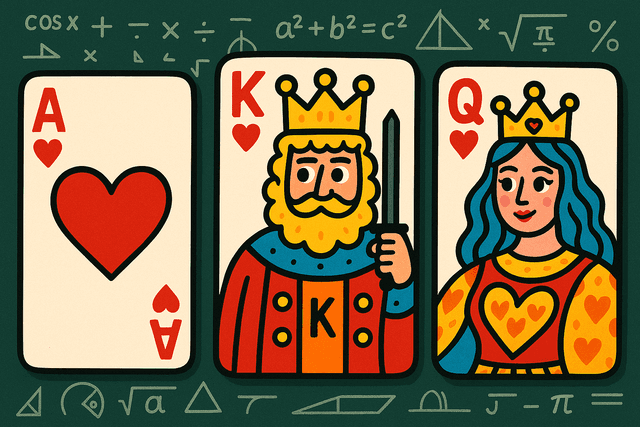
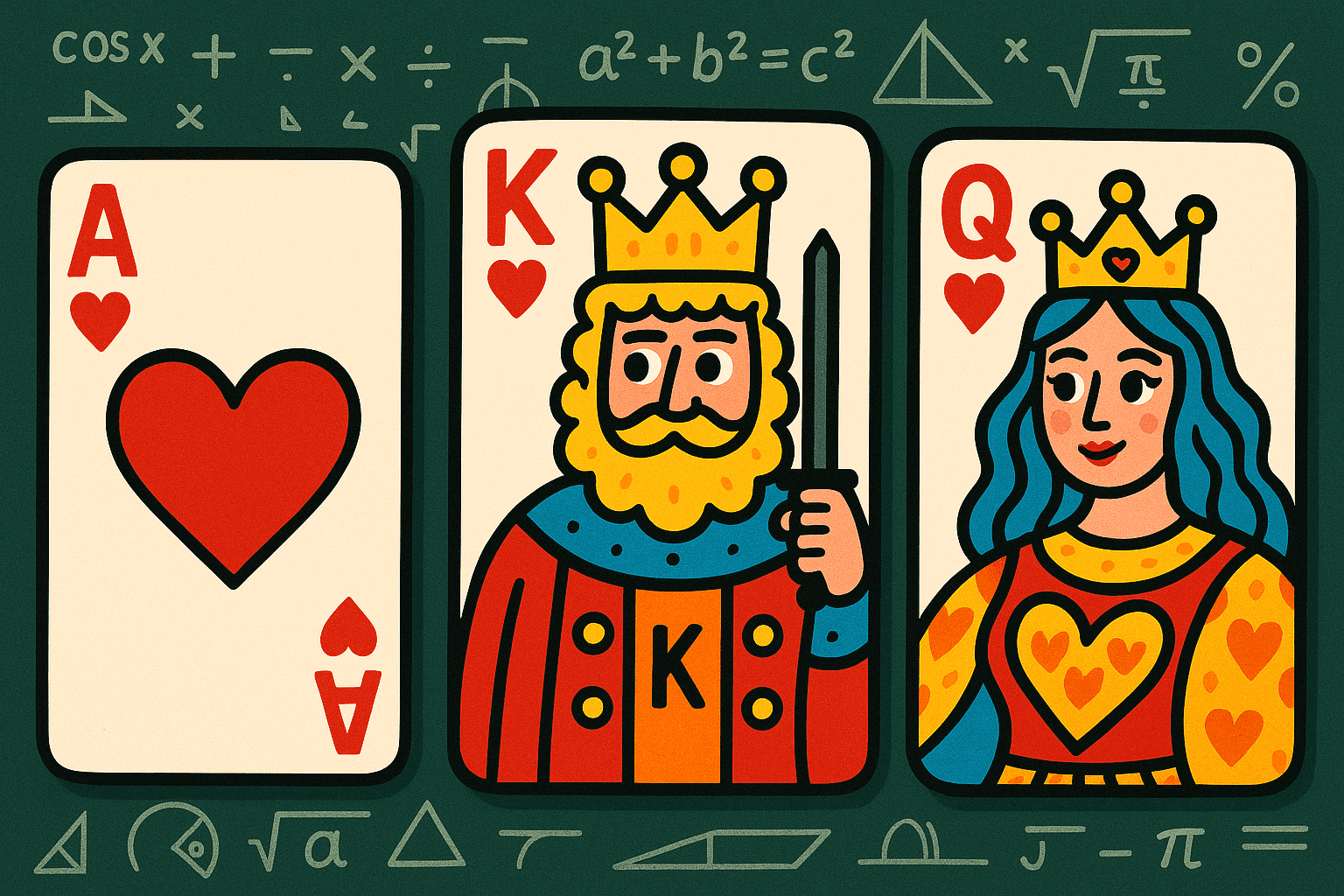
Only three cards are used: A, K, Q with the rank order A > K > Q. Each player is dealt one of these cards at random, and the same rank is never dealt to both players (let's also ignore suits).
Hero is always IP (in position), and Villain is always OOP (out of position).- s
- The hand starts right at the river, with Villain (OOP) acting first. At that point, Villain always chooses to check.
- Then Hero (IP) can choose any bet size or check back.
- If Hero checks back in step 2, the hand goes straight to showdown.
- If Hero bets in step 2, Villain can only call or fold — no raises are allowed.
- size
The initial pot is 1.
Through this simple game model, you can learn about betting strategy and how to think about ranges in poker.
3. Building a Strategy for Each Hand and Pure Strategies
First, let's summarize the optimal play for each hand, for both Hero and Villain.
Hero's Optimal Play
- ① A
As the strongest hand, always value bet to target Villain's K. - ② K
ting is a losing play: A will always call and beat you, while Q will simply fold. Always check. - ③ Q
It's the weakest hand, but mixed in with your A value bets, bluff bet at a frequency that makes Villain's K just indifferent.
Villain's Optimal Play After Hero Bets
- ④ A
You're guaranteed to win, so always call. - ⑤ K
You're beaten by Hero's A, but to avoid being bluffed off too often by Hero's Q, bluff-catch at the appropriate frequency. ( at a frequency that makes Hero's Q just indifferent about bluffing) - ⑥ Q
You're guaranteed to lose, so always fold.
Here, as the word "always" suggests, ①, ③, ④, and ⑥ have their optimal actions determined from the start, executed with 100% frequency. Choosing any other action would clearly lose money, as explained above.
In this way, a strategy in which an action is played 100% of the time is called a "pure strategy." Getting a pure strategy wrong results in a very large EV loss, so extra care is needed.
Now, since pure strategies can't be changed, what really matters for finding this game's optimal solution is
- ③, the bluff frequency of Hero's Q, and
- ⑤, the call frequency of Villain's K.
For ③ and ⑤, the optimal approach is to balance both actions, and a strategy like this is called a "mixed strategy." If you fail to strike the right balance and lean too far toward one action, your opponent will exploit your strategy. Let's look at these exploits in concrete terms below.
For ③, if Hero bets Q too often, he is bluffing too much, and Villain exploits this by bluff-catching K at 100% frequency. Conversely, if Hero bets Q too rarely, he is value-heavy with A, and Villain exploits this by bluff-catching K at 0% frequency.
For ⑤, if Villain calls K too often, he is bluff-catching too much, and Hero exploits this by bluff betting Q at 0% frequency. Conversely, if Villain calls K too rarely, he isn't bluff-catching enough, and Hero exploits this by bluff betting Q at 100% frequency.
So how exactly should we determine the right frequencies for ③ and ⑤? We'll explain in the next section.
4. Mixed Strategy Frequencies and Indifference
To find the optimal frequencies for a mixed strategy, we need to clarify the exact meaning of the phrase "make the opponent's X just indifferent," which appeared in ③ and ⑤ above. This is where the term "indifferent" comes in.
To be indifferent means that, for a given hand, the EV of multiple actions is equal.
That's a bit abstract, so here's a concrete example. Suppose the pot is 100 and your opponent bets 100 into it (a pot-sized bet).
Calling costs 100, and after calling, the pot becomes 100 (pot) + 100 (opponent's bet) + 100 (your call) = 300. In other words, you're being asked to pay 100 for a chance to win 300, so when your win rate is exactly 100/300 = 1/3, the EV of calling and folding are equal at 0.
This situation is called being "indifferent between calling and folding." In general, hands in an indifferent state tend to keep those multiple actions as options in order to maintain balance.
And here, the key to deciding the mix within the mixed strategies of ③ and ⑤ is adjusting your frequencies so that a specific hand of your opponent becomes indifferent.
Specifically,
- ③ Adjust Hero's Q bet frequency so that Villain's K is indifferent between calling and folding.
- ⑤ Adjust Villain's K call frequency so that Hero's Q is indifferent between betting and checking.
5. The Optimal Solution to the AKQ Game with the Bet Size Limited to 50% of the Pot
For clarity, in this section we'll limit Hero's bet size to 50% of the pot (0.5).
Hero's Strategy
Hero value bets A with full frequency (1), bluff bets Q with the optimal frequency (fQ), and plays a strategy that makes the EV of Villain's K call and fold equal. If Villain's K calls, the payoffs are as follows:
- Hero has A (1 combo) ... -0.5 (loses the 0.5 spent to call)
- Hero has Q (fQ combos) ... 1 + 0.5 (wins the 1 in the pot plus the 0.5 opponent bet)
If Villain's K folds, his chip stack neither increases nor decreases, so the payoff is 0.
Since (K's call EV) = (K's fold EV), this can be written as
1+fQ1・(−0.5)+fQ・(1+0.5)=0
Solving this gives fQ=31.
Villain's Strategy
Villain, meanwhile, calls K with the optimal frequency (fK) and plays a strategy that makes the EV of Hero's Q bet and check equal.
If Hero's Q bets, the payoffs are as follows:
- Villain has A (1 combo) ... -0.5 (Villain calls and Hero loses)
- Villain calls with K (fK combos) ... -0.5 (Villain calls and Hero loses)
- Villain folds K (1−fK combos) .. 1 (Villain folds and Hero wins the 1 in the pot)
If Hero's Q checks, it always loses at showdown, and the chip stack neither increases nor decreases, so the payoff is 0.
Since (Q's bet EV) = (Q's check EV), this can be written as
21・(−0.5)+fK・(−0.5)+(1−fK)・1=0
Solving this gives fK=31.
Putting it all together, the optimal strategies for Hero and Villain are as follows:
Hero's strategy
Hero's hand | Frequency of betting 50% pot | frequency |
|---|---|---|
A | 1 (100%) | 0 (0%) |
K | 0 (0%) | 1 (100%) |
Q | 0.3333 (33.33%) | 0.6667 (66.67%) |
Villain's strategy (vs. a Hero bet of 0.5)
Villain's hand | Call frequency | frequency |
|---|---|---|
A | 1 (100%) | 0 (0%) |
K | 0.3333 (33.33%) | 0.6667 (66.67%) |
Q | 0 (0%) | 1 (100%) |
6. The Optimal Solution to the AKQ Game with an Arbitrary Single Bet Size (b)
In the previous section, we solved the game with the bet size fixed at 0.5. In exactly the same way, we can find the optimal solution for any bet size b (a constant). Replacing 0.5 with b in the two equations above gives
1+fQ1・(−b)+fQ・(1+b)=0
21・(−b)+fK・(−b)+(1−fK)・1=0
Solving these gives fQ=1+bb and fK=1+b1−b.
Putting it all together, the optimal strategies for Hero and Villain are as follows:
Hero's strategy
Hero's hand | Frequency of betting b | Check frequency |
|---|---|---|
A | 1 | 0 |
K | 0 | 1 |
Q | 1+bb | 1+b1 |
Villain's strategy (vs. a Hero bet of b)
Villain's hand | Call frequency | Fold frequency |
|---|---|---|
A | 1 | 0 |
K | 1+b1−b | 1+b2b |
Q | 0 | 1 |
Now take a closer look at fK=1+b1−b. When b is greater than 1 (when Hero bets over the pot), fK becomes negative — something strange is happening. What does this mean?
In general, an overbet bluff requires a bluff success rate above 50%. When Hero bluffs with Q, Villain holds either A or K. But Villain will never fold A, so the bluff success rate can never exceed 50%.
In other words, we arrive at the conclusion that Hero should not bluff with overbets in the AKQ game. And if there's no bluff at that size, there obviously can't be a value bet at that size either, so Hero never uses overbets in this game. Therefore, from here on we consider 0<b≤1.
7. What Bet Size Maximizes the EV of Hero's Whole Range?
So far, we've found the optimal solution for any single bet size (b). Now for the main event.
In fact, the expected value (EV) of Hero's K and Q does not change with the bet size (b). Here's why:
- Hero's K... always checks and, at showdown, loses to A and beats Q, winning the pot of 1 with 50% probability. In other words, its EV is always 0.5
- Hero's Q... because Villain's K call frequency leaves Q indifferent between bluffing and giving up with a check, its EV is always 0
So the only hand whose EV changes with the bet size is A, which means Hero's optimal bet size is the amount that maximizes EV when Hero holds A. So let's actually calculate the EV of Hero's A bet when the bet size is b.
(EVofHero′sA)=(probabilityofbeingcalled)・(1+b)+(probabilityofbeingfolded)・1
The probability of being called is the probability that Villain holds K (21) and chooses to call (1+b1−b), so
it is their product, 211+b1−b. Letting this be P(b),
(EVofHero′sA)=P(b)・(1+b)+(1−P(b))・1=bP(b)+1=211+bb(1−b)+1
Ignoring the constant part, we just need to find the b that maximizes 1+bb(1−b).
1+bb(1−b)=1+b−b(1+b)+2(1+b)−2=2−(b+1+b2)=3−((1+b)+1+b2)
so by the AM–GM inequality, at 1+b=2, i.e., b=2−1≈0.414, 1+bb(1−b) reaches its maximum value 3−22.
What this means is that Hero's optimal bet size is 41.4% of the pot, which maximizes the EV of A. We set out thinking about poker, and yet a square root showed up in the bet size. Strange, isn't it?
Also, plugging the maximum value we just found back into the original equation gives
(MaxEVofHero′sA)=21・(3−22)+1=25−2≈1.086
Since A's EV would be 1 without betting, we can see that Hero being in position (IP) genuinely contributes to increasing the EV of the whole range.
8. Summary
This turned out to be a long, demanding article — thank you for reading this far. In this article, we examined how Hero's bet size affects expected value (EV). The conclusions can be summarized briefly as follows:
- The AKQ game is a simplified form of poker, and studying it in depth lets you master various theories used in real-world poker.
- For value hands, there exists an optimal bet size that maximizes EV, under the condition that your opponent cannot raise.
Through the analysis of the AKQ game, you can deepen your understanding of bet sizing and (Game Theory Optimal) strategy in poker. In the next article, we'll explore bet size optimization in more complex situations and how to apply these ideas in real games.