

Which do you prefer: tournaments or ring games? s, where all-ins fly fast and furious, and ring games, where you settle in and play patiently with deep stacks—each format has its own appeal. In this article, we'll explain the differences in rules and strategy between the two in an easy-to-understand way. We hope you'll get a sense of what makes both tournaments and ring games so enjoyable.
1. What Are Tournaments and Ring Games?
Tournaments
A tournament is a battle-royale-style game in which players are eliminated as soon as they lose all of their chips. Even if you've built up a huge stack, you're out the moment an all-in wipes you out. Another defining feature of tournaments is that the blinds rise as the game progresses, so you'll often find yourself playing with a shallow stack. In addition, most tournaments include a mandatory fee called the "ante" on top of the blinds, and you're encouraged to play more hands.
Ring Games / Cash Games
This is poker played with the simple goal of growing the chips you hold. Unlike in tournaments, the blinds never rise during play, so you can take your time and play with deep stacks. The casino may also collect a "rake"—its cut of the pot. s and cash games originally mean the same thing, but in Japan, "ring game" is often used specifically for games that don't involve real money.
Want to learn more about "antes" and "rake"? out these articles!


2. Difference #1 — Stack Size
It's no exaggeration to say that stack size (how many big blinds you're holding) is the single most important difference between tournaments and ring games. Because blinds keep rising in tournaments, you'll be playing with a shallow stack for most of the game. Let's look at what happens when your stack gets shallow.
2.1. s Are Powerful
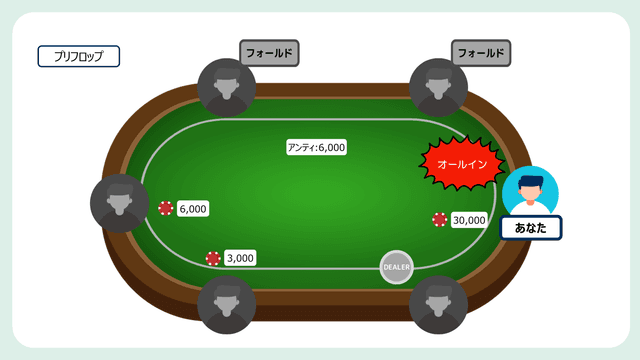
When your stack gets shallow, it becomes small relative to the pot. That's why, unlike with a deep stack, you'll need to go all-in a lot. If you hesitate to push all-in because you're too afraid of being eliminated, you'll leave profit on the table. Be willing to commit all-in aggressively. Once your stack drops below 20bb, start playing with open-shoving preflop in mind.
2.2. Values Change
With a shallow stack, even completing a strong hand won't win you many chips, so hands that hope to hit a strong but unlikely combination ("speculative hands"), like 98, lose value. Since the action frequently ends up all-in preflop, hands that are awkward to play postflop but have relatively high preflop equity—low pocket pairs like 55 or hands containing an ace like A4—rapidly gain value.
3. Difference #2 — The Value of Chips
In a ring game, the size of your stack directly represents its value. In other words, a 1,000-chip stack is worth exactly twice as much as a 500-chip stack. In a tournament, though, that's not necessarily the case: doubling your stack doesn't necessarily double the expected value of the prize money or prizes you can win.
Here's an example.
You're in a tournament where the top five finishers each win a seat in a major tournament (a "satellite tournament"), and 10 players remain.
Here's what each player's stack looks like:
- Chip leader: 10,000 chips
- You: 5,000 chips
- Remaining 8 players: 1,000 chips each
That's it.
In this tournament, 1st place and 5th place are worth exactly the same. All you need to do is make the top five. In other words, "the probability of finishing in the top five" is what gives your stack its value. The chip leader has twice as many chips as you, but is their chance of making the top five twice as high? Not at all. Both you and the chip leader are likely to make the top five more than 90% of the time.
As this example shows, in tournaments, you have to play with the goal of securing as much prize money and as many prizes as possible. In this scenario, if the chip leader moves all-in, you should probably fold even with AA. When you're close to cashing, stop trying to grow your stack and play to maximize the prize money and prizes you can win.
Summary
In this article, we've explained the differences in the goals and strategies of tournaments and ring games/cash games. To sum it up:
- All-ins matter in tournaments because stacks get shallow
- In tournaments, the goal isn't just to grow your stack—it's to win more prize money and prizes
And that's what it comes down to. Many beginners are so afraid of being eliminated that they fold too much and keep bleeding chips to the blinds and antes. Be brave and go all-in.
And if you've only ever played one of the two formats, use this article as a starting point and give the other one a try. You might discover a whole new way to enjoy the game.