
Introduction
This article is a continuation of the previous one. If you haven't read it yet, please start there:
This time, the theme is "bet-size splitting." In , stronger value hands generally tend to use larger bet sizes. But why? In this article, we'll explore that question from a mathematical standpoint using a toy game called the AKQJT9 game.
1. What Is the AKQJT9 Game?
The AKQJT9 game is a toy game I designed for this very topic, and it is a derivative of the "AKQ game" introduced last time. Compared with the AKQ game, the only difference is that the deck has grown from 3 cards to 6, but let's review the rules anyway.
- Players
This game is played by two players: Hero and Villain. - Cards
The game uses only six cards: A K Q J T 9 , with the rank order A > K > Q > J > T > 9. Each player is randomly dealt one of these cards, and the same rank is never dealt to both players. - s
Hero always plays in position (IP), while Villain always plays out of position (OOP). - s
- The game starts right at the river, and Villain (OOP) acts first, always choosing to check.
- Hero (IP) may then choose any bet size or check back.
- If Hero checks back in step 2, the hand goes straight to showdown.
- If Hero bets in step 2, Villain may only call or fold; raising is not allowed.
- size
The initial pot is 1.
2. The GTO Solution Computed by an Algorithm
We'll now compute the optimal solution to this game with formulas, but to make it easier to picture, let's first look at the GTO solution computed with the CFR algorithm. (I'd also like to cover the details of the CFR algorithm in more depth when the opportunity arises.)
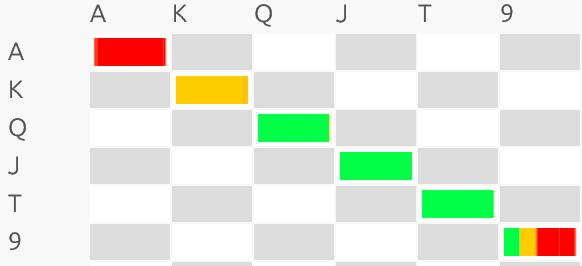
Figure 1 visualizes the GTO solution using a tool I built myself. The range table is styled after GTO Wizard. It shows Hero's strategy for his entire range after Villain checks, on a board of 22233 (which has no direct relation to the A through 9 hands in question) in real poker.
However, both players' hand ranges are limited to six combos: AA, KK, ..., 99 (only the spade-heart combos of each pocket pair are used).
Here, hand strength follows AA > KK > ... > 99, and the two players can never hold the same hand, so this situation is equivalent to the AKQJT9 game.
This time, bet-size options from 15% to 160% were provided. Red indicates a large bet, orange a small bet, and green a check.
You can see that the nut hand A uses a larger value-bet size than the second-nut K, and that size splitting is taking place.
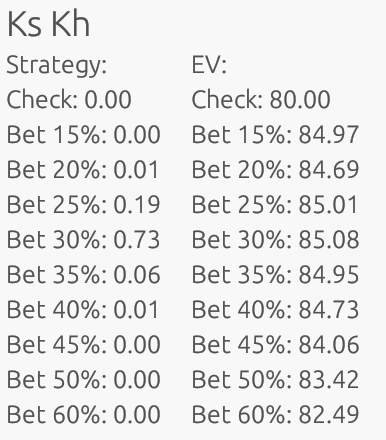
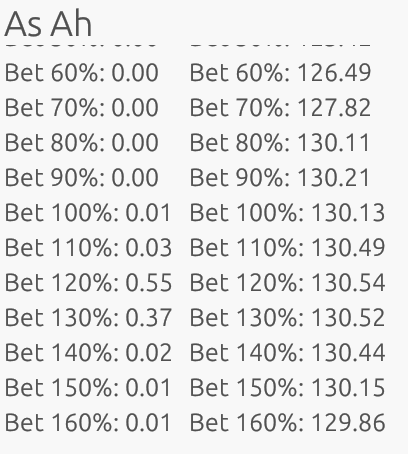
Figures 2 and 3 show in detail the strategies used when the hand is KK and AA, respectively. For each hand, the best approach is to use the bet size that maximizes its , and you can see that actions with higher are chosen more often.
Looking at Figures 1 through 3, here is a summary of what we can learn about the AKQJT9 game.
Summary so far
- The nut hand A always bets large. The optimal size appears to lie somewhere between 120% and 130%, closer to the 120% side.
- The second-nut hand K always bets small. The optimal size appears to lie somewhere between 25% and 30%, closer to the 30% side.
- The marginal hands Q through T always check.
- The weakest hand, 9, bluffs at appropriate frequencies using the same sizes as the A and K value bets.
Notes
- Q cannot be value-bet. If you bet with Q, the opponent will always call with A and K and always fold 9. Even if the opponent bluff-catches at full frequency with J and T, your equity when called is 50%, so the bet is not functioning as a value bet.
- T is never bluffed. ing with 9 alone provides enough combinations (as explained below).
3. The Optimal Solution to the AKQJT9 Game with Two Arbitrary Bet Sizes
Now let's move on to the mathematical analysis.
Since this game features size splitting, let the value-bet size used with A be bA, and the value-bet size used with K be bK.
From the previous article, when a strong hand is value-bet purely at size b, the bluff-bet frequency that makes the opponent indifferent between calling and folding their marginal hands is 1+bb. Since this game uses two bet sizes, Hero's optimal strategy is as follows.
Hero's strategy
Hero (IP) hand | Frequency of betting bA | Frequency of betting bK | Frequency of checking |
|---|---|---|---|
A | 1 | 0 | 0 |
K | 0 | 1 | 0 |
Q , J , T | 0 | 0 | 1 |
9 | 1+bAbA | 1+bKbK | 1−1+bAbA−1+bKbK |
Against this strategy, Villain responds as follows. For now, let the bluff-catch frequency against a bet of bA for marginal hands (K through T) be f1, and the bluff-catch frequency against a bet of bK for marginal hands (Q through T) be f2. (We'll calculate the specific values in a moment.)
Villain's strategy against Hero's bet of bA
Villain hand | frequency | frequency |
|---|---|---|
A (1 combo) | 1 | 0 |
K , Q , J , T (4 combos) | f1 | 1−f1 |
9 (1 combo) | 0 | 1 |
Villain's strategy against Hero's bet of bK
Villain hand | Call frequency | Fold frequency |
|---|---|---|
A , K (2 combos) | 1 | 0 |
Q , J , T (3 combos) | f2 | 1−f2 |
9 (1 combo) | 0 | 1 |
From the previous article, Villain's optimal bluff-catch frequency is the frequency that makes Hero indifferent between bluff-betting and giving up and checking with his weak hands. That is, we want
(EV of Hero's 9 betting bA) = (EV of Hero's 9 betting bK) = (EV of Hero's 9 checking)
so the following equations hold:
51・(−bA)+4f1・(−bA)+4(1−f1)・1=52・(−bK)+3f2・(−bK)+3(1−f2)・1=0
Solving these gives f1=4(1+bA)4−bA and f2=3(1+bK)3−2bK.
Also, 1−f1=4(1+bA)5bA and 1−f2=3(1+bK)5bK. (We'll use these later.)
4. Which bA,bK Maximize the EV of Hero's Entire Range?
Now that we know both players' optimal strategies, let's find the bA,bK that maximize the EV of Hero's entire range. As mentioned in the previous article, the EVs of marginal hands and weak hands do not depend on Hero's bet size. So the optimal bA,bK can be found by considering the EV of each value hand, A and K, on its own.
Let's actually calculate the EVs of A and K. The EV of A can be computed as before, but there is a caveat for the EV of K: K runs the risk of value-betting into Villain's A. Keeping that in mind, letting the EV of Hero's A be EA(bA) and the EV of Hero's K be EK(bK), we get
EA(bA)=54f1・(1+bA)+(4(1−f1)+1)・1=51((4−bA)+1+bA5bA+1)=51(5+1+bA5bA−bA)
EK(bK)=51・(−bK)+3f2・(1+bK)+(3(1−f2)+1)・1=51(−bK+(3−2bK)+1+bK5bK+1)=51(4+1+bK5bK−3bK)
Let's differentiate these functions to find the bA that maximizes EA(bA) and the bK that maximizes EK(bK).
Using the differentiation formula for rational functions taught in Japanese high-school Math III,
dbAdEA(bA)=(1+bA)21−51
dbKdEK(bK)=(1+bK)21−53
we get
Both dbAdEA(bA) and dbKdEK(bK) are monotonically decreasing functions, so the bA and bK at which they equal zero are the optimal bet sizes.
Solving gives bA=5−1≈1.236 and bK=35−1≈0.291.
This means that Hero's optimal bet size is 123.6% of pot with A and 29.1% of pot with K. Earlier, from the algorithm's results, we predicted that
- The nut hand A always bets large. The optimal size appears to lie somewhere between 120% and 130%, closer to the 120% side.
- The second-nut hand K always bets small. The optimal size appears to lie somewhere between 25% and 30%, closer to the 30% side.
and the math confirms these predictions exactly. At these sizes, the bluff-bet frequencies of 9 are
for the 123.6% pot bet, 1+bAbA≈1+1.2361.236≈0.553
and for the 29.1% pot bet, 1+bKbK≈1+0.2910.291≈0.225
so even combined they do not exceed 1. In other words, the 9 combo alone provides enough bluff combos, so there is no need to turn T into a bluff as well.
5. Cautions for Using Bet-Size Splitting in Practice
So far, we've discussed how bet-size splitting raises the EV of your range. However, you need to be careful when applying this in real poker.
In this game, Villain had no right to raise, but in real poker, you can get raised.
If your small-bet range contains no nut-class hands at all, and your opponent catches on, you'll be met with wide, polarized raises as an exploit.
When that happens, the EV of your range drops substantially.
Therefore, against a skilled opponent who raises appropriately, you balance by putting some nut-class hands into your small-bet range (especially when out of position).
Summary
This was another challenging article, but thank you for reading this far. In this article, we explained that GTO's bet-size splitting is an effective play with solid mathematical backing.
In brief, the conclusions are as follows:
- When splitting bet sizes, using larger bet sizes with stronger value hands raises EV.
- Bluff hands are chosen from the weakest hands with low equity, and bluffs are made at the appropriate frequency for each bet size (in practice, hands with good blockers tend to be chosen for larger bluff bets; in this game, there were no blockers).
- In practice, since your opponent can raise, even when splitting bet sizes, you need to distribute a reasonable share of nut-class hands across sizes to avoid being exploited.