Poker is a game of incomplete information, but the cards themselves follow fixed probabilities. Knowing the most important Texas Hold'em odds helps you understand which results are normal, avoid calls that lose money over time, and stay calm when a draw doesn't come in.
This page collects the numbers that matter most, from preflop to the river. All of them were calculated from a standard 52-card deck.
Starting Hand Probabilities
How often you're dealt each type of hand before the flop:
| Starting hand | Probability | About once every |
|---|---|---|
| Any pocket pair | 5.9% | 17 hands |
| A specific pair (e.g., pocket aces) | 0.45% | 221 hands |
| Suited cards | 23.5% | 4.3 hands |
| AK (suited or offsuit) | 1.2% | 83 hands |
There are 1,326 possible two-card starting hands, which group into 169 distinct hands once you ignore suits (13 pairs, 78 suited hands, 78 offsuit hands).
If it feels like you never get aces, that's normal: you'll wait an average of 221 hands for them. Use our starting hands chart to see which of the 169 hands are worth playing.
Flop Probabilities
What to expect when the first three community cards come out:
| Situation | Probability on the flop |
|---|---|
| Pocket pair flops a set or better | 11.8% (about 1 in 8.5) |
| Unpaired hand pairs at least one hole card | 32.4% (about 1 in 3) |
| Suited hand flops a flush | 0.84% (about 1 in 119) |
| Suited hand flops a flush draw (4 to a flush) | 10.9% (about 1 in 9) |
| Unpaired connector (e.g., 8-7) flops an 8-out straight draw | 9.7% |
| Unpaired connector (e.g., 8-7) flops a straight | 1.3% |
The most useful line here is the second one: an unpaired hand like AK misses the flop about two times out of three. If you're always continuing because "I might have hit," you're overplaying.
The first line is why small pairs are often called "set-mining" hands. You flop a set only about 1 in 8.5 times, so you need to win a lot when you hit to make up for the misses.
Outs and the Rule of 4 and 2
Your outs are the unseen cards that improve your hand to what you think is the best hand. Common draws:
- : 9 outs
- : 8 outs
- : 4 outs
- Two overcards: 6 outs
- draw + open-ended straight draw: 15 outs
The rule of 4 and 2
To turn outs into a percentage at the table:
- On the flop (two cards to come): outs × 4
- On the turn (one card to come): outs × 2
chart: exact odds vs. the shortcut
| Outs | Common draw | Turn only | River only (from turn) | By the river (from flop) | Rule of 4 |
|---|---|---|---|---|---|
| 2 | Pocket pair to a set | 4.3% | 4.3% | 8.4% | 8% |
| 4 | Gutshot | 8.5% | 8.7% | 16.5% | 16% |
| 6 | Two overcards | 12.8% | 13.0% | 24.1% | 24% |
| 8 | Open-ended straight draw | 17.0% | 17.4% | 31.5% | 32% |
| 9 | Flush draw | 19.1% | 19.6% | 35.0% | 36% |
| 12 | Flush draw + gutshot | 25.5% | 26.1% | 45.0% | 48% |
| 15 | Flush draw + open-ended | 31.9% | 32.6% | 54.1% | 60% |
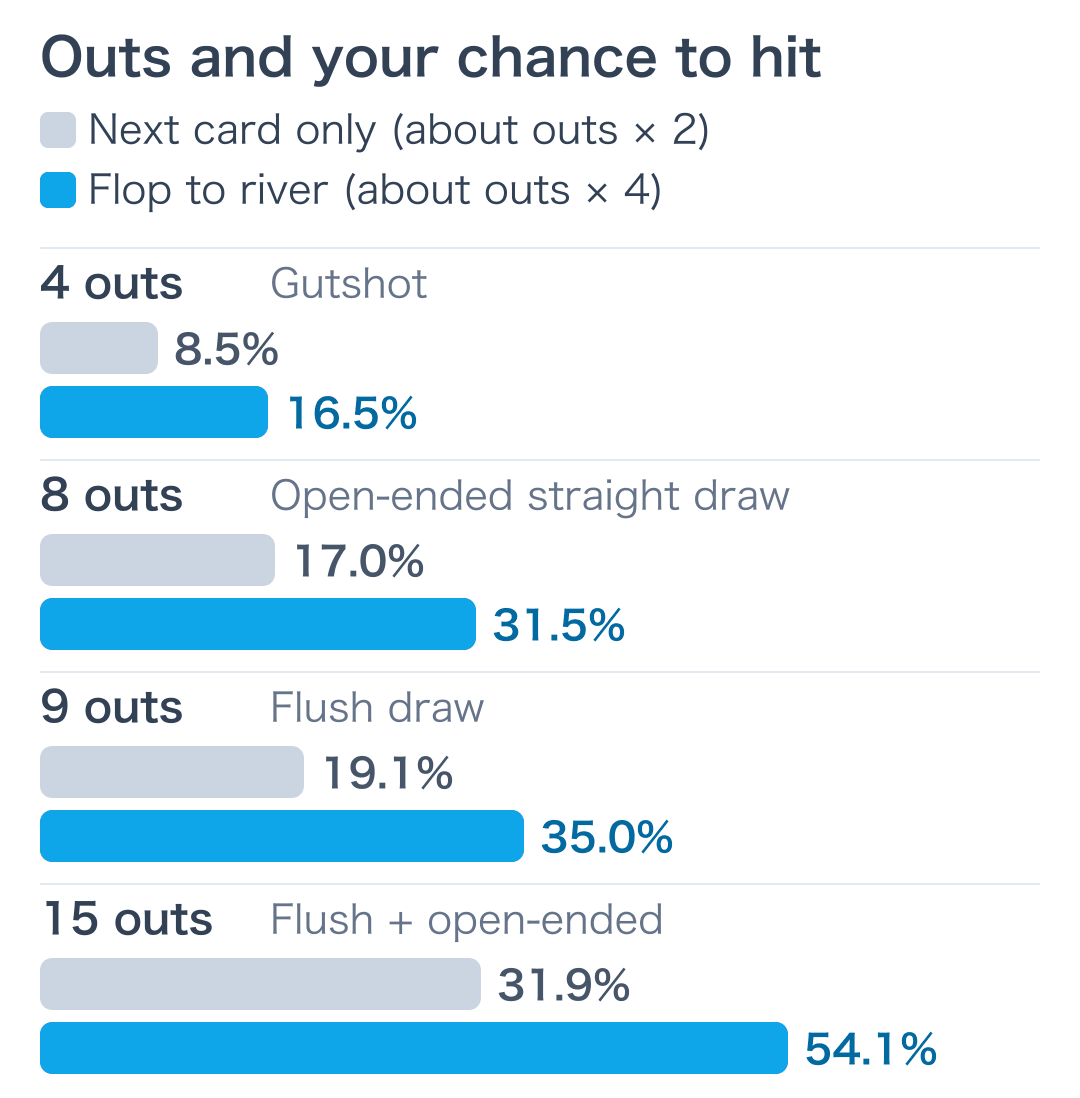
The rule of 4 is close up to about 9 outs but overestimates big draws. With 15 outs it says 60% when the real number is 54%. A common fix: when you have more than 8 outs, use (outs × 4) − (outs − 8).
Two more facts worth knowing:
- A backdoor flush draw (three to a flush on the flop) completes only about 4.2% of the time.
- A suited hand makes a flush by the river only about 6.4% of the time. Being suited adds a few percentage points of equity, but not much more.
Preflop Matchup Odds
Common all-in matchups, with all five board cards to come. These are typical figures; exact numbers shift by about a percentage point depending on suits.
| Matchup | Typical equity | Name |
|---|---|---|
| AA vs. KK | 82% vs. 18% | Overpair vs. underpair |
| QQ vs. AKo | 57% vs. 43% | The classic "coin flip" |
| 77 vs. AKo | 55% vs. 45% | Small pair vs. two overcards |
| AKs vs. 22 | 50% vs. 50% | A true coin flip |
| AKo vs. JTs | 64% vs. 36% | Two overcards vs. two undercards |
| AKs vs. 76s | 60% vs. 40% | Suited connectors hold up well |
| AK vs. AQ | 75% vs. 25% | Dominated hand |
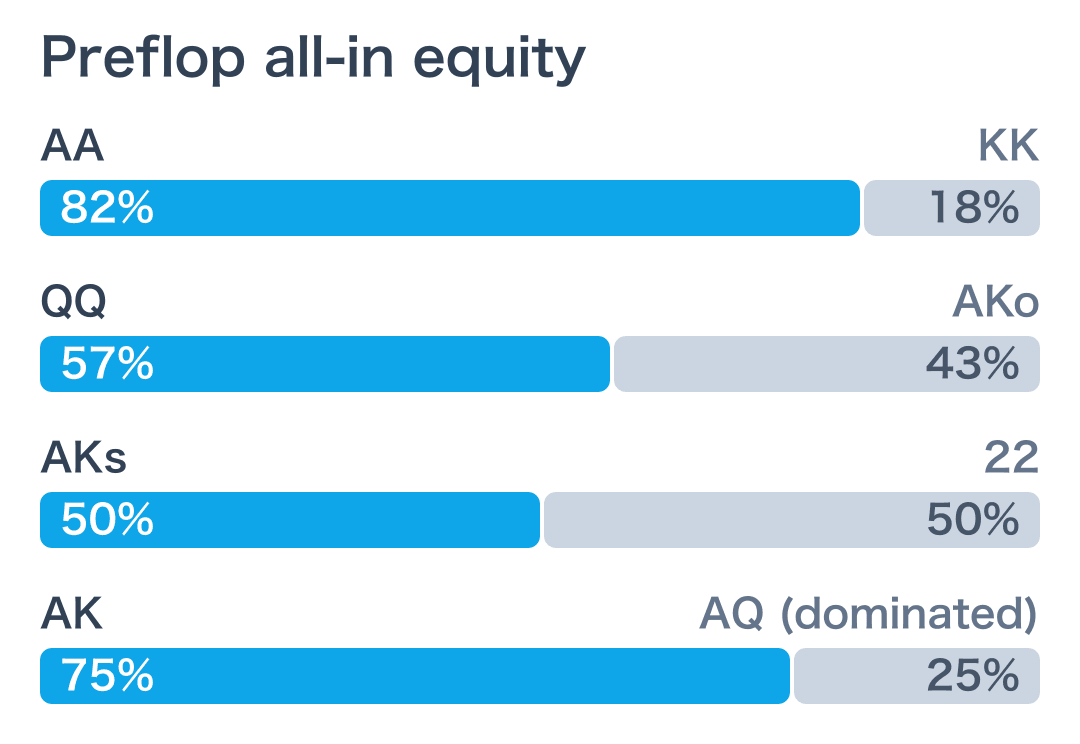
The big lesson: a pair vs. two higher cards is close to 50/50, but a dominated hand (sharing a card with a better hand, like AQ vs. AK) wins only about a quarter of the time. That's why hands like AJ or KQ get into trouble against tight raising ranges.
To check any matchup, or a hand against a whole range, use the equity calculator.
Flop Matchup Odds
A few common spots after the flop, with two cards to come:
| Spot | Equity |
|---|---|
| Set vs. overpair | about 91% vs. 9% |
| Nut flush draw vs. top pair | about 46% vs. 54% |
| Open-ended straight draw vs. top pair | about 34% vs. 66% |
| Flush draw + open-ended straight draw vs. a set | about 40% vs. 60% |
Strong draws are often much closer to made hands than they look. That's why a big draw can raise or go all-in on the flop as a semi-bluff.
Final Hand Probabilities (7 Cards)
How often each hand ends up as your best five cards out of seven (your two hole cards plus the five-card board):
| Final hand | Probability |
|---|---|
| Royal flush | 0.0032% |
| Straight flush (not royal) | 0.028% |
| Four of a kind | 0.17% |
| Full house | 2.6% |
| Flush | 3.0% |
| Straight | 4.6% |
| Three of a kind | 4.8% |
| Two pair | 23.5% |
| One pair | 43.8% |
| High card | 17.4% |
Notice that with seven cards, two pair or better happens about 39% of the time, and pure high card is less common than one pair. For how the hands rank, see our poker hand rankings guide.
How to Use Probability at the Table
Knowing odds only helps when you connect them to the price you're being offered.
- Count your outs and convert them with the rule of 4 and 2.
- Work out the price with pot odds: call ÷ (pot after call).
- if your chance of winning is higher than the price, unless implied odds or a raise make a different line better.
Our free pot odds calculator does steps 1–3 for you and is a quick way to check your instincts after a session.
Poker Probability FAQ
What are the odds of getting pocket aces?
1 in 221, or about 0.45% per hand.
What are the odds of flopping a set?
About 11.8% with a pocket pair, or roughly 1 in 8.5 flops.
What are the odds of hitting a flush draw?
About 35% by the river from the flop, and about 19.6% on the river alone from the turn.
What is the rule of 4 and 2 in poker?
A shortcut: multiply your outs by 4 on the flop (two cards to come) or by 2 on the turn (one card to come) to estimate your chance of hitting.
What is the most likely final hand in Texas Hold'em?
One pair, at about 43.8% of seven-card hands.
Key Takeaways
- You're dealt a pocket pair about 1 in 17 hands and a specific pair about 1 in 221.
- Unpaired hands miss the flop about two-thirds of the time.
- Use the rule of 4 and 2 to turn outs into percentages, but expect it to overestimate draws with more than 8 outs.
- Pair vs. two overcards is close to a coin flip; a dominated hand wins only about 25%.
- Probability matters most when you compare it with the pot odds you're getting.