

In the late stages of a poker tournament, you often have to decide whether to call or fold on the flop within five seconds. If you rely only on a simple out count (the Rule of 2 and 4), it fails to reflect the extra value from backdoor draws or overcards, which makes misjudgments more likely. In this article, I'll lay out a practical rule for estimating flop equity with backdoor draws included, in terms even beginners can follow.
What is the Rule of 2 and 4?
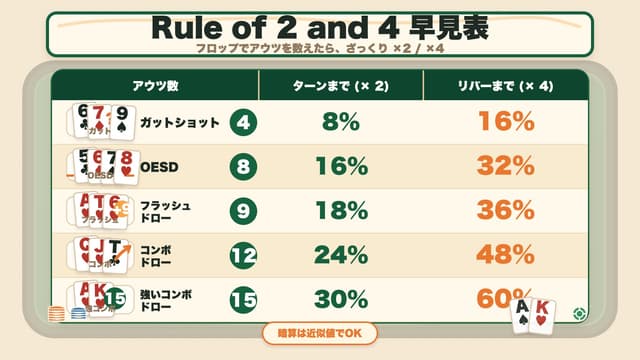
Let's start with a quick refresher. The starting point is the famous approximation for estimating equity from your outs: the Rule of 2 and 4.
Equity on the turn (one card to come): number of outs × 2%
Equity on the flop (two cards to come): number of outs × 4%
For example, if you have 8 outs on the flop, your chance of completing your hand by the river is about 32% (= 8 × 4). It's simple, easy to remember, and quick enough to calculate even at a live table. See the outs article for more on counting outs.
Why should you consider backdoor draws?
The Rule of 2 and 4 is convenient, but it's known to underestimate your flop equity. There are two reasons.
draw: a draw that requires hitting the right card on both the turn and the river (for example, you only have two cards of a suit on the flop, yet can still make a flush). It doesn't count as an out, but it adds about 4% to your equity
: a hole card that outranks the top pair on the board. A simple out count doesn't fully capture this either
Especially in the late stages of a tournament, when stacks get shallow and you face all-in bets on the flop, it's not unusual for this "difference of a few percent" to flip your from positive to negative. Once you can estimate equity a step more precisely, you'll find yourself in far fewer tough spots.
What are the odds of a backdoor draw?
Put simply, a backdoor draw is a draw that completes only when you hit the cards you need on both the turn and the river. For example, you only have two cards of a suit on the flop, but if the turn and river both bring cards of that suit, you make a flush.
Here's how the calculation works.
The remaining deck normally has 45 cards (your 2 hole cards, the 3 board cards, and your opponent's 2 cards excluded)
The number of two-card combinations for the turn and river is 45 × 44 ÷ 2 = 990
The probability of drawing one specific combination is 1/990 ≈ 0.1%
Concrete example: you hold KQ and the board is A72. If both a J and a T come, you complete a backdoor straight. There are 4 jacks and 4 tens, so that's 4 × 4 = 16 combinations. At 16 × 0.1%, the theoretical value is about 1.6%. Factoring in the chance that your opponent holds one of the cards you need, about 1.5% is a reasonable working estimate.
How do you use the practical rule?
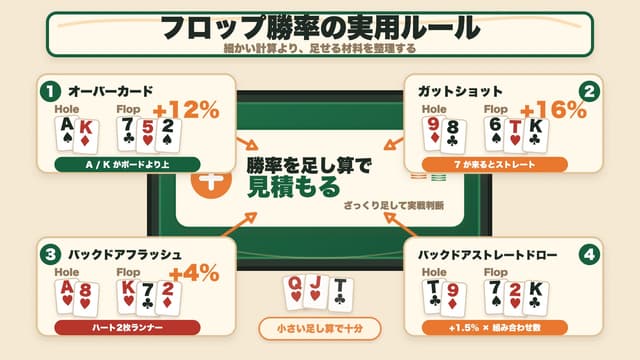
Doing precise calculations at the table isn't realistic, so we use a rough rule: add equity for each condition that applies.
Equity add-ons at a glance:
element | Equity add-on |
|---|---|
1 overcard (a high card that beats your opponent's top pair) | +12% |
(inside straight draw) | +16% |
Backdoor flush draw (two cards of a suit on the flop + one matching card in your hand) | +4% |
Backdoor straight draw (completes when you hit the needed cards on both the turn and river) | +1.5% × number of combinations |
Just add the corresponding equity for every condition that applies. If several apply, add them up. Just keep in mind that the more conditions you stack, the larger the margin of error.
Example 1: Ace-high with a backdoor flush draw
Let's check with a concrete example.
You: A4 vs opponent: KJ
: J52
Conditions that apply:
1 overcard (A) → +12%
Gutshot (a 3 completes your straight) → +16%
Backdoor flush draw (two diamonds) → +4%
Total: 12% + 16% + 4% = 32%
An equity calculator gives about 31.21%. Nearly spot-on.
Example 2: King-high with three backdoor straight patterns
Let's look at one more complex example.
You: K8 vs opponent: AQ
Board: Q96
Conditions that apply:
1 overcard (K) against your opponent's pair of queens → +12%
Backdoor flush draw (two hearts) → +4%
Backdoor straight draw (J,T / T,7 / 7,5 — three patterns) → +1.5% × 3 = +4.5%
Total: 12% + 4% + 4.5% = 20.5%
Your actual equity is about 20.87%. Extremely close, and more than accurate enough for a decision at the table.
What are the caveats?
This rule is only an approximation. Errors tend to grow in the following situations, so check them separately.
When you hold a strong flush draw or an OESD: simple out counting (× 4%) is more accurate. This practical rule is specifically designed to boost flop equity estimates for thin draws
Multiway pots: the more opponents there are, the more likely your outs are shared, and your equity dips slightly
When you already have a pair or a set: comparing made hands gets complicated, and this rule falls short
When a split pot is possible: accurately reflecting chops requires separate calculations
It's easiest to think of this as a rule that shines in the classic spot where you're torn between folding and calling on the flop with a thin draw.
Frequently asked questions about flop equity
Q. Do I need to memorize all the formulas?
A. Just remember these three: "overcard = +12%, gutshot = +16%, backdoor flush = +4%." That covers almost every situation. Backdoor straights are rare, so you can add them to memory when you have the bandwidth.
Q. How do I combine this with pot odds?
A. Just compare your estimated equity with the required equity from pot odds. Example: if you estimate 30% equity and the required equity is 25%, a call is +EV.
Q. Does this work on the turn and later?
A. After the turn, only one card remains, so backdoor draws no longer apply. Instead, "outs × 2%" alone gives you an accurate enough estimate.
Q. If I have two overcards, should it be +24%?
A. Simply doubling it can overestimate. In practice, it's safer to keep it around +18% to +22%. Also note that overcards can lose value depending on your opponent's range.
Summary
Here are the three points to remember from this practical rule for estimating flop equity with rough accuracy:
Add up 1 overcard = +12%, gutshot = +16%, backdoor flush = +4%
Backdoor straight = +1.5% × number of combinations
It's an approximation, so verify separately with strong draws or multiway pots
When you're forced to decide within five seconds at the table, this rough calculation is extremely powerful. Combined with pot odds and equity, it helps you make more accurate call/fold decisions.
If you want to build a concrete feel for probabilities and flop decisions through repetition, try internalizing them with lessons in the poker learning app POKER Q'z, such as "Learn About and " and "Estimate Equity".