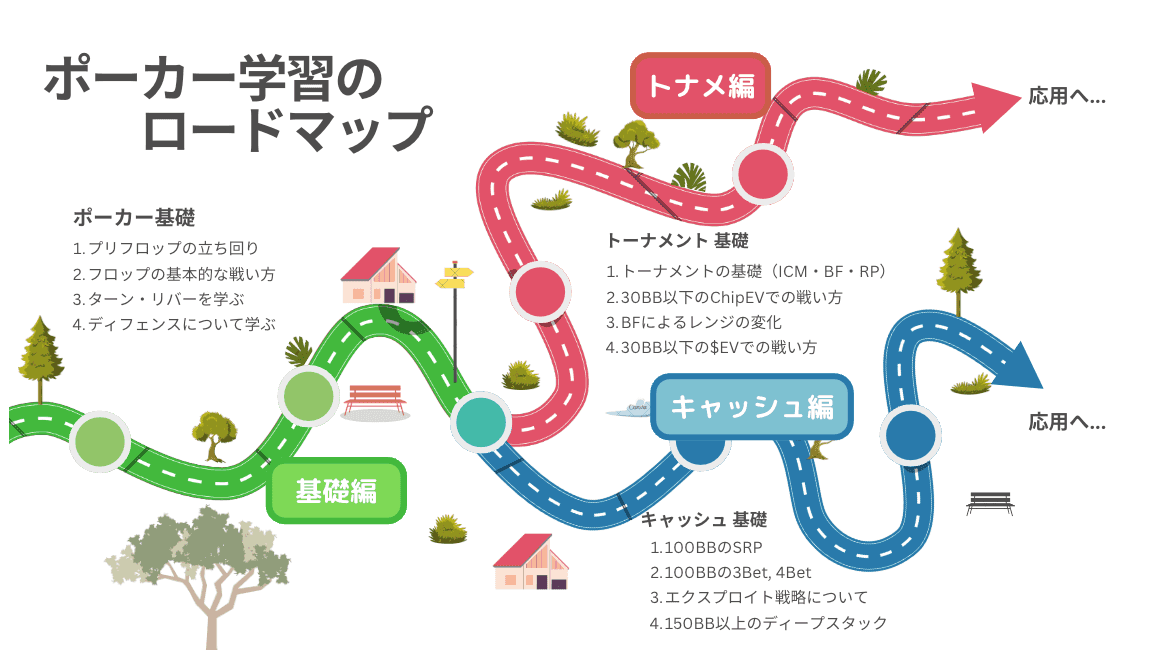

You've learned the rules of poker, but you're not sure what to study to get better at cash games and tournaments... This article is for you. Here, we introduce a learning roadmap that makes it clear what to study and in what order, so you can improve efficiently. Follow this roadmap, and you'll level up on the cash game or tournament route that fits you best — without losing your way!
1. Fundamentals: Build a Solid Poker Foundation First!
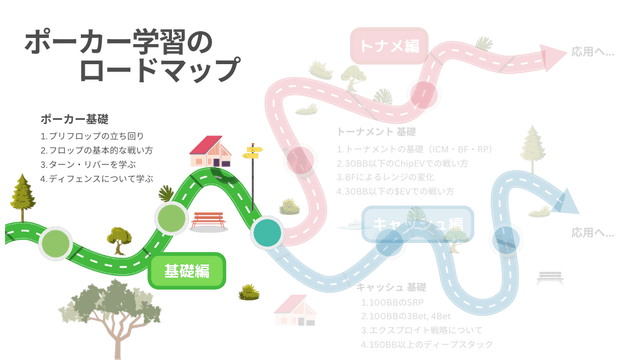
s and tournaments are games with different rules, but they share many important fundamentals. First, build a solid grasp of the basics that apply to both.
1.1 Learn Preflop Play
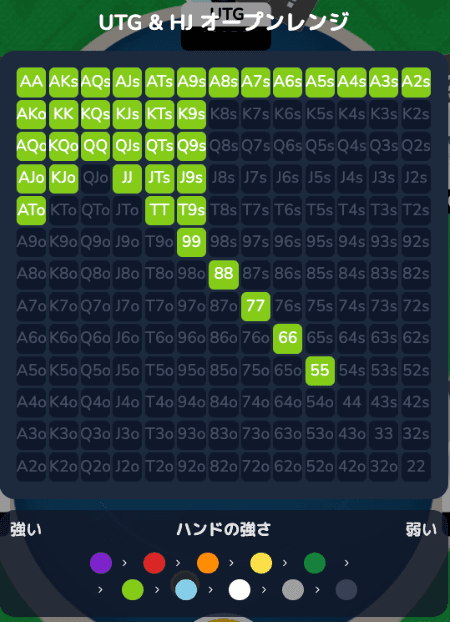
Preflop is the street you play on every single hand, so it has a huge impact on your results. That makes it the highest-priority street to study. Here are the key points to learn first:
- Enter the pot with a raise, not a call, when no one else has entered yet.
- more from positions where your turn comes earlier.
- Playing too many hands is a no-go.
New players often get excited and enter too many pots with weak hands, costing themselves money. Start by studying which hands to play from each position. Once you have a decent grasp of which hands to enter with, move on to studying how to respond when an opponent raises.
1.2 Learn How to Play the
Once you understand preflop play, it's time to learn how to play the flop. Preflop, you only needed your two hole cards to decide whether to enter the pot, but on the flop, your play changes dramatically depending on which cards hit the board. That's why it's important to grasp the characteristics of the board.
To understand the board, pay attention to the following:
- The highest card
- How connected the cards are
- The suits
- Whether there is a pair on the board
Based on the board characteristics, try to think about which player is more likely to hold a strong hand as you play.
1.3 Learn How to Play the and
After the flop, study the turn and river. You'll play these streets less often than preflop or the flop, but the pot is often bigger, so a single mistake can lead to a big loss. Common mistakes on the turn and river include:
- Overestimating the strength of your hand
- Putting your opponent on exactly one hand
In poker, it's very important to consider the range of hands your opponent can hold and estimate how strong your own hand is against it. A small shift in mindset can help you avoid making overconfident value bets and losing money one-sidedly.
1.4 Learn About Defense
ing or raising instead of folding in response to an opponent's bet or raise is called “defense.” When facing a bet or raise, you need to defend at the right frequency. Both defending too much and folding too much cost you money. Study how often and with which hands you should defend, depending on the size of your opponent's bet or raise.
2. The Cash Game Route
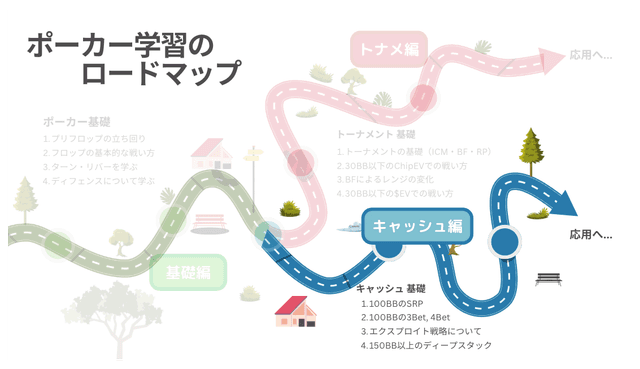
After learning the poker fundamentals, the road splits into the cash game route and the tournament route. Let's start with the cash game route. In cash games, your goal is always to make plays that maximize the expected value of your chip stack. You'll also often play with deeper stacks than in tournaments, so focus your study on those situations. We recommend studying in the following order:
- 100BB SRP
Start by studying a strategy without weaknesses () for SRP — single raised pots, where there is one preflop raise — since you'll encounter these spots most often.
- 100BB 3- and 4- s
Next come 3-bet and 4-bet pots. Since the pot is bigger than in an SRP, you'll play with an eye toward getting all-in even more often.
- ing Your Opponents
An exploit is a play that attacks the weaknesses in your opponent's strategy. Study how your play should change depending on your opponent's style. Reducing bluffs against opponents who call too much and increasing bluffs against opponents who fold too much are typical examples of exploitation.
- Deep s of 150BB or More
When stacks get deep, a single hand can win you a huge number of chips, which changes the value of hands. Study how you should adjust your play.
Recommended articles ↓

3. The Tournament Route
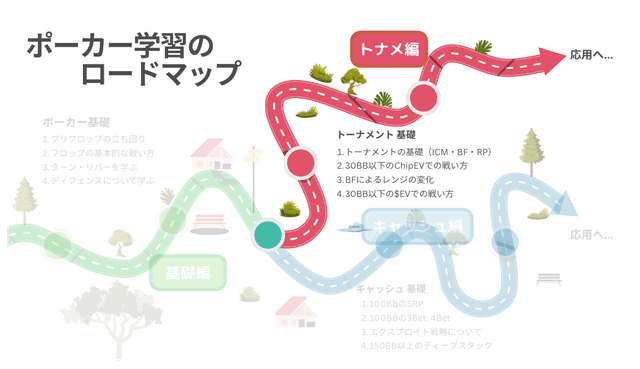
In tournaments, prize money is decided by your finishing position, so you need to learn knowledge specific to tournaments. Studying in the following order is a good approach.
- Fundamentals
Study the following concepts that are good to know when playing tournaments:
In tournaments, your chip count and your expected prize money don't always scale together. ICM (Independent Chip Model) is one model that estimates expected prize money from your chip count. In the late stages of a tournament, you need to choose your actions with ICM in mind.
- BF
“BF” stands for “bubble factor,” an indicator of the difference between the downside of losing chips and the upside of gaining chips. The higher this value, the greater the downside of losing chips.
- RP
“RP” stands for “risk premium,” an indicator of how much extra win probability (in percentage points) you need on top of the win probability required when considering chips alone.
It's difficult to calculate these indicators precisely during play, but estimating them roughly as you play will help you make choices that increase your expected prize money.
- Playing by chip with 30BB or Less
“chipEV” is the expected number of chips an action yields. In tournaments, chip count and expected prize money don't always scale together, but when you're far from the money, deciding actions by chipEV raises your expected prize money. Start by practicing plays that maximize your chips.
- How BF Changes Your
In spots where BF is high, hand ranges change. Study how the appropriate hand range changes depending on your stack and your opponent's.
- Playing by $EV with 30BB or Less
“$EV” indicates how much your expected prize money changes as a result of an action. In the late stages of a tournament, you'll often see spots where “chipEV” is positive but “$EV” is negative. Study what kind of play maximizes your expected prize money.
Recommended articles ↓

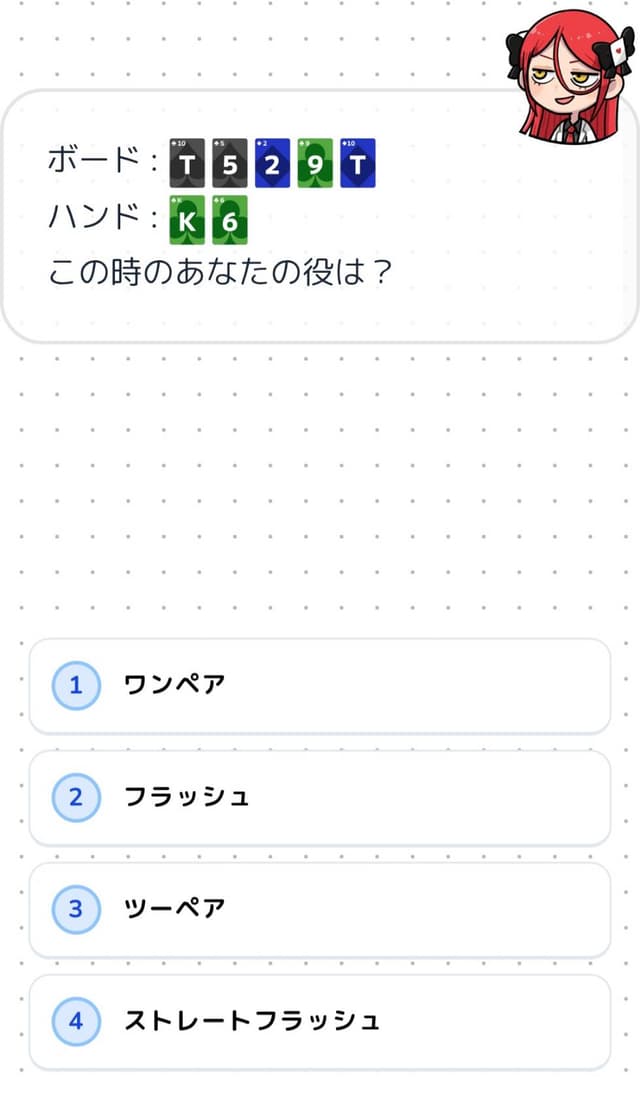
With POKER Q'z, you can study the poker basics introduced here in quiz format. Understand these basics and aim for the next level!

Summary
This article explained what to study to get better at poker. Poker is an imperfect-information game where you can't see your opponent's hand or the next cards to come, so it's not easy to judge whether your own play was correct. Choosing the optimal action requires basic knowledge and logical thinking. Use this article as a reference and sharpen your skills efficiently!