
When most people hear the word poker, the first games that come to mind are probably Texas Hold'em, familiar from international tournaments, and Five Card , a staple in Japan. These are certainly among poker's most representative rules, but the game actually has many more diverse variations.
Whether the table has shared community cards, whether you can exchange your hole cards, and which criteria are used to evaluate hand strength—these factors dramatically change how a game is played and strategized. In fact, some unusual variants have players competing with just four cards.
In this article, we'll systematically introduce poker's many variants and explain what makes each one appealing and unique. Whether you're a beginner or an experienced player, you should find new perspectives and fresh challenges to try.

Common Fundamentals of Poker
Poker has many variations, but most of them share certain core elements. Let's start by covering the essentials at the heart of every poker game.
- ting
The thrill of poker lies in betting.
• : a bet made when you hold a strong hand, designed to extract more chips from your opponents
• bet: a bet made with a weak hand to make opponents fold and win the pot
The goal of poker is to grow your chips across multiple betting rounds.
- strength
Hand rankings are the foundation of poker.
• “High (Hi)” system: a royal flush is the strongest hand, while high card (no pair) is the weakest
• “Low (Lo)” system: hands made of small cards, such as A2345, are the strongest
Which system a game uses varies, so be sure to check the rules.
- Game flow
Detailed rules vary widely—how many cards are dealt, whether community cards are used, how many betting rounds there are, and whether you can exchange cards. However, the basic flow is the same everywhere: after several betting rounds, the player with the strongest hand takes the pot.
The Main Families of Poker
Poker can be broadly divided into the following three families.
1. poker: make a hand using community (shared) cards
2. Draw poker: exchange your cards
3. Stud poker: some of your cards are exposed
From here, we'll introduce representative rules for each family.
1. Flop Poker
Flop poker is any game in which you make a hand by choosing five cards from your own hole cards and the community cards on the table. Alongside Texas Hold'em, we'll also introduce a game called Omaha.
1.1 − Texas Hold'em
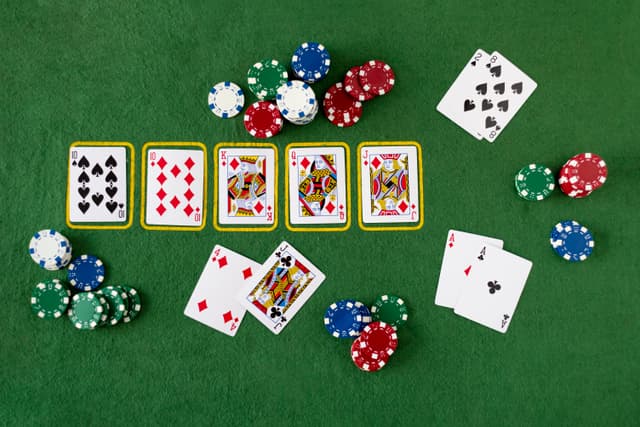
The world's most popular poker game, no introduction needed. Each player is dealt two cards and combines them with the five community cards on the table, choosing five out of seven to make a hand. The most common format is called No-Limit Hold'em, in which there is no cap on bet sizes. With just two hole cards, the rules are beautifully simple—yet the strategic depth is immense, and that is exactly what makes this game so compelling.
Key points
- Two hole cards per player
- Five community cards on the table (choose 5 of 7 total to make your hand)
- No-limit is the mainstream format: simple rules with surprisingly deep strategy
1.2 − Omaha
Each player is dealt four hole cards, and five cards are revealed on the table. You must use exactly two of your hole cards and three community cards. With more hole cards in play, strong hands such as flushes and full houses come together easily, and hand rankings are more likely to overturn than in Texas Hold'em. The popular format is called -Limit Omaha (PLO), in which you can bet no more than the size of the pot.
Key points
- Four hole cards per player
- Five community cards on the table
- You must use two hole cards and three community cards
- Strong hands are common, and with more hole cards, dramatic overturns happen more often.
2. Draw Poker
Draw poker is any game in which you can exchange cards during the hand. Its defining feature is that no cards other than your own are ever visible. Unlike other poker games, how many cards an opponent draws is important information, not just the size of their bet. There's even a tactic of deliberately drawing no cards with a weak hand to make it look strong. Alongside Five Card Draw—a familiar favorite in Japan—we'll look at 2-7 (deuce-to-seven) Triple Draw and a game called Badugi.
2.1 − Five Card Draw
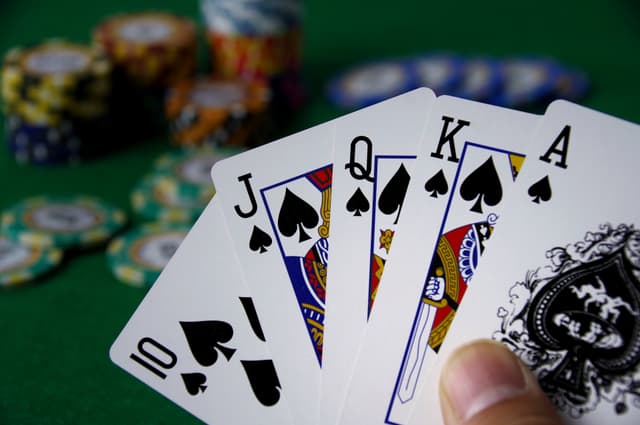
A poker format widely known in Japan; many people have played it with family or friends. Each player is dealt five cards and aims to build a strong hand by drawing. The number of draws varies by rule, but many versions allow three. Hand rankings are the same as in Texas Hold'em.
Key points
- Five cards dealt to each player
- Build the strongest hand through several rounds of draws
2.2 − 2-7 Triple Draw
A poker game in which hand rankings are the exact opposite of Texas Hold'em (though "A2345" does not count as a straight). Because "23457" with mixed suits is the strongest hand, the game is called 2-7 (deuce-to-seven). As the name suggests, you can draw three times. Strong hands are easy to hit, making this a popular draw game.
Key points
- Three draws allowed
- The 2–7 low hand is the strongest
2.3 − Badugi
A game that stands out even among poker variants. Hand strength is judged using just four cards. A four-card hand with no duplicate ranks or suits is called a "badugi." Aces are the strongest and kings are the weakest. "A234" in four different suits is the strongest possible hand. One notable feature is that drawing cards is unlikely to lower the value of your hand.
Key points
- Four cards with all different ranks and suits make a "badugi"
- Aces are the strongest, kings the weakest
- A234 is the strongest hand
3. Stud Poker
Stud poker is characterized by part of your hand being exposed to opponents. The mainstream format is Seven Card Stud, in which each player is dealt seven cards one at a time. Here, we'll look at two variants with different hand-ranking systems.
3.1 − Seven Card Stud High
Each player is dealt seven cards, four of which are exposed to everyone. Hands are ranked using the same criteria as Texas Hold'em. Because each player receives their own seven cards, hand strength is more likely to overturn mid-hand than in Texas Hold'em.
Key points
- Seven cards dealt to each player, four of them exposed
- high-hand criteria as Texas Hold'em
3.2 − Razz
Cards are dealt in the same way as Seven Card Stud High. Hands are ranked using the "low" (Lo) system, and "A2345" is the strongest hand.
Key points
- Dealt in the same way as Seven Card Stud
- ed by low rules ("A2345" is the strongest hand)
4. Hybrid Poker Games
You can also combine the poker games introduced above to create new rules—for example, adding draw elements to flop poker or evaluating hand strength under multiple systems. You can customize games freely to your liking, and trying a new rule set is a fun way to experience poker differently. Let's look at some representative examples of combined rules.
4.1 − Omaha Hi-Lo
Cards are dealt exactly as in Omaha, with four cards to each player. You make a hand using two hole cards and three community cards shared by everyone. The difference lies in how hand strength is evaluated. Regular Omaha uses the "high" system, but here the "low" system is also applied. The pot is split between the strongest high hand and the strongest low hand (though a low only counts if there are five distinct ranks of 8 or lower). An ace is the strongest card under both systems, making it even more valuable here than in most games.
Key points
- Four hole cards plus five community cards, same as Omaha
- The pot is split between the strongest high hand and the strongest low hand
- Special conditions apply for a low, such as needing five ranks of 8 or lower
4.2 − Baduecy
A poker game that fuses the draw games 2-7 Triple Draw and Badugi. Each player is dealt five cards and can exchange cards during the hand. The pot is split between the player with the strongest hand under 2-7 Triple Draw rules and the player with the strongest hand under Badugi rules (in this game, 2 is also the strongest card under the Badugi rules).
Key points
- A fusion of 2-7 Triple Draw and Badugi
- Five cards are dealt with a draw; the strongest hands under both 2-7 and Badugi rules split the pot
Summary
So, what did you think? We've looked at all kinds of poker games, grouped by family. Some let you exchange cards, others expose part of your hand—there are many poker variants with elements Texas Hold'em doesn't have. Some rules even combine multiple games into one. You might even enjoy inventing a new rule yourself. If you're getting a little tired of your usual game, why not try a rule you've never played before?