

If you play poker, you're bound to come across the term “rake.” In a word, it's the fee collected by the casino or poker room. Many players go through games without ever giving it much thought, but whether you understand how rake works and what the going rates are has a direct impact on your long-term win rate. This article lays out poker rake for beginners, covering its meaning, types, typical rates, impact on strategy, and rakeback.
What Is Poker Rake?
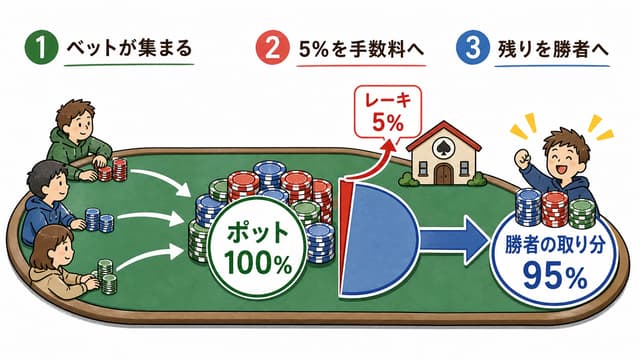
“” is an English word for a garden tool with prongs, and in casinos it originally referred to the rake-shaped tool used to gather chips. Over time, it became the established term for the cut taken by the casino or poker room in poker.
Other casino games such as blackjack and baccarat are structured so that the casino profits naturally through the house edge. Poker, by contrast, is a game played against other players, with the casino taking no part in the action. That's why casinos collect their profit as a “rake,” either by taking a portion of the pot or charging a fee based on time.
In other words, it's easiest to think of rake as something like a table fee for being allowed to play.
What Kinds of Rake Are There?
Rake isn't collected in a single way—it varies by poker room and format. Get familiar with these four main types.
rake: the most common method. A set percentage of the pot is taken as rake after every hand, usually with a cap such as “5% with a 3bb cap.” The standard in online poker.
Time rake: a fixed amount is collected from everyone at the table at set intervals (e.g., every 30 minutes). Often used at high-stakes tables and live casinos.
Dead drop: a fixed amount is collected from the player in the BTN (button) position before each hand begins. Seen at some live venues.
fee: the fee built into a tournament's entry price. In a buy-in listed as “100+10,” the $10 is the fee portion.
Of these, the one that affects your decisions while playing is pot rake, because it's taken directly out of the pot. Time rake and dead drop are fixed costs, so they don't directly influence hand-by-hand decisions.
How Much Is Poker Rake?
Typical rake varies widely depending on the setting (online / live / amusement) and the stakes. Representative benchmarks are as follows.
Online poker: pot rake of 3–5%, usually capped at around 2–5bb. Both the percentage and the cap tend to decrease as stakes rise.
Live casinos overseas: pot rake of 5–10%, or a time rake of roughly $5–15 every 30 minutes.
Amusement casinos in Japan: a time-charge system is the norm, around 1,000–3,000 yen per hour. Since chips can't be exchanged for cash, rake is collected as a time-based fee.
Tournament fee: usually 5–15% of the buy-in. The ratio tends to be lower for higher-buy-in events.
Even for the same game of “poker,” the real cost can be several times higher or lower depending on the collection method and stakes. ing the rake structure before you play is the first step toward becoming a winning player.
How Does Rake Affect Your Playing Strategy?
In an environment with pot rake, the expected value of every hand is reduced by the amount of rake. Specifically, keeping the following three points in mind will help you minimize its impact.
en up the hands you play: the more you enter pots with weak hands, the more rake you lose. s that are only “marginally +” without rake will likely turn negative once rake is included, so tighten your range.
Cut down on preflop calls: many rooms only generate pot rake when a hand goes to the flop (continues postflop). If you casually call from a position other than the BB, you're locked into paying rake the moment the flop is dealt. Make “raise or fold” your baseline, and use calls sparingly—mainly for set-mining.
Aim for small pots: the larger the pot, the greater the absolute rake (up to the cap). In raked games, keep thin value bets and marginal bluffs in check.
Using ranges built for a rake-free environment as-is will cost you EV to the tune of the rake. In real play, it's important to adjust your ranges to account for rake.
What Is Rakeback?
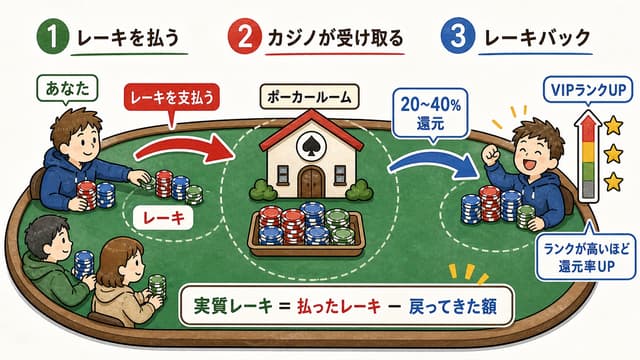
“Rakeback” is a system in which the poker room returns part of the rake you've paid to you as cash back. It's mainly offered in online poker.
Return rates of 20–40% are typical, and many rooms use a tiered structure where higher VIP ranks get higher rates.
How it's paid out varies by room, from “instant cashback” to “weekly/monthly bonuses” to “exchanging items in a VIP store.”
The more you play, the greater the benefit, effectively lowering your real rake rate.
Even at the same skill level, whether rakeback is available can dramatically change your annual bottom line. If you're serious about winning online, rakeback is something you should always check.
Does Rake Mean Players Can't Win?
“The average player can't win when rake exists” is close to correct. Poker is inherently a zero-sum game (the chips winners gain equal the chips losers lose), but rake turns it into a negative-sum game.
That means the total chips at the table keep shrinking over time, so to show a long-term profit you need to be clearly better than the table average. “Playing against opponents weaker than you (table selection)” and “choosing an environment with low rake” are two conditions you can't skip if you want to win.
Conversely, if you manage table selection and rake well, the difference in skill alone is enough to generate solid profits.
Frequently Asked Questions About Rake
Q. Who pays the rake?
A. In most cases, the winner of the hand. The rake is deducted from the pot and the remainder goes to the winner. Losing players don't pay any additional rake.
Q. What's the difference between an ante and rake?
A. An ante is a mandatory contribution that all players put into the pot in advance; it builds the pot and encourages action. Rake is the casino's cut, so its purpose and recipient are completely different. For details on antes, see our article explaining antes.
Q. Which is cheaper: online or live rake?
A. In general, online rake is designed to be cheaper (lower pot percentages and caps). Live rooms have dealer wages and facility costs added on, so the pot-rake percentage tends to be higher, or time-based fees add a fixed cost.
Q. Do tournaments also have rake?
A. In tournaments, rake is added to the buy-in in the form of a “tournament fee.” For example, with a 100buy−inplusa10 fee, the $10 is the casino's cut.
Q. Is there poker without rake?
A. Home games held at private residences and freerolls with a completely free entry generally have no rake, or rake is designed to be extremely small.
Summary
Poker rake is the fee collected by casinos and poker rooms, paid for the privilege of playing the game. There are four types—pot rake, time rake, dead drop, and tournament fee—and typical rates vary greatly by environment and stakes.
Because rake makes poker a negative-sum game, sticking to the four principles—“play tight,” “call less,” “use rakeback,” and “choose weaker tables”—is what leads to long-term winning.
If you want to build a feel for ranges that win even with rake, practice the right decision hand after hand with the poker learning app “POKER Q'z.”