

If you play tournaments, you have probably heard the word “ante” a lot. If you mostly play cash games, it may be less familiar—but whether you understand how the ante works has a direct impact on your tournament win rate. This article explains how antes work, why they exist, and how they affect strategy, in beginner-friendly terms.
What Is an Ante in Poker?
Under standard poker rules, the SB (small blind) and BB (big blind) are forced to put chips into the pot every hand. In addition to these blinds, an “ante” is an extra mandatory contribution paid by everyone at the table.
SB / BB: a forced bet paid by only two players, from fixed positions
: an extra mandatory contribution paid by everyone
Originally, every player paid the same amount each hand. In live poker today, however, “BB ante” rules, where the player in the big blind posts the ante for everyone, are increasingly common. This is a practical convenience that reduces the hassle of collecting chips—it doesn't change the effect on the table as a whole.
Why Do Antes Exist?
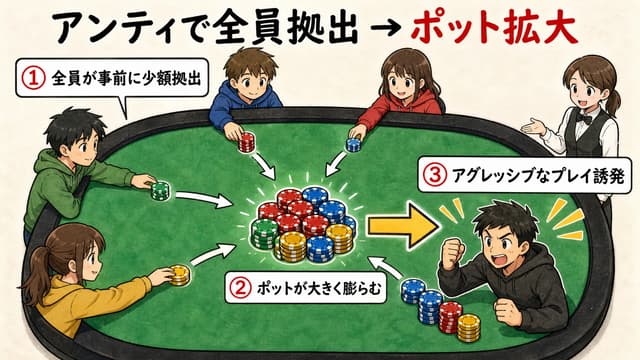
In a word, the purpose of an ante is to “build a bigger pot from the start and keep the action alive.”
Chips are in the pot before the hand begins → the expected value of playing a hand rises
As a result, players get involved in more hands, and folding every hand becomes a losing proposition
play becomes almost mandatory, keeping the game moving
In tournaments especially, antes are introduced to force the action, preventing the table from stalling with blinds alone and keeping only tight players alive. That is why tournaments that add antes in the later stages—or run with antes from the very start—have become the standard.
How Does an Ante Change Strategy?
An ante changes the required equity (pot odds) for every hand. Let's look at the numbers.
Example: blinds 200/400 with a BB ante of 400
Without an ante: starting pot = SB 200 + BB 400 = 600
With an ante: starting pot = SB 200 + BB 400 + ante 400 = 1,000
Even if you raise to the same 400, the total blinds you can win increases from 600 to 1,000. In other words, there is now real incentive to take the pot down: “everyone folds and you collect 1,000 on the spot.”
This structural change has the following strategic effects.
ing wider is fine: stealing (taking the pot by getting everyone to fold) becomes more profitable, so late position can raise aggressively
The BB's calling range widens too: since the ante is already paid, the required equity drops, so the big blind can defend wider
More 3-bet / 4-bet battles: with a bigger pot up for grabs, re-raising against steals becomes profitable more often
How Should You Play the BTN with an Ante?
The position that benefits most is the BTN (button). Open from the BTN, and if both SB and BB fold, you collect the entire pot including the ante on the spot.
Without an ante: you win SB 100 + BB 200 = 300 chips
With an ante (100 total): you win 300 + 100 = 400 chips
Since the profit is 33% higher, the standard play is to open a wider range from the BTN when an ante is in play. In practice, that means expanding to include Ax, Kx, suited connectors, and small pocket pairs.
The key factor is your opponents' 3-bet frequency. At a table where SB and BB 3-bet often, steal efficiency drops, so tighten your range a little. At a table where opponents fold easily, open wider and collect—adjusting with that kind of contrast is what matters.
How Should the BB Defend After Posting the Ante?
At a BB-ante table, the BB posts the ante for the whole table. It is natural to think, “Paying for everyone sounds like a bad deal,” but when you run the numbers on required equity, it actually means more opportunity.
Example: blinds 100/200 with a BB ante of 200, and the BTN opens to 500
Amount the BB needs to call = 300 chips
With an ante: pot = 100 + 200 + 200 + 500 = 1,000 chips → required equity = 300 ÷ (1,000 + 300) ≈ 23%
Without an ante: pot = 100 + 200 + 500 = 800 chips → required equity = 300 ÷ (800 + 300) ≈ 27%
With an ante, the required equity is lower—which means calling is profitable more often. What's more, the opponent's opening range is also wider because of the ante (it includes weaker hands), so the BB should defend wider.
As a rough rule of thumb, you can almost never fold suited hands. s and suited aces are often + once their post-flop potential is factored in.
How Much Is a Typical Ante?
Ante sizes vary by setting, but here are the general guidelines.
Online tournaments: equal to the BB, or around 1/2 to 1 BB
Live tournaments: a BB ante equal to the BB is the standard
s: no ante is the norm, but high-stakes tables sometimes use a BB ante (1–5)
Remembering “ante = same as the BB” gives you a good baseline. As blinds rise in the later stages of a tournament, the ante rises with them, so the importance of stealing grows the deeper you go.
Frequently Asked Questions About Antes
Q. Is the ante taken automatically online?
A. Yes—online, the app adds it to the pot automatically. In live play, as mentioned above, the BB usually posts the chips for everyone.
Q. What is the difference between an ante and rake?
A. An ante is a mandatory contribution that circulates among the players and is eventually taken home by the winner of the hand as part of the pot. , on the other hand, is a fee paid to the casino or poker room; it is deducted from the pot and never comes back. For details, see our article on rake.
Q. What if you can't post the exact BB ante in a live game?
A. Before your turn comes around, ask a neighboring player or the dealer to change your chips into smaller denominations. The standard rule is that the ante must be posted in the exact amount. We also cover how to do this in 4 Rules Every Live Poker Beginner Should Know.
Q. Do cash games have antes too?
A. Some settings use them, such as high-stakes tables and games in Macau, but at low-to-mid-stakes cash tables, no ante is the standard.
Summary
An ante is “an extra mandatory contribution paid by everyone,” and its purpose is to build the pot from the start and keep the action alive. The amount each player posts per hand may look trivial, but its strategic impact is huge.
At tables with an ante, opening wider is fine (especially from the BTN)
The BB should defend wider (because the required equity drops)
More 3-bet / 4-bet battles make range adjustments essential
That the correct action for the same hand changes with and without an ante is part of what makes poker interesting. If you play tournaments, build an ante-aware feel for ranges early. And if you want to practice making the right decision hand after hand, try sharpening your range instincts with the poker training app “POKER Q'z”.