

Introduction: How Do You Actually Get Better at Poker?
Hello, everyone!
In this article, we share a roadmap for improving your poker skills efficiently, aimed at players who have learned the rules but aren't sure how to get better.
Poker is a deep card game in which you aim to win through strategy and psychological play. But because luck plays a role, even when you win a pot it isn't easy to tell whether your action was the right one, that is, whether it was the action that maximized expected value.
To become a strong player, you need the ability to work out and choose the optimal action for each situation on your own. Building that skill requires knowledge of the fundamentals of poker (pot odds, understanding the nature of the game, and so on), strategy, and exploitative play.
This article lays out how to study poker and learn strategy in a systematic way and proposes a concrete approach to improving. We'll also recommend useful articles and tools along the way.
Poker is a game you can genuinely improve at with consistent effort. Use this article to sharpen your skills efficiently and become a player who enjoys the game more, and wins more.
What This Article s
This article is organized into the sections below. Each topic is explained in detail, along with tools and reference articles that support your learning.
- The Fundamentals
We explain the core concepts you need to improve at poker: how to fix the plays beginners tend to make, basic ideas such as pot odds and (minimum defense frequency), and the nature of the game. We'll also introduce helpful articles and tools.
- GTO Strategy
GTO (Game Theory Optimal) is a key concept at the heart of poker strategy. In this section, we explain what GTO is and why you need to learn it, along with a concrete process for studying GTO strategy and tools you can use.
- ative Strategy
We explain exploitative strategy: spotting your opponents' weaknesses and using them to maximize your profit. Building on GTO as a foundation, we show with concrete examples how to apply exploitation in specific situations.
By the end of this article, you'll have a systematic path from poker fundamentals to advanced strategy for improving your skills efficiently. Use the knowledge and tools covered at each step and aim to become a stronger player!
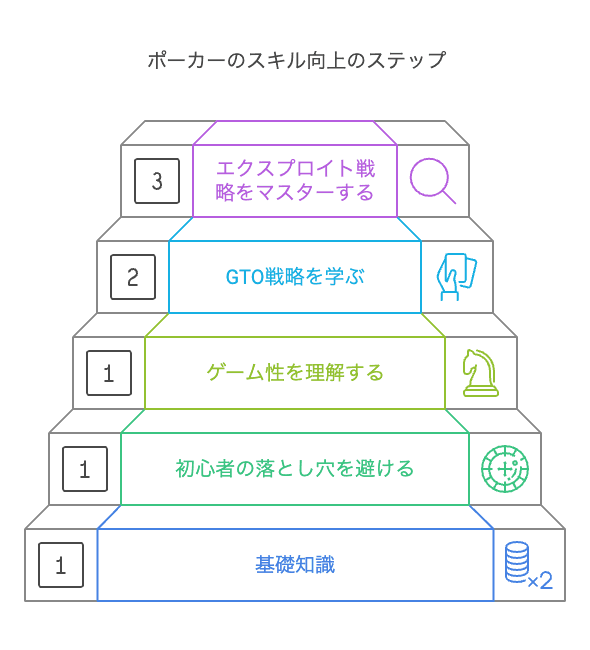
1. Understanding the Fundamentals
The first step toward improving at poker is building a solid understanding of the fundamentals. In this section, we cover the mistakes beginners tend to make, the key concepts in poker, and the nature of the game itself. Once you've got these down, you'll understand poker more deeply and be ready to learn GTO strategy and exploitative strategy effectively.
1.1 Breaking Out of the Beginner Stage
Learning the rules alone can let bad habits creep in without you realizing it. For example:
- ing (calling to enter the pot preflop)
- Cold-calling a 3-bet (calling to enter the pot when another player has opened and someone else has re-raised)
- ting (betting before the original raiser gets to act)
In general, these actions have low expected value. So breaking these habits is a key step toward leaving the beginner stage behind.
Points beginners should pay particular attention to:
- Limp less: raise aggressively to create more situations where you take control of the hand.
- Avoid calling with weak hands: don't force your way into pots; build the habit of playing hands with positive expected value.
- Don't donk bet: get into the habit of checking to the player who last raised or bet on the previous street.
Recommended article: ↓

1.2 Fundamentals: , MDF, Alpha, and More
To play poker strategically, you need a solid understanding of basic mathematical concepts such as pot odds and minimum defense frequency (MDF). Mastering them lets you evaluate risk and reward objectively.
fundamentals:
- odds: a metric for judging whether a call is worthwhile based on your equity.
- MDF (minimum defense frequency): the minimum frequency with which you should defend so that your opponent's bluffs are not profitable.
- Alpha (α): the fold equity required to make a bluff profitable.
It's very important to understand these concepts at least once. You'll learn why GTO can't be exploited and be able to apply the ideas to your own play. For example, using MDF when bluff-catching leads to accurate decisions.
Recommended article: ↓
1.3 Understanding the Nature of the Game
In poker, correct play does not always show up in your results. It's important to understand this “variance” and develop the mental control not to be swayed by short-term results. s in particular involve big upswings and downswings, so a long-term perspective is essential.
For example, imagine a player whose true skill level is break-even in the long run playing a $100 buy-in, 100-entrant tournament 100 times. Here is what a simulation of their results looks like.
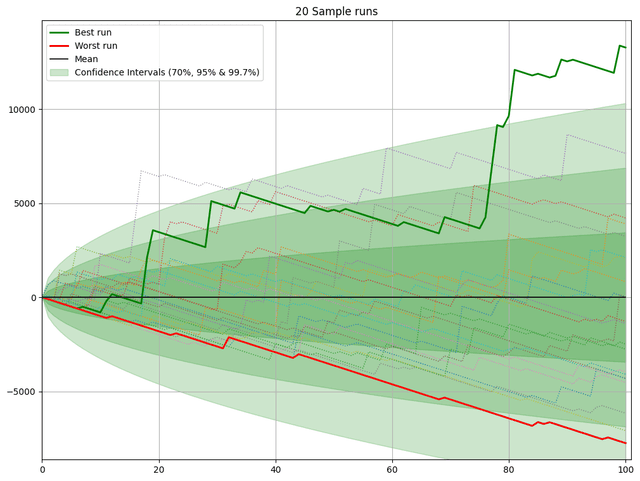
The vertical axis shows profit/loss in dollars, and the horizontal axis shows the number of tournaments played.
Looking at Figure 1, you can see that even though the player's true skill level is the same, the swings in results are enormous.
That's the nature of tournament poker.
To improve, you need to understand this reality, avoid getting too caught up in results, and focus on whether you made the best play.
Recommended articles: ↓
2. Learn About GTO: The Key to Improving at Poker
To improve at poker in a serious way, understanding GTO (Game Theory Optimal) strategy is essential. GTO strategy is a theoretical approach that lets you play without being exploited by opponents, and learning it helps you reduce your own weaknesses. In this section, we explain GTO from its basic concepts to how to study it and the tools you can use.
2.1 What Is GTO?
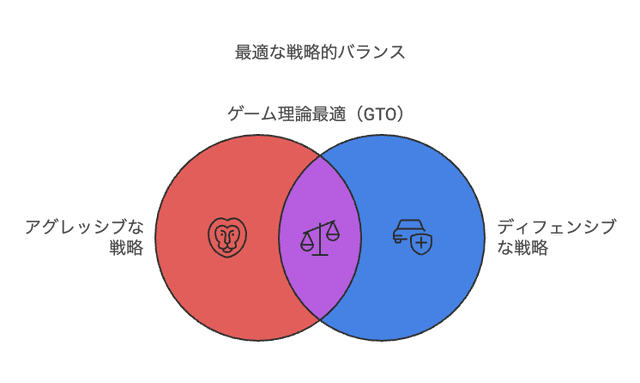
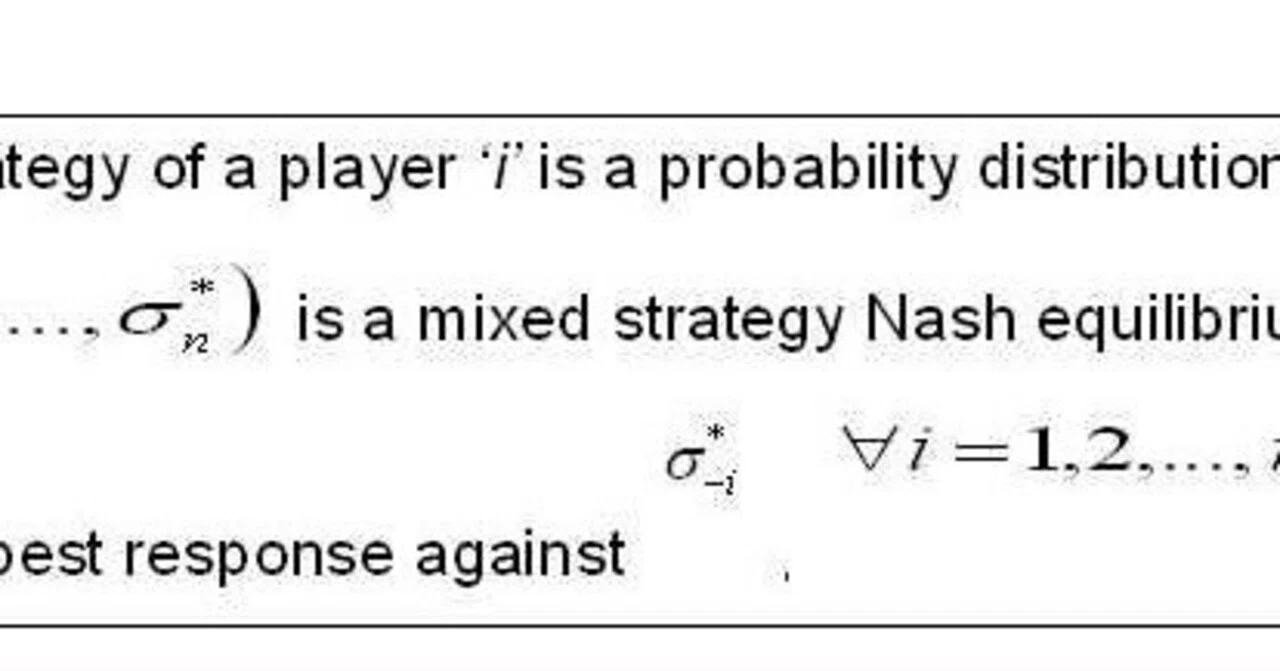
In poker, GTO (Game Theory Optimal) means “equilibrium play that cannot be exploited by opponents.” It's a strategy in which you take theoretically optimal actions no matter how your opponent plays, keeping your losses to a minimum.
For example, balancing your bluffing and calling frequencies appropriately makes it difficult for opponents to predict biases in your play and exploit them. In this way, GTO is the theoretical foundation of poker.
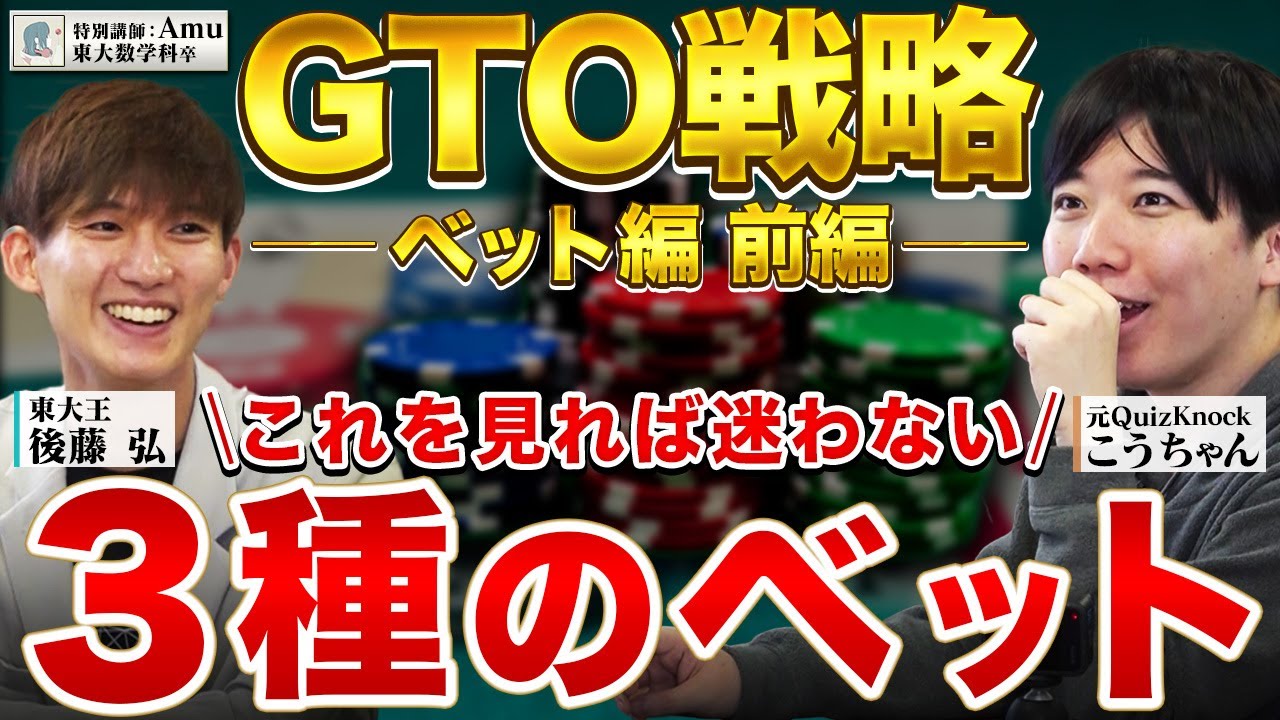
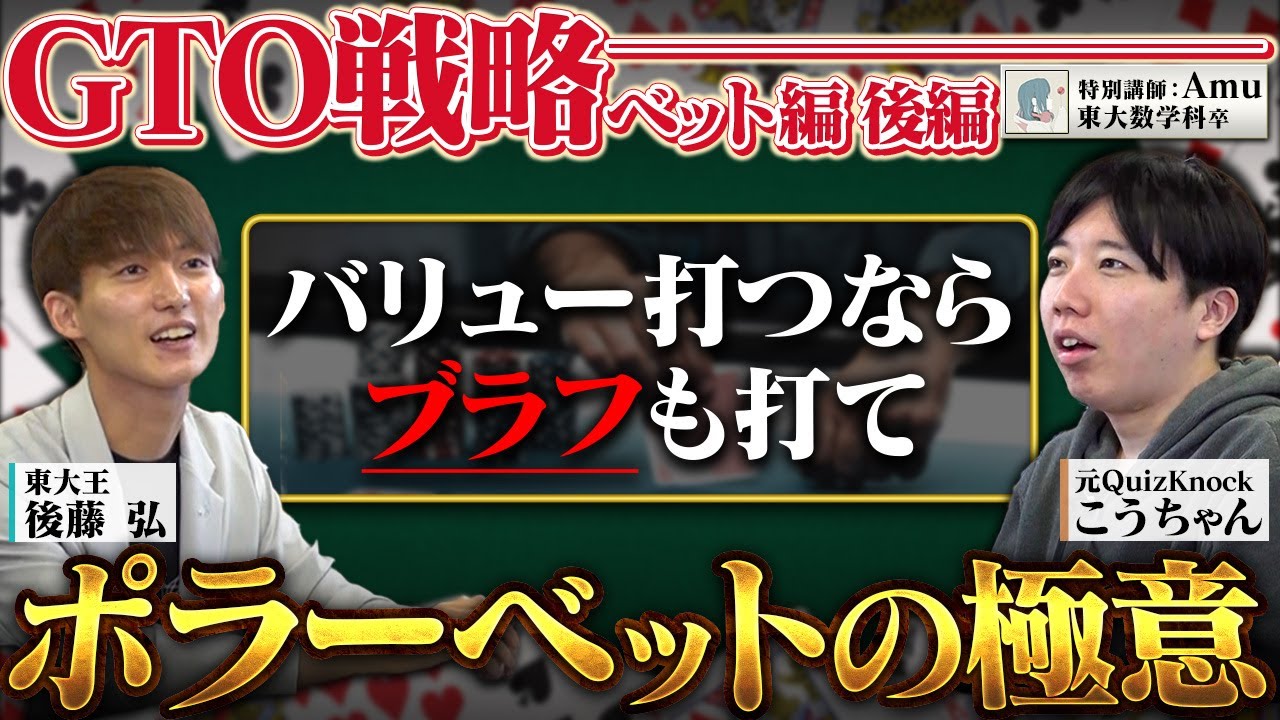
Recommended GTO content: ↓
2.2 Why Do You Need to Learn GTO?
Here's why you should learn GTO strategy:
- You won't be exploited
If you play based on GTO, you won't be exploited even against strong opponents. This is very important for keeping your long-term results stable.
- It's the foundation for exploitative strategy
Learning GTO develops your ability to analyze how far an opponent deviates from equilibrium. Spotting these deviations lets you apply exploitative strategy effectively.
- Theory-based play keeps your mentality stable
Because GTO-based play is backed by mathematics, you can keep playing with theoretical grounding instead of being swung around by results.
Recommended article: ↓

2.3 How to Study GTO
GTO strategy can seem difficult at first, but following a step-by-step approach makes it much easier to grasp.
Step 1: Understand the fundamentals
Start by mastering the basic concepts of poker, such as pot odds, MDF, and bluffing frequency. This builds the foundation for learning GTO strategy.
Step 2: Start with simple strategies
You don't have to start with complex strategy. For example, simplify your play by keeping bet sizes fixed or focusing your study on the positions you play most.
Step 3: Use tools
To actually study GTO strategy, using tools such as apps is recommended. Tools let you learn how to play specific situations.
2.4 Tools You Can Use
Here are some useful tools for learning GTO strategy:
POKER Q’z
- POKER Q’z is a learning platform that supports a wide range of levels, from beginner to advanced, with training that lets you study GTO step by step from the fundamentals to real-game scenarios. The AI-powered explanations for each problem are a particularly appealing feature.
- It covers both cash games and tournaments, with a lesson mode for building knowledge and ways of thinking, plus a practice mode for honing your decision-making in realistic play.
- Analyzing your play data lets you see your own tendencies and weaknesses, and your play log lets you track your learning progress. With your challenges made visible, you can level up efficiently.
Download here: ↓
https://pokerqz.comGTO Wizard
- GTO Wizard is a tool for learning GTO strategy. It provides detailed hand analysis and scenario-specific solutions so players can learn optimal play.
- It is widely used mainly by intermediate and advanced players as a useful tool for improving poker strategy.
Official website: ↓
https://gtowizard.com/ja/
3. Read Your Opponents! Understanding Exploitative Strategy
To win at poker, it's important to execute exploitative strategy: spotting your opponents' playing tendencies and using them to maximize your profit. In this section, we explain the basic concepts and mindset of exploitative strategy in concrete terms.
3.1 The Difference ween GTO and Exploitation
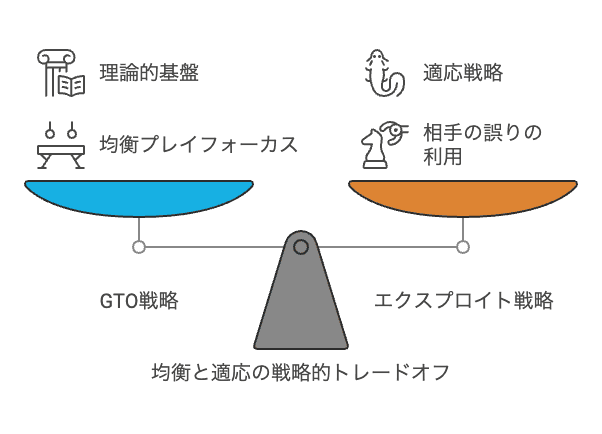
In poker, GTO strategy is a theoretical equilibrium strategy that aims to avoid being exploited no matter how your opponent plays. Exploitative strategy, on the other hand, is an approach that maximizes your own profit by taking advantage of your opponent's tendencies and mistakes.
To sum up…
- GTO strategy: a strategy for avoiding being exploited yourself. It forms the foundation for stable, long-term profits.
- Exploitative strategy: spotting your opponent's weaknesses and profiting as much as possible when they deviate from theoretically correct play.
For example, if an opponent bluffs at an extremely high frequency, calling more often and profiting from their bluffs is exploitative strategy.
Recommended articles: ↓
https://youtu.be/xnii87T97CY
https://japan.gtowizard.com/blog/principles-of-gto/
3.2 The Exploitation Mindset
The following steps are a good way to approach exploitative strategy.
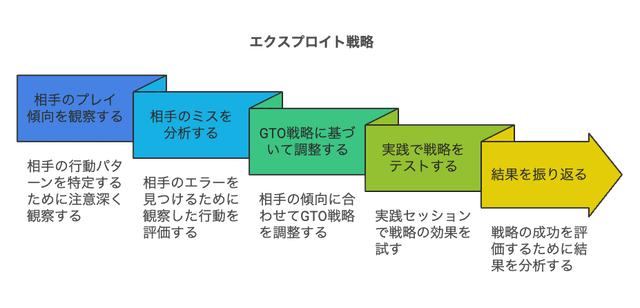
1. Observe your opponent's tendencies
The first step in exploitative strategy is observing your opponent's tendencies. the following points to see what kind of play they prefer.
- Preflop tendencies: for example, limping (calling) frequently, or a low 3-bet frequency.
- Postflop tendencies: a high continuation-bet (c-bet) frequency, or playing passively on the turn and river.
- ing frequency: whether they bluff a lot in specific situations, or lean toward value.
2. Analyze your opponent's mistakes
Based on your observations, analyze what kind of mistakes your opponent is making.
- Preflop mistakes: for example, if their hand range is too wide, attack aggressively by 3-betting (re-raising) more.
- Bluffing frequency mistakes: if your opponent bluffs a lot, widen your calling range.
- ing frequency mistakes: if your opponent folds a lot, increase your betting frequency.
3. Make adjustments on a GTO foundation
The basics of exploitative strategy are to use GTO as your foundation and adjust the balance according to your opponent's tendencies. For example, if your opponent tends to fold too much on the turn, you can profit by betting even when GTO would call for a check.
4. Test it in real games
Try the strategy in actual play and review the results. Exploitative strategy varies by opponent, so apply it while flexibly changing your approach. One point to be especially careful about is responding appropriately when your opponent adjusts their strategy.
Recommended article: ↓
https://japan.gtowizard.com/blog/exploitative-dynamics/
3.3 Concrete Examples of Exploitation
Below are concrete examples of exploitative strategy.
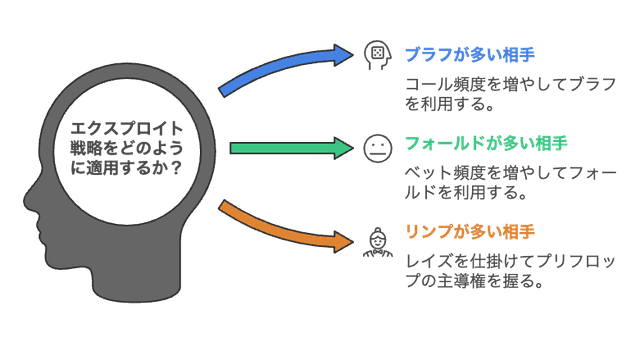
- Against an opponent who bluffs a lot: if your opponent bluffs frequently, you can profit by increasing your calling frequency. In this case, use MDF (minimum defense frequency) as a reference while deliberately adjusting your defense frequency according to the opponent's tendencies.
- Against an opponent who folds a lot: if your opponent folds frequently on the turn and river, maximize your profit by bluffing more. Widening your bluffing range compared with GTO strategy is effective here.
- Against an opponent who limps a lot preflop: if your opponent limps often preflop, raising with a wide range makes it easier to take control of the hand. This strategy is especially effective when your opponent tends to play passively postflop.
3.4 Cautions
Keep the following points in mind when using exploitative strategy:
- The opponent may adjust: your opponent may notice your exploitation and adjust their strategy. To handle this, always keep observing changes in your opponent and flexibly modify your own strategy.
- Be careful not to overdo the imbalance: to avoid the risk of being exploited yourself by leaning too far into exploitation, it's important to keep GTO's balance in mind.
Exploitative strategy has the potential to generate significant profits by making effective use of your opponent's weaknesses. Master the GTO fundamentals and make appropriate adjustments for each opponent to become an even better player!
Reference Links and Tools
Fundamentals
- Fundamentals article
- Mathematical Misconceptions in Poker
- Variance and Bankroll Management
- Poker results simulation site
GTO Strategy and Tools
- [For Beginners] A New Project That Makes Poker Easy for Anyone! The Right Way to Think About Preflop Using GTO [NLH Cash Game Tips #1] (YouTube)
- [Preflop] Remember Just These to Stand Out in Poker! What Are the 4 Easy-to-Remember Preflop Rules? [NLH Cash Game Tips #2] (YouTube)
- [Betting] What Are the 3 Types of Bets Advanced Players Use Differently? Learn GTO the Easy Way with a Quiz! [NLH Cash Game Tips #3] (YouTube)
- [Betting] What Is a Polarized Bet? A Complete Guide to the Mistakes Beginners Make! [NLH Cash Game Tips #4] (YouTube)
- GTO article 1
- GTO article 2
- POKER Q’z official site
- GTO Wizard official site