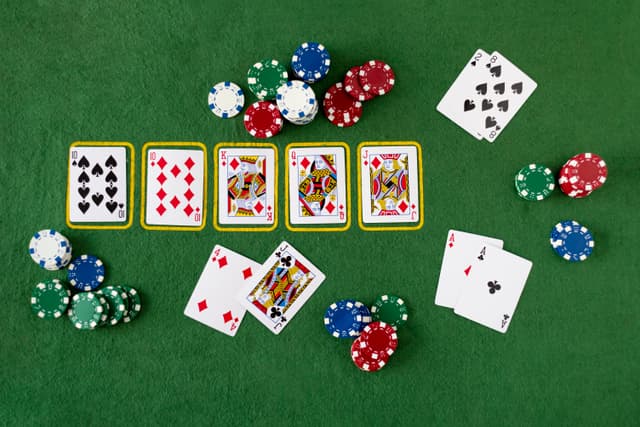

Ever Had a Frustrating Poker Moment?
"I can follow a range chart preflop, but once the board runs out, I have no idea what to do..." — does that sound like you? Many players feel exactly this way.
I felt the same way, especially when I was a beginner. And postflop, the pot keeps growing, so a single mistake can be fatal. You've probably agonized over a big bet, called it, and then realized your hand was nowhere near good enough — leaving you thinking, "Why did I even call back then?" If we study postflop play properly in advance, we can cut down on those costly mistakes!
In the previous article, we covered 2 bad habits to fix right away on the way out of beginner status preflop. In this sequel, we'll introduce 2 more bad habits beginners should fix first, this time postflop: "calling just because" and the "giant bet."
(Note: these are not standard poker terms — they're terms used only in this article.)
Fix these, and you'll take your first step beyond beginner status!
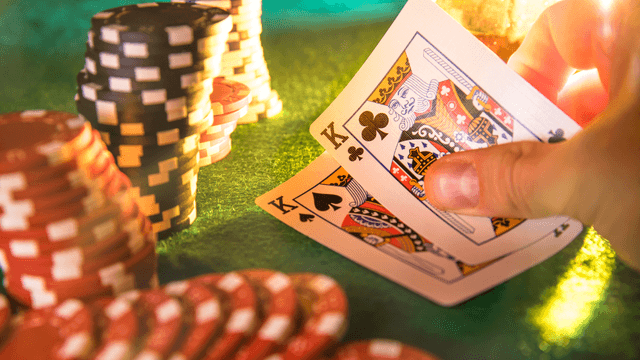
1. Bad Habit ①: Calling Just Because
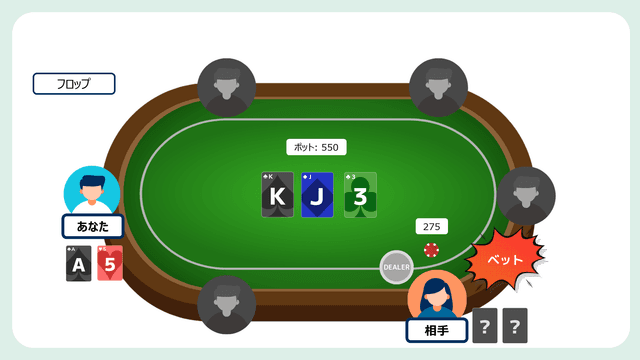
You're in the big blind holding A 5. You called the button's 250-chip raise, so the pot is 550 chips, including the folded small blind's contribution. You check, and the button bets 275 chips (half the pot).
Are you the type to think, "I have the strongest card — an ace — and if an ace hits, I win, so let's just call!"?
Stop that "call just because" right now
"A call like "I have an ace, so I'll call just because" only wastes chips. Cut it out immediately.
First, what are the actual odds of an ace landing on the board? The short answer is only about 12%. In other words, you'll hit your ace only about 1 in 8 times. And even if you do hit it, you'll lose to aces with strong kickers like A T, or to hands of two pair or better like K 3. So even when your ace hits, it's not a monster hand.
Now, there's an incredibly simple way to estimate the odds of that ace hitting, so let me introduce it. There's no difficult math involved — anyone can use it right away, even if you're not great with numbers. Be sure to remember it.
The 2%–4% Rule for Estimating Your
On both the flop and the turn, you can estimate the chance of the card you want hitting by the river like this:
: (number of outs) × 4 (%)
: (number of outs) × 2 (%)
An incredibly simple rule, right? It works this way because a deck has 52 cards. Let's apply it to the chance of hitting an ace in the situation above. Since you hold A, the remaining aces are A, A, and A — 3 cards. Because we're calculating the flop probability,
3 × 4 = 12 (%)
So your ace hits only about 12% of the time — roughly 1 in 8 times.
Beginners tend to "call just because" far too often. Before you call, pause and take a breath. And the 2%–4% rule above is really handy, so memorize it and use it in all sorts of spots!
2. Bad Habit ②: The Giant Bet
The Mighty Gian and the Feeble Nobita — When Strong, When Weak
Sitting at the poker table in front of you are Gian and Nobita. Gian always has the strongest hand, while Nobita always has no pair (high cards) — an extremely weak hand. How would you play against these two?
① When Gian bets, you know you're beat every time, so you'd fold every hand.
② Even if Nobita keeps checking, his hand is so weak that you'd bluff-bet to push him off the pot, even with a weak hand of your own.
That's what you'd do, isn't it? When you already know exactly what Gian and Nobita hold, dealing with them becomes trivially easy. And because of that, Gian never gets called and Nobita always gets pushed off the pot, so their chips never grow.
Here's the question.
Aren't your own actions turning you into "Gian and Nobita" too?
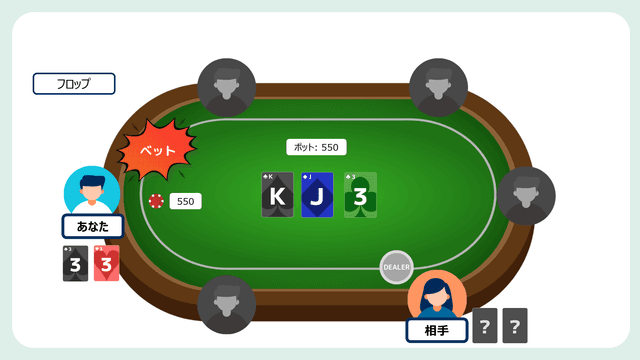
Consider a situation similar to the last one. You're in the big blind with 3 3. You called the button's 250-chip raise, so the pot is 550 chips, including the folded small blind's contribution. Then, by a stroke of luck, the flop brings 3 and you make trips. Thinking "I've made a super strong hand, so let's bet big!" you fire 550 chips (a full pot-sized bet). But here's the conclusion:
Stop that "giant bet" right now
Isn't that bet a giant bet? "I made a strong hand, so I bet a lot" means "I bet big when I'm strong, and I don't when I'm weak." That makes you exactly Gian and Nobita. You finally made trips — a genuinely strong hand — but your opponent folds right away, and you end up winning almost no chips at all.
To avoid falling into the giant-bet trap, keep these points in mind:
・Consider checking with strong hands, too.
・Consider bluffing when your hand is extremely weak (no pair, for example).
Donk Bet
A bet in the situation above — a bet made by the caller before the opponent who bet or raised — is called a "donk bet." Making this kind of bet as a beginner is often costly, so as a general rule, avoid donk betting.
Remember: "If you called, check."
If you want to know exactly why it costs you chips, or if you want to take the next step up, the article below explains donk bets in detail — be sure to check it out.