

Have you ever been all-in in a poker hand and heard the dealer or your opponent ask “Twice?” It’s a common option in ring games, but the first time you hear it, you’re likely to wonder: “What is that?” or “Should I take it?” This article breaks down what running it twice means, how the process works, its expected value, its impact on rake, and when to decline — all in beginner-friendly terms.
What Is Running It Twice?
“Twice” is shorthand for “run it twice”, an option that deals the remaining board two times and splits the pot according to each result when everyone is all-in before the river.
Its main purpose is to reduce variance (the swing of luck)
It is mainly used in ring games (cash games)
If every player who is all-in agrees, the board is dealt twice
Rules vary by casino / poker room — some restrict it to heads-up pots, while others allow three or more runs
Everyone has to agree, so if any player declines, the hand is decided with a single run, as usual. ing beforehand whether your table allows running it twice makes the process smoother.
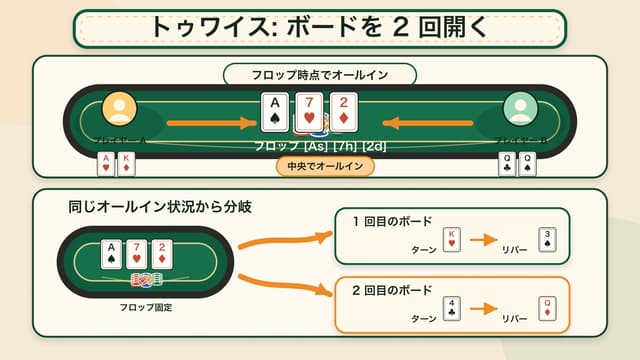
How Does Running It Twice Work?
Let’s look at a typical example to see the exact flow.
An all-in occurs (on the flop or turn)
The dealer asks whether everyone wants to run it twice
All players agree → running it twice is confirmed
s are opened, then the first board runs out (turn → river)
The result is recorded and half of the pot is awarded
The board is reset and run out a second time (new turn → river)
The remaining half of the pot is awarded
If the first and second runs have different winners, the pot is “chopped”, with each player taking half. If the same player wins both runs, they naturally take the full pot.
Is Running It Twice Good or Bad for You?
The short answer is that your chip (expected value) does not change. Running it twice only reduces variance — your long-term expectation is exactly the same whether you do it or not.
Let’s calculate it for an all-in on the turn. Example: your opponent is currently ahead, and you need to catch any of the five cards AAAJJ to win (5 outs). There are 44 cards left in the deck.
① Running it once: your chance of winning is 5/44 → EV = pot size × 5/44
② Running it twice: both runouts are outs = (5×4) / (44×43) = 5/473. Exactly one runout is an out = (5×39×2) / (44×43) = 195/946. Since winning both runs pays the full pot and winning one run pays half,
1 × (5/473) + (1/2) × (195/946) = 5/44
Again, this matches 5/44. The same invariance is known to hold for all-ins before the flop or on the flop.
Why Does Running It Twice Reduce Variance?
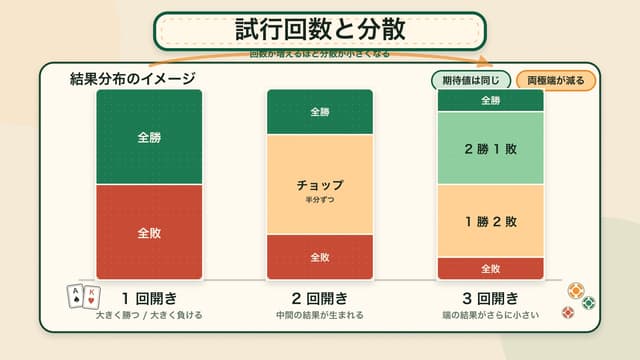
“ EV, lower variance” is the core point. It follows from a basic property of probability: splitting the result into two independent runs makes extreme outcomes less likely.
One run: “win everything or lose everything” — maximum swing
Two runs (= running it twice): “win both / chop / lose both” — the chop acts as a buffer
Three runs (= running it three times): “win all / 2–1 / 1–2 / lose all” — an even bigger buffer
In other words, when you have an edge but don’t want to risk it on a single runout, running it twice keeps your long-term EV unchanged while damping the swings for the day. That is the principle.
How Does Running It Twice Affect Rake?
The thing to watch is how rake (the casino’s cut) is handled. In some rooms, running it twice can trigger extra rake.
Treated as split pots: some rooms view the two runs as two separate pots and take rake from each
Treated as one pot: other rooms treat it as a single pot and rake it only once
already reached: if the pot is already capped, running it twice adds no extra rake
Even with the variance benefit, extra rake can make running it twice EV-negative. Understand how rake works, and check the table’s rules before you agree.
When Should You Decline Running It Twice?
Whether to accept or decline running it twice is a decision that should change with your situation.
Good times to accept:
You are ahead in equity and want to lock it in (= reduce variance)
You want to limit variance in a big pot
The room charges no extra rake, or the impact is small
Good times to decline:
You are behind in equity and want a shot at a comeback (= maximize variance)
Your opponent proposes it in a room where rake increases significantly
You want to enjoy a single-run gamble for fun
Some strong players split the decision mechanically: accept running it twice when they are winning in EV, decline when they are losing.
What Are Slice and Knock?
Besides running it twice, there are a few options for dealing the board multiple times.
Slice (run it three times): the board is dealt three times, reducing variance further. Also called “triple.”
Quad (run it four times): four runs, rarely seen in high-stakes cash games
Knock (run it once): deliberately settling with a single run; the term used when you decline an offer to run it twice
Not many rooms offer options with three or more runs, but they can be available in high-stakes private games and on some online cash sites.
Frequently Asked Questions About Running It Twice
Q. Can you run it twice in tournaments?
A. Generally, it is not available in tournaments. Because tournament chips convert to prize-pool expected value (ICM), splitting the pot gets complicated. Remember it as a ring-game-only option.
Q. Can you run it twice online?
A. Most major online cash-game sites allow it. If you enable “” in your settings, the board will be dealt twice automatically whenever your opponent agrees.
Q. Can the second run be changed after seeing the first?
A. No. The two runs differ only in the board: the hands and situation stay the same while the deck is reshuffled and the turn and river are dealt again. No further betting action takes place.
Q. Does everyone have to agree?
A. Yes — every player involved in the all-in must agree. If even one player declines, the board is dealt once as usual and the hand is decided that way.
Summary
Running it twice is a ring-game option for when you want to reduce variance. Three points to remember:
EV does not change: one run and two runs have the same expected value
decreases: “win everything or lose everything” is softened by the chop
Check the rake: some rooms charge extra rake when the board is dealt twice
Using it flexibly by situation — smoothing variance for a stable session, or deliberately declining to chase a comeback — is the fastest path to improvement. Combine it with how rake and equity work, and you will build better judgment at ring games.
If you want to learn variance and expected value in poker more systematically, in the poker learning app POKER Q'z, try lessons such as “Learning Expected Value and How to Think About Poker” and “Variance and Management Basics”.