

If you want to finish near the top in tournament poker, hand strength and alone aren't enough. There's one more concept you need: (Independent Chip Model). It's the idea that “chips aren't worth their face value” — a crucial perspective that takes your decisions near the bubble and at the final table (FT) to the next level. In this article, we'll break down what ICM is, why it matters, and how bubble factor and risk premium work — all in beginner-friendly terms.
What Is ICM?
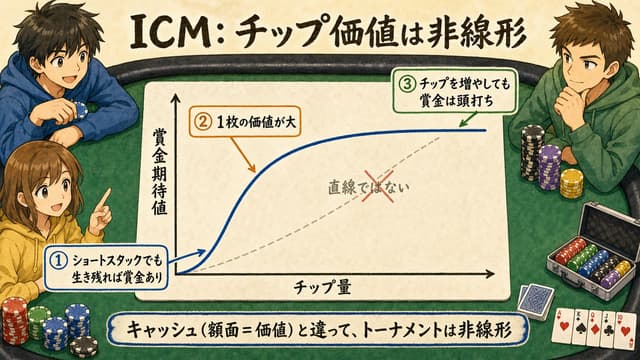
ICM stands for Independent Chip Model, and it's a model that converts your tournament chips into “prize equity” (expected prize value).
s: 1 chip = its face value in money (face value equals actual value)
s: 1 chip is later cashed out as prize money based on your finishing position → chip stacks and prize equity are non-linear
Even with the same 1,000 chips, prize equity differs between a short stack's 1,000 and a chip leader's 1,000. ICM is the mathematical way to express this.
Why Is Tournament Chip Value Non-Linear?
Thinking about the tournament prize structure makes this easier to picture.
s are tiered by finishing position: 1st / 2nd / 3rd... each position has a set amount, and the higher you finish, the bigger the jump
Lose your chips and you're out: 0 chips = 0 prize money (or the minimum payout if you're already in the money). As long as you have chips, a higher finish is still possible
Surviving has value in itself: even on a short stack, staying alive keeps you in contention for the money, so “survival value” can exceed face value
As a result, the chip value curve is concave (bulging upward): the first few big blinds carry a lot of value, but later the prize value per big blind levels off.
That's the mathematical basis for “a short stack's 1 BB is worth more than a chip leader's 1 BB.”
What Is Bubble Factor (BF)?
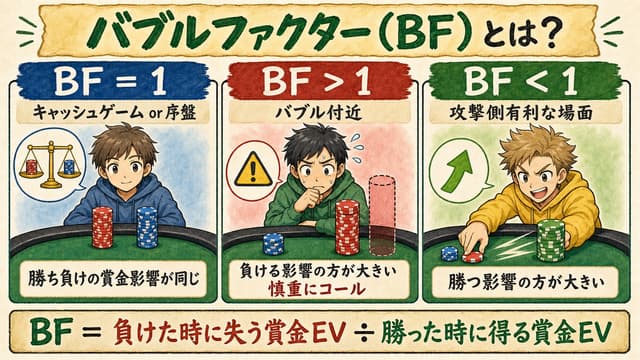
The most practically important metric in ICM is the bubble factor (BF).
= prize equity you lose when you lose ÷ prize equity you gain when you win
BF = 1: winning and losing affect your prize equity equally (= same as a cash game)
BF > 1: losing hurts more (= spots where you should call more cautiously)
BF < 1: winning matters more (= spots that favor the aggressor)
The higher the bubble factor, the more you should think, “losing this hand would cost me too much, so I can only call with a stronger hand.” This is a perspective beginners often miss, and judging purely by chip leads to mistakes in exactly these spots.
What Is Risk Premium (RP)?
Alongside bubble factor, the other key concept is risk premium (RP). It's the metric for “how much extra equity you should add on top of your true required equity before continuing.”
In cash games, you decide based on “required equity = your odds in chip EV terms” (RP = 0%)
On the bubble or at the FT, you need to add a risk premium on top of your required equity
Example: even a spot that's OK at 50% based on pot odds becomes one where you actually need 60% with a 10% RP
The higher the risk premium, the narrower your calling range → folding marginal hands becomes the correct play. To learn how to use the numbers, you can work through POKER Q'z's “Learn About Factor” lessons (parts 1 and 2) step by step.
Where Should You Pay Attention to ICM?
ICM doesn't demand the same level of attention in every situation. The spots where it matters most are limited.
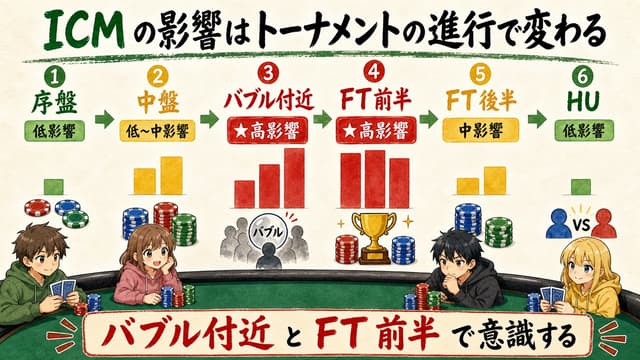
Early stages: ICM impact is small. is enough
When the remaining field nears the paid positions: ICM impact starts to appear. Be aware of the bubble line
The bubble (right before the money): ICM impact is at its maximum. Non-short stacks should play cautiously, while short stacks should tighten their calling range
The final table (FT): the prize jumps between positions are large, so moving up one rank is worth a lot. Avoid marginal spots
(HU): the prize difference is limited to two outcomes, so ICM impact disappears (BF returns to 1)
A rough rule of thumb: “most important near the bubble and early at the FT; gone in heads-up.”
How Does ICM Differ in Satellites?
A satellite tournament is a format where every cashing player receives an equal share of “the next tournament's buy-in”. The prize structure is unique, and from an ICM standpoint the strategy becomes even more extreme.
Everyone in the money gets the same prize. Whether you finish 1st or are the last player to cash, the payout is the same
When “one more elimination gets you in the money,” survival value becomes extremely high
As a result, there are spots where folding strong hands like AK is correct
Conversely, a chip leader can apply pressure with weak hands against the players they cover (short stacks)
The decision framework is very different from a normal tournament, so you'll want to review dedicated strategy before playing a satellite. POKER Q'z's “Learn How to Respond When Someone Shoves on You Right Before the Pays” lesson teaches the specific decision points.
What Are the Benefits of Understanding ICM?
Players who understand ICM can bring a real edge in decision-making to tournaments:
correctly when you should fold: avoid marginal spots on the bubble / FT and maximize prize equity
Attack correctly when you should attack: make the most of a chip leader's advantage
Spot your rivals' mistakes: apply strategic pressure when opponents don't understand ICM
Build the habit of thinking in prize equity: you can calmly factor in the structure that “you don't have to win to get paid”
On the flip side, if you ignore ICM, you'll often find that decisions that are correct in chip EV are negative in prize EV. That's one of the reasons so many tournament players are “good but their winnings never grow.”
Frequently Asked Questions About ICM
Q. Is ICM a perfect mathematical model?
A. No — ICM is an approximation model. It doesn't precisely reflect skill differences, stack positions, or the remaining structure, so it's realistic to use it as a reference value. Even so, it's still far more accurate than “judging by chip EV alone.”
Q. Are there ICM calculation tools?
A. Yes — there are many tools and apps called ICM calculators / ICM trainers. They're typically used to practice specific spots in advance; you don't need to calculate during actual play.
Q. Do you use ICM in cash games too?
A. No. In cash games, chips are face value = money, so the ICM concept isn't needed. BF = 1 and RP = 0%.
Q. When exactly are “high risk premium” spots?
A. At the bubble line, in the early FT, or right before a satellite pays — spots where the prize jumps between positions are extreme. You can learn the detailed benchmarks step by step in POKER Q'z's lessons.
Summary
ICM is an essential concept for dominating the late stages of tournament poker. Here are the three key points to remember:
Definition: a model that converts chip stacks into prize equity. Tournament chip value is non-linear
Where to pay attention: the bubble line / early FT (= spots where prize jumps between positions are large)
Metrics to use: bubble factor (BF) and risk premium (RP)
Understanding ICM raises your late-tournament decision-making to the next level, from all-in decisions and tightening calling ranges to how the chip leader applies pressure.
If you want to practice bubble factor calculations and satellite- or FT-specific strategies through repetition, work through the lessons in the poker learning app “POKER Q'z” — starting with “The Value of Chips in Tournaments,” “Learn About Bubble Factor,” and “Learn How to Respond When Someone Shoves on You Right Before the Satellite Pays”.