

In poker, the most dramatic action is the all-in. It's a one-shot gamble in which you stake your entire stack, and from the mid-tournament stage onward it appears so often that someone does it almost every hand. It cuts both ways — “used well, it's a weapon; misused, it's an instant exit” — which is why stronger players differ so much in how they pick their spots. This article breaks down the meaning of the all-in, when to use it, and the decision-making principles for beginners.
What Is an All-In?
An all-in is an action in which you bet all of your chips at once. It's possible on any street — preflop, flop, turn, or river — and you can also fire it yourself regardless of what your opponent does.
A player who is all-in can no longer bet, so the hand simply plays out to showdown (cards revealed). Anyone who calls also can't add any more bets, and both hands are shown.
When Should You Use an All-In?
s are broadly used in three patterns.
Preflop push (short stack): When your stack gets shallow in a tournament, after you raise and get called, you have no freedom, so you attack with an all-in from the start
4-bet all-in (deep stack): A spot where re-raising your opponent's 3-bet preflop naturally becomes an all-in due to the sizing
postflop plays: Extracting maximum value from your opponent with a nut-level hand, or taking down the pot with a strong bluff
The first all-in spot most beginners meet is “Push or ” in the late stages of a tournament. When your stack is short, half-measure raises stop working, so if you're going to play the hand, shoving from the start becomes the realistic choice.

What Are the Preflop All-In Matchups?
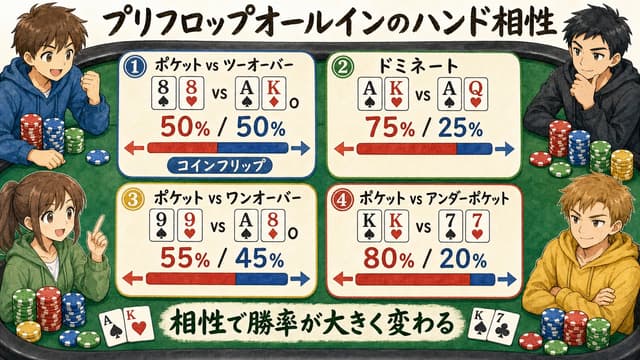
When two players clash with preflop all-ins, the matchup between the hands changes the win rate dramatically. The typical patterns are as follows.
vs. two overcards (e.g., 88 vs. AKo) → about 50% vs. 50%. The so-called “coin flip”
d hand (e.g., AK vs. AQ) → about 75% vs. 25%. When both hands share a card, the kicker decides and the gap is overwhelming
Pocket pair vs. one overcard (e.g., 99 vs. A8o) → about 55% vs. 45%. The pair has a slight edge
pair vs. low pocket pair (e.g., KK vs. 77) → about 80% vs. 20%. The high pocket pair is overwhelmingly favored
You don't need to memorize all the fine numbers, but holding just three intuitions — “sharing a card means domination and a huge gap,” “pair vs. non-pair is roughly a flip,” and “pair vs. pair is a huge gap” — will sharpen your all-in decisions considerably. In PQ'z's “Know the Win Rates of Preflop All-Ins” lesson, you can systematically learn far more detailed matchups.
How Do You Decide Whether to Call an All-In?
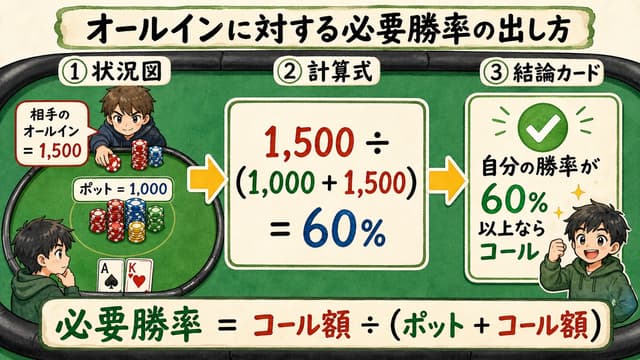
When your opponent moves all-in, whether you call is decided by required equity (pot odds).
Required equity = call amount ÷ (current pot + call amount)
Let's look at some examples.
1,000, opponent shoves all-in for 1,500 → call amount 1,500 → required equity = 1,500 ÷ 2,500 = 60%
Pot 2,000, opponent shoves all-in for 1,000 → call amount 1,000 → required equity = 1,000 ÷ 3,000 ≈ 33%
Compare the required equity with your hand's win rate: call when your win rate is higher, fold when it's lower is the correct play in chip terms. In tournaments, also comes into play, and the required equity can be higher than it appears (see the next section and the ICM explainer article).
What's Different About Push/Fold in Tournaments?
As your stack gets shallow in a tournament (the M value gets small), you'll face more spots where it's a binary choice of “all-in from the start or fold (Push or Fold)” instead of a normal open-raise. The reasons are as follows.
Even if you raise, your stack is thin, so depending on your opponent's response you may have no room to fold
A half-measure raise makes it hard to generate fold equity from your opponent
With an all-in, you maximize fold equity, and sometimes you can take the blinds on the spot
Exactly when you enter “Push or Fold mode” and which hands to push depend on your stack (M value), the number of remaining players, and the ICM situation. If you want to master it properly, you can learn step by step in PQ'z lessons such as “Know the M Value as a Survival Indicator,” “Try Using the Power Number Chart,” and “Learn About All-In or Fold”.
How Does ICM Change All-In Decisions?
In tournaments, the concept of ICM (Independent Chip Model) appears. In short, it's a model that says “chips aren't worth their face value; they're measured by their expected prize value.”
From an ICM perspective, special situations like these arise:
Near the bubble: In spots where “a few more eliminations and you're in the money,” the value of surviving rises dramatically. An all-in call that's correct in chip EV can be a correct fold in ICM terms
At the FT (final table): The prize gaps between places are large, so each rank you climb has significant value. Be more careful with marginal all-ins
As chip leader: You can use a stack whose loss doesn't hurt much to pressure the covered side (short stacks)
ICM is an area where judging “by chip EV alone” easily becomes a trap. The detailed mechanics are also covered in the ICM explainer article. It's recommended to study it together with PQ'z lessons around “The Value of Chips in s” and “Learn About the Factor”.
What Are Typical All-Ins to Avoid?
Here are the all-in landmine patterns that beginners tend to fall into.
Emotional all-ins: Trying to win it all back in one shot after losing several hands in a row. Most of these are -EV
ing with marginal hands: Calling an opponent's all-in with a mediocre hand like A5o or 22. If their range is strong, you'll lose more often
Light pushes near the bubble: In ICM terms, pushing light only works in spots where the opponent's calling range suddenly tightens
Aggressive pushes in satellites: Since everyone who qualifies wins the same prize, the value of taking risks often drops dramatically
pushes with a deep stack: The deeper your stack, the lower your fold equity. All-ins at a depth where you can play multiple streets are limited
Frequently Asked Questions About All-Ins
Q. Can you back out after declaring an all-in?
A. Once the all-in chips are pushed forward, it's final. It can't be undone. The same applies if you announce “all-in” verbally (depending on the room). Be careful.
Q. What if your opponent has more chips than you?
A. A side pot is created up to the amount of your stack, and the hand is contested within that range. The opponent's remaining chips are played out against other players.
Q. What happens if no one calls your all-in?
A. You win the pot on the spot. You have no obligation to show your hand, and you can move on to the next hand without revealing anything (in live play, depending on the room).
Q. How do you calculate fold equity for an all-in?
A. Opponent's fold rate × pot won = fold equity. In practice, rather than calculating it precisely, it's more practical to estimate by feel — “at this size, what percentage is the opponent likely to fold?”
Summary
The all-in is the most decisive action in poker. Three points to remember:
Choosing your spot: The main patterns are short-stack Push or Fold, 4-bet all-ins, and postflop nut plays
Calculating required equity: Be able to instantly work out call amount ÷ (pot + call amount)
ICM awareness: On the bubble / at the FT, don't judge by chip EV alone
The all-in is “a weapon when used well, an instant exit when misused”. Emotional shoving is your biggest enemy, so build the habit of always calculating your chances before you fire.
If you want to drill concrete short-stack strategy and matchup intuition through repetition, let the poker learning app “POKER Q'z” lessons — “Know the Win Rates of Preflop All-Ins,” “Learn About All-In or Fold,” and “See the s You Can Call Against an All-In” — make it second nature.