

In poker, the basic yardstick for turning "how strong is this hand?" into a number is equity. You may have heard players talk about "my flush draw's equity on the flop" and wondered whether the term was just floating around on its own. In reality, it comes down to a simple idea: win rate × pot = your expected share. It's the same concept that connects to pot odds and outs. This article walks through the meaning of equity, how to calculate it, hand vs range, and how much of it you actually realize, in a clear, beginner-friendly way.
What Is Equity?
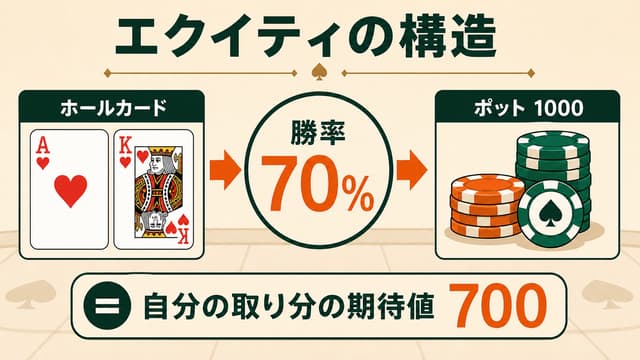
Equity is the expected share of the current pot your hand can win. As a formula:
Equity = your win rate × pot
For example, if the pot is 1,000 and your hand's win rate is 60%, you can think of yourself as "holding" equity = 0.6 × 1,000 = 600 chips' worth right now. The remaining 40% belongs to your opponent.
The key point is that equity describes not whether you win or lose, but what percentage of this pot you take over the long run. A single hand's result will fluctuate, but if you repeat the same spot 100 times, the expectation converges. In the short term you can keep losing, and even with 90% equity you'll take a bad beat 1 time in 10. However, if you build every decision from "actions that follow the equity," your chips will always move in line with equity over the long run.
Conversely, one of the biggest things to avoid in poker is judging whether a decision was good or bad based only on the result of that hand. When you decide by equity, you can say "this call was correct" with confidence even after losing the hand. That's the starting point of improvement.
What's the Difference Between Win Rate and Equity?
"Win rate" and "equity" are often used almost interchangeably in conversation, but strictly speaking they can be distinguished as follows.
Win %: the probability that your hand wins at showdown. Unit: %
Equity: the chip expectation you get by multiplying your win rate by the pot (= chips). Unit: chips
In other words, win rate is "how strong the hand is," while equity is "the chip value you hold right now." When a poker program's window shows "Equity 56%," it effectively means your win rate (counting ties as half) is 56%.
In this article, we'll also use "win rate" and "equity" interchangeably depending on context, but keeping "win rate is a probability; equity is the share of chips based on that probability" in mind will prevent confusion.
Going one step further, equity is commonly calculated as "wins + half of ties." For example, a hand with 48% wins, 4% ties, and 48% losses has an equity of 48 + 4÷2 = 50%. Ties aren't counted in full; they're split evenly between the two players. This rarely matters in practice, but if you look at a poker program's numbers and feel "hmm, it's a bit off from the win rate?" it's because of the tie split.
How Do You Calculate Equity?
The simplest case is an all-in spot. Since no more betting can occur, you can calculate it purely as "your win rate × pot."
Example: on the river with a pot of 2,000, both players are all in and your hand's win rate is 70%, so equity = 0.7 × 2,000 = 1,400. Over the long run, repeating this 100 times, you'd win 70 times and take 1,400 on average.
On the flop or turn, you can estimate your win rate from your outs with the Rule of 2 and 4.
Probability of completing with one card (turn → river) ≈ outs × 2%
Probability of completing with two cards from the flop (turn + river) ≈ outs × 4%
For example, with a flush draw on the flop (9 outs), your win rate by the river ≈ 9 × 4 = 36%. If the pot is 1,000, you can view your current equity as about 360. For details on counting outs and the Rule of 2 and 4, see the outs article.
In multi-street spots where more action remains (opponent bets, additional calls from you), a pure calculation alone doesn't decide it; you judge by combining it with the realized equity described below and pot odds.
Put in a more abstract formula, equity is the ratio of remaining card combinations in which you win. If two cards are still to come after the flop, equity is the share of all combinations of 2 cards from the remaining 47-card deck (47 × 46 ÷ 2 = 1,081) in which you win. Counting these by hand every time isn't practical, so at the table you use approximations like the Rule of 2 and 4 or keep the representative matchups below in mind.
Hand vs Hand and Hand vs Range
Equity calculation has two broad levels.
vs hand: the win rate when both players' two cards are fixed and the board is dealt out to the end. For example, simulating AK vs QQ gives about 45% vs 55%
Hand vs range: when your opponent's hand isn't known, the average win rate against the whole set of hands your opponent can hold (range). This is far more important in practice
In real play, you can't pinpoint your opponent's hand. So the basic approach is to assign them a "range inferred from their actions" and think in terms of the average equity against that whole range.
For example, if you hold AK and you've read your opponent's 3-bet range as "QQ+, AKs, AKo," the win rates break down as follows.
vs QQ → about 46%, vs KK → about 30%, vs AA → about 12%
vs AKs/AKo → close to a tie (about 50%)
Weight-averaging these by the frequency of each hand in the range gives your equity against the range. The result can move a lot: "it looks like 45% / 55% against a single hand, but it's only 35% against the whole range."
A common beginner pitfall is thinking about just one specific hand: "what if my opponent has AK..." In real play, your opponent's hand is a probability distribution, scattered in a form like "AA 6%, KK 6%, QQ 6%, AK 16%..." Instead of fixating on a single scenario, build the habit of deciding by the average over the whole range, and you'll stop swinging with every result.
On your side too, moving beyond "your hand's equity" to being aware of "your whole range's equity" takes you to the next level. For example, if you can build a 3-bet range that as a whole has an equity advantage against your opponent's calling range, you'll start to see betting lines you can push even when individual hands are somewhat weak.
Range Equity vs Realized Equity
Going one step deeper, equity has a gap between "the equity you hold" and "the equity you actually realize."
equity (raw equity): pure win-rate-based equity if the board is dealt out to the end
Realized equity (R%): the share of equity you can actually win, taking real-world actions into account (opponent bets, the chance of being folded off your hand)
For example, even with 35% equity on the flop, if you keep folding to your opponent's turn and river pressure, your actual win rate drops to around 25%. That's a state of "low realized equity."
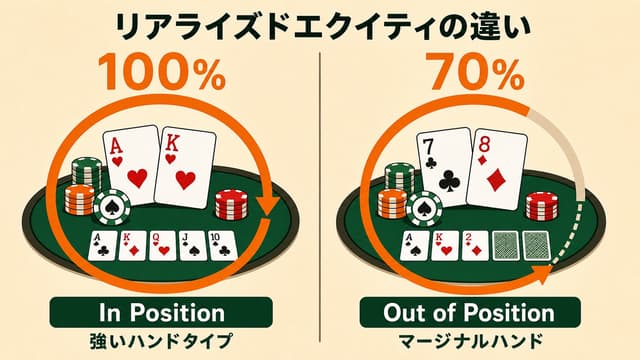
The main factors that affect realized equity are:
: in position (IP), you act later, so you're less likely to be folded off your hand and can more easily bluff-catch or take thin value → higher realized equity
OOP: the side that has to act first is more likely to be folded off their hand by an opponent's bet → lower realized equity
Hand type: hands that "can improve later"—pair + draw, connectors, SCs (suited connectors)—realize equity easily. Conversely, weak pairs with showdown value fold easily under pressure and realize less
Number of streets: the more streets remain from the flop, the more room there is to realize equity
Simply being aware of "does my hand realize equity easily?" can change your call / raise / fold choices dramatically. It gives you decision axes like: give up early on hands with low resistance to pressure, and actively go after equity with semi-bluffs on hands with plenty of room to improve.
What Equity Calculators Are There?
Here are some common programs for actually calculating equity. We recommend choosing one based on your stage of learning.
Equilab: a free, standard equity calculator. It can simulate both hand vs hand and hand vs range, and lets you build ranges visually, which is convenient
PokerStove: a veteran, simple equity calculator. Lightweight, for people who want to use just the minimum features quickly
zilla: a tool that breaks down "what percentage of your opponent's range has what hand" after the flop in fine detail. For intermediates and above who want to deepen their hand reading
Wizard / PioSOLVER: solver-type tools. For advanced players who want to go deep into equity, , and optimal frequencies under GTO strategy
Early on, simply plugging "what % is this hand against this range?" into Equilab will organize your table intuition at once. Once you're used to it, the standard path is to advance step by step: Flopzilla for "your opponent's hit rate per flop," and finally solvers for "optimal frequencies."
A tip for using them is to recreate hands that stumped you in real play the same day and check the equity. Rather than staring at numbers aimlessly, verifying hand by hand—"what % did that call have?" "how much equity did that fold throw away?"—makes it far more reproducible at the table.
Preflop Equity Intuition
Here are the preflop matchup numbers that help in real play. You don't need to memorize the fine numbers; the goal is to grasp them in a range, like "roughly this matchup is about this much."
Higher pair vs lower pair (e.g., KK vs 77): about 80% vs 20%. The higher pair is overwhelming
Pair vs two overcards (e.g., 88 vs AK): about 50% vs 50%. The so-called coin flip
Pair vs one overcard (e.g., 99 vs A8): about 70% vs 30%. The pair is favored
Domination (e.g., AK vs AQ): about 75% vs 25%. Sharing a card makes a big gap
Both cards higher (e.g., AK vs QJ): about 65% vs 35%. The high-card side is slightly ahead
vs two overcards (e.g., 78 vs AK): about 40% vs 60%. The gap is surprisingly small
Just having this intuition makes call decisions against preflop all-ins much easier. Remembering the three rules—"sharing a card means domination and a big gap," "pair vs non-pair is generally a flip," "pair vs pair is a big gap"—will keep you within about 5% on most spots. For specific preflop all-in decisions, we recommend reading the all-in article, and for tournament-specific adjustments, reading together with the ICM article.
Frequently Asked Questions About Equity
Q. What's the relationship between equity and pot odds?
A. Pot odds are the "win rate needed to call," and equity is "your win rate." The basic decision rule is: if equity ≥ the required win rate from pot odds, the call has positive EV.
Q. If equity is over 50%, should you always call?
A. In terms of chip EV, yes. But in tournament ICM situations, or in spots where realized equity is extremely low, you can't decide from apparent equity alone.
Q. How can a weak hand have high equity?
A. A hand with low showdown value but many "cards that can improve you to a win"—draws, connectors, and the like—can have surprisingly high equity even while currently weak. Using this actively is semi-bluffing.
Q. I can't pin down my opponent's range accurately...
A. You don't need to be exact. Start by roughly reading it with just two buckets: "roughly premium-leaning or wide." Once you're used to it, add finer branches.
Q. Does equity matter when bluffing?
A. Yes. Even on a pure bluff, the higher the "equity you hold when not folded", the better the bluff's EV (= semi-bluff). A bluff with complete air tends to become a one-shot gamble that relies entirely on fold equity.
Summary
Equity is the concept that serves as the "axis" of poker decisions. Here are the three points to remember.
Definition: win rate × pot = the expected value of your share of the chips
Hand vs range: think in terms of the average win rate against the opponent's whole range, not a single-hand comparison
Realization: position, hand type, and the number of streets remaining greatly change how much equity you realize
Once you have the equity perspective, poker's true decision axes become clear at once: "is this call positive in the long run?" and "which parts of the opponent's range can this bet fold out?" Combined with pot odds and outs calculations, the "calls out of a hunch" and "bets out of a hunch" from the days when you played by feel will decrease dramatically.
If you want to build matchup and range-vs-range equity intuition through repetition, try lessons in the poker learning app "POKER Q'z" such as "Learn the Win Rates of Preflop All-Ins," "Learn About and ," and "See Which Ranges Can an All-In."