
In poker, aggressively attacking with a hand that is weak right now but still has a chance to improve is a semi-bluff. It is a two-pronged attack — strong if you hit, and able to fold opponents out even when you miss — and a core strategy that advanced players use constantly. This article lays out the meaning of the semi-bluff, how it differs from a pure bluff, where it fits in real play, and rough guidelines by number of outs, all organized for beginners.
What Is a Semi-Bluff?
A semi-bluff is a play where you bet or raise with a hand that is currently weak but still has equity — a chance to complete on the turn or river. Rather than being a “completely empty bluff,” it is easiest to think of it as a bluff with insurance.
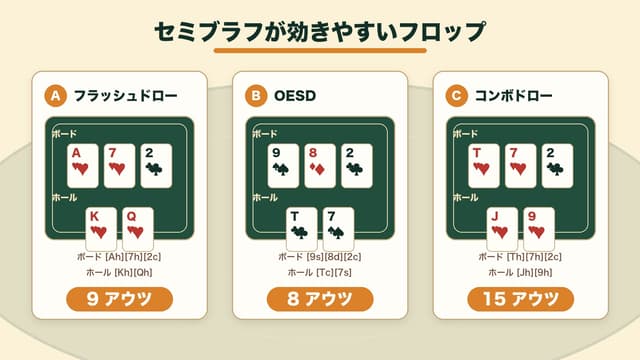
: four cards of the same suit, one more card completes it (9 outs)
(OESD): completes with one of four cards on either end (8 outs)
draw: multiple ways to complete, such as a flush draw plus a straight draw (12-15 outs)
For example, if the flop is A72 and you hold KQ, you currently have only high cards, but one heart will give you a flush close to the nuts. ting instead of checking here is a semi-bluff. Its biggest feature is being able to run two winning lines at the same time: “win immediately if they fold, or win if the flush completes even when they don’t.”
Conversely, betting with high cards that completely missed the flop, or with a hand that has no room left to improve, is a “pure bluff” rather than a semi-bluff. To qualify as a semi-bluff, at least one realistic way to complete (=outs) must still be in your hand.
How Is It Different from a Pure Bluff?
The semi-bluff is a type of bluff, but it is clearly separated from a pure bluff (=a completely empty bluff) by whether equity exists.
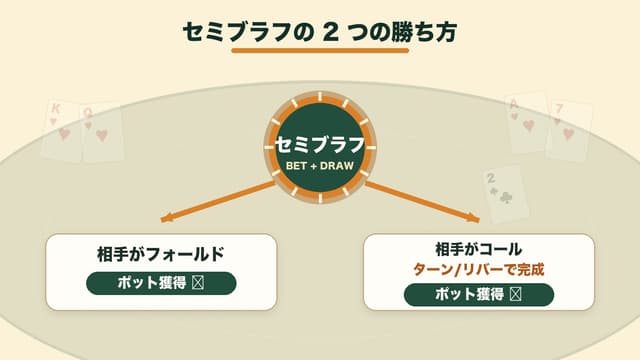
: almost zero outs. You can only win if your opponent folds. One way to win, aiming for a 100% fold rate
: outs remain, so even if you are called, you can win when the draw completes. Two ways to win: fold rate + completion rate
For example, betting the river with a hand that completely missed is a pure bluff; betting on the flop with a flush draw is a semi-bluff. Even though both are “bets with a weak hand,” whether you have backup makes a big difference in (expected value).
A pure bluff only becomes +EV when your opponent’s fold rate is high enough, but a semi-bluff can be judged by combining fold equity + completion equity, so it can be justified in a much wider range of spots. For example, in a spot where a pure bluff needs the opponent to fold 60% to be +EV, it is common for a semi-bluff to be clearly +EV with only a 20-25% fold rate.
Another important difference is the psychological damage when it fails. When a pure bluff gets called and loses, you often lose the chips outright, but a semi-bluff can still take value normally if it completes on the turn or river even when called. In the sense that it can be run steadily over the long term, the semi-bluff is arguably “a lower-risk way to attack for learners” than a bluff.
In What Situations Do You Use It?
The semi-bluff shines brightest when you take the initiative with a bet or raise on drawing hands on the flop and turn. Four typical situations:
draw on the flop: check-raise against your opponent’s c-bet. Insured by 9 outs
OESD on the flop: a donk bet you lead out with, or continuing with a c-bet. Backed by 8 outs
Combo draw on the flop: 12-15 outs from flush + straight. Nearly fair in equity even if you raise
one card away on the turn: it didn’t complete on the turn, but one card remains until the river — a semi-bluff bet
On the river, on the other hand, no chance to complete remains, so if you bet, a pure bluff or a value bet is the only option. The semi-bluff is a technique exclusively for when cards still remain behind.
As a general rule, bet the same size as a value bet, or slightly larger. Too small, and you can’t collect fold equity; too large, and the return no longer matches the risk. In general, 2/3 pot to pot-size is standard. If you attack with a raise, around 2.5-3x your opponent’s bet is the guideline.
texture also has a big influence on semi-bluff decisions. On draw-heavy boards (=many dangerous cards in your opponent’s range as well), your opponent checks and calls more often, lowering fold equity, while your own outs tend to be plentiful. On dry boards (=only pairs and high cards), the opponent’s range skews toward safety, so fold equity is higher, but your own drawing opportunities also shrink, making a semi-bluff harder to set up. Remember “draw-heavy boards: favor equity; dry boards: favor fold equity,” and sizing becomes easier to choose as well.
What Are the Benefits of a Semi-Bluff?
Advanced players love the semi-bluff not just as a “strictly better bluff,” but because it has the effect of lifting your whole strategy. Four main benefits:
Two ways to win: if your opponent folds, you win immediately. Even when called, you win if the draw completes
initiative: by being the one betting, you prevent your opponent from getting a free card (seeing the turn via a check)
balance: by betting with draws as well as strong hands, you make it harder for opponents to read your range
Pressure on your opponent’s range: you fold out marginal opponent hands (like middle pairs) and narrow your opponent’s calling range to strong hands
The range balance effect is especially large, because it breaks the pattern of “bet = only strong hands.” This also makes your value bets get through more easily, raising your overall bet EV. A player who only check-raises strong hands, folds weak hands, and calls with draws is easy to read, and their profits hit a ceiling.
The semi-bluff is an aggressive move, but at the same time it is part of building a defensive range. Furthermore, when your betting range includes draws, it also becomes a stock of hands you can continue as pure bluffs on the river when the draw doesn’t complete. By composing your entire betting range with “strong hands + draws,” your opponent can’t narrow down your range on any street, and as a result the profitability of each individual bet goes up.
How Do Outs Relate to Semi-Bluffing?
The number of outs greatly changes how justified a semi-bluff is. Let’s organize rough guidelines using the Rule of 2 and 4, which estimates your win rate with “outs × 2-4.”
15 outs (combo draw: flush + OESD): ≈30% by the turn, ≈54% by the river. A virtually fair hand, so even raises and 3-bets are fully justified
12 outs (flush draw + gutshot): ≈24% by the turn, ≈45% by the river. The classic zone for semi-bluff raises
9 outs (flush draw alone): ≈18% by the turn, ≈36% by the river. Attack aggressively if the opponent and board promise fold equity
8 outs (OESD): ≈16% by the turn, ≈32% by the river. A bit more conservative than the flush draw, but plenty semi-bluffable
4 outs (gutshot): ≈8% by the turn, ≈16% by the river. Basically check-call. Attack only in spots with very high fold equity
As a rule, remember 9 outs or more is the zone to actively consider a semi-bluff, 8 outs depends on the situation, and 4 outs or fewer is basically a check, and you won’t hesitate at the table.
However, this is only about equity in isolation. Make the final decision by factoring in your opponent’s range, stack size, and pot odds. Even with the same 9-out flush draw, if your opponent is tight and folds often, semi-bluff aggressively; against a calling station, switch to a simple call. The interesting thing about the semi-bluff is that the answer changes depending on the opponent.
If counting outs is difficult for you, first get to where you can instantly answer just these three — “flush draw = 9,” “OESD = 8,” “gutshot = 4” — and your decision speed at the table will jump a level. Combo draws follow naturally from these combinations, so memorizing the basic three is enough.
Which Semi-Bluffs Should You Avoid?
“If you have a draw, you can always semi-bluff” is not true. Here are four typical mistakes that lower EV:
Over-participating in multiway pots: with three or more players, fold equity drops sharply. Even if you fold out one player, the others remain, so attacking with only a draw tends to be -EV
Raising opponents who call extremely often: against a calling station (=an opponent who calls almost anything), fold equity is nearly zero. Switch from semi-bluffing to aiming for value
Attacking hard with thin-outs hands: raising big with only a gutshot (4 outs) or two overcards doesn’t become +EV when called
Semi-bluffing on the river: no chance to complete remains in the first place, so any river bet is a pure bluff. The concept of a semi-bluff itself doesn’t hold
In particular, semi-bluffing multiway is the pattern where beginners leak the most EV. With three or more players still in, even though the draw completion rate is unchanged, fold equity drops substantially, so the bet EV collapses. Remember: “lean toward checking when there are many opponents.”
Also, when your opponent is short-stacked, they are more likely to commit and call rather than fold. state is also a factor in deciding whether a semi-bluff is available. “Semi-bluffing an opponent you can’t get fold equity from can sometimes be a worse choice than a pure bluff” — this is a trap beginners often fall into, and getting into the habit of not automatically betting just because you have a draw will keep you stable.
How Should You Use It Differently in Live and Tournaments?
Semi-bluff decisions differ greatly between cash games (chip EV) and ICM-weighted tournaments.
s: judge by pure chip EV. Take semi-bluffs aggressively when they are +EV
Early tournament: stacks are deep and impact is small, so the same feel as cash is fine
Mid-tournament to around the bubble: ICM pressure starts to kick in, and the loss when you lose is heavier than its face value. Adjust toward lowering semi-bluff frequency
: ICM impact is at its maximum. Semi-bluff only with high-equity hands like combo draws. Attacking with half-baked draws tends to be -EV
In live play, you have the advantage of being able to estimate fold equity from physical information such as your opponent’s tempo, breathing, and how they touch their chips. Semi-bluffs get through more easily against opponents with weak reactions. Online, on the other hand, timing tells are about the only clue, so range-based judgment matters more.
Also, depending on stack size, you can be “committed,” in which case fold disappears from your options. For example, if you semi-bluff raise against an opponent with 20BB or less, they are likely to call or 3-bet rather than fold. When (Stack-to-Pot Ratio) is low, it becomes a choice between all-in or folding rather than a semi-bluff — remembering this will serve you well.
Frequently Asked Questions About Semi-Bluffs
Q. Is a semi-bluff ultimately a bluff or value?
A. By classification it is a bluff, but not a pure bluff — a hybrid of “a bluff backed by equity as insurance.” Remember that making them fold is the primary goal and completing is the secondary goal, and your sizing will feel right.
Q. What is the most important metric for a semi-bluff?
A. . Your completion rate is fixed by your outs, but fold equity varies greatly with the opponent, board, and size. Judge “will the opponent fold?” first and foremost.
Q. Can you semi-bluff with two overcards (e.g., AK)?
A. It depends on the situation. If board-favorable draws (backdoor flush or straight draws) ride on top of the 6 overcard outs, it is effectively worth 8-10 outs, and a semi-bluff is fine. Completely bare overcards are often tough.
Q. What size should a semi-bluff raise be?
A. Basically the same size as a value hand. For a raise, 2.5-3x is standard. If you change sizes, your range gets read, so betting the same size as your strong hands is the range-balanced answer.
Q. When a semi-bluff fails (called and the draw doesn’t complete), what do you do on the next street?
A. From the turn onward, re-evaluate SPR and fold equity. If outs remain, two consecutive semi-bluffs (double barrel) is also an option. If your outs are gone or your opponent is clearly strong, retreat.
Summary
The semi-bluff is one of poker’s core strategies. The three points to remember are:
Definition: an aggressive bet with a hand that is currently weak but still has equity to complete
Two ways to win: your opponent folds or the draw completes. EV is more stable than a pure bluff
Where it applies: attack mainly with draws of 9+ outs, in heads-up spots where fold equity can be expected
Mastering the semi-bluff lets you step up from passive play that just waits for strong hands to aggressive play that takes the initiative and forces your opponent to make difficult decisions. Combining your knowledge of bluffs, pot odds, outs, and equity makes flop and turn decisions dramatically easier.
If you want to drill specific semi-bluff spots and get the timing of attacks by number of outs into your body, try practicing with lessons like “Learn About and ” and “Fighting 3-Bet Pots Starting from the ” in the poker learning app POKER Q'z.