

When you want an objective answer to “should I call or fold?” in poker, the first tool to reach for is pot odds. It may look complicated, but all you need to remember is a ratio: how much you pay versus how much you can win. This article lays out the meaning of pot odds, how to calculate them, how they relate to required win rate, and how to use them in real play—all in beginner-friendly terms.
What Are Pot Odds?
are the ratio between the amount you need to call and the total pot you can win after calling. They express, in numbers, how good an investment this call is.
amount: the amount you pay to match your opponent’s bet
you can win: the current pot + your opponent’s bet (= your share if you call and win)
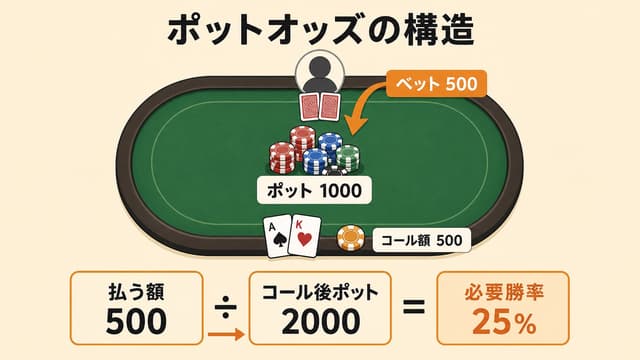
For example, with a pot of 1,000, an opponent bet of 500, and a call of 500, you pay 500 to chase 1,500. As a ratio, that is 1 : 3 — your pot odds.
How Do You Calculate Pot Odds?
The calculation is a single line:
Pot odds (required win rate) = Call amount ÷ (Current pot + Opponent’s bet + Call amount)
An easy way to remember the denominator: “the total amount in the pot after your call.” Here are three concrete examples.
Pot 100, bet 50, call 50: 50 ÷ (100 + 50 + 50) = 25%
Pot 200, bet 200, call 200: 200 ÷ (200 + 200 + 200) = 33%
Pot 100, bet 100, call 100: 100 ÷ (100 + 100 + 100) = 33%
If the numbers start to blur, just repeat: “amount you pay ÷ the entire pot after your call.”
How Do Pot Odds Relate to Required Win Rate?
Pot odds really tell you the minimum win rate a call needs to be profitable in the long run. This is called the required win rate, or break-even win rate.
If the pot odds are 25%, your call is + when your hand wins at least 25% of the time
If the pot odds are 33%, your call is +EV when your hand wins at least 33% of the time
If the pot odds are 50%, your call is +EV when your hand wins at least 50% of the time
So at the table, you can decide in three steps: “calculate pot odds → estimate your hand’s win rate → compare → decide.”
What Are the Common Bet Sizes and Required Win Rates?
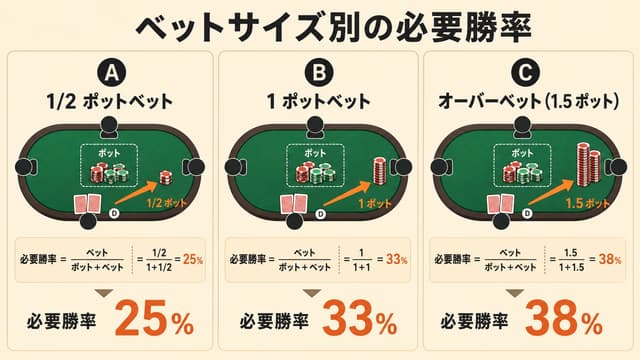
Calculating every time is tedious, so memorizing the required win rates for common bet sizes will speed up your play. sizes are shown as a fraction of the pot.
1/3 pot (33%): required win rate = 20%
1/2 pot (50%): required win rate = 25%
2/3 pot (66%): required win rate = 29%
3/4 pot (75%): required win rate = 30%
1 pot (100%): required win rate = 33%
1.5 pot (overbet): required win rate = 38%
2 pot (overbet): required win rate = 40%
Roughly speaking, remember “half pot = 25%, pot = 33%, overbet = around 40%,” and you can work out the required win rate at the table in an instant.
How Do You Use Pot Odds with Drawing Hands?
Pot odds shine brightest when you are deciding on a drawing hand (flush draws, straight draws, and so on). You estimate your win rate from your outs (= the number of cards that complete your hand) and compare it with your pot odds.
The famous shortcut is the “Rule of 2 and 4”:
Chance of completing on one card from turn to river ≈ outs × 2%
Chance of completing on two cards from the flop (turn + river) ≈ outs × 4%
Concrete example: a flush draw on the flop (9 outs) gives roughly 9 × 2 = 18% to complete by the turn. If your opponent bets half pot (required win rate 25%), the call looks unprofitable on the surface. However, as explained later, implied odds or play on later streets can raise your actual win rate in some spots.
To learn how to count outs and use the Rule of 2 and 4 in depth, check out the hand rankings list and the “Learn About and ” lesson in PQ'z.
What Are Implied Odds and Reverse Implied Odds?
There are two factors that pot odds alone cannot express:
: the additional chips you expect to win from your opponent when your hand completes. These are large for hands opponents are likely to pay off once they complete, such as flushes and straights
: the risk that your opponent has a stronger hand even after you complete yours, costing you extra chips. These are large for bottom draws and hands that often lose on kickers
In other words, even a call that is borderline in pot odds can be fine when the hand has large implied odds (a nut flush draw, for example). Conversely, when reverse implied odds are large, there are spots where folding is better even if the pot odds alone say calling is fine.
Where Do Pot Odds Help, and What Are Their Limits?
Here is a summary of where pot odds are especially useful and the limits to keep in mind.
Where they help:
Call decisions on drawing hands (flush and straight draws)
Call decisions facing an all-in (no more betting to come = a pure pot odds decision)
Sanity checks for marginal calls
Limits:
They cannot reflect multi-street action (= supplement with implied odds)
When your opponent’s range is extremely skewed, your actual win rate can differ substantially from the apparent odds
In tournaments, adjustment based on ICM is needed (near the bubble, for example)
Pot odds are a starting point for a decision, not the final answer. Layer in implied odds, , and your opponent’s range according to the situation.
Frequently Asked Questions About Pot Odds
Q. What is the difference between pot odds and “the ratio of the amount bet”?
A. “Amount bet : pot” (odds notation) and “call amount ÷ pot after calling” (required win rate notation) are different ways of expressing the same information. At the table, the required win rate notation is more intuitive and easier to compare directly with your win rate.
Q. Does the same calculation apply when the bet is larger than the pot (an overbet)?
A. Yes, the same formula works: call amount ÷ (current pot + bet + call amount). The larger the overbet, the closer the required win rate gets to 50%.
Q. How do I know my hand’s win rate?
A. The basic method is to estimate it from your outs with the Rule of 2 and 4. For preflop all-ins and similar spots, memorize rough matchup numbers (see the all-in article for details).
Q. I do not have time to calculate every time at a live table…
A. If you memorize the required win rates for the common bet sizes (1/3, 1/2, 2/3, 3/4, pot, overbet), there is nothing to calculate. Once the table in this article is in your head, you can decide in an instant.
Summary
Pot odds are the most fundamental tool in poker decision-making. Remember these three points:
The formula: call amount ÷ (current pot + bet + call amount) = required win rate
Common sizes: 1/2 pot → 25%, pot → 33%, overbet → around 40%
Compare with your win rate: your win rate ≥ required win rate means the call is +EV
Simply being aware of pot odds will dramatically reduce the “calls on a hunch” you made when playing by feel. Combine them with bluff frequencies and ICM adjustments, and your overall postflop decision-making will move up a level.
If you want to practice concrete outs calculations and repeat pot odds drills for different scenarios, the poker learning app POKER Q'z has lessons such as “Learn About Outs and Odds” and “How to Play 3-Bet Pots Starting from the ” to help you make them second nature.