
When you hold a flush draw or a straight draw in poker, the first step to correctly choosing between calling, folding, and raising is counting your outs. Once you know your outs, you can estimate your win probability and pick an + play simply by comparing it with pot odds. This article lays it all out in a form you can use at the table: what outs mean, how to count them concretely, estimating your equity with the “Rule of 2 and 4,” and discounting outs. led correctly, draws can be a powerful weapon — but miscount your outs and they can quietly bleed your bankroll. That's exactly why it's worth locking this down first. If you just want the definition, check out the outs entry in our glossary.
What are outs?
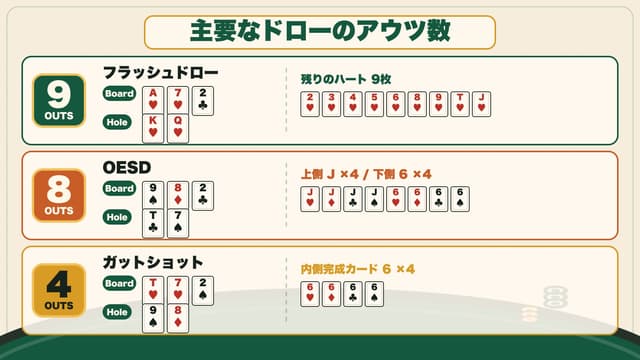
are the number of cards left in the deck that complete your hand — in other words, make it stronger than your opponent's. They answer the question “how many more cards can I draw to win?” and let you intuitively estimate the chance of completing on the next card.
(four of the same suit) → nine cards left can complete the flush = 9 outs
(OESD) → four cards at either end complete it = 8 outs
Gutshot (inside straight draw) → four cards of one rank complete it = 4 outs
Outs are the raw material of your win rate. Count your outs → convert them to a win rate with the Rule of 2 and 4 → compare with pot odds to decide whether to call. That sequence is the backbone of every draw decision.
Counting outs: worked examples
The principle is simple: count the cards that complete your hand among those still left in the deck. Let's see it on real boards (card notation is rank + suit written with s/h/d/c, so A = ace of spades).
draw example: your hand is AK and the flop is Q72. Four spades are visible, so the remaining spades are 13 − 4 = 9, giving you 9 outs.
OESD example: your hand is 98 and the flop is 762. You have 6-7-8-9, and a [Tx] (four cards) above or a [5x] (four cards) below completes the straight. That's 8 outs total.
Gutshot example: your hand is AK and the flop is QJ5. You have A-K-Q-J, and only the inside [Tx] (four cards) fills it. So that's 4 outs.
draw (watch for overlap) example: your hand is T9 and the flop is J82. On top of your spade flush draw (9 outs), a [7x] also completes the 7-8-9-T-J straight. But 7 is already counted with the flush, so the straight adds only three more cards: 777. The total is 9 + 3 = 12 outs, not the simple sum of 13. Learning to subtract these overlaps is the single biggest key to counting outs accurately.
Improving from a set example: your hand is 88 and the flop is 8K4, giving you a set (three of a kind). A paired board (the remaining three [Kx] and three [4x]) makes a full house, and 8 (one card) makes quads. Outs that upgrade your hand: 3 + 3 + 1 = 7 outs.
Two overcards example: your hand is AK and the flop is 962. You only have high cards right now, but an [Ax] (three cards) or [Kx] (three cards) gives you top pair. That's 6 outs total. However, these 6 outs often “don't work” when your opponent already has a pair, making them prime candidates for the discounting covered below.
What is the Rule of 2 and 4?
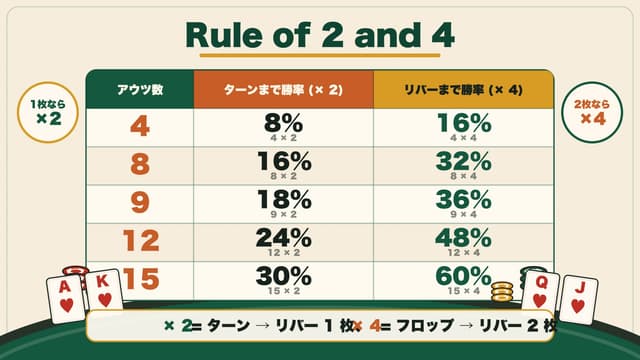
The Rule of 2 and 4 is a famous approximation formula for estimating your win rate from your outs.
Chance of completing with one card by the turn ≈ outs × 2%
Chance of completing with two cards from the flop (turn + river) ≈ outs × 4%
Here's a quick-reference table for the main draws.
| Outs | Typical draw | By the turn (×2) | By the river (×4) |
|---|---|---|---|
| 4 | Gutshot | ≈8% | ≈16% |
| 5 | One pair → two pair / set | ≈10% | ≈20% |
| 8 | OESD | ≈16% | ≈32% |
| 9 | Flush draw | ≈18% | ≈36% |
| 12 | Flush + gutshot | ≈24% | ≈48% |
| 15 | Combo draw | ≈30% | ≈60% |
The logic behind “× 2” is simple: after the flop, 47 cards remain in the deck (52 − 2 in your hand − 3 on the flop), so the chance of drawing one is outs ÷ 47 ≈ outs × 2.13%, which is rounded off. Two cards work out close to “one card × 2,” so “× 4” is used instead. However, with 12 or more outs the estimate runs a bit high — the true two-card win rate with 15 outs is about 54% (60% with × 4). With many outs, subtracting a few percentage points from the × 4 result improves accuracy.
If you'd like to check how accurate this estimate is, enter your outs in the odds calculator and compare the result with what the Rule of 2 and 4 gives you.
What are discounting outs?
Not every card you count as an out is a “clean winner.” Cards that complete your hand while also giving your opponent a stronger one are called dirty outs, and you discount them from your effective outs. The reduced count is what we mean by discounting outs (discount outs).
Example: your hand is JT and the flop is 982. It looks like an OESD with 8 outs from [Qx] or [7x], but there are two spades on the board. If your opponent holds a spade flush draw, a Q or 7 completes your straight while also completing their flush. Discount those two dirty outs and your effective count drops to about 6 outs.
Typical patterns to discount:
Cards that also complete your opponent's flush or straight
Cards that pair the board and give your opponent a shot at a full house
Cards where, even if you complete, your opponent's superior draw is still the favorite
For beginners, simply estimating your counted outs as one or two fewer on dangerous boards already makes your decisions much sounder. When you want accurate equity that includes your opponent's perspective, the reliable approach is to set their hand range in the equity calculator and check your true win rate.
What are backdoor outs (runner-runner)?
outs are outs for draws that can only complete by hitting two consecutive cards — one on the turn and one on the river. Also called “runner-runner,” they're worth less than ordinary outs because a single card can never complete them.
Backdoor flush draw: three of the same suit on the flop → you complete by hitting that suit on both the turn and river. It completes on its own about 4% of the time, worth roughly 1–1.5 outs
Backdoor straight draw: three cards close in rank → worth roughly 1 out
On their own, these aren't a reason to call, but when you add them on top of your main draw or overcards when converting to outs, they can change your semi-bluff and float decisions.
Example: your hand is AK and the flop is T72. You have neither a pair nor a draw yet, but alongside your two overcards [Ax] and [Kx] (6 outs), the three hearts give you a backdoor flush as well. Together they're worth roughly 7–8 outs — enough to back a semi-bluff on the flop or a continuation bet on the turn. To avoid double-counting these thin outs and overestimating your win rate, it's safer to add them as “main outs + a thin 1–2 for the backdoor.”
From outs to a pot odds decision
Once you've converted your outs to a win rate, the final step is to compare it with pot odds (required equity) and decide. The process has four steps:
Count your outs (discount dirty outs)
Estimate your win rate with the Rule of 2 and 4
Calculate the required equity from the pot odds
If win rate ≥ required equity, calling is EV+
How to find required equity: call amount ÷ final pot after your call. For example, if the pot is 100 and your opponent bets 50, your call of 50 makes the final pot 100 + 50 + 50 = 200. Required equity = 50 ÷ 200 = 25%.
Worked example: you have a flush draw on the flop (9 outs → about 18% by the turn) and your opponent makes a half-pot bet (25% required equity). Looking only at the turn, 18% < 25%, so calling is unprofitable. Whether you can stay in the hand anyway is decided by implied odds.
are the idea of effectively adding the amount you expect to win from your opponent on later streets after you complete, on top of the pot. If your opponent is deep-stacked and likely to pay you off big when your flush hits, calling can be justified even if you're slightly below the immediate required equity. Conversely, when stacks are shallow and you can't recover enough even after completing, the correct play is to fold strictly per the surface pot odds. Real-world call decisions layer this “how much can I win after completing?” question onto the outs → win rate → required equity framework.
Running the odds calculator and the equity calculator side by side makes this “outs → win rate → required equity” cross-check click into place at once.
How should you play hands with lots of outs?
The more outs you have (and the higher your win rate), the more you can raise your EV by mixing in semi-bluffs and raises instead of simply calling.
12–15 outs (combo draw): 24–30% by the turn — fair-fight hand territory. You can aggressively raise / semi-bluff
9 outs (flush draw): ≈18% by the turn. is viable depending on the situation
4 outs (gutshot): ≈8% by the turn. as the baseline; semi-bluff only when fold equity is high
A semi-bluff is a two-pronged play — “strong if you hit, with another chance still to come if you miss” — and it's a strategy skilled players use constantly. The point is that the equity from your outs (your win share when you complete) gets fold equity added on top from your opponent folding, making it more profitable on average than a plain call. See the semi-bluff article for details.
Frequently asked questions about outs
Q. Are outs and equity the same thing?
A. Not exactly. Outs are the number of cards that complete your hand, while equity is your expected share of the pot (your win rate). The relationship is that outs × the Rule of 2 and 4 gives you an estimate of your win rate. See the equity article for details.
Q. How accurate are “× 2” and “× 4”?
A. They're approximations, accurate to about ±2 percentage points. Below 8 outs they're very precise; at 12 or more they run slightly high. Either way, they're accurate enough for decisions at the table.
Q. How do you decide whether to call after the turn?
A. After the turn, only the river remains, so you use only “outs × 2” (× 4 no longer applies). Example: a flush draw with 9 outs on the turn → about 18% by the river.
Q. How much should you discount dirty outs?
A. The exact number depends on your opponent's range, but a solid guideline is to treat “one card that simultaneously makes your opponent a better hand = about 0.5 effective outs.” On dangerous boards, simply counting one or two fewer outs overall is already effective.
Q. Do backdoor draws count as outs?
A. On their own they're too thin to justify a call (a backdoor flush is about 4% ≈ 1–1.5 outs), but you can add them on top of a main draw or overcards as material for semi-bluff decisions. Just remember that they need two consecutive cards to complete.
Summary
Outs are the starting point for every draw-hand decision. Three things to remember:
Key out counts: flush draw 9 / OESD 8 / gutshot 4 / combo draw 12–15
Rule of 2 and 4: “outs × 2%” by the turn, “outs × 4%” by the river
Compare with pot odds: after discounting dirty outs, if win rate ≥ required equity, calling is EV+
Once you can count outs, decisions on the flop and turn get dramatically easier, and you'll spend less time agonizing over every draw. Combine them with pot odds and equity, and you can move from playing by feel to more data-driven decisions.
If you want to practice until it becomes second nature, try counting outs on real boards in the poker learning app “POKER Q'z” lessons “Learn Basic Draw Probabilities” and “Understand Made Hand Probabilities.”