

In poker, a “c-bet” (continuation bet / CB) is a bet made by the player who raised preflop, continuing with a bet on the flop. It is the most frequently used action among players of every level, and making it correctly can dramatically change your win rate from the flop onward. This article explains the basics of c-betting, when to make one, and how to size it for beginners.
What is a c-bet?
A c-bet is a bet made by the player who raised preflop, continuing after the flop is dealt. It is short for “continuation bet,” abbreviated as CB / c-bet.
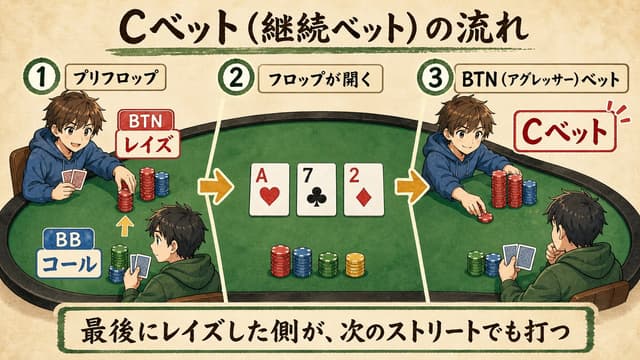
For example, if you raise from the BTN and the BB calls, the bet you make the moment the flop is dealt is a c-bet.
Why is c-betting effective?
C-betting is powerful because of the premise that the side that raised preflop = the stronger range.
The preflop raiser reaches the flop with a range that contains many strong hands
The opponent (the calling side) can be read as having a higher share of weaker hands than the raiser
When you bet on the flop, the opponent is more likely to fold because they sense that strong hands are continuing
In poker terms, this is called “range advantage”. Because the raiser has the stronger range across the flop as a whole, the basic stance is that you can c-bet at a certain frequency no matter what hand you hold.
When should you make a c-bet?
A c-bet is not something to fire automatically every time; the correct approach is to choose your spots. Here are the spots where c-betting works well.
Dry high-card boards: For example, A-7-2 or K-9-3, where the suits and ranks are all scattered. Your range, which contains aces and kings, is the stronger side
s where your range looks strong: On -style boards, the preflop raiser has the advantage
When the opponent’s range has few strong hands: On flops with high cards, the opponent tends to hold weak pairs
There are also spots you should avoid.
Low connected boards: For example, 6-5-4. The opponent’s calling range (suited connectors, etc.) connects easily
Multiway pots: When three or more players remain, the chance that at least one of them holds a strong hand goes up
When your hand is air with little room to improve: If the board favors the opponent’s range, checking instead of forcing a bet loses less
What size should your c-bet be?
Think of c-bet sizing in two broad types: “betting small” and “betting big”.
Small c-bet (around 1/3 pot): The spot to bet with your entire range. ed a range bet, it is fired widely on dry high-card boards and similar textures
Large c-bet (2/3 pot to pot-sized): The spot to mix strong hands with aggressive bluffs. Called a polarized bet, it is fired on specific boards where your range is polarized
For beginners, simply learning “dry high-card board = small range bet” will noticeably improve your c-bet accuracy. For the finer sizing distinctions, you can learn step by step in POKER Q'z’s “Getting to Know the CB” and “Learning the Basic Concepts of the CB” lessons.
How should you c-bet in multiway pots?
In multiway pots (three or more players still in), the basic rule is to sharply reduce your c-bet frequency.
As more players remain, the chance that someone calls rises dramatically
s get through less often, and c-betting from air hands is almost always unprofitable
only strong hands (top pair or better) and check to control with everything else
“Bet heads-up, don’t bet multiway” is a simple rule that pays off for beginners.
How is c-betting in 3-bet pots and 4-bet pots different?
In 3-bet pots (the flop after a 3-bet) and 4-bet pots, a lot of money has already moved in preflop, so the stack-to-pot ratio () is lower.
SRP (single-raised pot): SPR is high, leaving plenty of room to maneuver postflop
3-bet pots / 4-bet pots: SPR is low, making it easy for the action to go all-in quickly from the flop to the river
For this reason, c-bet sizes also tend to be smaller than in SRPs. Betting 1/4 to 1/2 pot in 3-bet pots and 4-bet pots is not uncommon. You can learn the detailed distinctions in POKER Q'z’s “Learning the Basic Concepts of 3BP and 4BP” lesson.
Frequently asked questions about c-betting
Q. How often should you c-bet?
A. It depends on the board. The basic approach is to create contrast: c-bet almost every time on dry high-card boards, and check significantly more often on low connected boards or boards that favor the opponent.
Q. What’s wrong with c-betting every time?
A. Opponents will read your balance and start striking back with raises and check-raises from the turn onward. The reason is that “betting every time = a high share of weak hands” is what gets inferred.
Q. What should you do when an opponent c-bets into you?
A. Decide based on the board and your hand. Call or raise with top pair or better, fold with air, and call or semi-bluff raise with draws. See our article on bluffing for more.
Q. How is it different from a donk bet?
A. A c-bet is made by the preflop raiser, while a donk bet is made by the calling side leading out first on the next street. See our article on donk betting for details.
Summary
A c-bet is the bet the preflop raiser makes to keep betting. It is the most-used action among players of every level. Here are the three points to remember.
Definition: The side that raised preflop keeps betting on the flop
Why it works: Because the raiser holds the range advantage
Choosing your spots: Dry high-card boards ✓ / low connected boards ✗ / multiway pots ✗
If you develop the habit of “betting anyway,” it becomes a typical point where improvement stalls, so be careful. For concrete board decisions and sizing, you can learn step by step in the “Getting to Know the CB” and “Learning the Basic Concepts of the CB” lessons in the poker learning app POKER Q'z.