
In poker, when you hear the term "donk bet," many players probably have a vague impression that it means a "bad bet". In fact, the name comes from the English slang term "Donkey (fool)," and it's often introduced as an action that beginners tend to make and that isn't recommended. However, in modern poker there are also situations where it can be used strategically. In this article, we'll cover the definition of the donk bet, where the name comes from, and why it isn't for beginners.
A donk bet is a bet made on the next street by the player who called a raise on the previous street, before the raiser gets to act. It isn't just a "bad bet" — depending on the situation, it can be a strategic choice.
What Is a Donk Bet?
A donk bet is when a player other than the one who raised preflop bets first on the flop or later.
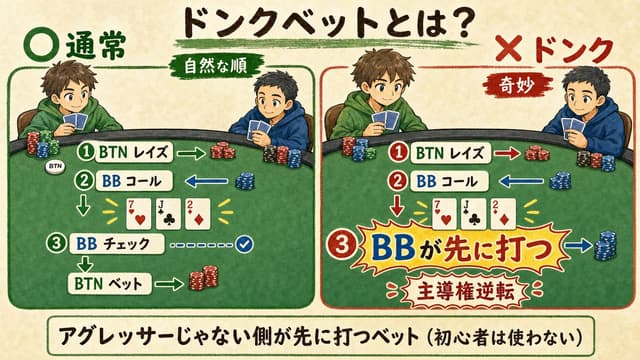
Here's an example of how it plays out.
BTN raises preflop
BB calls
The flop is dealt
BB (the side that didn't raise preflop) bets first ← that's the donk bet
Normally, the preflop raiser (BTN in the example above) holds the initiative and attacks the flop with a C-bet. A donk bet is the caller acting first, as if seizing that initiative.
Why Is It Called a "Donk"?
"Donk" is English slang that comes from "Donkey (the animal) = fool". In poker, weak players are sometimes mockingly called "Donks," and a bet made by such a player came to be called a "donk bet."
As the origin of the name suggests, it has long been talked about negatively as "a bet that bad players make". We'll look at the reasons in detail in the next section.
Incidentally, the word "Donk" itself carries a derogatory nuance, so telling an opponent directly, "that's a donk bet," is rude. It's useful to know as a term, but you should avoid using it lightly at the table.
Why Isn't the Donk Bet Recommended for Beginners?
There are three main reasons why the donk bet isn't recommended for beginners.
Because respecting the initiative is fundamental to poker: the "standard" is for the preflop raiser to keep attacking on the flop, and breaking that pattern makes the action harder to read
Because it gives away the strength of your hand: when beginners donk bet, it's usually because they "hit something on the flop," and to the opponent it's obvious at a glance that "this player has something"
Because a raise from a strong hand can make your losses grow: the opponent's preflop raising range contains plenty of strong hands, so when you donk bet you'll often get raised back and end up in a spot you're not sure how to handle
For beginners, the rule of thumb is "check first on the street after calling." to see the opponent's C-bet before deciding whether to call, fold, or raise gives you more information and leads to fewer mistakes. PQ'z's "Why Is a Donk a Bad Idea?" lesson also covers this fundamental approach.
Are There Situations Where Advanced Players Use Donk Bets?
In recent years, the spread of theory and the refinement of board-specific strategies have made it clear that the donk bet is not an action that is "absolutely forbidden". Advanced players mix in donk bets in situations like these.
When the board favors the caller: for example, when a low connected board (6-5-4, etc.) appears after BB calls. It connects well with BB's calling range, so leading out can seize the initiative
When you want to control the bet size: to guard against a big bet from the opponent, you lead small yourself to keep the pot size down (= block bet)
When you want to draw cheaply: rather than letting the opponent check behind and then face a big turn bet, you lead small yourself to gain information
However, all of these assume you can read the board and the opponent's range accurately. If beginners copy them right away, they'll step into the "raised back by a strong hand" risk described above. Learning the donk as an advanced application only after internalizing the standard line (checking and responding to C-bets) is the safe order of progression.
How Should You Respond to a Donk Bet?
Let's also lay out how to respond when you're the raiser and your opponent donk bets into you.
Strong hands (top pair or better): call or raise. Since you can't tell how strong the opponent's hand is, calling first to see how the hand develops — rather than raising big right away — also works
Medium-strength hands (middle pair / second pair): it depends on the board and the opponent's style; calling to see the turn is the safe play
Weak hands / air: fold. If you try to push them off with a raise and the opponent really does have a strong hand, the damage only grows
Assuming that "an opponent who donk bets is more likely to hold a strong hand than the average player" will make your responses more consistent.
Donk Bet vs. C-Bet vs. Check-Raise: What's the Difference
The three actions can be distinguished by who bets first and whether the player waits for the opponent's bet.
| Action | Who makes it and when | Main purpose |
|---|---|---|
| Donk bet | The previous street's non-aggressor bets before the aggressor | To take value or protection first on specific boards |
| C-bet | The previous street's aggressor keeps betting on the next street | To use range advantage to get value or folds |
| Check-raise | Checks first, then raises over the opponent's bet | To grow the pot with strong hands or bluffs |
Comparing the donk bet with the basics of C-bets first makes its definition clear. For which boards it's used as an exception, see GTO thinking; for taking profit from strong hands, refer to the value bet guide.
Frequently Asked Questions About Donk Bets
Q. If the preflop raiser bets OOP, is that a donk bet too?
A. No, it isn't. When the preflop raiser bets first even out of position, that's a C-bet (continuation bet). A donk bet refers to a bet made first by the side that didn't raise preflop.
Q. Is the 3-bettor making a donk bet?
A. The 3-bettor was the last player to apply aggression preflop — in other words, the aggressor — so their subsequent bets are C-bets, not donk bets. "Who is the aggressor?" is the criterion.
Q. Should you always be wary when you face a donk bet?
A. It depends on the opponent's level. Against beginners, you can read them as "likely to have hit something," so respond by calling with strong hands and folding otherwise. Against advanced players, it can be a strategic play, so judge based on the board and the opponent's tendencies.
Q. Do donk bets show up in leagues and home games too?
A. The more beginner-heavy the table, the more often you'll see them. Since the "I hit a pair and got excited, so I bet" pattern is common, a simple response — raise with strong hands, fold everything else — works well enough.
Summary
A donk bet is a bet made first on the flop or later by the side that didn't raise preflop. The name comes from "Donkey = fool," and it has long been known as an action beginners tend to make that isn't recommended.
Beginners shouldn't use it: "check first on the street after calling" is the rule of thumb
Advanced players sometimes use it strategically: caller-favorable boards / block bets / cheap draws
When it's bet into you, fight back with strong hands: the opponent is more likely to have "hit something" than the average player
Mastering the standard line (checking and responding to C-bets) first is the shortest route to improvement. out PQ'z's "Why Is a Donk Bet a Bad Idea?" lesson to review this fundamental approach.