
Once you start playing poker, you'll soon come across the word “range.” For example, in YouTube strategy videos and blog posts, you may have heard people talk about how “their range is wide here” or “our range is in an advantageous spot.”
In this article, we'll explain what a range is and how to use it in a way that's easy to understand even if you've just started playing poker.
1. What Is a “Range,” Anyway?
A “range” is the complete set of hands a player can hold. A “range chart” is a visual representation of which hands should and shouldn't be played.
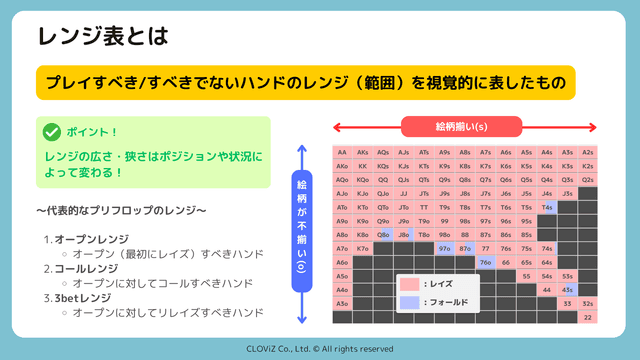
Note: charts often use notation such as AKs and AKo. s (suited) means the two cards are the same suit; o (off-suit) means they are different suits. Most range charts list suited hands on the horizontal axis and off-suit hands on the vertical axis.
For example, if an opponent raises preflop, they might hold big cards like A K, a suited connector like 8 7, or even a weak pocket pair.
This “list of hands your opponent could have” is their range.
Why Is the Range So Important?
Poker is a game where you can never be completely certain whether your hand is winning or losing until showdown.
By estimating “which hands your opponent is likely to hold,” you can choose actions such as betting, calling, and folding with much more precision.
The range concept also helps you think about how your own hand looks from your opponent's perspective.
2. How to Think About Ranges
Preflop Ranges
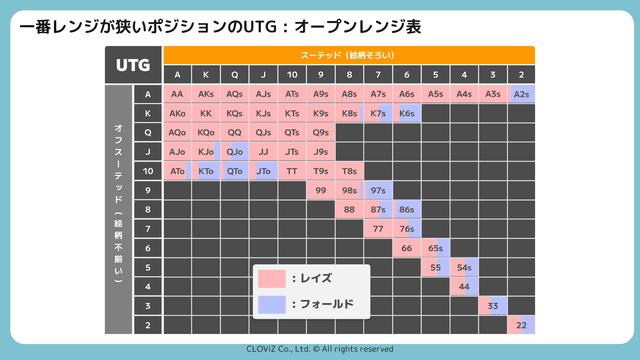
In poker, the first range you should learn is the preflop range. For example, poker strategy books and training sites often show tables like “recommended hands to raise from UTG (under the gun).” These tables show a guideline: roughly speaking, if you're going to raise from that position, this group of hands keeps your range balanced.
As a beginner, using these preflop range charts as a reference and learning patterns like “from this position, I'll play hands like these” is a shortcut to getting better.
How Ranges Differ by
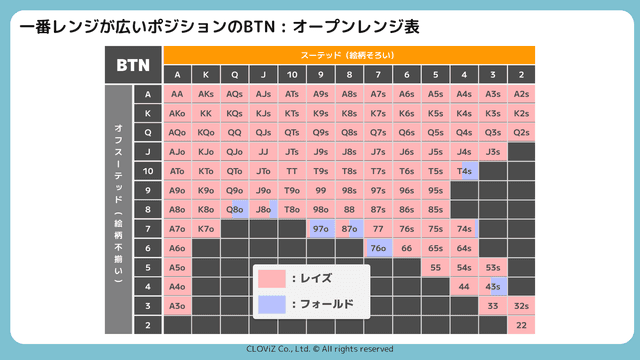
In poker, positions that get to act later (such as the BTN) have the advantage, and the more advantageous your position, the wider you can make your hand selection (range).
- Examples
- From UTG (first to act), you generally only open-raise relatively strong hands such as A K or Q Q.
- From the BTN (button) or SB (small blind), depending on the action around you and how many players have folded before you, you can play a relatively wide range that includes suited connectors and small pairs.
In short, keep in mind that the way you build your range changes depending on your position.
Thinking About Ranges by
A range isn't just a list of hands a player can hold — it also changes with a player's patterns of action.
- range
The hands a player holds when they open-raise
- ing range
The hands a player holds when they call (cold-call)
- 3-bet and 4-bet ranges
The hands suited to raising back against another player's open-raise or 3-bet
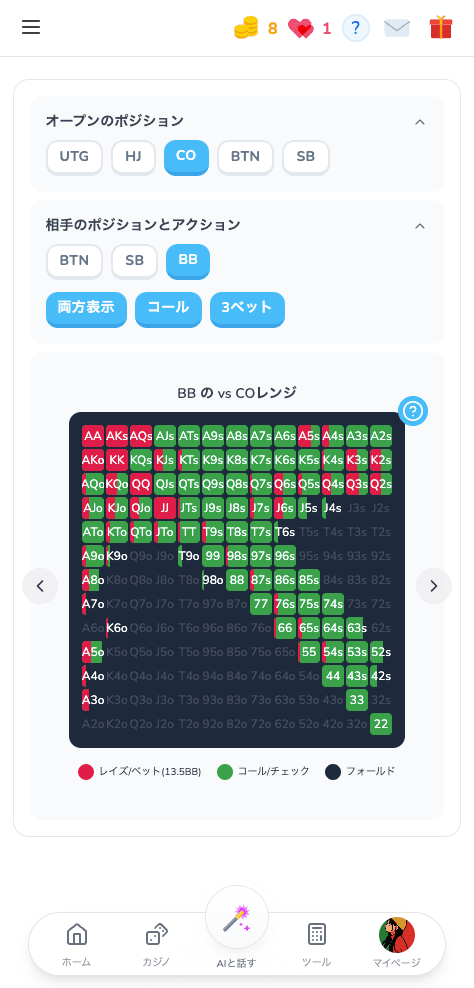
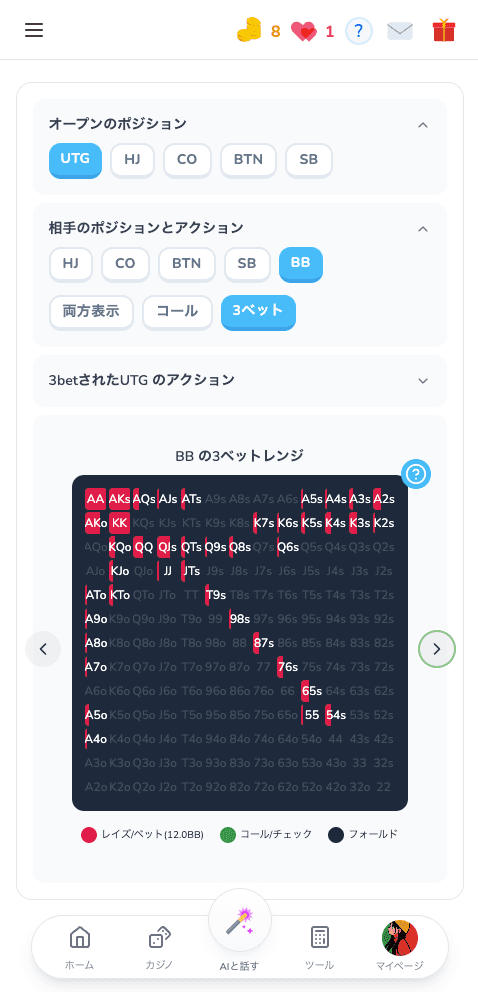
By imagining what hands a player can hold for each action, you can build a complete picture of your opponent's overall range.
The POKER Q'z app lets you not only check ranges for each position and action, but also practice whether you're playing in line with your range.
The app is free to start, so if you haven't downloaded it yet, we recommend installing it!
3. Benefits of Thinking in Ranges
- It's easier to estimate your opponent's strength
- Whether your opponent raised from UTG, raised from the BTN, or fired back with a 3-bet dramatically changes the types of hands they're likely to hold.
- Taking this into account improves your predictions of how likely your opponent is to have connected with the flop as soon as it's dealt, and what actions they'll take on the turn and river.
2. It's easier to decide your own actions
- If your opponent's range tends to be strong, it's often wiser not to bluff or call lightly.
- If their range is wide and likely includes many weak hands, c-bets and bluffs have a good chance of succeeding.
3. You can view your own hand as part of a range
- For example, if you raise from the button and the big blind calls, a range-versus-range situation is created: your button opening range vs. their calling range.
- In that situation, judging how strong your current hand is relative to your overall range is the key to choosing your next action — bet, check, or fold.
4. Points That Help You Read Ranges
- Your opponent's position
- s (UTG, HJ, etc.) often have narrow, strong ranges.
- s from the BTN or CO tend to come with wider ranges.
- Your opponent's playing style
- players only get involved with strong hands in the first place.
- -aggressive players may include lots of broadways and suited connectors in their ranges.
- sizes and the situation (tournament or cash game)
- Short-stacked late in a tournament, opponents often narrow their range and move all-in.
- In cash games, deep-stacked players tend to call or raise with somewhat wider ranges.
Summary
The range is one of the most important concepts in poker. Once you can play while thinking not just about your own hand in isolation, but also about “what hands your opponent might have”, and “how your range looks from your opponent's perspective,” the battle of reads — poker's greatest thrill — becomes far deeper.