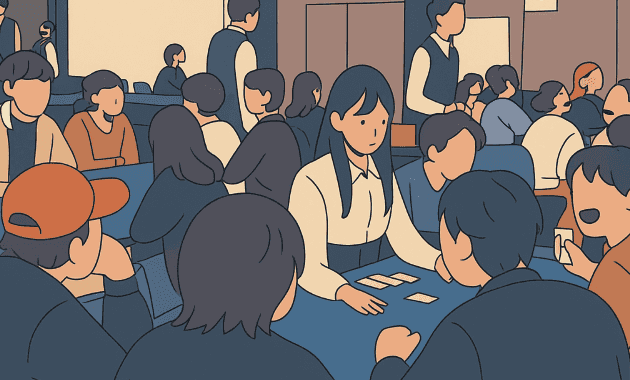

Tournaments Aren't a "Game of Luck"
In a tournament, the blinds keep rising and your stack keeps shrinking.
You stare sadly at your dwindling stack, think, "Well, I guess it's about time to go all in..." and reluctantly shove — only to bust out more often than not.
"s really are just a game of luck, aren't they?"
Is that what you've been thinking?
Let's settle this once and for all.
Tournaments are absolutely not a game of luck.
Now, let's take a look back at your own play.
- Did you play with an opening range for tournaments, not the one you'd use in a cash game?
- Did you adjust your opening range flexibly according to your stack size?
- Did you keep track of how many more players needed to bust before you'd cash and the stacks around the table?
- Were you able to make decisions that accounted for ?
- Did you navigate the bubble line well?
- Did you make the right all-in decisions?
If you didn't understand what any of these mean, that's proof that you haven't studied tournaments enough.
These are the fundamentals of tournament play, so you can understand them quickly with a little study.
Knowing versus not knowing makes a world of difference, so let's close that gap as soon as possible.
Of course, there are plenty of other things to consider beyond the points listed above.
If you play a tournament exactly like a regular cash game, you won't win the way you hope.
If you want to finish even a little higher in tournaments,
let's commit to "tournament-specific study"
properly.
Tournament Basics — How Tournaments Differ from Cash Games
Tournaments differ from cash games in several important ways. Let's start by sorting out what those differences are.
1. The Goal Is to Survive to the End and Win a
Tournaments and cash games have fundamentally different goals. In a cash game, the goal is simply to increase the chips in front of you. In a tournament, the goal is to survive as long as you can and win the prize that goes with your finishing position.
In other words, your chips and the prizes don't match up one to one.
For example, say you're in a tournament with 100 players and prizes go down to 5th place. Everyone from 6th to 100th is the same in that they get no prize at all. In other words, there's a decisive gap between 5th and 6th place.
This is why, in tournaments, you need to play with your finishing position in mind.
2. The s Keep Going Up
In a cash game, the blinds usually stay fixed, but in a tournament the blinds rise over time.
For example, say you start with 20,000 chips, which is 200 big blinds at 50-100. Once the blinds go up to 500-1,000, that same 20,000 chips is worth just 20 big blinds.
In other words, rising blinds mean your chips are losing value. It's important to correctly track how many big blinds you and your opponents have and play with that in mind.
3. There Are s
Unlike cash games, tournaments have "antes." These are chips that players put into the pot in advance, separate from the blinds. In many cases, the ante is equal to the big blind, and it's often paid by the player in the big blind.
This means that in a tournament, the pot always contains at least 2.5 big blinds: the SB (0.5 BB), the BB (1 BB), and the ante (1 BB).
Because the pot is bigger than the 1.5 big blinds of a cash game, the return when you join the pot is larger.
4. There's No
s usually take a fixed "rake" out of the pot postflop, but tournaments have no rake.
So, just like the point above, the pot never shrinks postflop, which means the return on playing postflop is larger.
Even at the level of basic rules, tournaments and cash games differ greatly.
Naturally, tournament strategy is also very different from cash-game strategy.
Keep this firmly in mind, and study with a focus on how tournaments differ from cash games.
Now let's look at what you should study first.
Tournaments Are 90% Preflop!?
Where should you start studying tournaments...?
Let's get straight to the answer.
Overwhelmingly, preflop.
Tournaments are 90% preflop.
Stop overthinking it and just study preflop.
...That probably sounds too blunt, so let me briefly explain why preflop deserves so much weight.
As I mentioned earlier, tournament blinds keep going up, so you'll play with a short stack very often.
This means you'll end up all in preflop far more often.
If you get a preflop all-in decision wrong, it's a fatal mistake.
All your hard work up to that point goes down the drain. That's really hard to swallow.
Tournament preflop play differs from cash-game preflop play in many ways, and it's complex because there are a lot of tournament-specific factors to consider.
Through studying preflop, let's learn the fundamentals of tournaments.
Now, let's look at just three concrete examples.
Example 1: An All-In Decision Right Before the Money
Say you're in a satellite tournament, and you'd cash (win a prize) if just one more player busted out. You're dealt AK in the big blind with 10 big blinds behind.
The chip leader on the button shoves for 50 big blinds, and everyone else folds.
The remaining stacks are 20 big blinds for UTG and CO, 10 big blinds for the SB, and 2 big blinds for HJ.
It's shove or fold — which action do you take?
(This situation is based on a POKER Q'z lesson.)
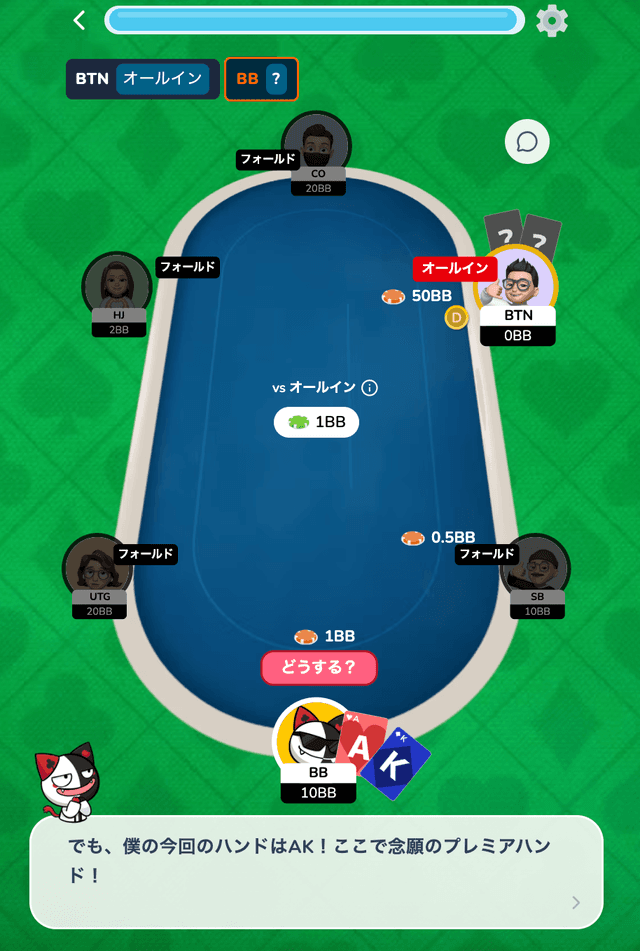
...The correct answer is fold!
"Wait, you fold AK?"
If that's what you're thinking, then you won't win tournaments. ing the all in here is clearly a huge loss.
Let's break down the situation: you're one player away from the money, and the HJ with just 2 big blinds looks like they're about to bust any moment.
In other words, there's a good chance HJ busts and you cash without doing anything at all.
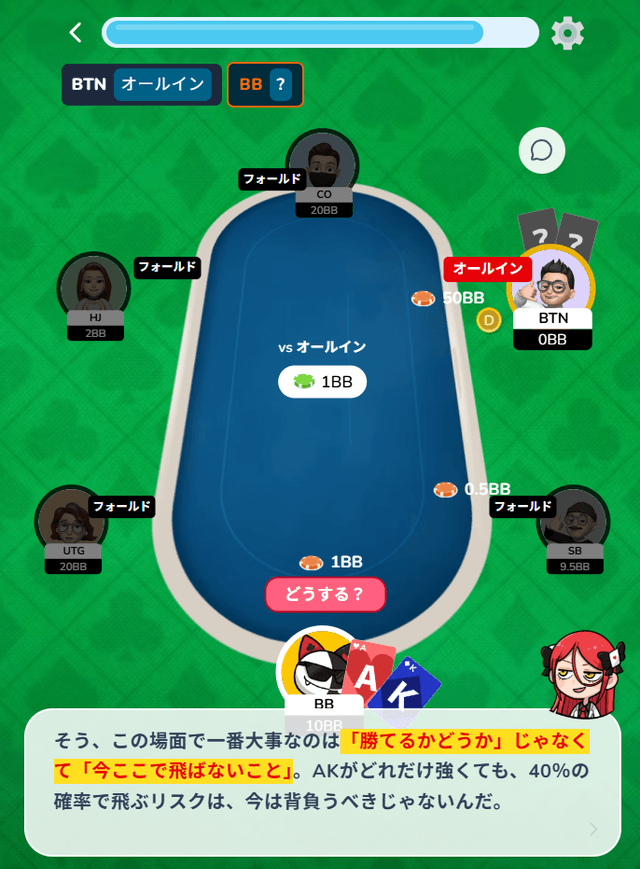
AK is certainly a very strong hand, but even so, it only has around 60% equity against the button's entire shoving range.
When you're likely to cash without doing anything, taking a gamble that busts you about 40% of the time is clearly a bad deal.
If you were about to shove, correct that thinking right now.
Example 2: Defending the Big Blind
Say it's an ordinary spot and the money is still far away. You have 50 big blinds and are dealt 94 in the big blind.
UTG, who also has 50 big blinds, opens to 2.3 big blinds, and everyone before you folds. What do you do?
, call, or fold?
...The correct answer is call!
Did you think, "Wait, isn't 94s weak?"
But tournaments have antes, so the big blind can defend with quite a lot of hands.
Against an open to 2.3 big blinds like this one, you can compete for a pot of 1.3 BB × 2 + 2.5 BB (blinds + ante) = 5.1 big blinds by paying just 1.3 more.
Here's a surprising fact about suited hands and defending the big blind.
When the open is small, the big blind can call with every suited hand.
That's right: every single one.
Thanks to the ante, the big blind's defending range can be this wide.
One caveat: if the open is big — 3 big blinds, for example — it's better to fold the weaker end of your suited hands.
As you can see, winning your way through a tournament requires correctly understanding its characteristics and responding flexibly to each situation.
Example 3: An All-In Decision in the Middle Stages (Advanced)
Here's one advanced example. If it's too much, feel free to skim past it.
You enter a tournament with 40,000 chips.
You build your stack steadily into the middle stages: about a third of the field remains, the average stack is 120,000 chips, and the blinds have gone up to 3,000-6,000.
With 120,000 chips (20 big blinds), you open to 14,000 (2.3 big blinds) from LJ, and the SB shoves for 120,000.
Against this shove, which offsuit aces (AXo) do you call with?
AKo, AQo, AJo, ATo, A9o...
...The correct answer is AJo!
According to the expected values calculated with Wizard:
Calling with AJo: +1.32 big blinds
Calling with ATo: ±0 (though it's mostly a fold)
Calling with A9o: -1.37 big blinds
That's how the numbers work out.
"Just a bit over 1 big blind? That's nothing,"
you might think.
But "1.3 big blinds" is a difference of about 10,000 chips in this situation.
Whether you folded AJo or called with A9o,
it would be like throwing away 10,000 chips out of the 40,000 you started the tournament with — a colossal mistake.
As time goes by and the blinds rise, a single mistake becomes fatal in tournaments.
So, Yes: Tournaments Are 90% Preflop
We've looked at several examples so far,
and the bottom line is: tournaments are 90% preflop. Start studying preflop right now.
...I said that with conviction,
"That's easier said than done."
many of you may have thought.
To be honest, the author of this article felt the same way at first.
But for you, I have a study method I recommend!
How to Study Tournaments Efficiently
We've covered a lot about tournaments so far. Now let me introduce an efficient way to study.
First, how are you currently studying poker?
Some of you might not study poker at all.
Others might just play hands and review afterward.
Reviewing after real play is of course important, but
- you can't get enough hands in
- it's hard to find the correct answer on your own
- you can only practice the situations that happen to come up
...which inevitably becomes inefficient.
There are plenty of ways to study on your own, like books and YouTube, but there's one I'd particularly like to recommend this time.
That is a "poker learning app."
With a poker learning app, you can
- make steady progress in spare moments, like on the train
- practice a lot of hands in a short time
- always be told the correct answer
and study efficiently even on your own!
The Poker Learning App: POKER Q'z
Now, here's the app I want to recommend to you. It's
"POKER Q'z" .
POKER Q'z - Poker Learning & Skill Assessment App
POKER Q'z uses the latest AI to help you learn poker in a fun, easy-to-understand way.
The point I want to recommend most about this app is that you can study from it like a textbook.
Please don't think, "It's just an app, so it must be sloppy."
The developers seriously thought about "what makes you better at poker" and packed it with all kinds of quizzes and lessons.
There are tournament lessons too, so you can steadily learn about tournaments from the fundamentals.
You can efficiently master situation-based strategies — like the bubble (right before the money) and the early and middle stages — through a "lesson → practice → explanation" flow. The curriculum focuses especially on preflop strategy, the most important part of tournaments, so you can study it thoroughly from the basics to advanced play.
On top of that:
- learn enjoyably through quizzes
- study carefully from the fundamentals with level-based lessons
- characters explain everything in an easy-to-understand way
- you can ask questions to the AI
It's an app you can pick up casually, so just install it and give it a try.
For example, Example 1 from earlier is explained just as clearly inside the lessons.
Summary
In this article, we introduced the fundamentals of tournaments and how to study them.
These are essential for winning tournaments, so remember them well.
If you play a tournament exactly like a regular cash game, you won't win the way you hope.
"Tournaments are 90% preflop."
Let's use POKER Q'z and build up your tournament study step by step from the fundamentals!