Learn the Basics of Preflop Strategy in Poker

Affiliated with the School of Informatics at the University of Tsukuba.
Also active as a poker player specializing in mixed games, mainly in Las Vegas.
Engaged in business development at CLOViZ Inc.
In this article, we’ll cover the essential preflop concepts you need to study poker effectively, with a focus on how to understand and learn hand ranges.
You can play poker without knowing preflop ranges, but if you want to enjoy the game at a higher level and start winning consistently, understanding and tracking ranges becomes a key skill.
Get the Big Picture of Open Ranges
Many beginners who already understand the rules try to memorize every starting hand range perfectly from day one. Because ranges are so large and detailed, a lot of players end up overwhelmed and give up.
When you break down 6-max ranges one by one, you’ll find things like:
・Open-raise ranges by position
・Big blind defense ranges vs an open raise
・Raise ranges after an open raise, such as 3-bets
That alone adds up to more than 40 different charts.
And each chart includes multiple branches for raise, call, and fold actions, different raise sizes by position, and even mixed-frequency hands that you sometimes play and sometimes don’t. There are many layers of complexity.
For now, let’s set those complicated details aside and start by learning the broader rules that explain preflop strategy.
Instead of memorizing ranges like multiplication tables, you’ll learn the logic behind why ranges are built the way they are. Once you understand that logic, ranges become much easier to see and remember.
How Ranges Expand by Position
Let’s start with open-raise ranges. An open raise means you raise when no one has entered the pot before you. If you’re not confident with the terminology, check this article first.
...Link to terminology article...
In poker, there’s a core principle: the fewer players left to act behind you, the wider your range can be.
This may sound obvious, but you don’t know what hands the players behind you were dealt.
The more players still to act, the higher the chance that someone wakes up with a strong hand.
Because ranges widen as you move closer to the button, let’s begin with the tightest position: UTG.
Note: In this article, we’ll use standard 6-max cash game ranges from GTO Wizard as examples.
UTG
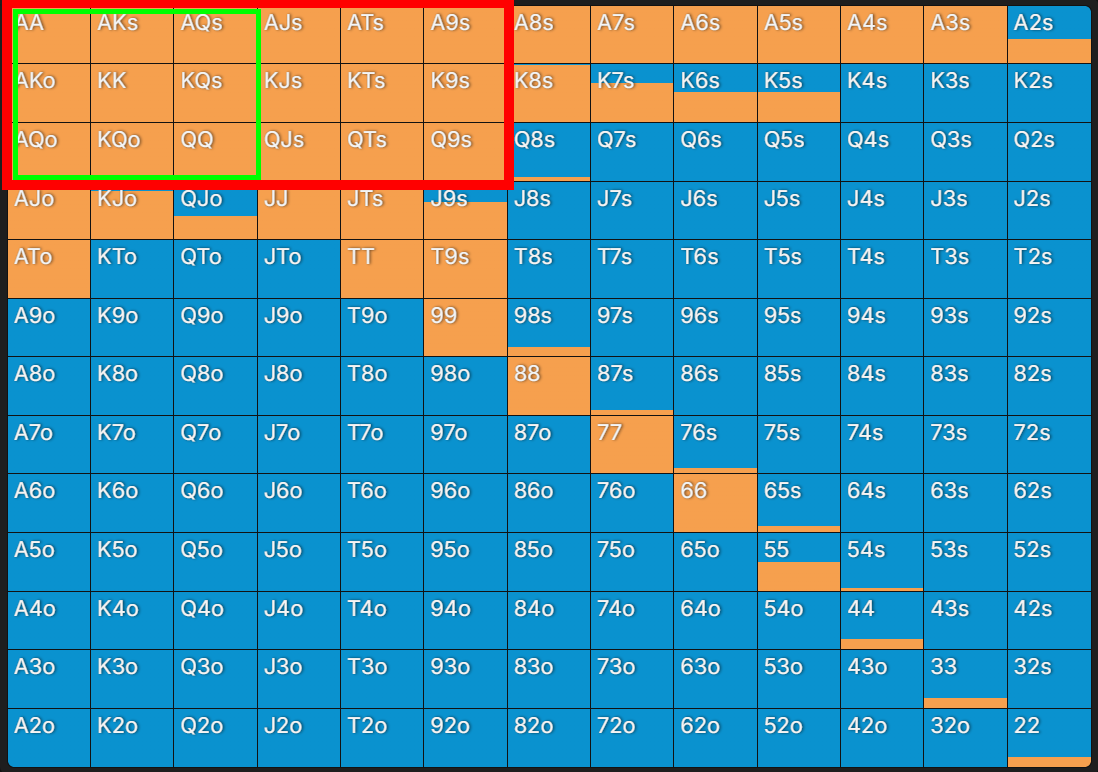
Orange hands are open raises, and light blue hands are folds.
UTG’s open range is very tight. You can only play about 17% of all starting hands.
First, memorize the area outlined in green: a 3x3 square with Q as the outer edge. You always play the hands inside this square.
Next, also remember the red rectangle that includes the adjacent 3x3 block. Keep these two shapes in mind first.
Now let’s check HJ and later positions the same way.
HJ
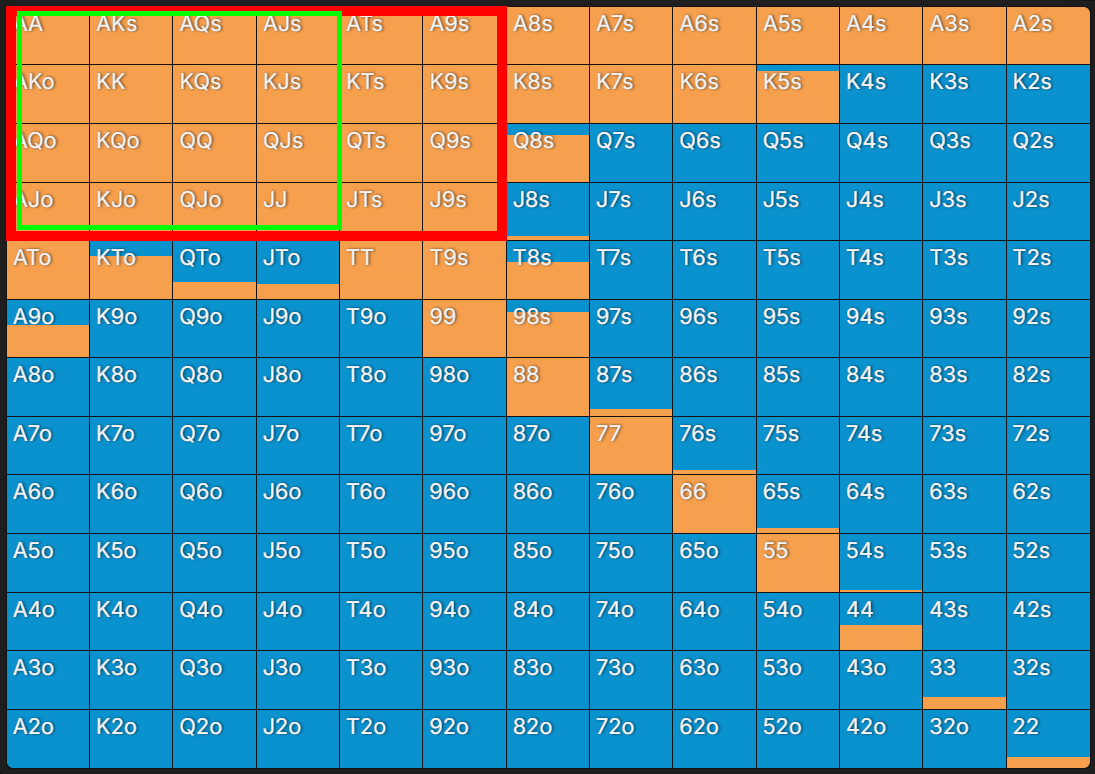
In HJ, the green area expands to 4x4.
The red area stays similar, and its vertical expansion follows the green square.
CO
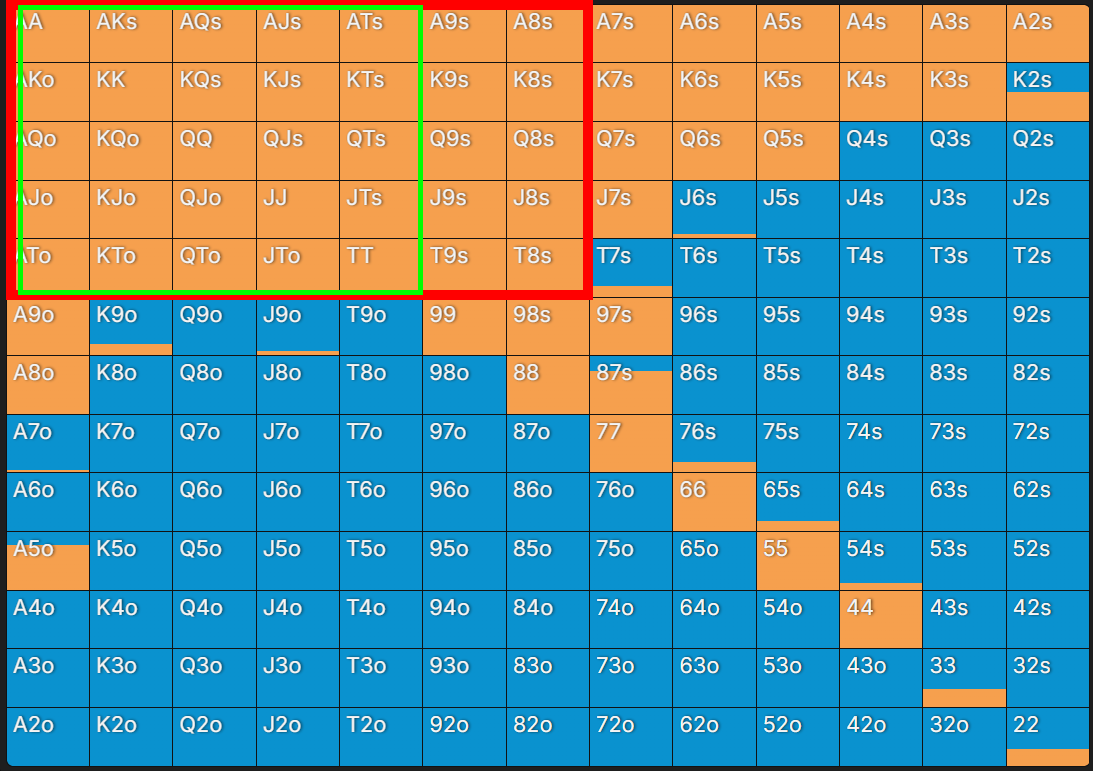
The green area becomes 5x5.
The red area expands one cell to the right.
BTN
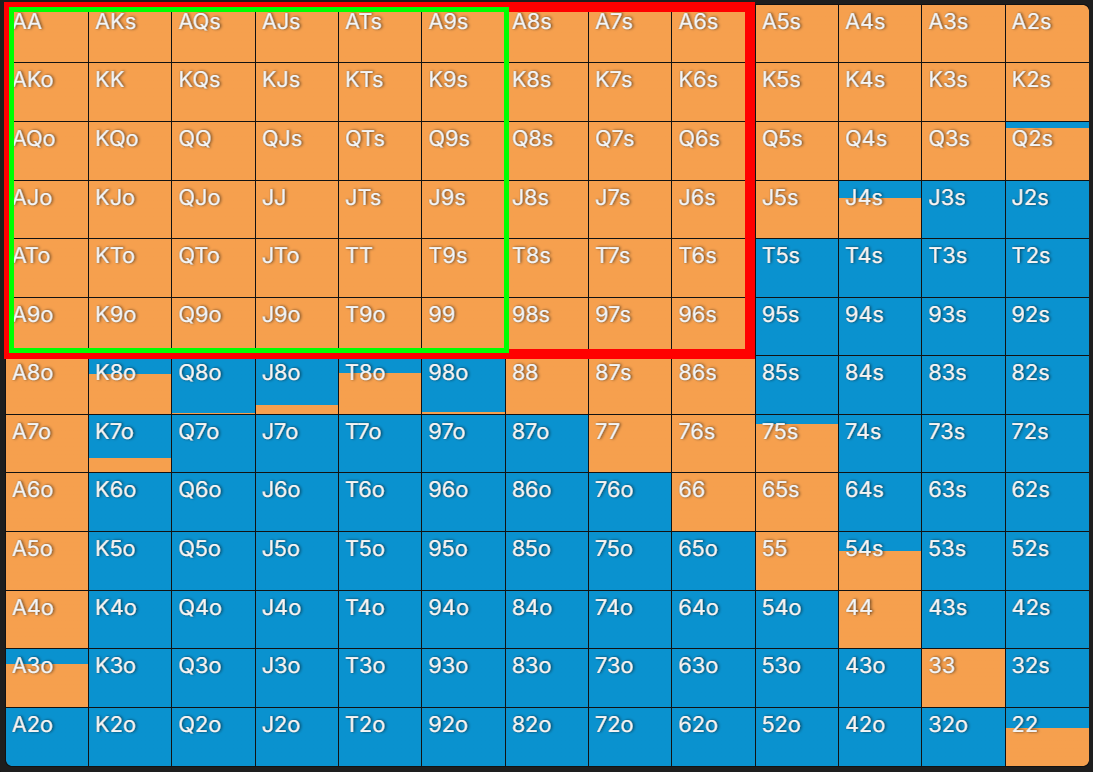
The green area becomes 6x6.
The red area expands two cells to the right.
As you can see, the range gradually widens from UTG to BTN.
This is strongly tied to how many players are left to act behind you.
UTG has five players behind with unknown hands and unknown actions. BTN only has two. Since UTG faces a higher chance that someone holds a strong hand, UTG must play tighter, while BTN can open wider.
Remember the pattern: the green area expands by one step each position, and the red area expands in a consistent way. Vertically it tracks the green square, and horizontally it expands by 0, 1, then 2.
If you have extra time, memorize the remaining hands too.
You’ll notice that suited Ax hands and pocket pairs appear across all positions (sometimes at low frequency), meaning you can play them from anywhere in many strategies.
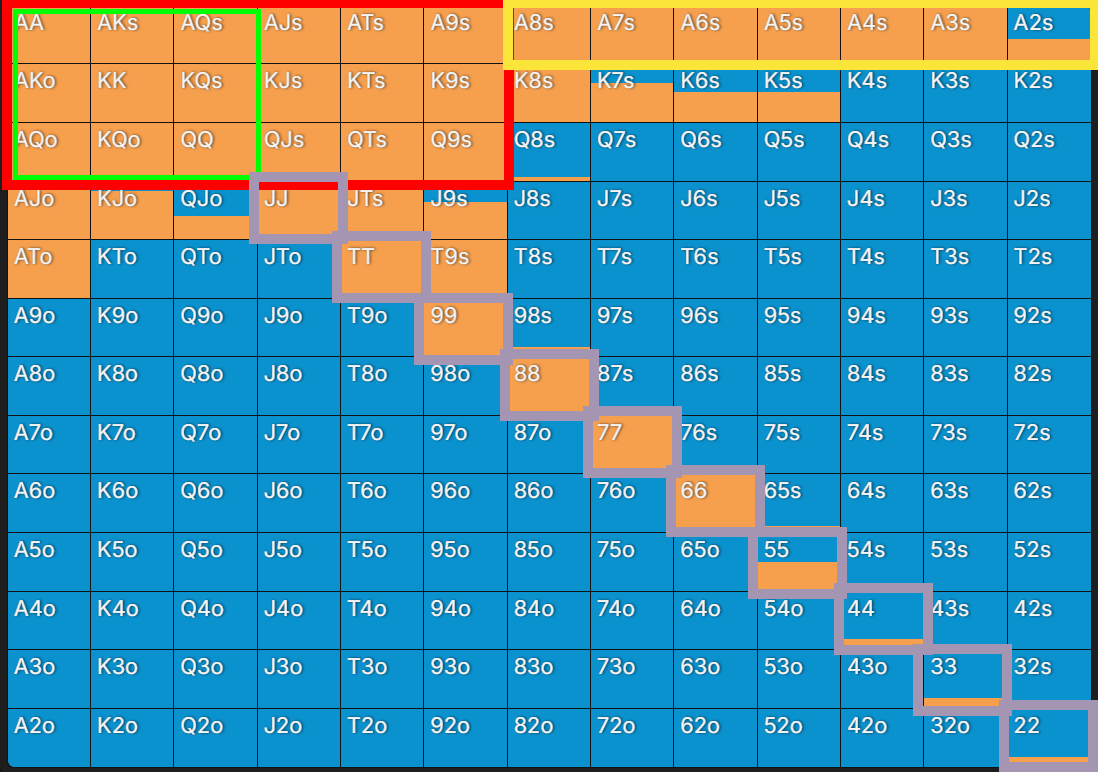
When you look at ranges this way, you can cover most of the open-raise range quickly. Use the same process for other positions, then fill in the smaller details afterward to complete your UTG-to-BTN open ranges.
By learning the majority of the range first and adding the remaining hands later, you’ll memorize ranges much more efficiently than trying to learn everything at once.
Playing from the Small Blind
Because the small blind is guaranteed to play heads-up against the big blind, some strategies include a lot of limping ranges.
In this article, to make comparisons easier, we’ll look at a simplified strategy that only uses two actions: open raise or fold.
SB 3bb open
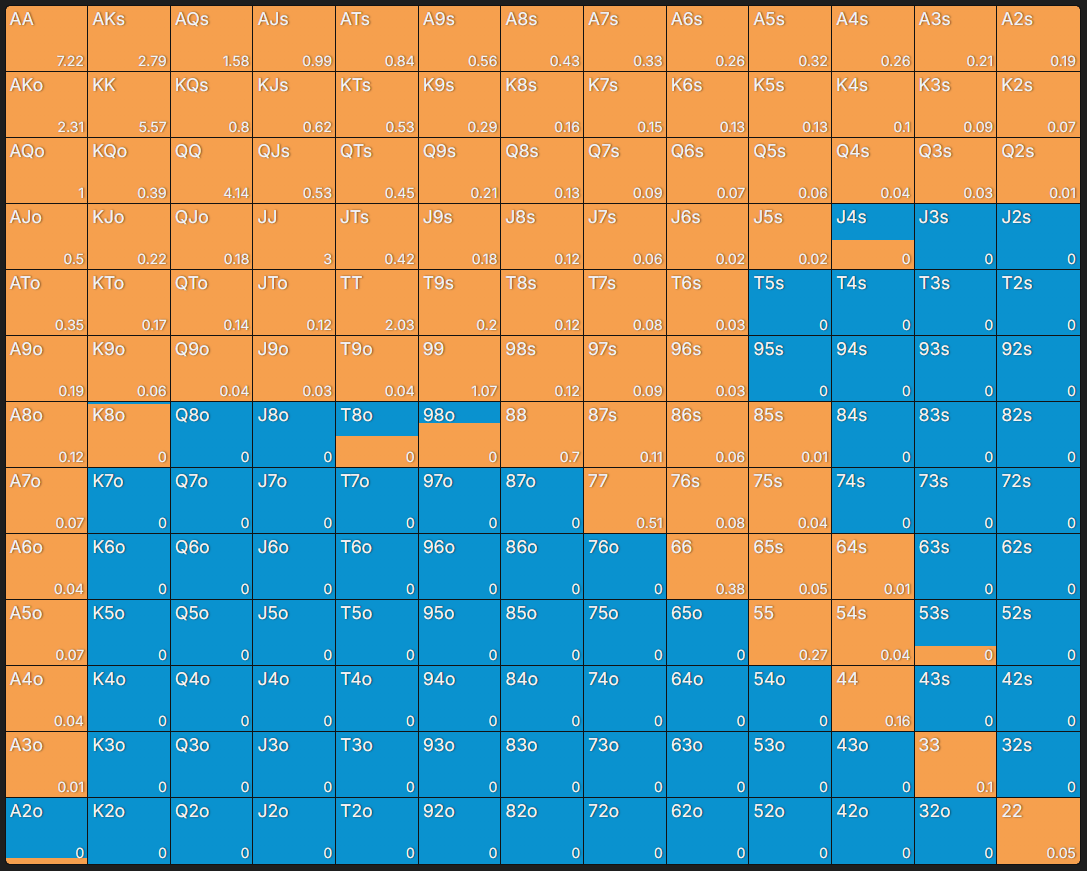
The SB has even fewer players behind than the BTN, but there are two key differences:
・You’ve already posted a blind
・You’ll be out of position against the BB
Because you’ve already posted a blind, you get better pot odds, which increases how often you can enter the pot compared to other positions.
If you want to learn pot odds in detail, read this article.
...(Link to pot odds article)...
Being out of position against the BB reduces how often you should enter the pot.
These factors combine so that, in practice, the SB range ends up being built from almost the same group of hands as the BTN.
When you think in terms of raise-or-fold, remember that SB and BTN ranges are essentially the same.
Playing from the Big Blind
The big blind has unique advantages: you’ve already posted a blind, and by calling a raise you can close the preflop action yourself. As a result, the BB calls far more often than any other position.
You’ll even see hands like 74s and 63s that you would never play from other positions. The range looks wide and hard to memorize, but if you break it down step by step, it becomes much easier to understand.
BB vs BTN open
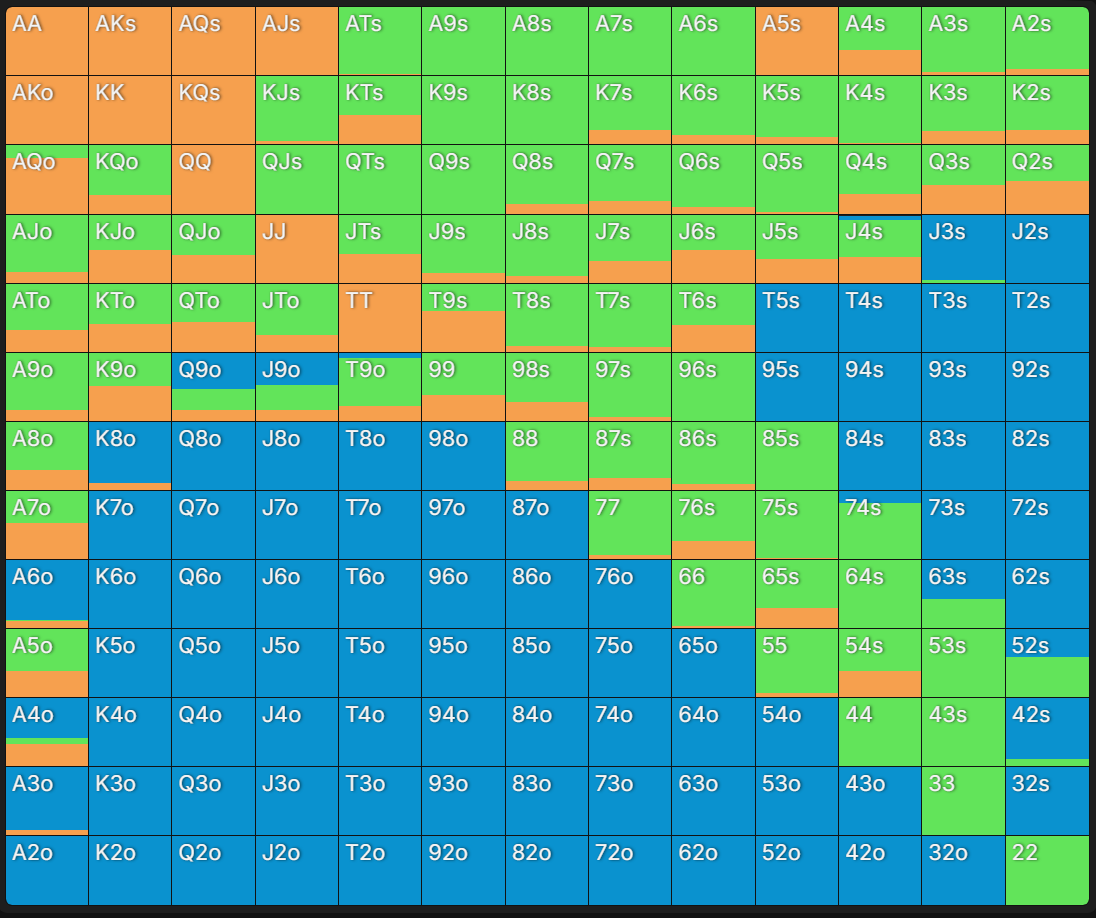
Because playable hands split into raises and calls, start by memorizing the overall set of hands you can continue with.
The BB’s continuing range is very similar to the BTN’s open-raise range, but it adds hands like 85s and 74s, while removing some offsuit Ax and A8-type hands.
To separate raises from calls, you first need to understand the nature of the BB’s 3-bet range.
Here is the SB’s range versus a BTN open raise.
SB 3bet vs BTN open
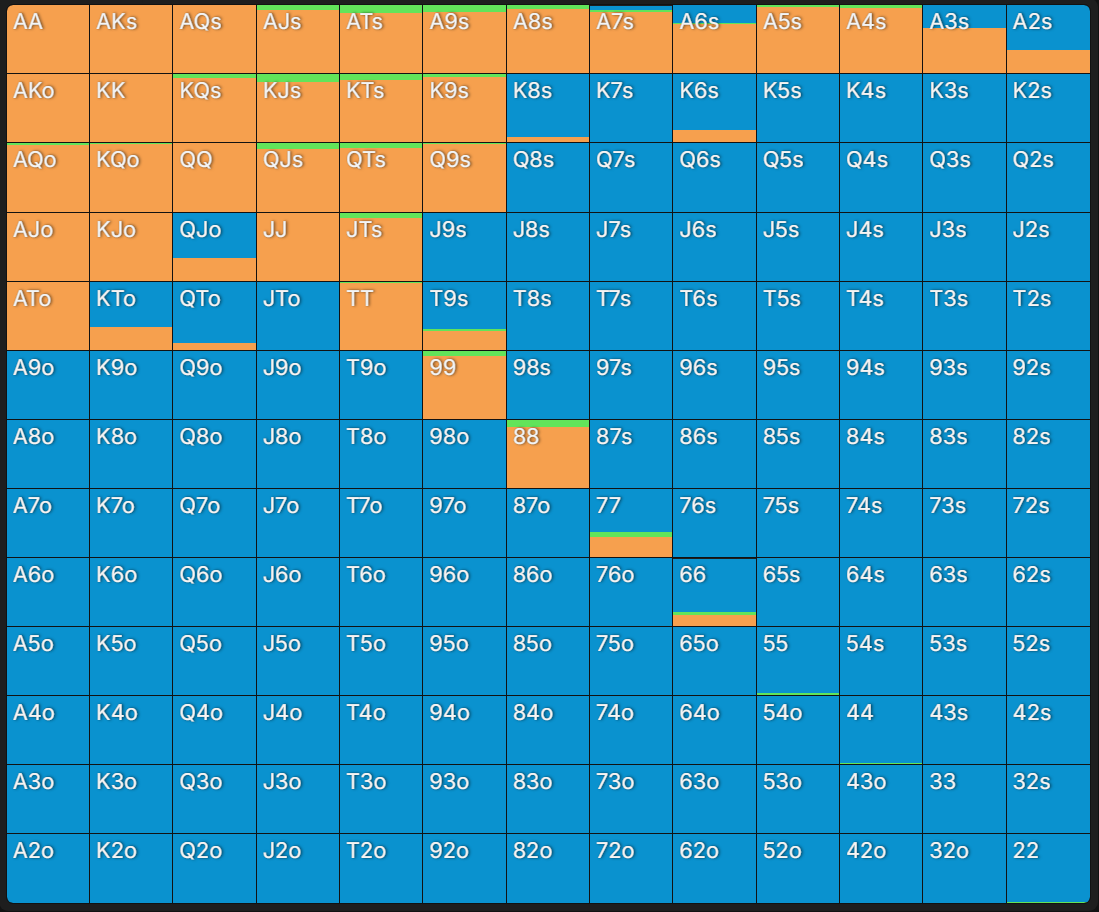
The overall 3-bet frequency isn’t that different, but the composition is very different.
The BB doesn’t 3-bet hands like K9s and Q9s as often, and instead uses hands like K3s and Q3s. Meanwhile, the SB tends to 3-bet in a more straightforward way, starting from the strongest hands.
Why does this difference happen?
The BB’s 3-bet range is shaped mainly by two factors: no players are left to act behind you, and you’ve already posted a blind.
Because of these factors, the BB can defend with a very wide calling range compared to other positions.
In other words, the BB can call with weaker hands that wouldn’t be profitable without the blind already invested.
From another perspective, if you 3-bet all your strong hands, your calling range becomes extremely weak. To avoid that, GTO strategies often move some hands that could 3-bet into the call range to stay balanced.
The BB’s 3-bet range typically includes premium hands like AA and KK that are too strong to just call, plus some weaker hands like Q3s and J6s that balance the range.
The BB range may look complicated at first, but once you understand this concept, ranges become much easier to read and memorize.
Preflop hand strength alone doesn’t decide who wins in poker. The game continues after the flop, so you need a strategy that accounts for what happens next.
Understand Raise Sizes
Next, let’s talk about raise sizing.
A standard open-raise size is usually 2 to 3 big blinds. You can use one consistent size across positions, but in equilibrium play, using position-specific sizes can produce higher EV.

When GTO changes sizes by position, it tends to use smaller opens in early position and larger opens in late position. Just like range width, this also relates to the players behind you.
At first glance, larger open sizes may seem better because they often increase EV when everyone folds or calls. However, when you compare the EV after facing a 3-bet, smaller open sizes reduce the EV loss.
If EV feels a bit difficult, check this article first.
...Link to EV article...
Since you’ll have to fold your weaker hands after getting 3-bet, smaller opens from early position make more sense.
To improve at poker, you need to think beyond just the hands you can enter with. You also need to plan for what happens next and view the entire range as a system.
In the next section, we’ll look at how to respond when you get raised.
Learn How to Respond When You Get Raised
So far, we’ve focused on open ranges. But after you open-raise and someone raises you, what should you pay attention to?
Below is UTG’s action after opening, then facing a BTN 3-bet, with everyone else folding.
UTG vs BTN 3bet
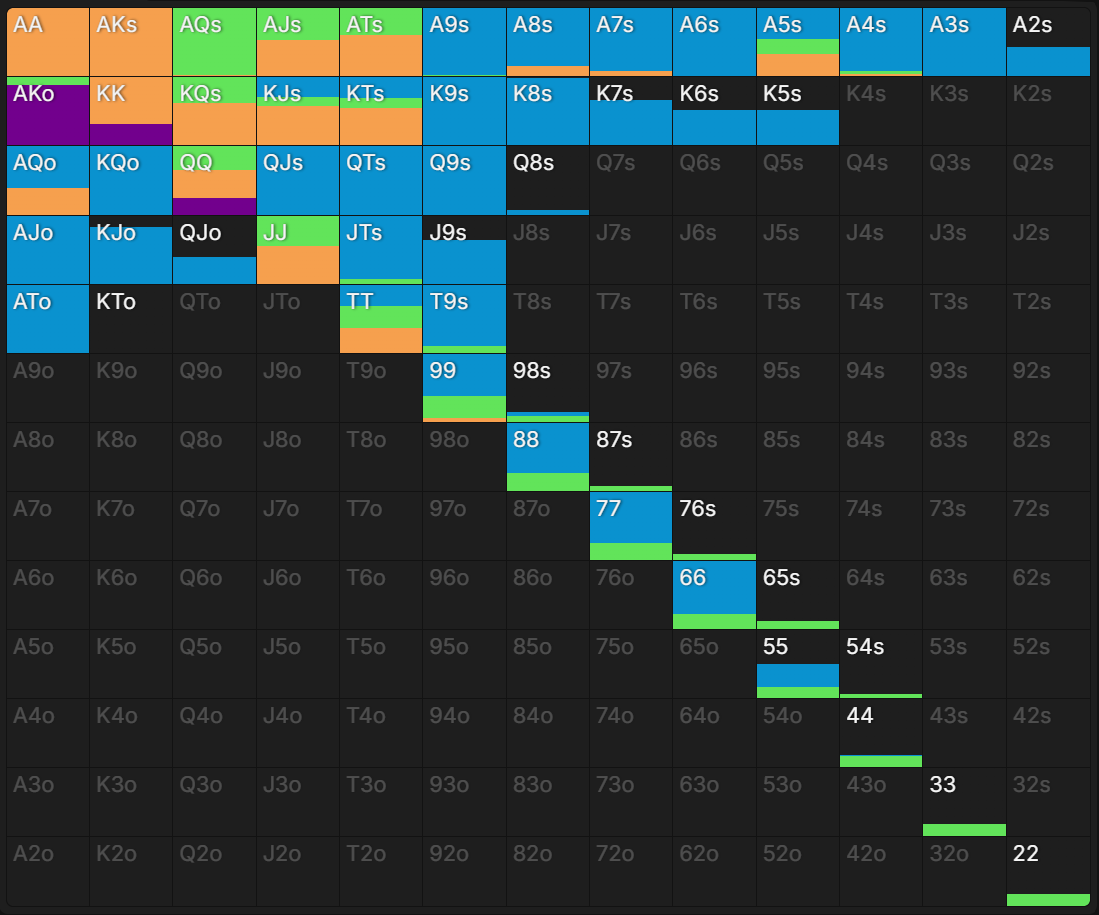
Purple is all-in, orange is a smaller 4-bet, green is call, and light blue is fold.
Because there are four action branches, this can feel more complex and harder to memorize than open ranges. But here too, start by understanding the broad structure first.
The most important point to remember is that you are folding more than 50% of your opening range.
The exact number changes with positions, but in most cases, the opener folds 50% to 70% versus a 3-bet.
It may feel unfair to fold more than half your hands after tightening up in UTG, but your opponent also entered the pot with a selective range. In fact, you can see below that BTN continues with a range that is stronger overall than UTG’s opening range.
BTN vs UTG 2bb
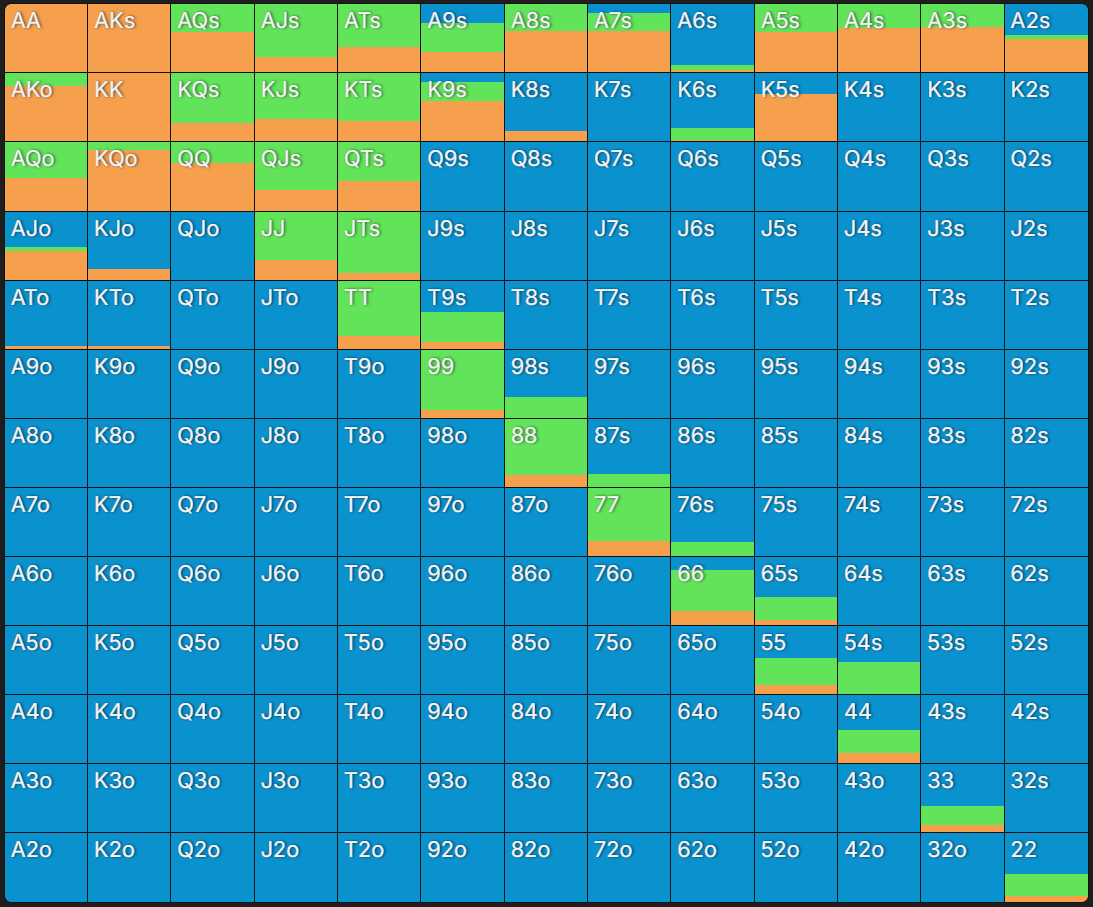
When you learn ranges versus a 3-bet, start by focusing on this idea: fold the hands that don’t reach the top 50% of strength within that range. Many beginners play too many hands preflop, and when reviewing hands, the biggest issue is often that the preflop entry itself was incorrect.
Preflop mistakes don’t always get discussed, and you may not notice them on your own. But they’re also one of the easiest leaks to fix. If you’re struggling to win at poker, reviewing your preflop decisions first may improve your results quickly.
Go Beyond Memorization
We’ve covered practical ways to memorize the broad shape of ranges, but you shouldn’t treat hand ranges as something you simply memorize and apply blindly. What matters is not how strong your hand feels in isolation, but how strong it is compared to your opponent’s range.
For example, if your opponent’s 3-bet range is tighter than equilibrium, you should fold more. If your opponent only includes strong hands when they use a large raise size, you also need to fold more hands.
Do you need to memorize every preflop chart perfectly to become strong at poker? Not at all.
Even among pros who make a living from poker, it’s rare to find someone who has every preflop range memorized perfectly and can recall them with complete accuracy. The fastest path to improvement is to interpret range construction in a realistic way and organize it in your own system.
Once you understand the core principles and can apply them in real games, you may discover a whole new way to enjoy poker.
In this article, we covered the minimum essentials and the key principles you should know.
When you study range charts, try to memorize them while keeping these ideas in mind.
Learn Poker Like a Pro!
Download POKER Q'z – AI-Powered Poker Learning App ↓
Start learning on your favorite platform!


Follow Us
Follow us for poker quizzes, tips, and strategies!


Company Info
Company: CLOViZ Inc.
Location: Setagaya, Tokyo, Japan
Founded: May 7, 2024
CEO: Sotaro Masaki
URL: https://cloviz.co.jp