![[Member Interview #1] Changing a Reality Where Poker Learning Opportunities Depend Largely on Your Environment - Toshiki Ohata](/_next/image?url=https%3A%2F%2Fpokerqzimages.blob.core.windows.net%2Fblog-images%2Feyecatch%2Finterview01%2Fen%2F757a277a-4fa6-4da5-b2b0-ae6b9094acd8.jpg&w=2048&q=50)

Hello! This is the PR team at CLOViZ Inc.!
Many of you are probably wondering what CLOViZ really is and what kind of people work here.
In this article, we'll introduce CLOViZ members in interview format. Touching on CLOViZ's vision and values, along with each member's role and skill set, we'll show the strength of the team as a whole and the appeal of each individual.
For the first installment, we'd like to introduce Toshiki Ohata, who works on the development side of our poker learning app!
1. A UTokyo Graduate Student's Challenge: Explainable AI for Imperfect-Information Games
—First, please tell us a little about yourself!
My name is Toshiki Ohata, a first-year master's student in the Department of Information and Communication Engineering at the University of Tokyo's Graduate School of Information Science and Technology. At the university, I belong to the Tsuruoka Laboratory, which handles game AI, machine learning, and reinforcement learning.
My research theme is explainable AI for imperfect-information games like poker and mahjong. For example, when a game situation offers multiple possible actions, the system outputs in natural language which action would be the most profitable.
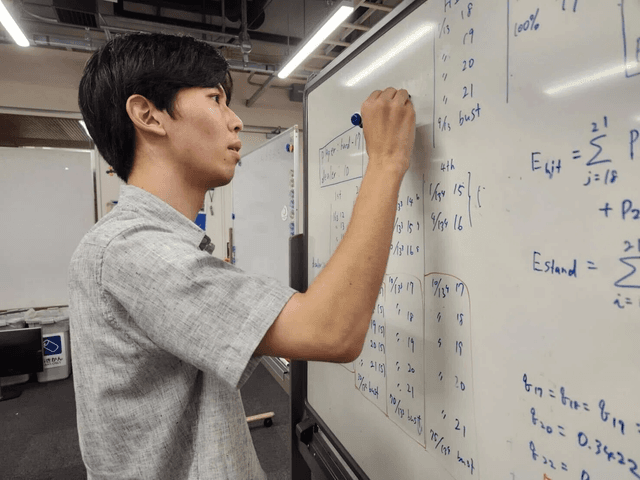
I also served as president of the University of Tokyo poker circle "Big Slick" for about two years, from the fall of my sophomore year to the fall of my senior year. I've since handed over the president role, but I still often organize the circle's activities. We regularly hold tournaments and study sessions.
As for poker achievements, I've won the Student Poker Championship, a tournament open to players under 30.

~ About the Tsuruoka Laboratory, where Toshiki belongs ~
~ About the Student Poker Championship: U30 ~

2. How COVID Introduced Me to Poker
—I see, so you combine poker and AI research!
That's very interesting. You also served as president of a poker circle—could you tell us how you first encountered poker?
My first encounter with poker was in the spring of my freshman year.
Originally, I wanted to join a sports circle, but the pandemic made it impossible for the circle to continue its activities. So I looked for other cultural clubs and found the University of Tokyo poker circle "Big Slick".
I'd actually been playing mahjong since high school, and poker felt like a similarly interesting game to me. Poker and mahjong share a common core: in both, you have to think about the optimal action without knowing your opponent's hand. However, poker requires reading people even more than mahjong does, and I found it appealing that you can try a wide range of plays to adapt to your opponent. That was what led me to join the poker circle.
3. The Road to Improving at Poker: Blending Practice and Theory
—It certainly is appealing to be able to try different plays depending on your opponent!
How did you go about studying poker?
At first, it was almost entirely self-study.
Nowadays there's an abundance of useful content, such as GTO Wizard (a service where you can look up game-theory-optimal play) and YouTube, but back when I learned poker in 2020, that kind of environment wasn't in place yet.
So I built up a certain feel for the game through real play, and whenever I had questions, I asked the reliable seniors around me. For example, I used advice like "you can raise this kind of hand" or "you can fold in this kind of situation" to recognize the gap between my instincts and those of stronger players, and to adjust accordingly.
When I was around a sophomore, the GTO Wizard service mentioned above became well known. Once I started using it, I studied what kind of play is profitable when both players are strong.
In practice, I was especially conscious of observing how far my opponents deviated from that strong play. From there, I started thinking things like "against this opponent, this kind of play is probably more profitable" or "this play probably won't work," and acting on those thoughts.
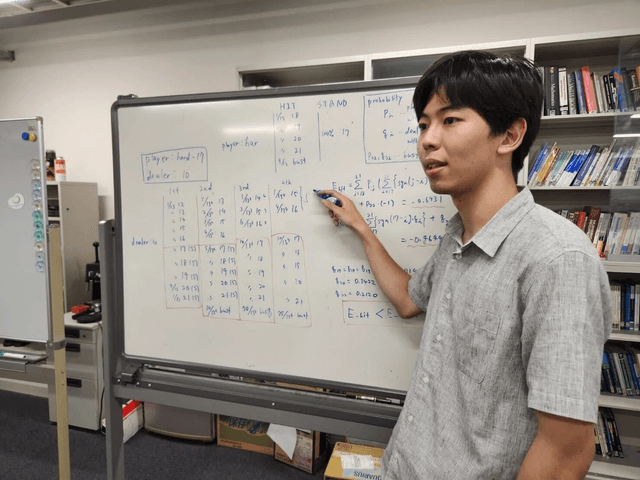
4. A Poker Study Method for Beginners: Objective Evaluation
—I see, so you've studied by skillfully combining practice and theory!
Is there a study method you'd recommend to people who are about to start learning poker?
I'd say asking people who are better than you.
For example, the person who introduced you to poker. It's important to have them watch your play and point out your problems. Mistakes in poker are hard to notice by yourself, so I believe you really need other people to look at your game.
The tricky part, though, is whether someone better than you will spare the time, and whether that person can explain things properly.
Some people offer coaching online, but I've also heard that it's too expensive for many to take up. It often costs at least ¥5,000 per hour, and most of us can't afford to spend that kind of money, right?
I think the reason so many people learn the rules but fail to make progress in their studies is that there's a problem with their environment.
5. My Role at CLOViZ: Developing the Poker Learning App "POKER Q'z"
—As you say, getting advice from stronger players is effective, but it's hard in terms of cost and access.
By the way, what role do you play at CLOViZ?
At CLOViZ, I develop the poker learning app "POKER Q'z". For example, I discuss what features the app needs with people in the company, and then work with the engineers to build them.
I also help create content such as poker quizzes and YouTube videos.
To connect back to what I said earlier, I believe poker learning opportunities are largely determined by one's environment. If Poker Q'z—the app we're currently developing—could improve that, I'd be really happy.
If any player could hear explanations from an AI on their own, at any time they like, at low cost, that kind of disparity would gradually shrink.
There's plenty of paid content online, but it's incredibly hard to select content that matches each person's level.
I also often see players who try to learn advanced concepts on YouTube without even understanding the basics, and it ends up not sticking at all.
In reality, there must be many people who have potential but weren't lucky enough in their environment and never got to develop their talent.
The "POKER Q'z" we're developing guides beginner players through what they need step by step, so even people who don't know where to start can use it with peace of mind.
I hope people who have the time and passion but lack a proper learning environment will definitely give this app a try.
6. The Appeal of POKER Q'z: Objective Evaluation and Practical Exercises
—POKER Q’z, the passion you put into developing it really comes across.
It's wonderful that you're working to improve the poker learning environment and give everyone equal opportunities to learn.
Could you tell us a bit more about the specific appeal of Poker Q'z?
I think the appeal is being able to see your own objective playing style and a benchmark for hand strength.
Poker has theoretical answers, but it's hard to figure out how far you are from that answer yourself. If there were an indicator that evaluates you objectively—saying "you're too aggressive" or "you fold too much," for example—you could adjust on your own, right?
If you're told you fold too much, call when you're unsure. If you're told you're too aggressive, give up on the bluff when you're unsure. By adjusting in that way, I believe you'll eventually get closer to the correct play.
There are also boundaries in poker—between whether a hand is strong or weak, or whether an opponent is aggressive or passive. I think top players can sense those boundaries precisely because of the familiarity built through experience. Through this app, I hope players will sharpen their skills by doing many exercises that are close to real play.
—Toshiki, thank you very much for the interview today!
Thank you as well. If you're interested in what we're doing, or feel you'd like to be involved in developing the service with us, please don't hesitate to contact us via the link below!