
3 Essential Poker Math Concepts: Master Odds, MDF, and Alpha

Currently enrolled in the College of Arts and Sciences (Science I) at the University of Tokyo.
Discovered poker in high school and remains actively involved.
Primarily responsible for engineering at CLOViZ Inc.
Poker is a game where you play without knowing key information like “the hand your opponent holds” or “which cards will come on future streets.” That’s why, if you want to get better at poker, you need a solid understanding of probability. In this article, we’ll cover three especially important concepts:
- Odds
- MDF
- Alpha
1. Odds
Many people have heard the word “odds” before. In horse racing, for example, it’s used to describe how many times your stake is paid back if your prediction is correct. In poker, it’s used in a similar way: it tells you how many times the chips you put in will come back to you when you win.
During a hand, you face repeated decisions, and your goal is to choose the most profitable action whenever possible. Odds are a key tool for judging whether a decision is profitable.
Let’s look at an example. Consider the following situation:
- Heads-up on the river
- Pot is 100
- Your opponent bets 50
- You must choose between calling or folding
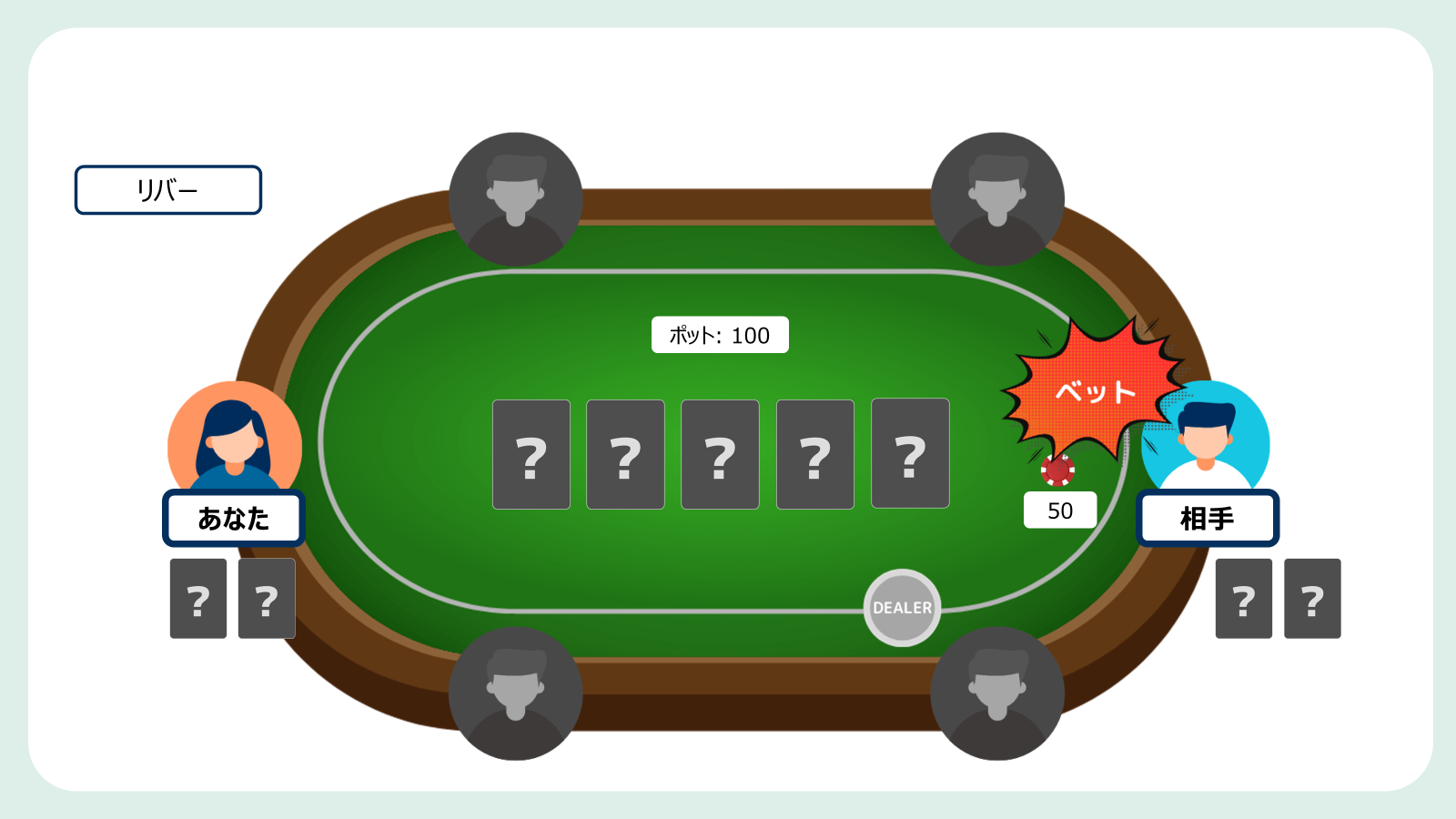
If you call, you need to put in 50. If you win, you receive the original 100 in the pot plus both players’ 50 chips, for a total of 200. So the odds are 200 ÷ 50 = 4. In other words, when you win, you get back 4 times what you called. That means if you expect to win at least 1 out of 4 times, calling is profitable. When your equity is high enough relative to the odds, you say “the odds are good” (you’re getting the right price). When your equity isn’t high enough, you say “the odds are bad” (you’re not getting the right price).
Once you understand odds, you can calculate how much equity you need for a call to be profitable. Instead of vaguely thinking “I’m probably ahead, so I’ll call” or “I’m probably behind, so I’ll fold,” you can make decisions based on logic and math.
Key points
- Odds = how many times your invested chips are returned when you win
- Understanding odds tells you how much equity you need for a profitable call
2. MDF and Alpha
MDF and alpha are paired concepts, so we’ll explain them together. MDF stands for Minimum Defense Frequency. It’s a guideline for how often you should defend (by calling or raising) versus an opponent’s bet. On the other hand, alpha represents the required success frequency for a bluff to be profitable. Let’s use an example. Consider this spot:
- Heads-up between Player A and Player B on the river
- Pot is 100
- Player A bets 50
- Player B must choose between calling or folding
Assume Player B calls only half the time. From Player A’s perspective, by betting 50 (half the pot), they make Player B fold 1 out of 2 times. If Player A holds a hand with 0% equity and bluffs for 50, then 50% of the time they get called and lose 50, and 50% of the time they make Player B fold and win the 100 pot. In that case, Player A could profit by bluffing every time with losing hands.
So how can Player B prevent Player A from profiting too easily with bluffs? If Player B calls, Player A loses 50. If Player B folds, Player A wins 100. That means Player A’s bluff becomes profitable if they can make Player B fold at least 1 out of 3 times. This fold frequency is called alpha. Conversely, Player B can prevent being bluffed too often by calling at least 2 out of 3 times versus this bet. That calling frequency is MDF.
How to calculate MDF and alpha
First, think from the bluffer’s perspective. Let x be the amount you risk to bluff, and y be the amount you win when the bluff succeeds. If the bluff success frequency is a, then the expected value of the bluff is:
(1-a)(-x)+ay=(x+y)a-x
For this expected value to be positive:
(x+y)a-x>0
a>x/(x+y)
So alpha can be calculated as x/(x+y).
Conversely, if you keep your opponent’s bluff success frequency at or below x/(x+y), they can’t profit by bluffing indiscriminately. Therefore, MDF is 1 - x/(x+y).
Important note
MDF is only a shield that prevents an opponent from profiting by bluffing with any two cards. You should only think in terms of MDF when your opponent is capable of bluffing at an appropriate frequency. If your opponent almost never bluffs, calling according to MDF will simply increase your losses. Against those players, you should call only with sufficiently strong hands.
Key points
- MDF = the defense frequency that prevents your opponent’s bluffs from being automatically profitable
- Alpha = the required success frequency for a bluff to be profitable
- Alpha = (chips risked to bluff) / (chips risked to bluff + chips won when it works)
- MDF = 1 - alpha
Conclusion
How was it? If you want to profit in poker, you can’t avoid learning probability. By playing while thinking about the concepts introduced here, you’ll gradually make more profitable decisions. Try applying them in real games.
Learn Poker Like a Pro!
Download POKER Q'z – AI-Powered Poker Learning App ↓
Start learning on your favorite platform!


Follow Us
Follow us for poker quizzes, tips, and strategies!


Company Info
Company: CLOViZ Inc.
Location: Setagaya, Tokyo, Japan
Founded: May 7, 2024
CEO: Sotaro Masaki
URL: https://cloviz.co.jp