![[Member Interview 2] Learning Poker While Having Fun - Kanji Endo](/_next/image?url=https%3A%2F%2Fpokerqzimages.blob.core.windows.net%2Fblog-images%2Feyecatch%2Finterview02%2Fen%2Fe57bef4c-7125-4d0c-b1cb-7c5027d51e4f.jpg&w=2048&q=50)

Hello! We're the PR team at CLOViZ Inc.!
Many of you are probably wondering what CLOViZ actually is, and what kind of members work here.
In this note, we'll introduce CLOViZ's members in an interview format. As we touch on the vision and values CLOViZ aims for, along with each member's role and skill set, we'll introduce the strength of the team as a whole and the appeal of each individual.
As the second installment, this article introduces Endo, who is involved in the development side of our poker learning app!
1. A Poker Researcher Who Also Works as a Pioneer of Mixed Games
— Could you briefly introduce yourself, Endo?
I'm Kanji Endo, a third-year student in the College of Media Arts, Science and Technology at the University of Tsukuba. At university, I study a broad range of subjects: technical information fields like programming, as well as content production, voice, acoustics, media, and art.
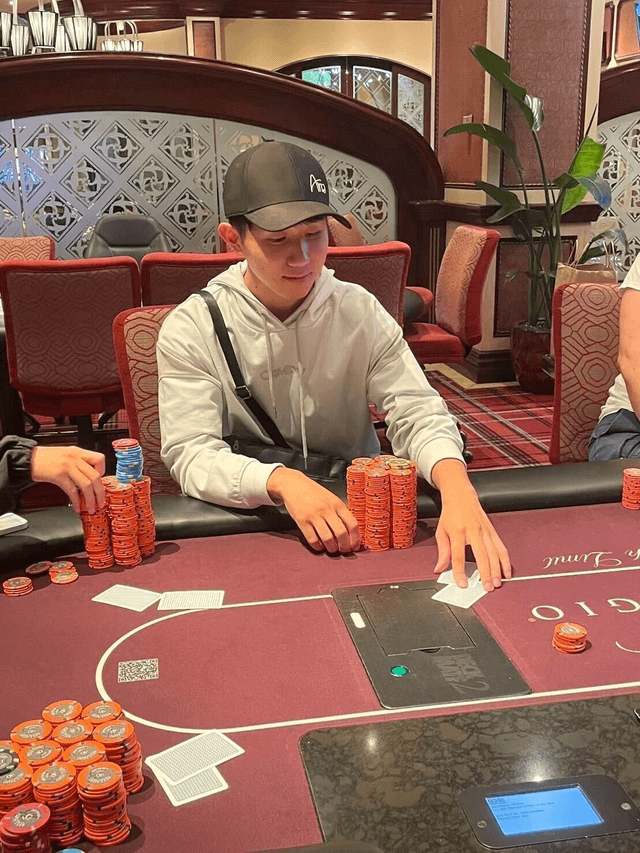
I started playing poker in my first year of university and got hooked; I've even taken a leave of absence to play in Las Vegas for about half a year. Currently, I create poker learning content and support development at CLOViZ, and I'm also involved in running JOPT as a dealer.
Unlike No-Limit Hold'em, the mainstream game in Japan, I focus my research on mixed games, which combine multiple variants, and I share the results on note. Some of my articles are paid, but since information on mixed games is scarce in Japan and the player pool is small, I publish them at a price that's low compared to the time and effort they take, hoping to share my knowledge, grow the player base, and raise the overall level of play.
Most recently, from early September to late October, I went on a poker trip to Las Vegas with Amu, a well-known figure in the poker world (GTO Wizard's Japan Official Coach, who researches poker game theory). I'm truly grateful that I was able to join peers of my generation who approach poker with the same passion.
Because I was being staked on the trip, I got to play stakes I could never play with my own bankroll, such as 10-20 NLH and 40-80 FL mix — it was a great experience. The trip also finished nearly 9,000 USD in the black, so it was a good one in terms of results too.
~ About Endo's note ~
2. Experiencing Authentic Poker in Las Vegas
— You've played in Las Vegas three times! How was the experience of playing authentic poker?
What I realized actually playing in Las Vegas is that learning poker theory and game dynamics is important, but mental control matters enormously regardless of the stakes. Even if there's a skill difference, weak mental control can make you lose.
For example, as you improve, you increasingly face battles between players with well-defined hand ranges. But no matter how strong a hand a skilled player holds, they can lose big pots in a row to hands that look unfavorable on the surface. Getting emotional in situations like this is called tilt — players who let unfair situations get to them can no longer play the way they normally would. This mental control is especially essential when playing for long hours.
Also, in equilibrium you'd almost always enter the pot preflop with an open raise of 2–3 BB, but local players sometimes take strategies far from equilibrium, like limping or opening to 5 BB. Thinking about what actions such opponents will take, and how we can play profitably against them, is something you really need actual play to learn.
Studying is of course important too, but I felt that the experience of playing and thinking every day about how to deal with unusual opponents is what really matters.
As for results, my sense is that solid winning players can often earn around 5 BB per hour, and even better players can aim for two to three times that.
This has nothing to do with poker, but one memory that stays with me is pausing our game with poker friends during our Las Vegas stay to watch the New Year's fireworks and ring in the new year together. Making friends through poker and becoming people who can enjoy things beyond the game — looking back, I feel that has been a real plus in my life.
3. The Appeal of Poker, Through Endo's Eyes
— Taking a leave of absence to go all the way to Las Vegas and play takes real drive!
Is there anything in poker you've been paying attention to lately?
Lately I've been especially focused on mixed games and tournaments.
First, about mixed games: in Japan, compared with the rest of the world, there are few variants available and the player pool is limited, so I feel few people have discovered their appeal. Since mixed games are played by combining multiple variants, they don't bind you to a single game — the need for versatility and adaptability is a big part of their appeal.
Among them, I'm particularly hooked on a game called 'Paradise Pick'em'. This game has a unique rule: you combine various variants and choose which one to play on each hand.
Rather than specializing in a single variant like Texas Hold'em, players must quickly adapt to different games on the spot. This is what makes it so appealing — your adaptability is put to the test. You need to understand the rules and characteristics of each variant while instantly deciding how to handle each hand. The variety and strategic depth run deep, and every time you play, there's something new to discover.
As for tournaments, what I'm paying attention to is that they demand a fundamentally different strategic approach from cash games.
Near the bubble, for example, you often see players folding hands they would normally enter a cash game with a raise. That's because as the bubble factor rises, losing your chips and busting becomes extremely costly.
I want more people to know the appeal of mixed games and tournaments, so I plan to keep sharpening my own skills as a player while spreading that appeal.
4. The Growth of the Poker Industry: Increasing the Player Base
— The fact that mixed games test your adaptability, with new discoveries every time you play, is really interesting! How would you like the poker industry to develop from here?
Compared with the past, I feel that easy-to-understand poker commentary and play videos and entertaining content from YouTubers and influencers like Sekai no Yokosawa have increased, and more people are becoming interested in poker.
I think this trend is very good. First of all, I believe it's important that more people get opportunities to be exposed to poker, and that the number of people who can say "I've played poker" grows — that's what will make the industry even livelier.
Right now there's a big skill gap between advanced and beginner players, and I feel the barrier to entry is high: beginners can't easily join games and find it hard to get started. So providing easy-to-understand information for beginners and casual players, and giving them a reason to start, is one of the important elements in growing the player base.
Building learning environments for advanced players is of course important too, but I hope that first, many people enjoy poker, and that its diversity becomes a springboard for new growth.
Also, I love poker myself, so I'd be happy if more people came to love it too, and if the environment where they can enjoy it even more kept expanding.
5. Recommended Poker Study Methods: Environment and Motivated Learning
— Few people around me play poker either, so I really hope the player base grows! Do you have any recommended ways to study poker?
I think the best way is to learn in an environment where good players are around.
In my case, rather than amusement facilities, I mainly played through club activities, which also gave me contact with working adults. Fortunately, I was able to learn in an environment where highly knowledgeable players gathered, and by being taught by people whose study methods and game understanding surpassed my own, I could feel myself steadily improving.
In particular, encountering the concept of "toy games" early on made a big difference — most notably the famous "AKQ game", a game that packs in the essentials of learning poker.
For example, I was able to learn early on the theoretical reasoning behind why marginal hands, which belong to neither the value range nor the bluff range, are better checked than bet. I feel that experience still has a big influence on how I study poker today.
Of course, studying and getting stronger is one way to enjoy poker, but I think enjoying the game itself is the most important thing. If you can't enjoy poker, you won't feel motivated to study it in the first place, so I hope people have a good time first, and then become interested in getting stronger along the way.
When you approach it with motivation, the people teaching you get more motivated too, and the quality of what they teach rises, so you should improve even more.
That's why at POKER Q'z, the service we provide, we use AI to create a service where you can learn in a good environment and stay motivated.
6. The Appeal of POKER Q'z: You Learn While You Play
— You're right, enjoying the game comes first! POKER Q'z — could you tell us in detail about its appeal?
In Japan today, GTO Wizard (a service where you can look up game-theory-optimal play) is widely used, but much of its content targets advanced players and it sits in a high price range, so I feel the bar is high for beginners.
POKER Q'z, on the other hand, offers a wealth of content that even beginners can easily understand. It starts with basic strategy and gradually progresses to more complex concepts, so even people who have just started learning poker can keep going without strain.
Poker study has an image of being hard to get into and easy to shy away from, but when you actually use POKER Q'z, that isn't the case — I think it's a tool that makes you want to keep learning on your own.
Also, POKER Q'z isn't just an app: poker quizzes are posted regularly on X (formerly Twitter) and LINE open chat, and we hold in-person events for beginners, giving you the experience of "you play, and before you know it, you've learned." Please, do give PokerQ'z a try!
— Endo, thank you very much for the interview today!
Thank you as well. If anyone is interested in what we're doing, or feels they'd like to be involved in developing the service together, please contact us via the link below!