

When you play live poker, you’ll often see dealers quickly running through several different shuffles. Why go to the trouble of combining multiple shuffles? Because each one has a role beyond simply “mixing” the cards. In this article, a working dealer explains the four shuffles—wash, riffle, box, and cut—along with the purpose of each.
Why do dealers use so many different shuffles?
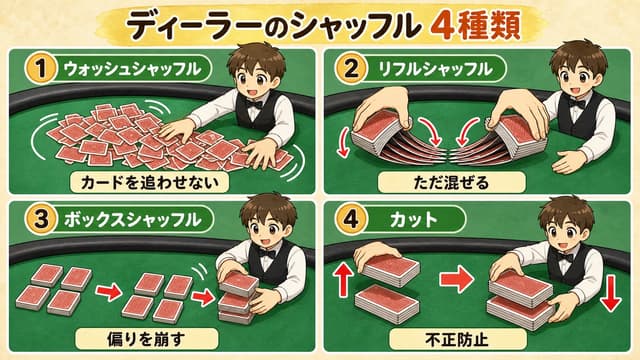
In short, a single type of shuffle can’t completely eliminate card bias or the risk of cheating. Each shuffle a dealer performs serves a different purpose.
Wash shuffle: makes it impossible to know where the cards from the previous hand ended up
Riffle shuffle: simply mixes the cards
Box shuffle: breaks up the bias a riffle alone can’t remove
Cut: prevents manipulation of the top card
Only by combining shuffles with different roles does a truly “random, fair deal” come together. Let’s look at each one in order.
What is the wash shuffle?
The wash shuffle is performed after the previous hand is over: the dealer spreads the cards across the table and mixes them up. Because of the way it looks, it’s sometimes called “yakisoba,” after the Japanese fried noodles.

Two things matter in a wash:
Mixing the cards to a certain degree
Making it impossible to tell where the cards from the previous hand are
When you actually try it, you’ll find that a wash doesn’t mix the cards all that much. Its real purpose is the second one: obscuring the card positions. Without a wash, after a hand containing an A is mucked (discarded), someone with excellent dynamic vision could still track where the A goes through the shuffles that follow.
That’s why the wash makes it completely impossible to know where mucked cards or board cards end up during the subsequent shuffles.
What is the riffle shuffle?
The riffle shuffle is practically a dealer’s signature move: split the deck into two piles and quickly interlace them together.
Its purpose is simple—to mix the cards. That said, a few riffles alone can still leave “biases” in the card order. For example, if the board just ran out A-2-3-4-5 and the next hand is only riffled, the following board can still carry a gapped bias like A-x-3-x-5.
The box shuffle that comes next exists to break up this bias.
What is the box shuffle?
The box shuffle divides the whole stub into three or four packets and restacks them out of order.
By swapping the positions of entire packets, it wipes out the “order bias” that a riffle alone can’t fully eliminate. Only by combining the riffle and the box does the deck finally reach a state that is “sufficiently shuffled as a permutation.”
What is the cut for?
The cut is the move that splits the stub in half at the end of the shuffle and reverses the two halves. It may look humble, but it’s a vital step that forms the cornerstone of cheating prevention.
With a riffle or box shuffle, for instance, a deliberate manipulation could, in theory, keep only the top card of the stub from getting mixed in. That would make it possible to deal a specific card to a specific player.
By flipping the top and bottom of the stub and moving the card that was on top toward the middle, the cut makes this kind of cheating physically impossible. It’s also an iron rule that the dealer always performs the cut with one hand—another rule designed to leave no room for cheating.
So in what order does a dealer shuffle?
A typical dealer’s shuffle sequence looks like this:
Wash shuffle ×1
Riffle shuffle ×2
Box shuffle ×1
Riffle shuffle ×1
Cut ×1
This combination covers the whole chain of “hiding positions → randomizing → removing bias → preventing cheating.” As a side benefit, shuffling by hand introduces subtle differences every time, which can make the results more random than a machine shuffle.
Frequently asked questions about shuffling
Q. Which is fairer: an auto-shuffler or a human shuffle?
A. Auto-shufflers have the edge in statistical randomness, but a human shuffle that follows the steps above is plenty fair in practice. At high-stakes tables, more and more rooms are adopting auto-shufflers for speed.
Q. Is there anyone who can read a shuffle like in Liar Game?
A. Even with excellent dynamic vision, tracking cards becomes practically impossible at the wash stage. It’s safe to treat that as a fictional device.
Q. Should I do all of them when I deal myself?
A. For a home game, sticking to the minimum of “wash → riffle ×2 → cut” is enough to be fair. Adding a box shuffle makes it even more accurate.
Summary
There is a reason dealers use several different shuffles.
Wash: keeps the previous hand’s cards from being tracked
Riffle: just mixes
Box: breaks up the bias left by riffles
Cut: prevents manipulation of the top card
Combined, these moves create a “fair game where everyone draws their hand with the same probability.” Next time you watch a dealer shuffling, remembering what each move means should make live poker even more enjoyable. If you want to sharpen your decisions on every hand, be sure to check out the poker learning app “POKER Q'z.”