
“I just started playing live poker, but I don’t know the etiquette that’s unique to live games and I feel a little nervous……” Many players feel exactly this way. Unlike apps, in live poker even a small gesture can affect the atmosphere of the table and even the outcome of a hand. In this article, a working dealer walks through the 6 manners beginners should learn first, with concrete examples.
What manners should live poker beginners focus on first?
Live poker has manners that don’t exist in apps — they arise precisely because people are sitting at the same table together. The following 6 points in particular are ones beginners often overlook.
ing your chips: Keep them easy for others to read
How you fold: Slide your cards across the table instead of tossing them
s: Don’t push chips out one by one
Slow-rolling: Don’t take your time revealing your cards when you’re winning
protection: Protect your own cards
ing a count: Have the dealer count your opponent’s all-in amount
Not following these rules can sometimes lead to penalties, so let’s look at each one.
How should you stack your chips?
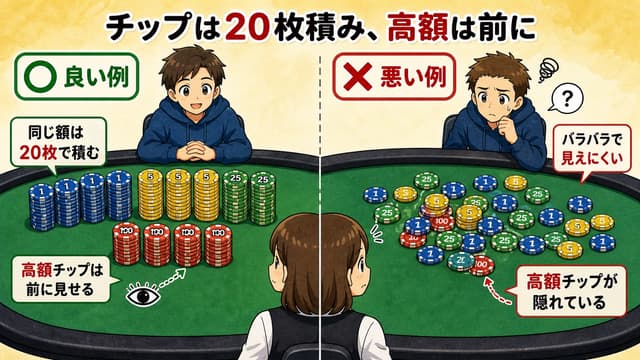
In apps, everyone’s stack is shown as a number, but live you have no choice but to roughly read your opponent’s chips with your eyes. That’s exactly why it’s good manners to stack your stack so the people around you can read it easily.
Stack chips of the same denomination 20 at a time
Put high-denomination chips somewhere others can easily see
For example, stacking 20 chips worth 100 points each shows 2,000 at a glance. Because everyone shares this convention, you can read your opponent’s stack instantly. On the other hand, hiding high-value chips behind your other chips makes your stack look smaller, tempts opponents into misreading your stack, and is bad manners.
Some players also look at their hole cards behind their stack, but if the position of your hand can’t be seen, it can even cause you to be skipped in the action. Keep your cards somewhere other players can see.
What’s the smart way to fold?
When beginners go to live games, they often see the players around them tossing their cards to fold in style. In reality, that’s a gray-area move.
Under the globally used rules of the TDA ( Directors Association), folding is recommended as “putting your cards down low on the table.” Sliding them quietly across the table is smarter and safer than tossing them.
One thing to watch out for: when sliding your cards across the table, if you pinch the edge of the card, it can flip through the gap between your fingers and be seen by other players. When you fold, don’t grab the cards — imagine sending them out while gliding over the table surface.
What’s wrong with string bets?
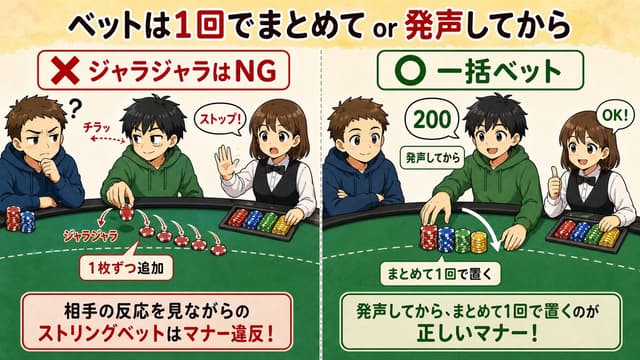
Many people have probably seen scenes in movies or anime where a player pushes chips out a little at a time. This is called a string bet, and it’s a prohibited action.
Why is it prohibited? Because if you put chips out slowly one at a time, you can adjust the size of your bet while watching your opponent’s expression. That makes fair poker impossible.
There are two ways to avoid a string bet:
Push out all the chips for your intended bet in a single motion
If that’s difficult, say the amount out loud first — for example, “200” — then push your chips
The bigger the bet, the harder it is to push out all at once, so announcing the amount is the safest choice when in doubt.
Why is slow-rolling bad manners?
At a live showdown, unlike in apps, you have to turn over and show your own hand. Taking your time to slowly reveal your cards even when you’re winning is called slow-rolling, and it’s one of the most disliked behaviors in live poker.
That’s because it gives the losing player a brief moment of false hope — “wait, maybe I won?” — and spoils the mood of the whole table. The more confident you are that you’re winning, the better it is to show down quickly and with good grace.
What is hand protection?
In apps, your hand never disappears unless you fold. But live, accidents can happen where the dealer mistakenly picks up your hand. And the responsibility lies with the player.
That’s why many players place a chip of the smallest denomination or a dedicated card protector on top of their cards to signal, “This is a live hand.”
Even if your hand is mistakenly taken, you can usually get it back if you declare it right away, so the moment you notice your hand is gone, call out to the dealer. Protecting your own cards is the golden rule.
What are you asking for when you call a “count”?
When an opponent goes all-in, an app shows the amount immediately, but live you can only see a rough amount. In that situation, don’t hesitate to ask the dealer, “Count, please.”
The dealer will count your opponent’s chips accurately for you. stops while the count is in progress, so it also gives you time to organize your decision. It’s a handy way to buy thinking time when you’re torn between calling and folding.
Frequently asked questions about live poker etiquette
Q. What happens if you break the etiquette rules?
A. Sometimes a light warning is enough, but in some rooms repeated violations can lead to penalties such as being forced to leave the table. Early on, being a little too careful is just about right.
Q. Am I not allowed to toss my cards when folding?
A. It’s not completely forbidden, but the TDA standards don’t recommend it. Cards can accidentally hit other players, so make a habit of sliding them out.
Q. Can anything be used as a card protector?
A. A chip, a small item, a lucky charm — anything is fine. If you pick one about a size larger than your cards, the dealer can tell at a glance that it’s a live hand.
Q. Can I ask for a count as many times as I want?
A. Basically, there’s no problem asking multiple times in a single hand. However, players will dislike it if it looks like you’re stalling for time, so use it only when you really need it.
Summary
Unlike apps, live poker is a game where the gestures between people themselves create the mood of the table. Once you master the 6 manners introduced here, even a beginner can sit down at the table with confidence.
Chips: stacks of 20, high-value chips in a visible position
: slide your cards, don’t toss them
: all at once, or say the amount first
Winning showdowns: fast (never slow-roll)
Protect your own hand
When you want to know an all-in amount, say “count”
Mastering these manners will noticeably improve both the atmosphere of the table and your own concentration on the game. If you want to train your hand-by-hand decision-making, try building your range intuition with repeated practice on the poker learning app “POKER Q'z”.