
Are you making these mistakes?
It's been exactly one year since I learned the rules of poker myself. I was no exception—at first, I had no idea how to get better, and studying the game was a struggle. So this time, I'd like to share with you all the approach that helped me leave the beginner stage behind.
First, this article covers the two preflop bad habits that beginners should fix first: limping and cold-calling. Fix these, and you'll have taken your first step toward leaving beginner status behind!
1. Bad Habit ①: Limping
"ing" simply means calling the big blind to enter the pot. In other words, it means entering the pot for the minimum amount.
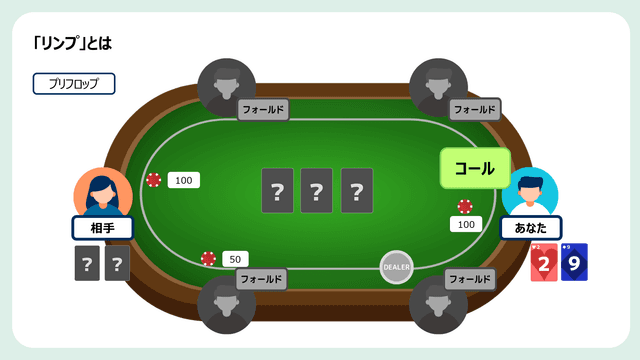
You hold 2 9, and everyone before you has folded. ing the 100-point big blind to join the pot is limping. Many of you may be thinking, "I'll just get in and see what cards come next." But let me get straight to the point.
Stop limping.
A hand this extremely weak should be folded on reflex. your ears and ignore the devil on your shoulder whispering, "What if a 2 and a 9 hit the board and you make two pair?" Now let me explain the problem with limping such a weak hand.
Limping weak hands just loses you chips
A hand like 2 9 has only about 36% equity even against a random hand, which includes your opponents' weak hands. Against stronger hands, or when several players contest the pot, that win rate drops even further. You might think, "It's only 100 points," but every little bit adds up. Entering the pot with such an extremely weak hand only loses you chips.
Next, let's consider the following scenario.
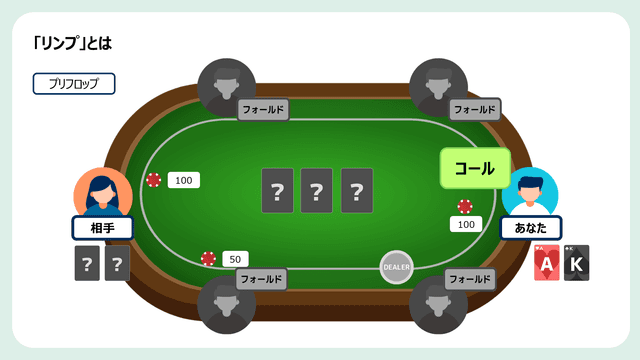
This time, you hold the extremely strong hand A K. Calling the 100-point big blind to enter the pot—that's limping too. I'm sure you already see where this is going, but let me state the conclusion again.
Stop limping.
s this strong should be raised with confidence. Cover your ears and ignore the devil on your shoulder whispering, "It'd be a waste if everyone folds now that I finally have a strong hand." There are two main problems with limping a strong hand like this.
① strong hands to raise your salary
A hand like A K is, as you'd expect, extremely strong. If an ace lands on the board, you can make the strongest one pair, and even if nobody pairs up, you can win with ace-high. And when you complete a straight or flush, it will be a strong one. In other words, this is a hand that beats your opponents very easily. But there's something important to remember here: poker is not a game of winning or losing hands—it's a game of growing your chips. Even if you win at showdown, you can't win at poker if you only take a few chips each time. The pay for the "work" of "folding out opponents / winning at showdown" with this hand only grows if you bet aggressively yourself. Raise your own salary with your own hands.
② Don't let weak hands beat you
Limping means the big blind can join without doing anything at all. What's more, it makes it very easy for everyone else to get involved too. In poker, the more players join the pot, the lower your win rate. And poker's "strong hands" are actually not as strong as you think. Even a hand like A K has only about 48% equity once it's a three-way pot, even against a random hand that includes your opponents' weak hands.
Speaking of digressions: Mitsuhide Akechi, the man behind the Honnō-ji Incident, was later defeated by Hideyoshi Hashiba's forces and fled toward his home province of Ōmi in the dead of night. On the way, a farmer hunting down fallen samurai stabbed him with a spear from a bamboo thicket, and that was his end. It was sheer misfortune that a farmer happened to be there, and he met this pitiful death. What matters for winning reliably with a strong hand is creating a situation with fewer players in the pot, with the weak hands eliminated. Be careful not to let a farmer kill you from a bamboo thicket.
2. Bad Habit ②: Cold-calling
"Cold-calling" simply means calling a raise from the player before you to enter the pot preflop.
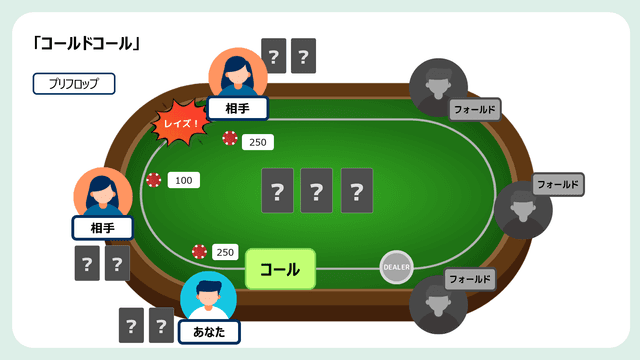
You're in the SB, and the player before you raises. Which hands would you cold-call with? Let's get straight to the conclusion again.
Don't call with any hand.
Are you thinking, "It's not strong enough to raise, but folding also feels like a waste, so I'll call"? That is basically a losing action, so be careful not to do it. Let me explain the problems with cold-calling.
① Everyone can see your hand isn't strong
As I explained in the limping section, the basic approach is to raise with strong hands to raise your salary and avoid being killed by a farmer from a bamboo thicket build the pot, reduce the number of players, and aim to win reliably and collect a lot of chips, while folding everything that isn't strong. But if you deliberately call here, doesn't that make your hand look like one that is neither strong nor weak? When it's obvious that your range contains no strong hands, you'll be at a severe disadvantage in the hands that follow.
② Acting first puts you at a disadvantage
In particular, from the SB, you'll have to act first on every street from here on. Poker is a game where information is key, because you can't see your opponents' hands. Whoever can decide their action after seeing an opponent's action holds the advantage, so the SB is like standing on the weak side of the digital divide. You don't want to fight from a position like that. That's why it's a position where the value of raising to fold out your opponents is especially high. Conversely, you could say that a player in the BTN—who acts last—has a little more room to cold-call.
Preflop drills you can start today
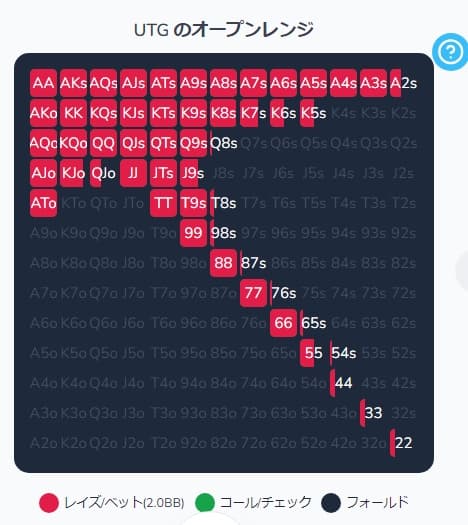
In this article, I've introduced two preflop bad habits that beginners should fix first. How many of them did you recognize in yourself? Unlike postflop, preflop is a situation that comes up every single hand, so losing chips preflop is the biggest loss of all. Besides the points I've covered here, there are many other things to be careful about preflop. And when you take all of those into account, preflop has something called a range chart. A range chart is a table that summarizes which hands to play, and how, from each position. Memorizing the range chart is the fastest shortcut to mastering preflop.
That said, memorizing the entire range chart all at once is no easy task. But with POKER Q'z, you can practice preflop in a fun, quiz-style way! Download it from the link below and give preflop practice a try! Master this and you'll have completely left beginner status behind!