

“It’s my first time playing live poker, and I’m too nervous to sit down because I don’t know the rules……” – Plenty of players share that worry. Unlike an app, live poker changes the meaning of your action depending on how you put out your chips, so there are a few rules that can cost you if you don’t know them. In this article, a professional dealer walks you through the four fundamental rules every beginner should learn first, with concrete examples.
What are the first rules you should learn in live poker?
Live poker has rules that don’t exist in apps because they arise from physically handling chips and cards. These are the four that beginners tend to stumble over most:
BB ante: Post the ante in the exact amount
One-chip rule: A single chip dropped without saying anything counts as a call
Minimum raise: You have to calculate the minimum raise amount yourself
: Tap the table twice to signal your action
Not knowing any of these can lead to mishaps like being “counted as a call and losing big” or “accidentally checking just by tapping the table.” Let’s go through them in order.
How do you post the BB ante?
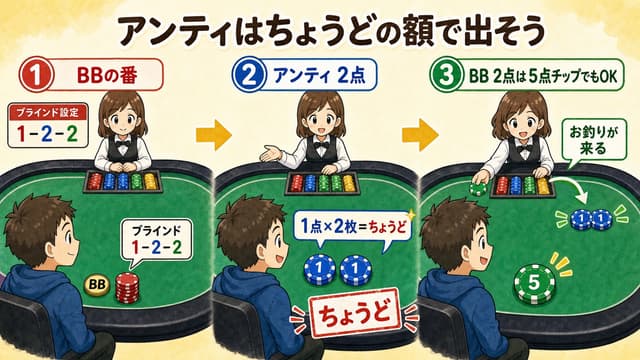
In apps, the ante is collected automatically from everyone, but in live poker, the BB normally posts the ante for the whole table. Here are the two rules to follow:
Always post the ante in the exact amount (so no change is needed)
The BB and SB can receive change, so it’s fine if they can’t post the exact amount
Say you’re in the BB with blinds of 1-2-2 (SB: 1 / BB: 2 / ante: 2). You need to post 2 for your BB and 2 for the ante, but the 2 for the ante must be posted exactly—for example, two 1-point chips. The 2 for your BB can be a single 5-point chip or even a 25-point chip (you’ll get change back).
If you can’t post the exact amount for the 2-point ante, ask the players around you to change your chips into smaller denominations before your turn comes (for example, when you're in the UTG). You can also refer to our article explaining the ante for more on how antes work.
What is the one-chip rule?
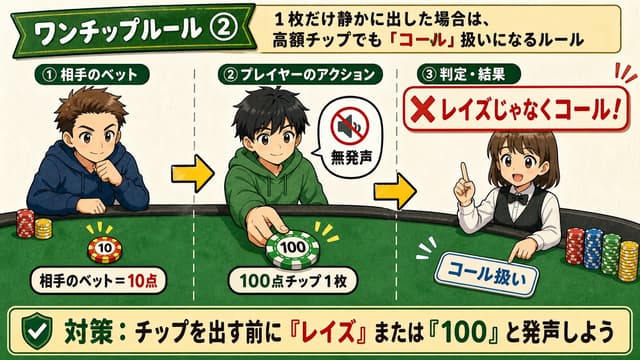
In an app, you just press a button to raise, but in live play, putting out a single chip without saying anything counts as a call—no matter how large the chip is. This is called the “one-chip rule (one-chip drop).”
Example: if your opponent bets 10 and you silently put out a single 100-point chip, it counts as a call of 10 rather than a raise, and the remaining 90 points are returned to you.
To avoid this, it’s important to announce the amount before putting out chips, saying something like “raise” or “100.” At real tables, it’s not uncommon to see players trying to push an opponent all-in who silently drop a single big chip and end up being ruled a call.
How do you calculate a minimum raise?
The smallest amount allowed for a raise is called the “minimum raise.” In live poker, you have to calculate it yourself, so it’s worth understanding the logic.
The rule is “the previous raise amount + the amount added on top of the last raise.” That’s hard to follow from words alone, so let’s use the 1-2-2 blind structure as an example:
Someone raises to 6 preflop → the added amount is 6 − 2 = 4 points
If you want to reraise, the minimum raise is 6 + 4 = 10 points
From the flop onward, the opponent’s bet amount is itself the added amount, so the minimum raise is twice the opponent’s bet
Also, many poker rooms use the “50% rule.” If you put in at least 50% of the raise increment needed for a minimum raise, the minimum raise stands; if you put in less than 50%, it counts as a call. In the example above, putting in 8 or 9 against an added amount of 4 rounds up to the 10-point minimum raise, while 7 counts as a call (of 6).
When in doubt, put in at least twice your opponent’s amount, and you won’t have to worry about falling short of the minimum raise.
How do you check in live poker?
There’s no check button in live play. The standard way to signal it is tapping the table twice.
The key is to do it clearly enough for the dealer and other players to notice. Saying “check” out loud as you tap makes it even more certain.
One important caution: tapping the table twice counts as a check even if you had no intention to check. Beginners very often tap the table absent-mindedly while thinking and end up thinking “I didn’t mean to check……” If you have a habit of tapping with your hands, be careful.
Frequently asked questions about live poker rules
Q. What should I do if I can’t post the exact ante amount?
A. Before your turn comes, such as when you’re in the UTG, ask a nearby player to change your chips into smaller denominations. Some rooms will also change chips for you if you ask the dealer.
Q. Does the one-chip rule apply to any chip?
A. Yes. Even if you silently drop a single 10,000-point chip, it counts as a call for the amount of the opponent’s bet. The remainder is returned to you.
Q. Is the 50% rule used in every room?
A. Most poker rooms use it, but house rules vary from room to room, so at a new venue it’s safest to confirm with the dealer first.
Q. Can I check some other way than tapping the table?
A. Simply saying “check” also counts. Conversely, if you tap the table without saying anything, be sure to tap twice clearly.
Summary
Unlike apps, in live poker the physical act of putting out chips is itself your action declaration. If you remember at least the four rules introduced here, even a beginner can sit at the table without mishaps.
Post the ante in the exact amount (the BB and SB may receive change)
Dropping a single chip without saying anything counts as a call
When raising, add at least the previous added amount. Twice your opponent’s amount is safe
Check by tapping the table twice clearly. Watch out for accidental checks
If you want to practice making the right decision hand after hand, train your range intuition with the poker learning app “POKER Q'z.” Having the mental space to focus on the rules at the live table will take your win rate up a notch.