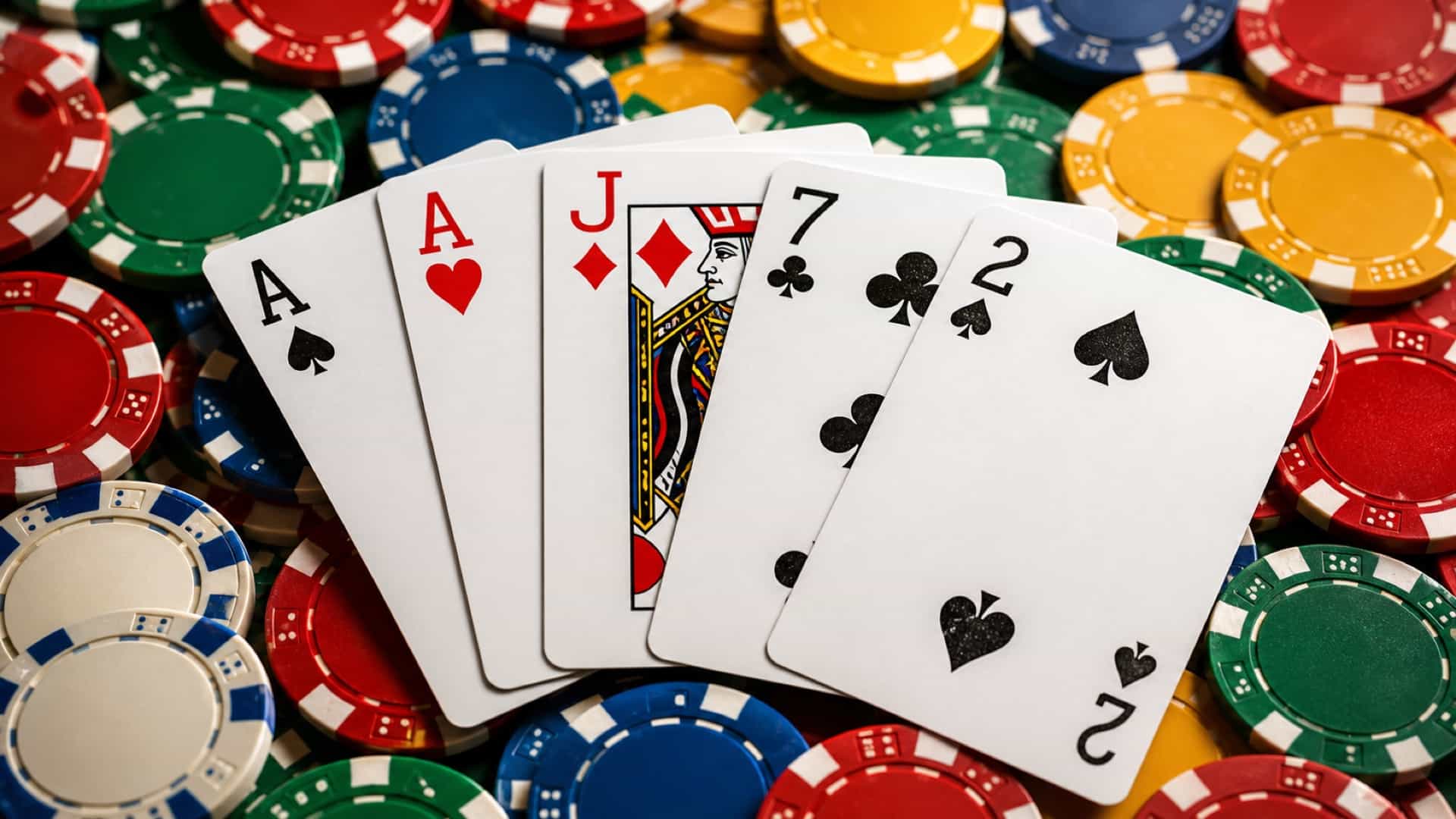
In poker, a one pair is a simple hand made up of just two cards of the same rank. In Texas Hold'em, it completes about 43.83% of the time—roughly once every two hands—making it the most familiar hand of all. This article explains “what a one pair is in poker” for beginners, covering how it's formed, its position in the hand rankings, kicker tie-breakers, its probability, and the difference between pocket pairs and board pairs.
What Is a One Pair? How It's Formed
A one pair is a hand that contains two cards of the same rank. The suit doesn't matter—as long as you have “two cards of the same rank,” the hand is complete.
For example, all of the following combinations are one-pair hands.
AAJ72 (pair of Aces + kicker J)
KK952 (pair of Kings + kicker 9)
77AJ8 (pair of 7s + kicker A)
The remaining three cards act as kickers to decide the winner. The higher the pair, the stronger the hand; when two players hold the same pair, the result is decided by kickers.
What's the Difference Between a One Pair, Two Pair, and High Card?
How many sets of matching ranks you hold determines the name and strength of your hand.
: no matching ranks
One pair: one set of two cards of the same rank
: two sets of two cards of the same rank
One set of a pair gives you a one pair; two sets promote you to two pair. Think of a one pair as the bottom of the “made hand” range, with two pair sitting one step above it.
How Strong Is a One Pair? Its Position in the Hand Rankings
In Texas Hold'em, a one pair ranks above high card and below two pair. The hand rankings are as follows (stronger at the top).
Royal flush
Full house
Three of a kind
Two pair
One pair (here)
High card
Among the ten hand types, a one pair is second from the bottom. It appears more often than any other hand: in Texas Hold'em, it completes about 43.83% of the time, so roughly once every two hands you'll end up with a one pair. To see how all the hands fit together, check out the poker hand rankings chart.
When Two One-Pair Hands Clash, Which One Wins?
When two one-pair hands meet, the winner is decided in the following order.
First, compare the rank of the pair. The higher pair wins.
If the pairs are the same rank, compare the highest kicker (the best of the remaining three cards).
If the first kicker is also the same, compare the second, then the third, in order.
For example, with “pair of Aces + kicker J” versus “pair of Kings + kicker A,” the strength of the pair takes priority, so the pair of Aces wins. s only matter “when the pairs are the same rank,” which makes the strength of the pair overwhelmingly more important.
How Likely Is a One Pair?
In Texas Hold'em, you combine your two hole cards with the five board cards for seven cards total, then choose the best five to make your hand.
Total number of ways to deal 7 cards from 52:
52C7 = 133,784,560Of these, the number of combinations that end in a one pair:
58,627,800 waysAs a probability:
58,627,800 / 133,784,560 ≒ 0.438252In percentage terms, that's about 43.83%, appearing roughly once every two hands. It's the most frequent of all hands and a common result in Texas Hold'em. For the basics of probability, see poker probability knowledge worth knowing.
Pocket Pairs vs. Board Pairs
There are two main ways to make a one pair.
: both of your hole cards are the same rank (e.g., AA). The pair is complete the moment you're dealt them. A strong hand even preflop.
pair: one of your hole cards matches a card on the board (e.g., you hold K7, and a K hits the board to make a pair). The pair completes on or after the flop.
A pocket pair is powerful because your pair is already locked in beforehand, but you're only dealt one about 5.88% of the time (once every 17 hands). Board pairs are far more common, and most one-pair hands are made after seeing the flop. ing these two types apart is important for your play decisions.
Frequently Asked Questions About One Pair
Q. Is a one pair strong?
A. In the hand rankings, it's second from the bottom, so it can't be called a strong hand. That said, it appears more often than any other hand, and opponents frequently stop at high card or one pair, so high pairs like Aces or Kings are more than playable in practice.
Q. Which is stronger, a pocket pair or a board pair?
A. As hands, both are the same “one pair,” but a pocket pair has the strategic advantage that “your opponent can't see your hand.” Add in the chance of improving to three of a kind (a set), and a pocket pair leads to more valuable play.
Q. Is a one pair at a disadvantage with a weak kicker?
A. Yes, it is. Even with the same pair, a kicker A versus a kicker 2 makes a big difference in win rate. For example, when you make a pair of Aces with A-8, you can lose “on kickers” to a player holding A-K.
Q. What if the pair rank and all remaining cards are identical?
A. It's a tie (chop). The pot is split equally. A difference in suits alone can't separate the hands.
Summary
A one pair is the most familiar hand, made from two cards of the same rank. In Texas Hold'em, it appears about 43.83% of the time—roughly once every two hands. Once you understand that winners are decided in the order of pair rank → kickers, and the difference between pocket pairs and board pairs, your judgment in real games will improve dramatically.
To learn the poker hand rankings systematically, check out the poker hand rankings chart. For hands-on practice, the poker learning app POKER Q'z is a great choice.