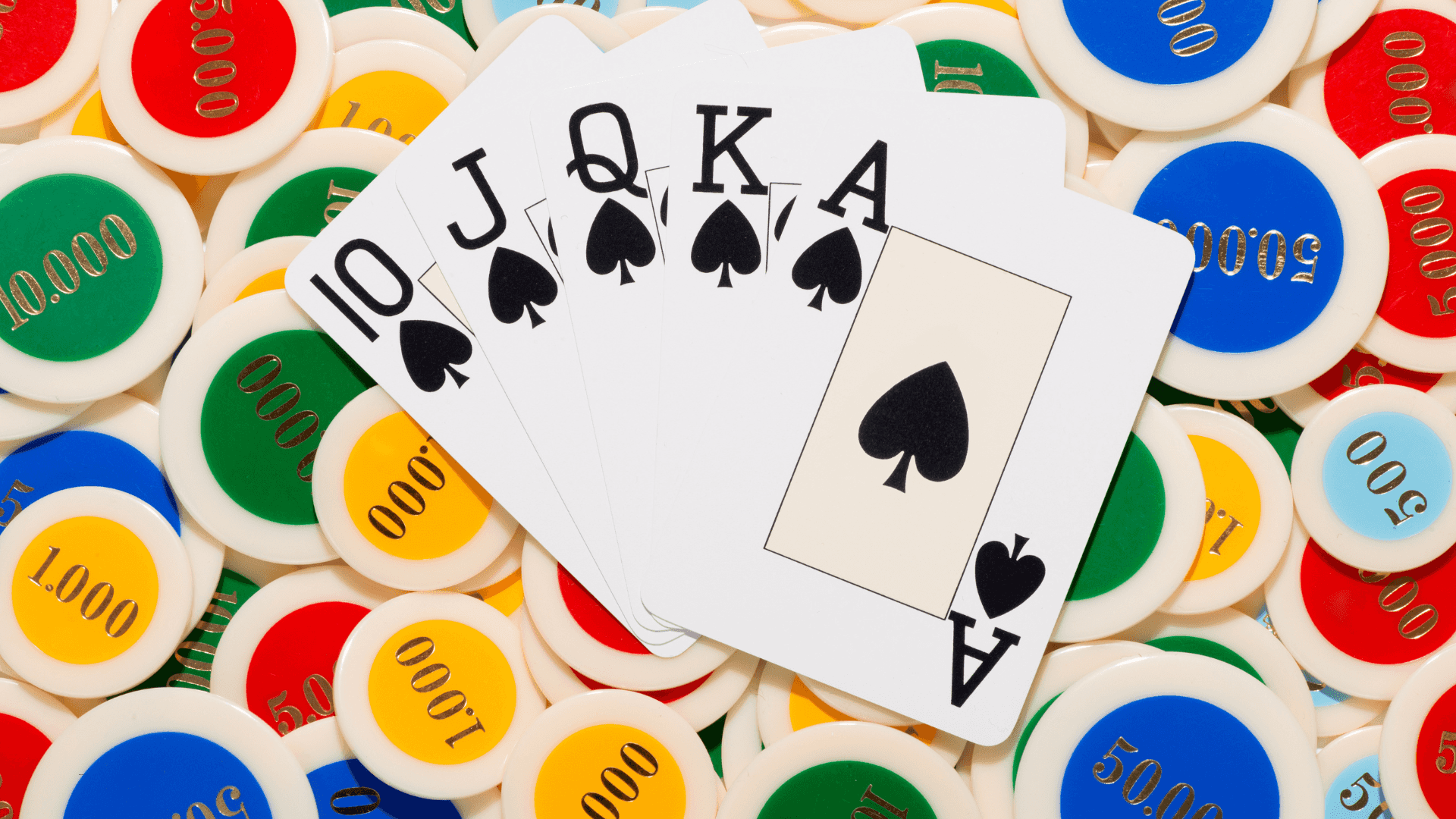

To win at poker, the very first thing you need to master is the strength order of hands and how often each one appears. If your hand knowledge is shaky, you might not even notice a great hand when it comes, or worse, you could bet big on a weak hand and lose. This article walks you through all 10 hand rankings in Texas Hold'em, ordered by strength, with probabilities and concrete examples.
How many poker hands are there?
Texas Hold'em has 10 hand rankings in total. The further down the list you go, the weaker the hand; the higher up, the stronger.
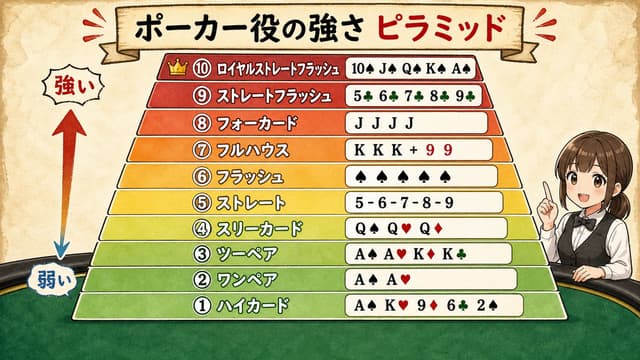
strength roughly tracks how hard a hand is to make. The rarer the hand, the stronger it is; the more common, the weaker—it's a simple structure at heart.
Strength and odds of all 10 hands
In Texas Hold'em, you combine 2 hole cards + 5 board cards = 7 cards in total and choose the strongest 5-card hand you can make. Each probability below is the chance that hand will be completed from your final 7 cards.
| Rank | Hand | Example | Probability |
|---|---|---|---|
| 1st | Royal Flush | AKQJT | about 0.0032% |
| 2nd | Straight Flush | 98765 | about 0.028% |
| 3rd | Four of a Kind | K-K-K-K-3 | about 0.17% |
| 4th | Full House | Q-Q-Q-7-7 | about 2.6% |
| 5th | Flush | AJ962 | about 3.0% |
| 6th | Straight | 9-8-7-6-5 | about 4.6% |
| 7th | Three of a Kind | 9-9-9-K-3 | about 4.8% |
| 8th | Two Pair | K-K-8-8-4 | about 23.5% |
| 9th | One Pair | A-A-9-7-3 | about 43.8% |
| 10th | High Card | A-J-8-5-2 | about 17.4% |
As the table shows, one pair and two pair together account for about 70% of all hands. Most hands that actually appear in play fall in this range, so it's fine to think of anything stronger than a four of a kind or a flush as a rare, powerful hand you'll almost never see.
What is a royal flush?
It's A-K-Q-J-10 all in the same suit. At about 0.0032% (roughly 1 in 30,000), it's the rarest of all hands, and some Texas Hold'em games even make it a jackpot-qualifying hand. For details, see our royal flush guide.
What is a straight flush?
Five consecutive cards of the same suit (e.g., 98765). It's the consecutive hand that isn't a royal, so when two players both have straight flushes, the higher top card wins. For details, see our straight flush guide.
What is four of a kind?
Four cards of the same rank (e.g., K-K-K-K-3). The typical path is making a set (a pocket pair + one board card) on the flop and completing quads when the fourth card lands on the turn or river. For details, see our four of a kind guide.
What is a full house?
A three of a kind combined with a pair (e.g., Q-Q-Q-7-7). The higher three of a kind (the Q above) wins; if those match, the pair decides. It's a strong hand that's relatively easy to make. For details, see our full house guide.
What is a flush?
Five cards of the same suit (e.g., AJ962). They don't need to be consecutive. When two flushes clash, it becomes a kicker battle where you compare the strongest cards in order. For details, see our flush guide.
What is a straight?
Five consecutive ranks (e.g., 9-8-7-6-5). The suits can be mixed. An ace can be used as either the strongest card (A-K-Q-J-10) or the weakest (A-2-3-4-5, the wheel), but the wheel is treated as the lowest straight. For details, see our straight guide.
What is three of a kind?
Three cards of the same rank (e.g., 9-9-9-K-3). There are two ways to make it: a "set" (a pocket pair plus one board card) and "trips" (a paired board plus one hole card). The key point is that a set is stronger and easier to make. For details, see our three of a kind guide.
What is two pair?
s of different ranks (e.g., K-K-8-8-4). You compare the higher pair first, then the lower pair, with the remaining card as the kicker. For details, see our two pair guide.
What is one pair?
Two cards of the same rank (e.g., A-A-9-7-3). It's the most common hand in poker, appearing about 44% of the time. If the pairs match, kickers decide. For details, see our one pair guide.
What is high card?
A hand where none of the rankings above are made. You win with your strongest single card out of the five. It's the fallback hand for when you don't even have a pair, and it still takes the pot when your opponent also fails to make a hand. For details, see our high card guide.
How is the winner decided when two hands are the same?
Poker decides winners by comparing the main cards of the hand first, then kickers (the remaining cards). For example, when two players both have one pair:
First, compare the rank of the pair (a pair of Ks beats a pair of 9s)
If the pairs are equal, compare the remaining 3 cards from strongest to weakest
If all five cards line up, it's a tie (split pot)
We explain how kickers work and the finer comparison rules for each hand in our guide to kickers and hand comparison.
Tips for memorizing the hand rankings
Learn from the top down: listing the hands from strongest to weakest—royal → straight flush → four of a kind…—makes the order easier to keep straight
Link probability to rarity: having a sense of numbers like 0.17% for four of a kind or 2.6% for a full house lets you instantly judge "this is strong" at the table
Make the 3 most common hands second nature: one pair (44%), two pair (23%), and high card (17%) make up 85% of all hands. Recognizing these instantly keeps your play smooth
Think in 5 cards once a hand is made: Texas Hold'em chooses the strongest 5 out of 7 cards. The other 2 cards don't participate in hand comparison, so keep that in mind
Frequently asked questions about hands
Q. What happens when two royal flushes meet?
A. It's a tie. A royal flush is always A-K-Q-J-10, so the ranks can't differ. Since suits are generally not given a strength order, the pot is split (chopped).
Q. Does A-2-3-4-5 count as a straight?
A. Yes—it's called the "wheel" and counts as the lowest straight. It's the special case where the ace is used as a 1.
Q. How are two flushes compared?
A. You compare the highest rank in the hand first, working down. If all five cards are equal, it's a tie (in Texas Hold'em the board is shared, so ties are common by that point).
Q. Are hand rankings the same outside Texas Hold'em?
A. Most poker games, including Omaha and stud, use the same order. For rule differences between game types, also see our guide to poker game variants.
Summary
Poker's 10 hand rankings line up closely with their strength order and how often they appear. Beginners should start by locking in these three points:
Order: royal flush > straight flush > four of a kind > full house > flush > straight > three of a kind > two pair > one pair > high card
Frequency: one pair, two pair, and high card account for about 85% of all hands
Comparison rules: main cards → kickers → split pot
Once you've learned the hand rankings, the next step is range reading (figuring out what hands your opponent might hold), which makes poker even more interesting. If you'd like to practice your feel for the hands through repetition, try the poker learning app "POKER Q'z" to build your instincts for hand-by-hand decisions.