
When someone asks, “What happens if both players make the same hand in poker?”, the answer usually comes down to a concept called the kicker. It isn’t as famous as hand names, but in real play the result is decided by kicker differences surprisingly often. If you learn this early as a beginner, you won’t hesitate when the moment comes. This article explains the rules for deciding a winner when hands tie, with the kicker at the center.
What happens when both players have the same hand?
In poker, the first thing used to decide the winner is hand strength. beats one pair — that much is clear.
The tricky part is when both players make the same hand. For example:
Both players have one pair (with the same pair rank)
Both players have a flush
Both players have a straight
When hands are this close, what decides the winner is the kicker, explained next.
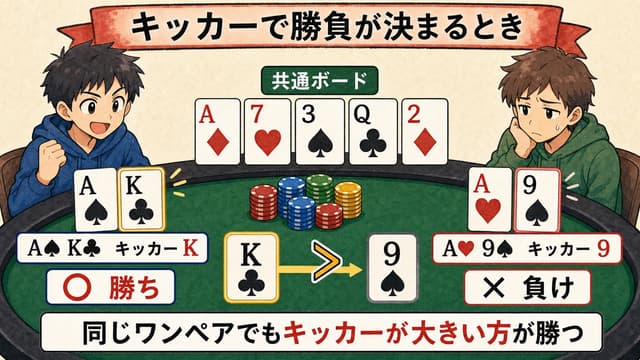
What is a kicker?
In a nutshell, a kicker is “the card(s) left over that aren’t used to make the hand”.
Poker hands are basically judged by 5 cards. So:
One pair (2 pair cards) → the remaining 3 cards are kickers
Two pair (4 pair cards) → the remaining 1 card is a kicker
(3 cards) → the remaining 2 cards are kickers
(4 cards) → the remaining 1 card is a kicker
When the same hands collide and the hand itself doesn’t separate them, you compare these kickers from strongest to weakest to decide the winner.
Let’s look at a concrete example. Suppose both players have a pair of K:
You: K-K-A-7-3
Opponent: K-K-Q-9-4
The pair rank (K) is the same, so you compare the strongest of the remaining 3 cards. It’s A vs Q, so you win. It helps to think of the kicker as the next most important rank after the hand itself.
How do the tie-breaking rules differ by hand?
When the same hand collides, the comparison method changes slightly for each hand. Let’s go through the main hands in order.
When neither player makes any hand, compare from the strongest card down. If those are the same, keep going to the 2nd, 3rd… and all the way down to the 5th card.
You: A-J-8-5-2
Opponent: A-J-8-5-3
Decided by the 5th card — the opponent wins.
One pair
First compare the pair rank. If it’s the same, compare the remaining 3 kickers from strongest to weakest.
Two pair
First compare the higher pair → if the same, the lower pair → and if those are also the same, the remaining 1-card kicker, in that order. See also the article on two pair for details.
Three of a kind
Compare by the rank of the three cards. Two three-of-a-kind hands with the same rank almost never happen, but they can occur when the board is shared, as in Texas Hold’em. In that case, compare the remaining 2 kickers from strongest to weakest.
Compare only the highest card. That settles it — it’s as simple as “a straight to 9 < a straight to 10”.
One thing to watch is A-2-3-4-5 (the wheel). Because the A is used as a “1”, the top of the straight is 5. Remember it as the weakest straight. See the article on straights for details.
Card sequence doesn’t matter; compare the 5 cards from the strongest down. Having the same suit does not make it a tie.
You: AJ952
Opponent: AJ953
Decided by the 5th card — the opponent wins. See also the article on flushes.
Full house
First compare the rank of the three of a kind → if the same, the rank of the pair settles it. In Texas Hold’em with a shared board, matching three-of-a-kind ranks happen fairly often, so it’s surprisingly common to go all the way to comparing the pair.
Four of a kind
First compare the rank of the four cards. If those are also the same, the remaining 1-card kicker settles it.
As with a straight, compare the highest card. Two same-suit five-card sequences colliding is already extremely rare, so you’ll almost never have to think about this.
What about royal flush vs royal flush?
It’s a tie. The hand is fixed at 10-J-Q-K-A, so there’s no way for the ranks to differ. Poker generally doesn’t rank suits, so the pot is split as a tie.
When does it become a tie (split pot)?
If the same hand appears and every relevant rank is also equal, it’s a tie. The basic rule is to divide the pot equally, which is called a split pot or a chop.
In Texas Hold’em, the stronger the hand, the more often it’s decided by the board, so ties happen more often than you might think. For example, if the board already makes a straight:
: 5-6-7-8-9
You: A-2 → straight to 9
Opponent: K-3 → straight to 9
In this case, both players have a straight, so it’s a tie and the pot is split. When “the board completes the hand”, ties like this happen frequently.
What does “make a hand with 5 cards out of 7” mean?
A point that confuses beginners: in Texas Hold’em, you choose the best 5 cards from your 2 hole cards plus the 5 board cards — 7 cards in total.
What to watch out for is that unused cards don’t take part in the comparison.
You: K-K-2-2-J (unused: 3-2)
Opponent: K-K-2-2-Q (unused: 7-4)
Only 5 cards make the two pair; the other 2 are discarded, so the kicker comparison is just “J vs Q”. The opponent wins.
“Not all 7 cards are used” is a point people often miss. When you check your hand, make it a habit to always ask yourself “What are my best 5 cards?”
What should beginners focus on?
You can learn the small exceptions as they come up. To start with, there are just these 3 points:
Compare the main rank: the pair rank, the three-of-a-kind rank, the top of the straight, etc.
If still equal, compare the remaining cards from strongest to weakest (kickers)
If everything is equal, it’s a tie and the pot is split
Remember these as “main hand → kicker → tie”, and you’ll almost never be stuck at the table.
Frequently asked questions about kickers
Q. How much of a disadvantage is a weak kicker?
A. Even with the same top pair, A-K (kicker K) and A-9 (kicker 9) make a huge difference in win rate. How often you lose on the kicker to an opponent’s A hand is nothing to ignore, so with hands like A-9o it’s safer not to go after value too aggressively.
Q. How many kickers are considered?
A. Up to 5 cards in total including the hand. One pair uses 3, two pair uses 1, three of a kind uses 2 — only the cards not used in the hand become kickers.
Q. If the kickers are the same, is it a tie?
A. Yes. If the best 5 cards you can make from 2 hole cards + 5 board cards are completely identical, it’s a split pot (chop).
Q. Do kickers exist outside Texas Hold’em?
A. The kicker concept is the same in most poker games, including Omaha, Stud, and 5-card draw. The hand-comparison rules themselves are shared with the hand rankings article.
Summary
In poker, when the same hand appears, the winner is decided in this order: main rank of the hand → kicker → tie.
A kicker is “the leftover card(s) not used to make the hand”
If the main rank inside the hand is the same, compare the kickers from strongest to weakest
If everything matches, it’s a tie (split pot) and the pot is divided
In Texas Hold’em, note the rule of choosing the best 5 cards out of 7
s are a quiet presence, but in real play, moments like “the same pair decided by a single kicker” happen surprisingly often. Start with the rough idea that “if the hand is the same, compare the remaining cards”, and learn the detailed rules for each hand little by little as you play. If you want to practice making the right decision for each hand, be sure to try the poker learning app “POKER Q'z” too.