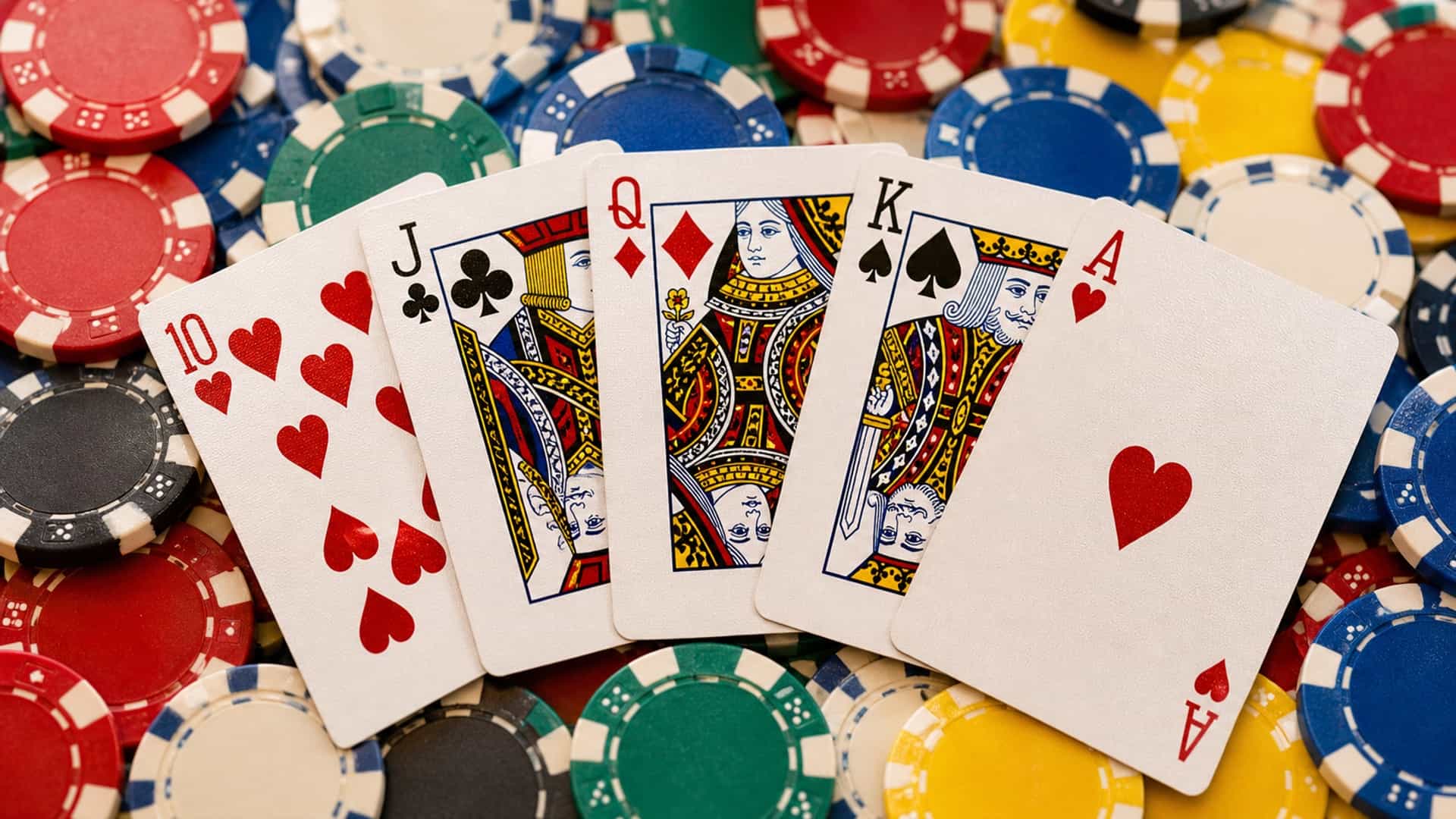
In poker, a straight is a hand in which the ranks of five cards form a consecutive sequence. The suits can be mixed, and in Texas Hold'em it is completed about 4.62% of the time — roughly once every 22 hands. This article explains what a straight is in poker, covering the conditions for making one, its place in the hand rankings, how the ace is handled, its probability, and how it differs from other hands — organized for beginners.
What Is a Straight? Conditions for Making One
A straight is a hand in which five cards form a consecutive sequence of ranks. The suits do not need to match — all that matters is whether the ranks line up in a row.
For example, all of the following combinations are straights.
45678 (a 4-to-8 straight)
9TJQK (a king-high straight)
56789 (a 9-high straight)
Even if the suits are mixed, the hand is a straight as long as the ranks connect in order. This is the biggest difference from a flush.
How Is the Ace Handled?
The first thing that trips people up with straights is how the ace is used. The ace can be used either as the lowest card (a 1) or as the highest card — but not both at the same time.
A2345 (the wheel / bicycle, a 5-high straight) →
TJQKA (, an ace-high straight) → Straight
QKA23 → ❌ Not a straight
In other words, you cannot wrap the ace all the way around and place it in the middle. Just remember that straights containing an ace come in only two patterns — at the very bottom or at the very top — and you won't go wrong.
How Strong Is a Straight? Its Place in the Hand Rankings
In standard poker, the straight is ranked above three of a kind and below a flush. The hand rankings are as follows (the higher, the stronger).
Royal flush
Full house
Straight (right here)
Three of a kind
One pair
Among the 10 hand types, the straight ranks 6th from the top. It beats every pair-based hand, but it cannot reach the flush, full house, or higher-ranking hands. If you want to organize the relationships between all the hands, also check out the list of poker hand rankings.
What's the Difference Between a Straight and a Straight Flush?
"Straight" and "straight flush" sound similar, but they differ greatly in both strength and conditions.
Straight: Five consecutive ranks. The suits can be mixed
Straight flush: Five consecutive ranks and all of the same suit
In other words, if a hand satisfies the straight condition and the flush condition at the same time, it automatically upgrades to a straight flush. evaluation always gives priority to the higher-ranking form, so such a hand is never counted as a straight.
When Two Straights Collide, Which One Wins?
When two straights go head-to-head, the winner is decided by the highest card in the sequence.
A straight to 10 > a straight to 8 (the one with the higher card wins)
An ace-high straight (10 through A) is the strongest
Ace-low (A-2-3-4-5 = the wheel) counts as 5-high, the weakest straight
If the highest card is the same, it's a tie (chop). s have no hierarchy, so a 4-to-8 straight in spades and a mixed-suit 4-to-8 straight have equal strength.
What Are the Odds of Making a Straight?
In Texas Hold'em, you make your hand by choosing the strongest five cards from the seven total cards — your two hole cards plus the five board cards.
Total number of ways to deal 7 cards from a 52-card deck:
52C7 = 133,784,560Of these, the number of combinations that end as a straight (excluding cases that become a straight flush):
6,180,020 combinationsAs a probability:
6,180,020 / 133,784,560 ≒ 0.046194In percentage terms, that's about 4.62% — it appears roughly once every 22 hands. It's slightly more common than a flush (about 3.03%), and among the higher-ranking hands it's one of the easier ones to run into. For the basics of probability calculations, see poker probability knowledge worth remembering.
Tips for Chasing a Straight: Open-Ended and Gutshot Draws
When you are one card away from a straight on the flop, that state is called a straight draw. The two most common types are as follows.
(OESD): A draw that completes with a card on either side of the sequence. With 8 outs, the chance of completing by the river is about 32%
: A draw that needs exactly one card in the middle. With 4 outs, the chance of completing by the river is about 17%
Even though both are "one card away," how easy the draw is to complete changes dramatically depending on how many cards can fill it. Understanding your odds when drawing will sharply improve the accuracy of your bet and call decisions.
Frequently Asked Questions About Straights
Q. Which is stronger: A-K-Q-J-10 or A-2-3-4-5?
A. The ace-high straight (10 through A) is overwhelmingly stronger. A-2-3-4-5 counts as "5-high" and is the weakest form of straight.
Q. Does Q-K-A-2-3 make a straight?
A. No. The ace cannot be placed in the middle to wrap around the sequence.
Q. If two straights have the same card ranks but different suits, how is the winner decided?
A. It's a tie (chop). Suits have no hierarchy, and the pot is split equally.
Q. How different are the probabilities of a straight and a straight flush?
A. A straight is about 4.62%, and a straight flush is about 0.028%. A straight flush is about 165 times rarer.
Summary
A straight is a hand in which five cards line up in consecutive order. In Texas Hold'em it appears about 4.62% of the time, making it a higher-ranking hand that's slightly more common than a flush. Remember it as "the hand that looks at the order of ranks rather than the suits", and combine that with the special way the ace works, and you'll hesitate less when identifying hands.
If you want to systematically master the poker hand rankings, see the list of poker hand rankings; to cover the different types of poker, check out an explanation of poker variants. For real practice, the poker learning app "POKER Q'z" is a great choice.