
In poker, the first hurdle is deciding whether to join the hand preflop. Many beginners look at a range chart and give up because it's too detailed to memorize. In fact, for beginners, "effectively just one hand to memorize" is almost all you need. This article explains how to build the world's simplest preflop opening range.
Do You Really Need to Memorize Preflop Ranges?
To get straight to the point: at the beginner stage, memorizing detailed range charts is unnecessary. If trying to learn a perfect range makes you want to give up, creating one simple benchmark and widening it by position is far more practical in real play.
Only these three things matter.
Use LJ / HJ (LoJack / HiJack) as your benchmark
Widen one step for each later position
For offsuit hands, drop only one side; for suited hands, you can drop both
You can learn the finer details as you gain experience at the table. The first step toward improvement is having "a framework that keeps you from hesitating".
Why Does Position Change the Hands You Can Play?
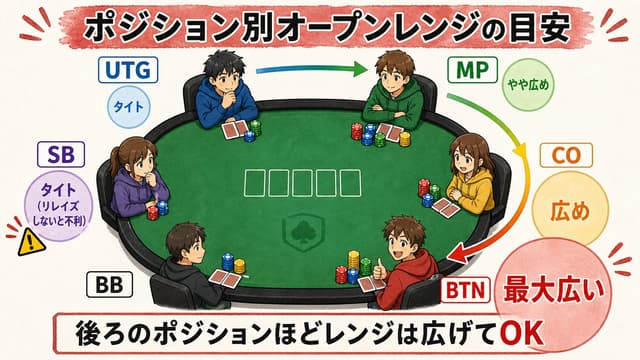
In poker, later positions have a big advantage. Acting from a later position means you can decide after seeing what the other players do.
UTG / LJ / HJ (early): many players still act behind you, so the risk of being re-raised by a strong hand is high → join tight
CO / BTN (late): only SB / BB remain behind you. You have more information, and the expected value of stealing (winning the pot by making everyone fold) is high → join wide
Understand this principle of widening your range as your position gets later, and you can build the general framework without even looking at a range chart. For the names and roles of each position, see the article on positions.
What Do You Memorize at LJ / HJ (the Benchmark Position)?
The hand to memorize is effectively just one: A9o. Use it as the benchmark and put the following three groups in your opening range.
s equal to or stronger than A9o (strong pairs, broadway hands)
ed hands containing an A (A2s through AKs — all of them)
Suited hands with both cards 9 or higher (98s, T9s, JTs, QJs, etc.)
That's it. The idea of "memorize the strength of A9o once, then widen from there" is easy for beginners to internalize.
Strictly speaking, real ranges are more detailed, but at this stage you'll rarely be in trouble at the table — you'll be within roughly a few hands of a professional range.
How Do You Widen at CO?
CO () is one position later than LJ / HJ, so loosen the benchmark by one step.
Hands equal to or stronger than A8o
Suited hands containing a K (K2s through KQs)
Suited hands with both cards 8 or higher (87s, 98s, T8s, etc.)
The key is the one-step slide: "A9o → A8o," "9 or higher → 8 or higher," "A suited → add K suited". The amount you need to memorize doesn't increase from LJ.
How Wide Can You Go at BTN (the Button)?
BTN is the strongest position in poker. ing becomes far more efficient, so you can widen your range considerably.
Hands equal to or stronger than A7o
Suited hands containing a Q (Q2s through QJs)
Suited hands with both cards 7 or higher (76s, 87s, 98s, etc.)
At BTN, opening with about 40% or more of all hands is fine. Even with somewhat weaker hands, only SB / BB remain behind you, so play after the flop is much easier — a world of difference. The basic stance is to play wide without fear.
What Should You Consider at SB (the Small Blind)?
SB is a special position: when everyone folds to you, it becomes a heads-up battle (vs. BB only). Since BB is forced into the pot and can only defend, SB can open fairly wide.
Hands equal to or stronger than A6o
Suited hands containing a J (J2s through JTs)
Suited hands with both cards 6 or higher (65s, 76s, 87s, etc.)
However, SB is OOP (out of position: first to act) after the flop, so "being able to open wide" and "postflop being easy" are two different things. Make raise or fold your default, and avoid casually limping (just calling) — that's the standard approach.
Why Can We Call It the World's Simplest?
The strength of this system is simply that there are very few rules to remember.
The benchmark is just one: LJ/HJ = A9o
Widen one step at a time as you move later (A9 → A8 → A7 → A6)
Suited hands drop both sides; offsuit hands drop only one side
With just this, you can build opening ranges for four positions on the spot. It's not perfect, but what matters for beginners is a steady framework matters more than perfect accuracy. With a framework in place, you can act without hesitation on every hand, and it becomes the foundation for improvement.
What Happens When You Fail Preflop?
Conversely, if you join with too weak a hand preflop, you'll struggle all the way from the flop onward. Four common problems:
Making a pair doesn't bring peace of mind (you hesitate between continuing to bet with a weak kicker or checking)
You tend to lose on kicker (situations like A-5 vs. A-K)
Strong draws are less likely (unconnected hands like A-3 have few ways to improve)
Postflop decisions get harder (you end up facing big bets with a mediocre made hand)
Choosing your hands reasonably well preflop makes postflop play much easier. That first decision is exactly what affects your long-term results the most.
Frequently Asked Questions About Preflop Ranges
Q. Is limping (just calling) okay?
A. For beginners, generally no. Make "raise or fold" the rule preflop. ing puts you at a disadvantage when raised back, and hands the initiative to your opponents.
Q. What raise size should I use?
A. 2.5BB–3BB is standard for typical ring games, and 2BB–2.2BB for tournaments. When antes are in play, a little smaller is fine.
Q. Do ranges change between 6-max and 9-max?
A. In 6-max there is no UTG; the first seats correspond to LJ / HJ. In 9-max, UTG / UTG+1 need to play much tighter, but the range feel for CO / BTN / SB is nearly the same and carries over directly.
Q. Should I widen my range when antes are in play?
A. Yes — the steal expectation at BTN / SB in particular goes up, so widening one step is fine. See the article on antes for details.
Summary
The ultra-simple beginner preflop range comes down to a single rule.
LJ / HJ: A9 benchmark
CO: A8 benchmark
BTN: A7 benchmark
SB: A6 benchmark
After that, it's just "offsuit drops one side, suited drops both." This covers more than 90% of real-game situations. You don't need to aim for perfection from the start. First, get a framework that keeps you from hesitating — that's the first step toward improvement.
If you want to drill your preflop decisions hand by hand, try the preflop lessons in the poker learning app POKER Q'z to build the habit through practice that feels like real play.