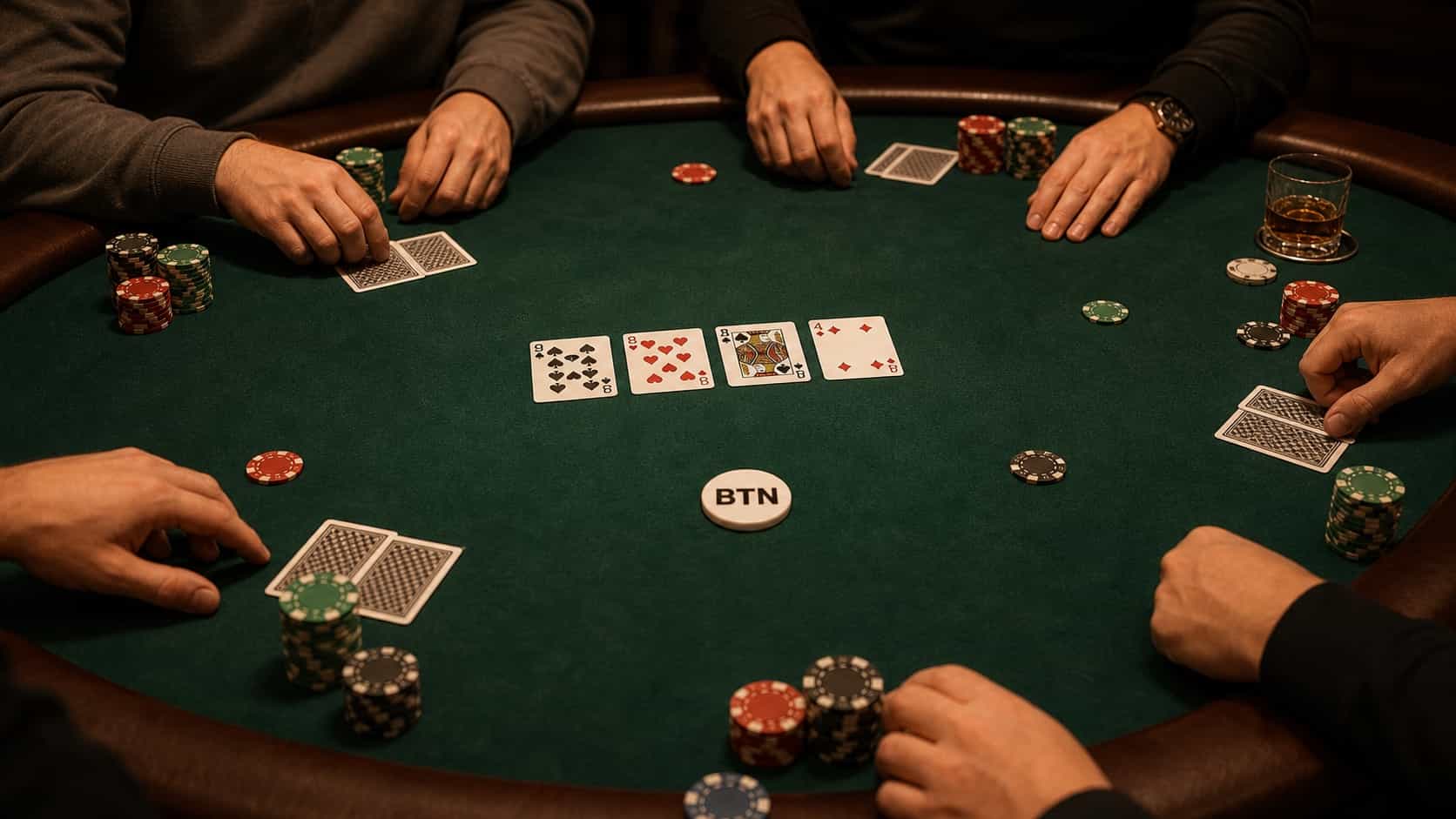

In poker, you often hear that “position matters,” but surprisingly few beginners understand why it’s so important, or know the names and roles of each position in a systematic way. In fact, the same hand can call for a different correct action depending on your position — that’s poker. This article explains position names such as UTG / BTN / SB / BB and what each one means strategically, in a beginner-friendly way.
What Is “Position” in Poker?
refers to where you sit at the table. More specifically, it is determined by how far you are from the dealer button (BTN).
Poker action moves clockwise, and players who sit later can make their decisions after seeing everyone else’s actions. That is why people say position matters.
: you must act with less information = disadvantage
Late position: you can decide after seeing everyone act = advantage
Even with a hand of the same strength, the strategies available from UTG (first to act) and BTN (last to act) are very different — that’s part of what makes poker interesting.
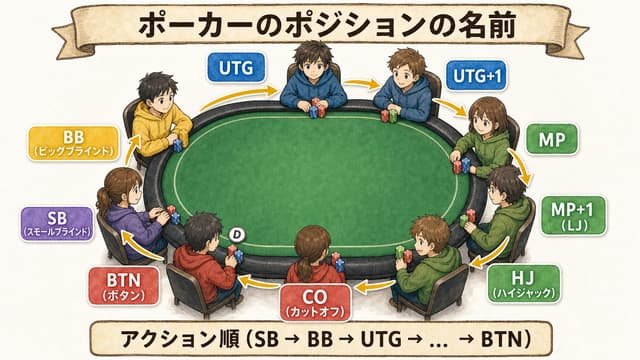
All the Positions at a 9-max Table
Let’s go through the position names at a standard 9-handed table (9-max), clockwise from BTN.
BTN (Button): the seat with the dealer button. The strongest position
SB (Small ): immediately to the left of BTN. Forced to post the small blind
BB (Big Blind): immediately to the left of SB. Forced to post the big blind
UTG (Under the Gun): immediately to the left of BB. Must act first — the most disadvantageous seat
UTG+1: to the left of UTG
MP (Middle Position): the middle seats
MP+1 / LJ (Low Jack): slightly later than MP
HJ (High Jack): two seats before BTN
CO (): one seat before BTN. Second strongest after BTN
The names may look scattered, but it helps to group them: “first 3 seats (UTG family) = tight,” “middle 3 seats (MP family) = moderate,” “last 3 seats (HJ/CO/BTN) = wider.” SB / BB are special seats that post blinds, so we treat them separately.
What About 6-max?
At the 6-handed table (6-max), which is the online standard, the three early seats in the UTG family are dropped. Specifically:
UTG (sometimes called LJ)
HJ
CO
BTN
SB
BB
Compared with 9-max, fewer players act each hand, so the basic approach is to widen your range at every position. There is more action, and the pace is faster.
Why Is BTN the Strongest?
BTN (Button) is considered the most profitable seat of all poker positions. The reasons boil down to these three:
You decide preflop after seeing everyone act: if the other 8 players fold, only SB and BB remain. You have maximum information
You act last on every postflop street: from the flop onward, you can size your bet after seeing all of your opponents’ actions
s work best from here: with only SB / BB behind you, one raise is enough to win the pot on the spot if those two fold
Statistically, professional players’ win rates are clearly strongly positive from BTN, while UTG tends to be break-even or negative. Position makes that much difference.
Why Is UTG the Most Disadvantaged?
UTG (Under the Gun) is the seat to the left of BB that must act first preflop. Just as the name suggests, it is the most disadvantageous position in poker.
Most players remain behind you: 8 players are still to act after UTG. The chance that someone has a strong hand is also the highest
You must act first postflop too: from the flop onward, you have to decide before seeing opponents’ actions, so you have the least information
Steals don’t work: there are too many players to fold out, and a raise is likely to be called or re-raised
That’s why the standard approach at UTG is to enter only with strong hands (AA / KK / QQ / AKs, etc.). en your range, and when you do enter, enter with strength — that contrast matters.
How Should You Think About SB / BB?
SB and BB are special positions that are forced to post blinds. You need to think about them on a different axis from “early or late position.”
SB (Small Blind)
When action folds to you: only BB remains. You can open-raise wide and go for a steal
When someone else opens: you will be OOP (first to act) postflop, so estimate your calling range more tightly
Basic stance: raise or fold. Avoid limping
BB (Big Blind)
You have already posted the blind, so the amount you need to call is smaller → you can defend a wider calling range
Being OOP postflop is a weakness, but since your required equity is lower, you can defend more hands
It’s fine to go with roughly “don’t fold suited hands as a rule”
The logic behind BB’s wide defense is also touched on in our ante guide, and it follows from the required-equity formula.
How Does Position Change Your Opening Range?
The further back your position, the wider the range of hands you can open. Rough guidelines:
UTG / UTG+1: about 12–15% of all hands (mainly strong pairs and broadways)
MP / LJ / HJ: about 15–22%
CO: about 25–30% (add suited kings and suited connectors)
BTN: about 40–50% (you can play wide)
SB: about 30–40% (heads-up against BB)
Beginners don’t need to memorize a detailed chart from day one; the feel of “widen one step each time you move back” is enough to use in real play. For specific hand selection, see our guide to preflop opening ranges.
What Changes When You Start Thinking About Position?
Simply starting to think about position gives you a whole new set of strategic options at once:
Steal: play wide from late position to steal the blinds
3-bet / call: infer your opponent’s range from their position, and use it to decide between re-raising and calling
sizing: bet bigger in IP (late), keep it more conservative in OOP (early)
Avoiding multiway pots: in early position, stick to strong hands to avoid going multiway
Position is one of the most important pieces of information in poker, right up there with hand strength. Once you build the habit of checking “What position am I in, and what position did my opponent act from?” every hand, your poker precision goes up a level.
Frequently Asked Questions About Position
Q. How many players is a standard live casino table?
A. Texas Hold’em at live casinos is 9-max as standard. Some high-stakes tables are 8-max or 7-max, but the position names are the same.
Q. I often hear “I have position” — what does that mean?
A. In a heads-up pot (one opponent), it means you are in position (IP = In Position) and your opponent is out of position (OOP = Out of Position). It’s an advantageous state where you act after seeing your opponent’s action on every postflop street.
Q. Does a straddle change the positions?
A. With a straddle (a live-game rule where UTG voluntarily posts twice the BB), UTG is temporarily treated like BB. starts from UTG+1, so effectively every position shifts by one.
Q. How should you play when your position is weak?
A. From early positions like UTG / SB, the basic approach is to tighten your range. When you do enter, raise clearly with a strong hand and avoid multiway pots.
Summary
Position in poker is the most important information along with hand strength. Here are the three things to remember:
Names and order: starting from BTN, SB → BB → UTG → MP → HJ → CO → (back to BTN)
The three-group feel: front (tight) / middle (moderate) / back (wide) + SB / BB as the special seats
BTN is the strongest, UTG the weakest: even the same hand offers completely different strategies
Once you start thinking about position, poker evolves from “a battle of reading hand strength” into “a battle of reading position × hand combinations”. If you want to drill the right decision hand by hand, try the lessons in the poker learning app “POKER Q'z” and let position-aware range instincts sink in.