
In poker, the first decision you face in every hand is the preflop open raise — the action of raising to enter a pot that no one else has joined yet. Sizing, hand selection, and positional awareness are the foundation of improving at poker, so getting this right makes a big difference to your results. This article breaks down the meaning of the open raise, the sizing, and how to choose your hands for beginners.
What is an open raise?
An open raise is the action of raising first into the pot preflop, when no one else has entered yet.
For example, suppose you're in the CO (cutoff) and everyone from UTG through HJ folds. If you now raise to enter the pot, that's an open raise. On the other hand, if someone has already raised, it's no longer an "open raise" — it becomes a different action: calling or re-raising (a 3bet).
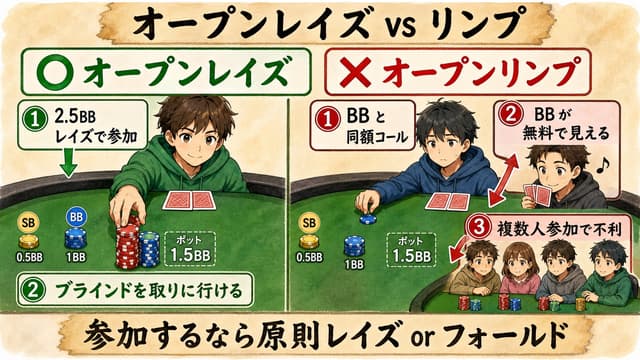
Why is limping (just calling) bad?
When no one has entered the pot, entering with just a call instead of a raise is called open limping, or simply "limping." Beginners do this a lot, but it's an action that's generally not recommended.
You can't fold out the BB: When you limp, the BB gets to enter for free. With a raise, you could fold out players who would otherwise stay in
More players tend to join: ing is cheap, so players behind you follow along and the pot goes multiway. Even strong hands face a higher risk of being outdrawn multiway
The pot stays small: When you hit a strong hand, the pot doesn't grow, so there's less to win
You don't take the initiative: You can't apply "I look strong" pressure, which makes postflop play harder
The exception is limping from the SB when no one else has entered (in tournaments with antes, for example). That's a special situation, so while you're a beginner, making "raise or fold" your default keeps decisions clear. PQ'z also covers this basic rule in the "Why are limping and cold-calling bad?" lesson.
What size should your open raise be?
Standard open-raise sizing varies by game type and environment.
s (ring): 2.5BB–3BB is the classic sizing
s: 2BB–2.5BB is the classic range. Because blinds increase over time, players tend to use smaller increments
Tables with antes: equity is higher, so smaller sizes still work
Tables where players rarely fold: Size up a bit (3.5BB–4BB) to narrow the field
For how strategy changes with a big blind ante, see the article on antes.
Which hands should you open?
It's easiest to remember the hands that are good to open-raise by grouping them into 3 main groups.
Two high cards: s containing an A or K (AK / AQ / KQ / AJ, etc.). They can win with a pair or kicker, giving you a steady win rate
s: 22 / 33 / ... / AA. You already have one pair from the start, and if you flop a set (a third card of your rank), they can pay off big
s: Consecutive suited hands like 76s / 87s / 98s. Their raw win rate is lower, but they're devastating when a flush or straight gets there
You widen or tighten these based on position. For a simple framework of concrete opening ranges, the article on preflop opening ranges is a great companion read.
How does position change your opening range?
The golden rule of poker is "the later your position, the wider your range." The later you act, the more information you have and the higher your steal equity, so more hands become playable.
UTG / UTG+1 (early position): the tightest. Strong pairs and broadways
MP / HJ (middle position): A bit wider. Add suited broadways and higher pocket pairs
CO / BTN (late position): the widest. ed connectors, weaker Ax hands, and small pocket pairs become playable
SB: Often heads-up (vs BB), so you can be wider, but you're out of position (OOP) postflop
names and roles are covered in the article on position. For concrete range charts, PQ'z lessons like "Learn the UTG / HJ ranges" and "Learn the CO / BTN ranges" let you build that skill step by step.
How do tournaments and ring games differ?
Even the same open raise is thought about a little differently depending on the game type.
Tournaments: The later stages, when antes kick in, raise steal equity, so BTN / SB can enter wider than usual. With shallow stacks (under 15BB), an all-in also comes into play
Ring (cash): depths stay constant. Sizes stay fairly fixed at 2.5–3BB, and you adjust your range to opponent tendencies (tight / loose)
For tournament-specific stack adjustments and how to widen with antes included, PQ'z's "Learn the differences between tournament and ring game preflop strategy" lesson covers it systematically.
Frequently asked questions about open raising
Q. How often should I open-raise?
A. It varies a lot by position. As a rough guide, about 10–15% of all hands from UTG and 40–50% from BTN. Remembering that BTN can open 3–4 times wider than UTG will give you the right feel.
Q. Is it okay to keep one fixed open size?
A. Fixed sizing is basically fine. Keeping it around 2.5BB makes it harder for opponents to read your hand strength. Not showing strength through your bet size is fundamental to good play.
Q. Aren't there strategies that mix in limps?
A. Advanced players sometimes build a deliberate "limping range," but it's difficult, so we don't recommend it for beginners. Sticking strictly to raise-or-fold is enough to keep your results stable.
Q. Do I have to memorize range charts?
A. No. If you grasp "wider in later positions" and "the 3 groups (high cards / pocket pairs / suited connectors)", that's plenty for real play. For details, see the article on preflop opening ranges.
Summary
The open raise is the first key decision of every hand in poker. Getting this right alone is a big step toward leaving beginner status behind.
or fold as a rule: Limping isn't for beginners
Size at 2.5–3BB: Slightly smaller in tournaments
Widen your range in later positions: BTN is 3–4 times wider than UTG
Think in 3 hand groups: s / pocket pairs / suited connectors
If you'd like to master concrete ranges step by step, the poker learning app POKER Q'z lessons "Know which hands you can open," "Learn the UTG / HJ ranges," and "Learn the CO / BTN ranges" will help make position-based instincts second nature.