
When you hear "Indian Poker," many people picture the classic scene of players holding cards to their foreheads. It's a staple card game that livens up drinking parties, gatherings, and family time — and its appeal lies in how simple the rules really are. In this article, we'll walk beginners through everything: how many players you need, how to deal the cards, how the winner is decided, fun forfeit variations, and tips for winning. By the time you finish reading, you'll be ready to play on the spot. If you're ever stuck for a first game at a get-together or party, this one deserves a spot on your shortlist.
What Is Indian Poker? What Kind of Game Is It?
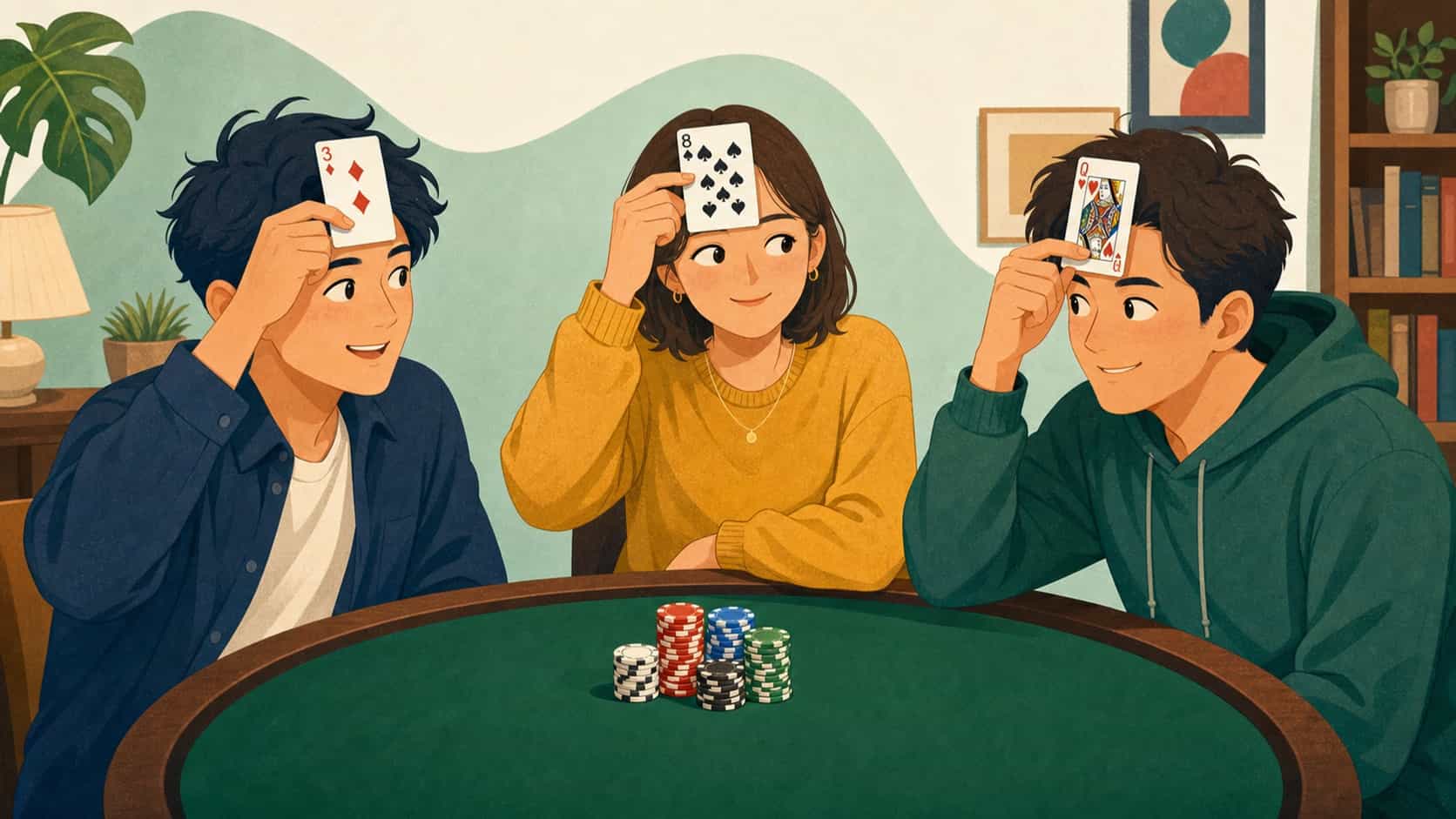
Indian Poker is a card game in which you hold your single dealt card to your forehead so that only you can't see it, and play based on the other players' cards. It's familiar from movies and variety shows, and it's sometimes referred to as "Indian Parker," but the correct name is "Indian Poker."
While regular poker is about "hiding your hand and keeping your opponents guessing," Indian Poker is the exact opposite — its defining feature is that your own hand is the only one you don't know. It packs the essence of psychological play into one simple game: you infer whether your card is strong or weak from your opponents' expressions, betting patterns, and the mood of the table. Because all you need is a single deck of cards, it's widely loved as an entry-level party game.
There are several theories about where the name comes from, but it's said to evoke the image of a feathered headdress worn on the forehead. The rules themselves are the same everywhere, with small local variations (house rules) added from group to group and region to region. It requires no special equipment or much space, and explaining the rules takes about 30 seconds — which is why it's one of the first games people suggest when they want something light to play.
How Many Players, What Equipment, and How Long Does It Take?
You need very little to get started, so you can play the moment the idea strikes. Here's a quick reference table.
| Item | At a glance |
|---|---|
| Number of players | 2–6 (3–4 is the most fun) |
| Equipment | 1 deck of cards (jokers usually removed) / point sticks, chips, snacks, etc. |
| Time per game | About 1–3 minutes per round |
| Age range | Kids are fine as long as they understand which numbers are bigger |
| Difficulty | Easy rules, surprisingly deep strategy |
Using snacks or coins instead of chips makes the game even more intense. It works with 2 players, but with 3–4 you can compare several cards and read each other better, which makes it more exciting. With 5–6 players the pace slows down, but it becomes much harder to tell "who's actually strong," adding the fun of surprise upsets. The way the atmosphere changes with the number of players is part of what makes this game so rich.
Basic Rules and How the Winner Is Decided
The core rule is just one: don't look at your own card, only at everyone else's. Each player gets one card and holds it up in front of their forehead without looking at it. As a result, you can see everyone else's cards but have no idea what your own is.
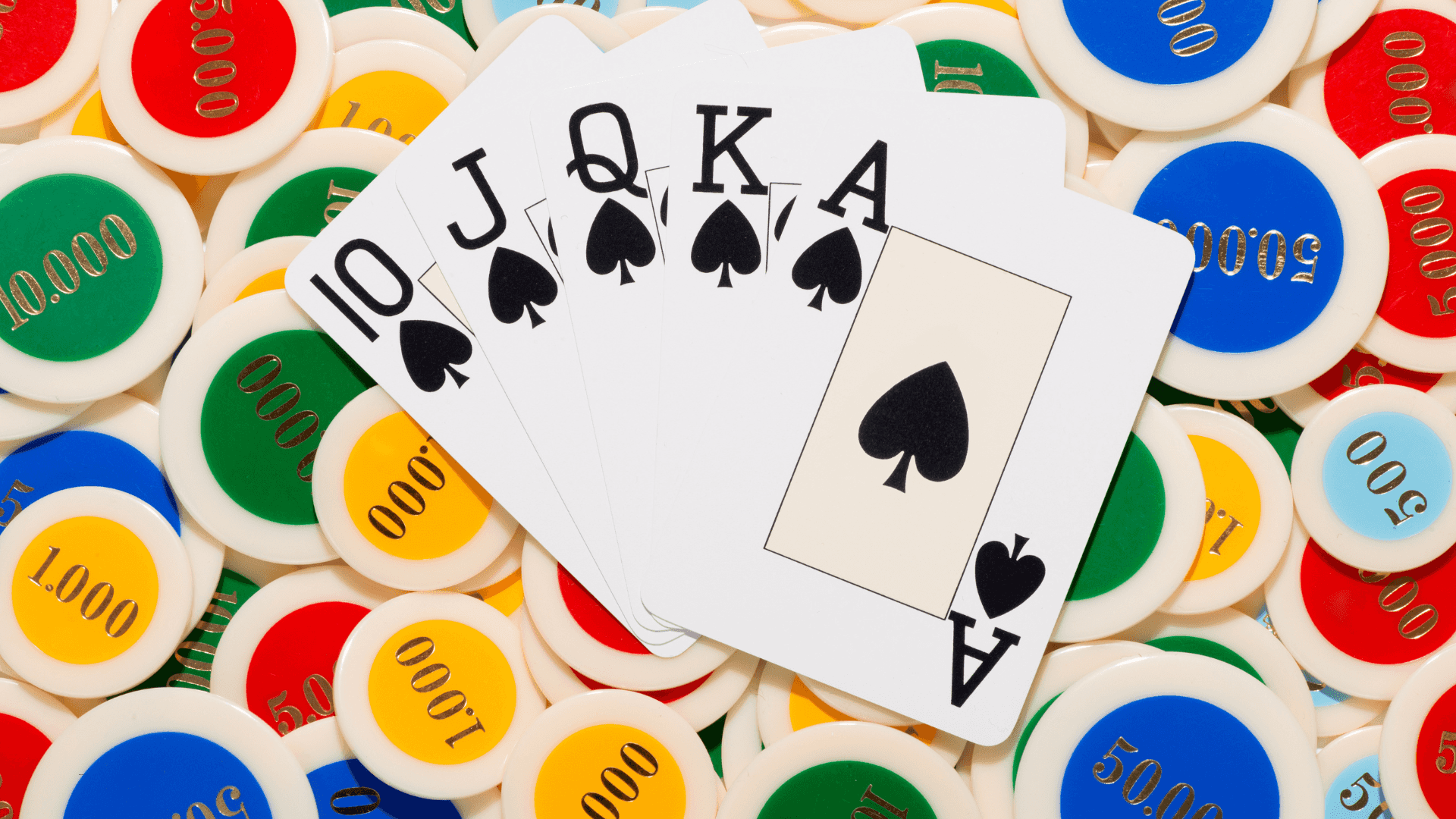
In principle, the player with the highest card wins. The card rankings are as follows.
A (Ace) is the strongest, followed by K, Q, J, 10, 9... down to 2, which is the weakest
Suit (the symbol type, such as A) generally doesn't affect the outcome (equal numbers are a draw or are settled by house rules)
For example, if the other three players are holding K Q 7 to their foreheads, the highest visible card is K. You can't see your own card, but as long as you're in the hand, you can bet on the slim hope that "maybe I have an A." This structure — "you can bet precisely because you can't see" — is the source of Indian Poker's fun.
Deciding how strong A is before you start will save you from arguments later. In most cases A is treated as the strongest, but some local rules make A the weakest (treated as a 1). Before you begin, just confirm these three points — ① the order of card strength, ② how to handle equal numbers, ③ whether to include jokers — and the game will run smoothly without disputes.
How to Deal the Cards and Run the Game
Let's walk through the actual flow step by step. There's nothing complicated here.
Choose the dealer: Decide the dealer with rock-paper-scissors or another method, then rotate clockwise after each round.
Deal one card to each player: The dealer shuffles the deck well and deals one card face-down to each player. The player receiving the card must never look at it.
Hold the card to your forehead: On a signal, everyone simultaneously raises their card to their forehead with the number facing the other players.
Observe your opponents: Study the other players' cards and expressions to figure out your chances of winning.
Bet or fold: Choose whether to keep playing by betting chips or to fold if you think you can't win (more on this in the next section).
Reveal and settle the winner: The remaining players bring their cards down, and the one with the highest number wins, taking all the chips that were bet.
After that, it's just a matter of repeating. The game moves at a brisk pace, so you can enjoy many rounds in a short time. Beginners often accidentally peek at their own card, so it helps to agree in advance that the dealer hands the card over face-down and the receiver brings it straight to their forehead.
Betting and Bluffing: The Fun of the Mind Game
The real thrill of Indian Poker isn't just comparing numbers — it's the betting and bluffing. Since you can't see your own card, the only thing you have to go on is your opponents' behavior. That's where the psychological battle begins.
The basic flow is: after everyone raises their card, players take turns betting chips, and anyone who wants out can fold. Two things matter most:
Weak cards around you are a sign of strength: If everyone around you has low numbers, then "your card," as seen by your opponents, is likely to look relatively strong. Conversely, if your opponents look uneasy and ready to fold, it might be proof that you're strong.
Bet big to scare them off: Even with a weak card, a large bet can intimidate your opponents and sometimes force out someone who's actually strong. That's a bluff — and when it works, the payoff is unbeatable.
Let's think through an example. Say the other three players are holding 3 5 8 and nobody is betting very aggressively. The visible numbers are all low. That means your card looks relatively high from their perspective, so they're likely hesitant because they think they might lose. In other words, you can reverse-engineer your own situation from other people's behavior.
This reversed way of thinking — "read your own situation from your opponents' reactions" — is exactly why Indian Poker stays fun despite being so simple. As you get used to it, even subtle signals like the size of the bet, the pause before pushing chips out, and eye movements become valuable clues, and the mind games grow deeper the more you play with the same group.
Fun Forfeit Games and Variations
Even without chips, imposing a forfeit on the loser can make the game a hit at any party. Here are some classic variations.
Forfeit rules: The player with the lowest card each round has to perform a challenge, like a quick act or an impression.
Drink rules: The loser takes a sip (a party staple — only as much as everyone's comfortable with).
Point accumulation: Each win earns 1 point, and the first to reach the target wins. Great for a longer session.
Reverse Indian (low wins): The player with the lowest number wins. Perfect as a change of pace for experienced groups.
You can also expand the game endlessly with ideas like "loser takes all," where only the overall loser of several rounds does a forfeit, or "survival mode," where players drop out once their chips run out. The trick is to balance the reward for winning against the risk of losing to fit your group's size and mood.
Adding a twist like "the winner decides the forfeit" adds even more heat to the mind games. Feel free to adapt it to the vibe of the moment.
Tips for Winning at Indian Poker
It's a game with a big element of luck, but how you play can raise your win rate. Here are the key tips to keep in mind.
Use the strongest visible card as your baseline: If several A's or K's are already visible, your chances of beating them go down. Knowing when to fold instead of forcing the play is also important.
Study your opponents' habits: Players tend to bet more cautiously when they've been dealt a strong card and look resigned when they're weak — reading these tendencies helps you work out your own situation.
Keep a poker face: Your expression is the material your opponents use to "read their own cards." Not showing your nerves is a genuine weapon.
Don't bluff too often: If you bluff every time, people will see through you. Save it for the moments that really matter.
Stay calm when you're losing: Luck comes in waves. Getting stubborn and playing every hand only deepens the damage. Folding cleanly on bad rounds and waiting for a spot you can win is ultimately the strongest play.
A sense of probability helps too. For example, if no A or K has shown up on the table, your chances of holding one of those high cards are better than usual. Conversely, the more high cards are already out there, the less likely it is that you're the strongest. With only 13 possible ranks, keeping in mind that "every visible card narrows down what your card can be" will keep your decisions consistent.
"Use the information you can see to deduce the card you can't." Getting used to this thought process is the fastest road to winning. Even if it feels like pure luck at first, with each round you'll naturally get better at judging when to fold and when to go for it.
Actually a Great Gateway to Texas Hold'em?
If you've read this far and thought "I love the feeling of thinking from my opponent's perspective," you're a perfect match for serious poker — Texas Hold'em. That's because the skill Indian Poker naturally trains — reading a situation from your opponent's point of view — is the very skill that matters most in Texas Hold'em.
In Texas Hold'em, you can see your own hand but not your opponents'. That's why "deducing your opponent's hand from their betting" and "being aware of how you're perceived" decide the outcome. If you've practiced reading opponents with a card on your forehead, you've already experienced the mental framework for it.
Of course, Texas Hold'em has plenty more to learn that makes it even more enjoyable — hand rankings, position, and bet construction, to name a few. Still, having the core concept of "putting yourself in your opponent's shoes" as second nature from Indian Poker is a huge advantage. Don't overthink it; step into real poker gradually, as an extension of having fun.
There are many other kinds of poker, and hand rankings follow set rules. If you want to play more seriously, start with this guide to poker variations and rules or the poker hand rankings list. If you'd rather learn step by step from the basics, the POKER Q'z lessons, where you can learn while playing for free, are perfect for beginners. Take the joy of reading your opponents that Indian Poker sparked and carry it straight into real poker.
Frequently Asked Questions About Indian Poker
Q. Do you use jokers?
A. Usually you play without them, to keep the strength comparisons simple — the standard is just the 52 cards from A to 2. Some house rules include jokers as the "strongest" or "weakest" card, but decide on that with everyone beforehand.
Q. Can two people play?
A. Yes. You look at your opponent's single card and bet on whether yours is stronger or weaker. However, the mind game gets deeper with more players, so 3–4 is recommended.
Q. What happens if two players have the same number?
A. The usual approach is to split the pot. If you want a definitive result, you can use a house rule that ranks ties by suit (e.g., A > A > A > A).
Q. Can you play without a deck of cards?
A. You can substitute numbered cards or an app. As long as you can deal one card with a meaningful rank (like 1–13) to each player, the game works.
Q. What's the difference from regular poker?
A. In regular poker you see your own hand but not your opponents'; in Indian Poker your own hand is the only one you can't see. There are also no hand combinations — you simply compete on the size of a single card.
Summary
Indian Poker is a light yet deep party game built on one reversed idea: you're the only one who can't see your card. Let's recap the key points.
The rules are ultra-simple: hold one card to your forehead, and the highest number wins.
All you need is one deck of cards: 3–4 players is ideal, and forfeits or chips let you adapt it freely.
At heart it's a mind game: the real fun is reading "the you you can't see" from your opponents' behavior.
And this "ability to think from your opponent's perspective" is the perfect doorway into serious poker like Texas Hold'em. Start by having a blast with friends over a round of Indian Poker, and when you're ready for deeper strategy, take your first step into real poker with POKER Q'z.