
Play live poker long enough and you’ll eventually see someone toss chips in and announce “straddle!” before the preflop action even starts. If you don’t know the rule, you might wonder why they’re betting on their own. A straddle is an optional action that effectively raises the blinds one level, and it’s a live-game tradition that juices up the action. Once you understand how it works, you won’t panic when you sit down at a table full of straddles — you’ll be able to decide for yourself whether to join in. This article covers the definition of a straddle, the reasons players do it, the math behind whether it pays, how to play in a straddled pot, and its variations. If you just want a quick definition of the term, check out the straddle entry in the glossary.
What is a straddle?
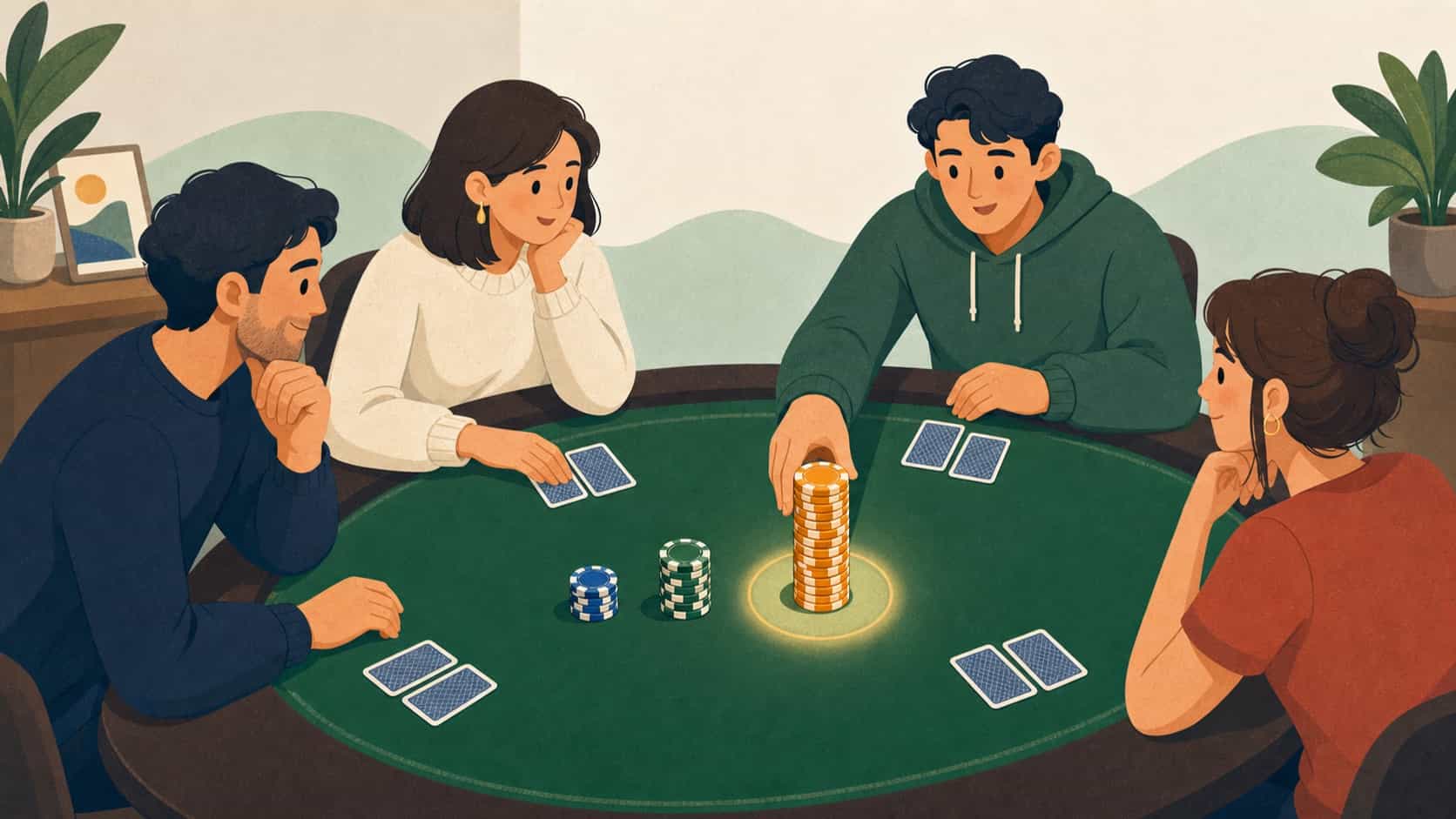
A straddle is an optional blind in which UTG (under the gun — the seat to the left of the big blind) voluntarily puts in 2x the big blind before the cards are dealt preflop, without looking at their hand. The key point is that the chips go in “blind” — you commit before you see your hand.
For example, at a table with SB 1 / BB 2, UTG puts in 4 as a straddle. This effectively creates a third blind, and the blinds in play effectively double. Normally, a player who wants to open-raise preflop opens to 2–2.5x the BB (2), but with a straddle in place the benchmark becomes the straddle amount (4), so the open size also jumps a level to 8–10. The chips moving in a single hand naturally swell.
A straddle usually comes with one more perk: the right to act last preflop (last action). Just like the BB, the straddler’s turn comes last, so they get to see everyone’s actions before choosing to call, raise, or fold. In exchange for putting in extra money, they gain the positional advantage of acting after everyone else.
How do you put in a straddle?
The basic procedure is simple.
Announce it before the cards are dealt: Say “straddle” out loud or place the required chips on the betting line. As a rule, you can’t do it after the cards are dealt.
The amount is exactly 2x the big blind: If the BB is 2, the straddle is 4. That’s the standard at most casinos and amusement venues.
Which seat can straddle depends on house rules: The most common rule allows only UTG (left of the BB) to straddle. Some rooms allow other seats, such as the Mississippi straddle described below.
Whether straddles are allowed and how high they can go are entirely up to house rules. At a new table, it’s safest to ask the dealer or floor one quick question: “Are straddles allowed?”
Why do players straddle?
Putting in extra money voluntarily sounds like a losing move, but straddles are popular for a reason.
Bigger pots and livelier action: The blinds effectively double, so the money per hand jumps. It’s a mechanism that answers live players’ demand for “bigger games.”
You get last action: You get to act last preflop, which gives you an informational edge. Some players straddle because they value this.
A live tradition that fires up the table: When one player straddles, it tends to spread, raising the tempo and energy of the whole table. This is an action with a strong entertainment element.
In short, it’s best to understand the straddle as not a play designed to maximize strict , but a live-specific option for making the game bigger and more fun. There’s also a practical reason: dealers will sometimes encourage you to straddle. Bigger pots tend to mean more rake (the house’s cut) and more chips in play, so the house welcomes straddles too. As a player, it’s wise to keep this “juice the game” dynamic in mind and decide calmly whether to join in.
Is a straddle mathematically a loss or a win?
to the point: a straddle on its own is basically -EV (negative expected value). The reason is simple — you’re forcing yourself to invest 2x the big blind with a random hand you haven’t looked at. There’s no guarantee of a good hand, and on average you’re putting extra money in with a weak range.
You do get last action in return, but that informational value generally doesn’t make up for the “cost of putting in 2x without looking.” Looking only at the math, the accurate assessment is that this isn’t something you voluntarily do when maximizing your win rate is the priority.
Let’s think a little more concretely. Like the BB, a straddle is a fixed cost you put in regardless of your hand. The BB is an obligation you can’t avoid just by sitting in that seat, but a straddle is an obligation you add by your own choice. Because you’re deliberately increasing an avoidable cost, it’s worse than the BB. When a strong hand does come, the bigger pot works in your favor, but on average your range is random, so the losses from dumping chips with weak hands outweigh the gains. That’s why it’s said to be “basically -EV.”
Still, writing it off with a single “it’s a loss” would be premature. A straddle also has these plus sides.
It can improve (loosen up) the game overall: If opponents are lured in by the straddle and join with wider ranges, it can become an environment that’s actually easier to profit in for skilled players.
s get shallower, changing the dynamics: Because stacks are shallower relative to the blinds, the game changes in nature (detailed in the next section).
In other words, even if “your EV on that particular hand” is negative, from the long-term perspective of “how you shape the whole table,” it can’t be dismissed as a flat-out bad play. The first thing to know is the principle: “Basically -EV. So don’t use it too often.”
What kinds of straddles are there?
There are several variations of the straddle, and the rules adopted vary by room. Here are the most common ones.
UTG straddle (standard type): The most common. The seat to the left of the BB puts in 2x the BB — the standard form described above.
Mississippi straddle: A type that can be placed from any seat, such as the BTN (button), rather than UTG. A Mississippi straddle from the BTN is considered more aggressive than the standard type, since you raise the stakes while keeping your position.
Double straddle / re-straddle: The seat to the left of the first straddler puts in another 2x of that amount. The blinds snowball in a chain up to the house limit.
Button straddle: A type where the BTN is designated to put it in. Sometimes treated as a form of Mississippi straddle.
Which variations are allowed, how many levels the cap goes to, and who last action moves to are all dependent on house rules. Mississippi-type straddles in particular change the action order from normal, so be sure to check before placing one. When the BTN places a Mississippi straddle, the starting point of preflop action and the seat that acts last can swap from normal, and it’s easy to mistake your turn if you’re not used to it — be careful.
How should you play in a straddled pot?
A pot with a straddle differs from a normal pot in “effective stack depth.” This is the single most important point that shapes your strategy.
When the blinds effectively double, it’s the same as your stack depth in big blinds being cut in half. At a 100BB table, a straddle brings the game closer to feeling like a shallow 50BB game. The shallower it gets, the more these adjustments kick in.
en your range: With shallow stacks, speculative hands (those relying on implied odds) lose value. Don’t casually join with suited connectors or small pocket pairs; lean toward hands with raw strength.
Preflop commitment decisions come sooner: The shallower the stack, the sooner you reach the 3bet / all-in threshold. Shift your mindset toward settling the hand preflop rather than grinding fine postflop battles.
The straddler with last action can defend a bit wider: Thanks to the right to act after everyone, the straddler themselves can widen their calling range somewhat. Conversely, if you’re attacking the straddler, keep that in mind and avoid value betting too thin.
Let’s look at a concrete example. At a 100BB table, opening lightly from the BTN with suited A5 and “winning big when you hit” is a play that works normally. But when a straddle makes the effective stack as shallow as ~50BB, you can’t go deep even when you hit, and the big implied odds you were after aren’t there. s like this lose value, so it makes sense to lower your participation frequency or, when you do join, lean toward hands with raw fighting strength.
To build a feel for ranges at shallow stacks, the fastest way is to check an actual range chart and see with your own eyes “how wide you can open at this depth.” PQ'z’s range chart tool also lets you check ranges for each position in MTTs (tournaments). Late-tournament stacks are shallow by default, so it’s a useful reference for how your range should look in straddle-shortened spots. The position-by-position opening standards themselves can be learned systematically in the lessons “Learn the Basics of Which Hands You Can Open” and “Learn the Types of Ranges”.
How should you respond when someone else straddles?
Let’s also organize how to think when you’re not the one placing the straddle but facing another player’s straddle.
Basic policy: tight and strong: The pot is big and effective stacks are shallow. ing in with marginal hands only adds variance and costs you. When you do join, step in with a strong range that’s not afraid to 3bet.
Don’t forget the straddler’s last action: Even if you raise, the straddler (in the standard type) keeps the right to act last, so factor in the possibility of them coming over the top from behind.
the effect of opponents loosening their ranges: At tables where many opponents join wide because they’re lured in by the straddle, simply keeping your discipline gives you an edge. Choosing not to join a straddle war is also a perfectly good option.
This is a spot where the fundamentals of position and range apply directly, so if you’re not used to it, keeping just three points in mind — “shallow, tight, position-first” — will keep you from going far wrong.
Etiquette when straddling at amusement and live tables
Precisely because the straddle is an action with strong entertainment value, table etiquette matters.
House rules come first: Whether straddles are allowed, their cap, and which seats can place them vary by venue. Don’t decide on your own — follow the dealer’s or floor’s guidance.
Declare clearly, before the cards are dealt: Vague timing is a recipe for trouble. Make your intention clear with both your voice and your chips.
Don’t slow down the game: Even when chains of re-straddles heat up the table, keep your actions snappy. Not making others wait too long is common courtesy.
Don’t forget bankroll management: A straddle is effectively an act of doubling the blinds. Don’t let it strain your funds beyond entertainment scope — use it in consultation with your own bankroll.
At amusement tables where no real money is wagered, a straddle is a great spice to enjoy more action risk-free. Starting out in a low-risk environment is the recommended way to get a feel for it.
Frequently asked questions about straddles
Q. Is it better to never straddle?
A. Looking only at EV, it’s basically -EV, so it’s not recommended when win rate is your top priority. But if your goals are to liven up the game, enjoy it as entertainment, or loosen the table to your advantage, using it with an understanding of the cost is perfectly reasonable.
Q. Can you straddle from any seat?
A. In the standard type, only UTG (left of the BB). Some rules allow placing it from the BTN, like the Mississippi straddle, but whether it’s allowed depends on house rules. Always check before placing one.
Q. How much is a straddle?
A. The standard is exactly 2x the BB. With a re-straddle it can double again in a chain, and the cap is set by house rules.
Q. What happens to position when you straddle?
A. In the standard type, the straddler gets the right to act last preflop (last action). Being able to act after everyone else, like the BB, is the payoff for putting in extra money.
Q. Can you straddle online?
A. Some cash games offer it as a feature, but support depends on the site. The straddle is an action with strong live-culture roots, and it’s often not supported online.
Q. Should you change your hand selection in a straddled pot?
A. Yes, changing it is recommended. Because the straddle makes effective stacks shallower, speculative hands that rely on implied odds (small suited connectors, etc.) lose value. Adjusting your range tighter toward hands with raw strength will make your decisions less shaky.
Summary
A straddle is an optional blind in which UTG puts in 2x the BB without looking, a live-specific tradition that makes pots and action bigger in exchange for the right to last action.
Basically -EV: You’re putting in 2x without looking, so don’t use it often if win rate comes first.
It still has value: From the standpoint of loosening the table, entertainment, and game-making, it’s not flat-out a bad play.
d pots have shallow effective stacks: Tighten your range and play with an emphasis on position.
Variations like the Mississippi straddle and etiquette start with checking house rules.
To build range feel at shallow stacks, burn it into your eyes with the range chart tool and learn systematically with the lessons — that’s the shortcut to improving. If you only need the key points of the term, the straddle entry in the glossary is there too.