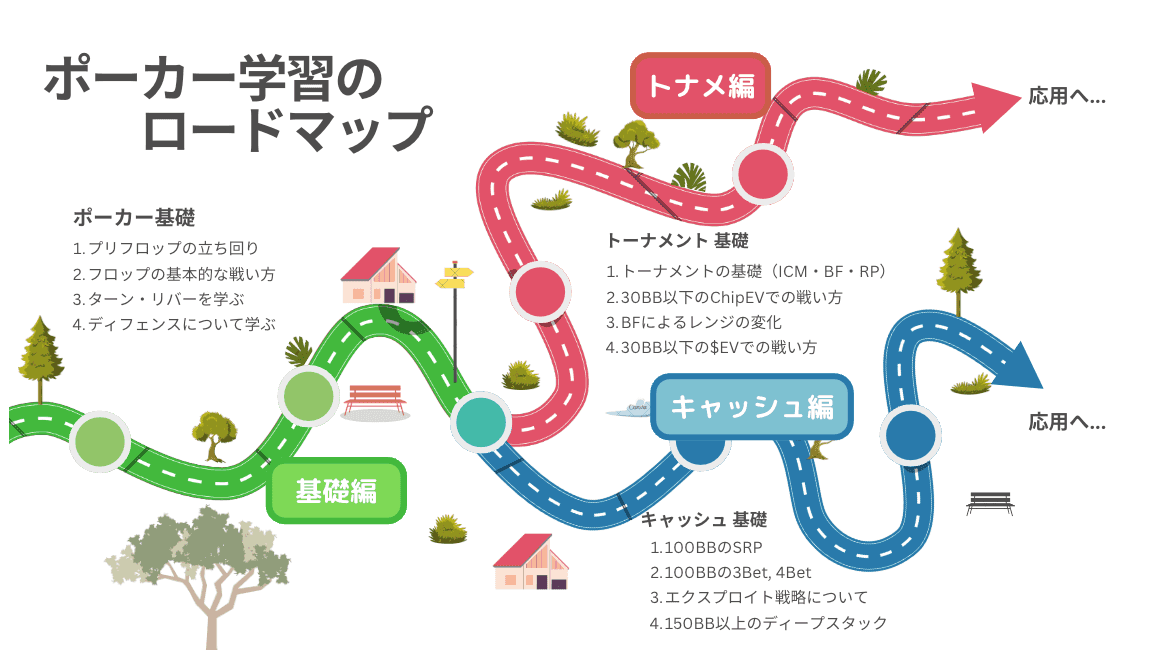

Ever feel like you just can't get better at poker, or that you'll never beat players with natural talent? The truth is, improvement depends less on talent than on knowing the right techniques and turning them into habits. This article introduces seven practical tips that help beginners and intermediate players break through plateaus. The key is that these aren't just words of encouragement—they're built into POKER Q'z lessons, calculators, and quizzes so you can verify them right away. When you finish reading, pick one tip and actually put it into practice. You don't need to master all seven at once. Just choose the tip that seems most useful to you right now and keep it in mind during your next session—you'll already feel a difference in your play. If you'd like to see the full learning picture first, start from the learning page.
Why Do Some People Never Improve at Poker?
To get stronger, it helps to first know the traps that players stuck in a rut tend to fall into. In most cases, the cause comes down to these three:
Playing on feel alone: making calls and raises because a hand "seems strong," without being able to explain your reasoning in numbers
Playing without reviewing: never reflecting on individual hands and repeating the same mistakes again and again
Focusing only on results (win or lose): short-term outcomes are heavily influenced by luck, yet you change your approach based on a single result
Look at it the other way: simply shifting these three habits to "have a reason, review your play, and take the long view" will dramatically speed up your improvement. Every tip below supports that shift.
One more thing worth keeping in mind is the order of priorities: work on "losing less" before "winning big". Flashy bluffs and big hands stand out in poker, but what sustains your long-term results is the unglamorous play of not giving away chips needlessly. ing hands you shouldn't play and not chasing thin draws—locking in these "decisions not to play" will stabilize your bottom line. Remember: improve by building your defense first, then sharpening your offense.
Tip 1 | Maintain Preflop Discipline
The foundation of improvement is, above all, preflop discipline—the decisions you make with your first two cards. If this falls apart, no amount of good play on the flop, turn, or river can make up for it. Players who improve quickly all have a standard for "which hands to play, from which position, and how."
A common mistake is casually entering pots with hands that "look fun to play," like J9 or a picture card paired with a small card. These hands are easily dominated by stronger hands and slowly drain your bankroll over the long run. If you want to improve, first make your hand-selection standard clear, and have the courage to fold everything else without hesitation.
Start with Learn which hands you can open to grasp the concept of opening ranges, then study position-based differences with Learn the UTG / HJ ranges. Your biggest weapon is the range chart tool. When you wonder, "Should I open AT from UTG?" you can open the UTG opening range chart on the spot and check the answer. Training yourself to see the correct answer with your own eyes instead of relying on feel builds discipline. You don't need to memorize the charts at first. Just check "how far is my judgment from the correct answer?" and fix the spots with the biggest gaps first—that's enough.
Tip 2 | Think of Odds and Equity in Numbers
Deciding whether to chase a draw is a fork in the road for improvement. Strong players don't decide by feel; they compare pot odds (the ratio between what you must call and what you can win) with equity (your chance of winning). The basic idea is simple: if your win rate is higher than the percentage you need to call, the call is profitable over the long run.
The famous shortcut for estimating draw equity is the "Rule of 2 and 4." Count your outs (the cards that can make you win) on the flop, multiply by 4 if you can see through the river, or by 2 if through the turn, and you get a rough win rate. For example, a flush draw has around 9 outs, giving you roughly 30–40% equity from flop to river. Compare that with "the percentage you need to call," and you can decide whether to chase or fold without emotion.
First, understand how it works with Learn the odds of basic draws, then check real numbers with the odds calculator and the equity calculator. Every time you compare your own estimate with the tool's numbers, your "feel for numbers" develops surprisingly fast. It's fine if mental math is hard at first. After repeating the answer check after each session, numbers close to the exact ones will start coming to mind at the table. This ability to translate intuition into numbers is the decisive difference between players who stay stuck and those who break through.
Tip 3 | Make Hand Reviews a Habit
Nothing accelerates improvement more than hand reviews (reflection) after play. It's not your winning hands but your confusing hands and losing hands that are a goldmine for study. Put into words, one by one: "Was there no other option for that turn bet?" "Was calling really correct given the opponent's range?"
Note down the spots that confused you, then check the correct answer later with tools or lessons
Be able to explain in one line, every time, "why I chose that action"
If the same mistake appears twice, practice that situation intensively
The key is to evaluate the "process" of your decisions rather than the "result" of winning or losing. Even with a good decision you can lose to bad luck, and vice versa. If you only review results, you may end up doubting plays that were actually correct. Build the habit of asking, "Given this situation and this information, was this choice reasonable?"—and judge the process.
POKER Q'z quizzes and lessons are perfect for running this review loop. Review the topic you struggled with in the relevant lesson on the learning page, and you'll eliminate your weaknesses in a way that sticks. Even five minutes a day—just reflecting on one confusing hand—will change the view after a month.
Tip 4 | Make the Most of Position
A big factor that separates beginners from intermediates is awareness of position (the order in which you act). The later your seat (the closer to the BTN), the more you can decide after seeing your opponents' actions, giving you a huge advantage. Strong players don't just say "I play because I have a good hand"; they naturally adjust, opening wider in good position and tighter in bad position.
Concretely, tighten your hands in early positions like UTG and HJ, and open your range more aggressively from CO and BTN. In the range chart tool, comparing BTN opens with early positions makes the difference obvious at a glance. If you internalize that "the same KT can lead to a different decision depending on your seat," you're playing a level up.
The advantage of position isn't only about preflop. Postflop, too, being in a later seat lets you act after seeing your opponent's checks and bets, making both bluffs and value bets easier to set up. From early seats, by contrast, building a big pot in a bad position forces tough decisions on every street and increases mistakes. Simply keeping in mind "don't inflate the pot from a bad position" steadily improves your win rate. is one of the quickest tips you can apply the moment you learn it.
Tip 5 | Balance Value Bets and Bluffs
There are two kinds of bets: value bets, which extract value with strong hands, and bluffs, which fold out opponents with weak hands. A common plateau is leaning too far one way—"I can't bluff, only value bet" or "I bluff too much and bust myself." Players who are hard to read mix the two in an appropriate ratio.
What beginners should focus on is that a bluff needs a reason. A bluff creates expectation value only when the conditions line up: the opponent's range is weak, our story is consistent, or we still have a chance to improve to a strong hand on the next card. Conversely, betting a strong hand too slowly and missing value you could have taken is also a typical leak. Just keeping the two axes in mind—"take value properly when strong, and bluff only with a reason when weak"—makes your play much harder to read.
First, organize the roles of both with Understand value bets and bluffs, then practice spotting "when to bluff" with Think about whether to bluff. When you want a quick refresher on terminology, the bluff entry in the glossary helps too. when the opponent has a reason to fold, not "just because"—following this principle alone cuts down wasted losses.
Tip 6 | Manage Your Bankroll Strictly
No matter how much your skill grows, bankroll management is essential for stable results. Poker is a game with large short-term swings of luck, so even skilled players will hit losing streaks. If you chase a comeback by playing stakes beyond your means, you'll run out of money before you can show your real skill.
Keep enough bankroll cushion for the stakes you play, and never risk your whole roll on a single hand
If losses pile up, don't steam—move down in stakes and rebuild
Judge by long-term total results, not "today I won / today I lost"
Having a comfortable bankroll also steadies your mind and makes it easier to make sound decisions. The reassurance that "losing this hand won't be fatal" is what lets you calmly pick the highest- option without being chained to short-term wins and losses. Conversely, when you're playing with money that affects your livelihood or trying to win back losses, your judgment gets distorted—either overly cautious or recklessly aggressive. Protecting your bankroll is the top priority, also to secure enough practice volume for improvement. Skill, mental game, and bankroll management are three pillars; missing any one of them means stable results will stay out of reach.
Tip 7 | Build Mental Control and Tilt Management
The final tip is mental control. When unreasonable losses (bad beats) pile up, anyone can lose composure and let their decisions get sloppy. This state is called "tilt," and it's one of the biggest enemies of improvement. Even if you know the technically correct play, you can't execute it while tilting.
The countermeasure is simple: stop and take a break when emotions take over. rules in advance, such as "if I get frustrated, sit out a few hands" or "if losses pile up, end the session." Accept that when your emotions are running high, you are definitely weaker than your normal self—players who can reset and restart the battle on those terms grow in the long run. Also, understanding that bad beats happen by probability helps you take unfair losses in stride as "part of the game." Poker is a game where the player who stacks up correct decisions—not the one who chases single results—wins in the long run. Not getting carried away by the outcome of any single hand is, in fact, the most repeatable "tip for improving."
Build a Habit of Verification with Tools and Improve Fast
What all seven tips share is one point: backing up your intuition with numbers and correct answers. Many people assume that playing a lot will naturally make them better, but play without verification just layers the same mistakes on top of each other and barely leads to improvement. In contrast, checking each hand's review against the correct answer makes every session more educational even with less play. And the fastest way to run this verification loop is POKER Q'z. When you're unsure at the table, make it a habit to open the following on the spot and check the answer.
Unsure about hand selection → check the correct range with the range chart tool
Unsure whether to chase a draw → quantify it with odds calculation and equity calculation
Want to solidify the theoretical foundation → learn strategic thinking with What are GTO and exploitative play?
If you want to learn more systematically, working through the lessons on the learning page in order is the fastest route. The more you run the "learn → try → verify" cycle, the faster you improve.
Frequently Asked Questions
Q. To get better at poker, where should I start?
A. Start by building preflop discipline (Tip 1). Just having a standard for hand selection will make your later decisions much more stable. Begin with Learn which hands you can open.
Q. How long until I notice improvement?
A. It varies by person, but once you build the habit of "playing on feel → verifying with numbers and correct answers," the reasoning behind your decisions changes within a few weeks. It's not the volume of play but the quality of your review of each hand that drives growth.
Q. What matters more for getting stronger: live play or tools?
A. Running both together is fastest. Verify the spots you struggled with in live play using the range charts or equity calculations, then try them in your next session—that back-and-forth is the engine of improvement.
Q. Should beginners learn too?
A. Memorizing terms isn't necessary, but touching the idea of "standards that are hard for opponents to exploit" early will give you a solid foundation. Start casually with the GTO glossary entry or What are GTO and exploitative play?.
Summary
The secret to improving at poker isn't talent—it comes down to the habits of "having a reason, reviewing your play, and taking the long view". All seven tips introduced here—preflop discipline, odds and equity, hand reviews, position, balancing value bets and bluffs, bankroll management, and mental game—are things you can start today. What matters is continuing to verify your intuition with the range charts and calculators. Take your first step toward improvement by checking one confusing spot with a tool. The learning page will be your companion along the way.