POKER Q'z Blog

Poker strategies, techniques, and the latest information to help you improve

Terms & Basics

Beginner Poker Learning Roadmap to Get Better From Fundamentals to Cash Games and TournamentsBasics

Beginner Poker Learning Roadmap to Get Better From Fundamentals to Cash Games and Tournaments

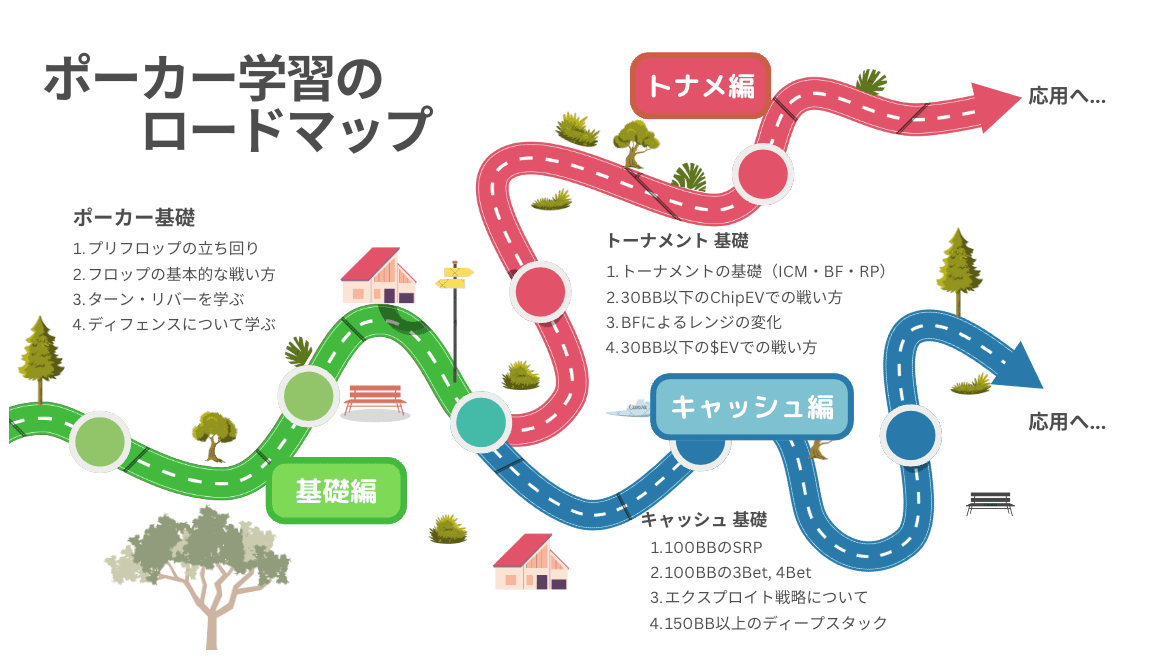
You’ve learned the rules of poker, but you’re not sure what to study to actually get better at cash games or tournaments. This article gives you a clear learning roadmap that shows what to learn and in what order, so you can improve efficiently. Follow this roadmap and you’ll build real skill without losing direction, whether you prefer cash games or tournaments.1. Fundamentals: Build a Strong Poker Foundation FirstCash games and tournaments follow different formats, but they share many core concepts. Start by mastering the fundamentals that apply to both.1.1 Learn PreflopYou play preflop every single hand, so it has a huge impact on your results. That’s why preflop is the first street you should prioritize. Here are the key points to learn first.When no one has entered the pot yet, open-raise instead of open-calling.The earlier your position, the more hands you should fold.Playing too many hands is a mistake.Many new players want to play lots of hands and end up losing money by entering pots with weak holdings. Start by studying which hands to play from each position. Once you understand your opening ranges, move on to how to respond when someone raises before you.1.2 Learn How to Play the FlopAfter you understand preflop, study flop strategy next. Preflop decisions depend only on your two hole cards, but on the flop your strategy changes dramatically depending on the board texture. That’s why learning to read boards is essential.To understand board texture, focus on these factors.The highest cardHow connected the ranks areThe suits on boardWhether the board is pairedUse these features to think about which player is more likely to have strong hands, and choose actions based on that.1.3 Learn How to Play Turn and RiverNext, study turn and river play. You reach these streets less often than preflop and flop, but the pot is usually larger, so one mistake can cost you a lot. Common turn and river mistakes include:Overestimating the strength of your handTrying to put your opponent on one exact handIn poker, you need to consider your opponent’s possible range and estimate how strong your hand is against that range. A small mindset shift helps you avoid overvaluing hands, value-betting too thin, and losing money in one-sided spots.1.4 Learn DefenseWhen you face a bet or raise and choose to continue by calling or raising (instead of folding), that’s defense. You must defend at the right frequency. If you defend too much, you lose money. If you fold too much, you also lose money. Study how your defense frequency and defending hands should change based on bet size and raise size.2. Cash Game TrackAfter you learn the fundamentals, you can branch into a cash game track or a tournament track. Here’s the cash game track. In cash games, you aim to make decisions that maximize the expected value of your chip stack at all times. Compared to tournaments, you often play with deeper stacks, so focus your study on those situations. We recommend learning in this order.100BB single-raised pots (SRP)Start with SRPs (spots where there is one preflop raise), because you’ll play them most often. Learn a solid, leak-free strategy based on GTO.100BB 3-bet and 4-bet potsNext, study 3-bet and 4-bet pots. Pots get bigger than in SRPs, so you need to plan more often with all-in scenarios in mind.Opponent-specific exploitsExploitative play means targeting weaknesses in your opponent’s strategy. Study how to adjust based on different player types. Classic examples include bluffing less against players who call too much, and bluffing more against players who fold too much.Deep stacks (150BB+)When stacks get deeper, you can win or lose a lot more in a single hand, which changes hand values and optimal lines. Study how your strategy should adapt.Recommended articles:https://japan.gtowizard.com/blog/principles-of-gto/https://japan.gtowizard.com/blog/exploitative-dynamics/3. Tournament TrackBecause tournament payouts depend on your finishing position, you need tournament-specific knowledge. This learning order works well.Tournament fundamentalsStudy these key concepts that matter in tournament play.ICMIn tournaments, your chip stack does not translate linearly into prize money EV. One model used to estimate prize money EV from chip stacks is ICM (Independent Chip Model). In late stages, you must choose actions while accounting for ICM.BFBF stands for Bubble Factor. It measures the gap between the downside of losing chips and the upside of gaining chips. A larger BF means losing chips hurts more.RPRP stands for Risk Premium. It indicates how much additional equity you need on top of chip-only requirements to justify taking a risk.It’s difficult to calculate these values precisely during play, but estimating them roughly helps you choose actions that increase your prize money EV.How to play 30BB and below in chipEVChipEV is the expected value of chips you gain from an action. In tournaments, chips and prize money EV don’t always align, but when you’re far from the money, making decisions based on chipEV often increases your long-term prize money EV. First, practice playing to maximize chips.How ranges change with BFWhen BF is high, optimal hand ranges change. Study how correct ranges shift based on your stack size and your opponent’s stack size.How to play 30BB and below in $EV$EV refers to how much an action changes your expected prize money. In late-stage tournaments, you’ll often see spots where chipEV is positive but $EV is negative. Study how to maximize prize money EV with the right decisions.Recommended article:https://note.com/gaku_btn/n/n42d355a709efWith POKER Q'z, you can study the poker fundamentals introduced here through quiz-style training. Build a strong foundation and level up your game.ConclusionThis article explained what to study first to become a stronger poker player. Poker is a game of incomplete information, so it’s not always easy to judge whether your play was correct. To choose the best actions consistently, you need solid fundamentals and logical thinking. Use this roadmap to train efficiently and keep improving.

1963
Are You Making Giant Bets? Bad Poker Habits You Should Fix Now Part 2Basics

Are You Making Giant Bets? Bad Poker Habits You Should Fix Now Part 2

Have you ever regretted a hand?Many players can follow preflop range charts, but once the board comes down they think, “I have no idea what to do postflop…”I was exactly the same when I started. And because the pot grows quickly postflop, one mistake can be costly. Maybe you’ve faced a big bet, tank-called, then immediately realized your hand was never good and thought, “Why did I call there if I’d just stayed calm?” If you study postflop in advance, you can reduce those painful, high-impact mistakes and keep more chips in your stack.In the previous article, we covered two bad preflop habits you should fix right now to move beyond the beginner stage. In this follow-up, we’ll look at two postflop bad habits beginners should fix first: “auto-calling” and “Gian betting.”Note: These are not standard poker terms. They are labels used only in this article.Fix these, and you’ll take a real first step toward becoming a stronger, more confident player.https://pokerqz.com/blog/poker-beginner-bad-habits-0011. Bad Habit 1: Auto-CallingYou’re in the big blind with As 5h. The button raises to 250 and you call. Including the small blind that folded, the pot is 550. You check, and the button bets 275 (half pot).Do you ever think, “I have an Ace, the strongest card. If an Ace hits, I can win, so I’ll just call for now”?Stop making that “auto-call.”Calling just because you have an Ace is a great way to bleed chips. Cut it out immediately.How often does an Ace actually hit the board? The answer is only about 12%. That means you’ll hit an Ace only around 1 time in 8. And even if you do hit, you can still lose to a better Ace kicker like Ac Tc, or to two pair or better like Ks 3s. In other words, even when you hit your Ace, it’s not automatically the “best hand.”Here’s a simple way to estimate the chance of improving your hand. It requires no difficult math, and even if you’re not confident with numbers, you can use it right away.The 2%–4% Rule for Quick Equity EstimatesOn the flop and turn, you can estimate the chance of hitting your outs by the river like this:Flop: (number of outs) × 4 (%)Turn: (number of outs) × 2 (%)Simple, right? This works because a standard deck has 52 cards. Now let’s apply it to the spot above. You hold As, so the remaining Aces are Ah Ad Ac, which gives you 3 outs. Since we’re on the flop:3 × 4 = 12 (%)So you’ll hit an Ace only about 12% of the time, or roughly 1 time in 8.Beginners often auto-call too much. Before you call, pause for a moment and think. The 2%–4% rule is extremely useful, so memorize it and start applying it in real hands.2. Bad Habit 2: Gian BettingThe unbeatable Gian vs. the helpless Nobita: bet when strong, check when weakImagine a poker table where Gian and Nobita are sitting in front of you. Gian always has the strongest possible hand, and Nobita always has no pair (just a high card). How would you play against them?1) When Gian bets, you know you’re always behind, so you fold every hand.2) When Nobita keeps checking, you know he’s extremely weak, so even with a weak hand you bluff and make him fold.That’s probably what you’d do. If you already know what they have, the decisions become easy. But then Gian never gets called, and Nobita always gets pushed off the pot, so neither of them wins chips.Now ask yourself this:Are your actions turning you into “Gian and Nobita” too?Let’s look at a similar spot. You’re in the big blind with 3s 3h. The button raises to 250 and you call. Including the small blind that folded, the pot is 550. Then you get lucky and the flop brings 3c, giving you three of a kind. You think, “This is super strong, I should bet big,” and you lead for 550 (a pot-sized bet). But here’s the truth:Stop making that “Gian bet.”If you bet huge only when you have a strong hand, you’re basically telling your opponent: “When I bet big, I’m strong. When I don’t, I’m weak.” That’s exactly the Gian and Nobita problem. Even though you flopped a powerful hand like trips, your opponent will often fold immediately and you won’t win much at all.To avoid falling into the Gian betting trap, keep these points in mind:• Consider checking sometimes even with strong hands• Consider bluffing when your hand is extremely weak (like no pair)Donk BettingA bet like the one above, where the caller bets into the preflop raiser, is called a donk bet. When beginners use donk bets, they often lose money, so in general, avoid donk betting.Remember: “If you call, then check.”If you want to understand why donk betting is usually a mistake and take your game to the next level, check out the article below for a detailed explanation.https://pokerqz.com/blog/donk

1081
What Does “Run It Twice” Mean in Poker? A Beginner-Friendly GuideTerms

What Does “Run It Twice” Mean in Poker? A Beginner-Friendly Guide

When you’re playing poker and someone goes all-in, you may hear the term “twice.” This is most common in cash games, so if you mainly play tournaments, you might not have come across it yet. In this article, we’ll explain what “twice” means in poker in a beginner-friendly way.1. What does “twice” mean?“Twice” is short for “run it twice.” It refers to an option where, when all players are all-in before the river, the remaining board is dealt two separate times and the pot is split based on the results. Players use it to reduce variance (swings caused by luck).This option is mainly used in cash games, and the most common rule is that the board is run twice only if every all-in player agrees. Depending on the casino or poker room, rules can vary, such as “only allowed in heads-up pots” or “you can run it three times or more.” It’s a good idea to confirm the house rules in advance.2. Example of running it twiceLet’s look at how running it twice works in practice. Consider the following situation.Two players are competing for the pot.One player goes all-in on the flop, and the other player calls.If both players agree to run it twice, the turn and river are dealt two separate times. Then the pot is split based on the outcome of each run. In the example image, the right player wins the first run, and the left player wins the second run, so the pot is chopped and each player receives half.3. Is running it twice good or bad?Does running it twice change your expected value in chips? Let’s use an example where players get all-in on the turn.In this spot, the right player is currently ahead. For the left player to win, they need to hit one of five outs on the river: Ah, Ad, Ac, Js, or Jc. Let’s calculate the left player’s expected chip return with and without running it twice.If you do not run it twiceThere is no possibility of a tie on this board. Out of the 44 unseen cards, the left player wins if one of the 5 outs appears, and loses if any of the other 39 cards appears. So the expected value is 5/44 of the pot.If you run it twiceNow let’s find the probability that the left player wins both boards, and the probability they win exactly one board.Winning both runsTo win both, you deal two cards from the remaining 44, and both must be outs. The probability is:(5×4)/(44×43) = 5/473Winning exactly one runTo win exactly one, one card must be an out and the other must not be an out. The probability is:(5×39×2)/(44×43) = 195/946When you win exactly one run, you only receive half the pot. So the expected value becomes:1×(5/473) + (1/2)×(195/946) = 5/44This shows the expected value is the same as not running it twice: 5/44 of the pot.We used a turn all-in example here, but it’s also known that if players get all-in preflop or on the flop, running it twice does not change equity.Running it twice does not change equity, but you do need to pay attention to rake. In some rooms, running it twice can increase the rake. Reducing variance is appealing, but depending on the rake structure, running it twice can actually cost you money. Check the rules beforehand.Key pointsRunning it twice does not change equity.Running it twice may increase rake and could be unprofitable.If you want to learn more about rake, see this article:https://pokerqz.com/blog/rakeConclusionIn this article, we explained what “twice” means in poker. Running it twice reduces swings and can make your results feel more stable, but you can also choose to decline and embrace higher-variance situations for the thrill. Pick the option that fits your style. We hope this guide helped.

1080
Tournament vs Ring Games: What’s the Difference in Poker Rules for Beginners?Basics

Tournament vs Ring Games: What’s the Difference in Poker Rules for Beginners?

Do you prefer tournaments or ring games? Tournaments are full of all-ins and fast-paced action, while ring games let you play deep-stacked poker and think through every street. Each format has its own appeal. In this article, we’ll clearly explain the key differences in rules and strategy so you can enjoy both tournament poker and cash games even more.1. What Are Tournaments and Ring Games?TournamentsA tournament is a battle-royale style poker format where players get eliminated as soon as they lose all of their chips. Even if you were the chip leader a moment ago, one lost all-in can knock you out immediately. As the tournament progresses, the blinds increase, so you often end up playing with a short stack except in the early stages. In addition, most tournaments include an “ante,” a forced contribution separate from the blinds, which encourages you to play more hands.Ring Games / Cash GamesThis is poker where the goal is simply to increase the chips (money) in front of you. Unlike tournaments, the blinds do not go up over time, so you can play deep-stacked and take your time. In many cash games, the casino also takes a “rake” from the pot. “Ring game” and “cash game” originally mean the same thing, but in Japan, “ring game” often refers specifically to games that do not involve real-money wagering.For more on “ante” and “rake,” check out these articles:https://pokerqz.com/blog/antehttps://pokerqz.com/blog/rake2. Difference 1: Stack DepthThe size of your stack (how many big blinds you have) is arguably the most important difference between tournaments and ring games. In tournaments, blinds keep rising, so you’ll often play with a short stack outside the early levels. Let’s look at what changes when stacks get shallow.2.1. All-ins Become Extremely PowerfulWhen stacks get shallow, your stack becomes relatively small compared to the pot. As a result, unlike deep-stack play, you need to go all-in much more often. If you fear elimination too much and hesitate to shove, you’ll miss profitable spots. Look for chances to apply pressure and get your chips in. Once you drop below 20bb, you should play with the possibility of open-shoving preflop in mind.2.2 Hand Values ChangeWith a short stack, even if you make a big hand, you can’t win that many chips. That’s why speculative hands that rely on making strong but low-frequency hands, such as 9h 8h, lose value. Since preflop all-ins happen more often, hands that are harder to play postflop but have relatively high preflop equity, such as small pocket pairs like 5s 5d and ace-x hands like Ah 4c, become much more valuable.3. Difference 2: The Value of ChipsIn a ring game, the size of your stack directly represents its value. A 1,000-chip stack is worth exactly twice as much as a 500-chip stack. In tournaments, however, that’s not always true. Even if you double your stack, your expected prize value does not necessarily double.Here’s an example.You are playing a tournament where the top 5 players win a seat to a major event (a “satellite tournament”), and there are 10 players left.The stacks are:Chip leader: 10,000You: 5,000The remaining 8 players: 1,000 each.In this tournament, 1st place and 5th place have exactly the same value. You just need to finish in the top 5. In other words, your stack’s value is determined by your “probability of finishing in the top 5.” The chip leader has twice as many chips as you, but do they really have twice the probability of finishing in the top 5? Of course not. Both the chip leader and you are very likely to finish in the top 5, probably well over 90%.This is why, in tournaments, you must play to maximize prize value, not just to accumulate chips. In this example, if the chip leader shoves on you, you should often fold even As Ad. As you get closer to the money or a seat, shift your focus away from building a bigger stack and toward maximizing the prizes you can realistically secure.ConclusionIn this article, we explained the differences in goals and strategy between tournaments and ring games/cash games. In summary:In tournaments, stacks get shallow, so all-ins become a key weaponIn tournaments, your goal is not simply to win more chips, but to maximize the prizes you can earnMany beginners in tournaments fold too much because they fear busting, and they slowly bleed chips to the blinds and antes. Have the courage to go all-in when the spot is right.If you’ve only played one format, use these ideas to try the other. You might discover a whole new side of poker that you enjoy.

631
What Is Rake in Poker? A Beginner-Friendly Explanation for New PlayersTerms

What Is Rake in Poker? A Beginner-Friendly Explanation for New Players

Have you ever heard the term “rake” while playing poker? If you’ve only played tournaments or home ring games, it might not be a familiar word. In simple terms, rake is the casino or poker room’s cut. In this article, we’ll explain what rake means in poker and how it should affect your strategy, in a way that’s easy for beginners to understand.1. What Is “Rake”?“Rake” originally means a garden rake in English. In casinos, it referred to the tool used to pull in chips. Over time, the word came to mean the casino’s share in poker.In most casino games, the casino naturally earns a profit because of the game’s structure. But poker is a player-versus-player game, so the casino wouldn’t profit without a fee. That’s why poker rooms take a portion of the pot or use other methods to collect their share.2. Types of RakeThere are several ways rake can be collected. Here are the most common types.Pot RakeThis is the most common method. After each hand ends, a portion of the pot is taken as rake. The rake percentage and a maximum cap are set, often described like “X% with a Y bb cap.” This method is especially common in online poker.Time RakeAs the name suggests, this rake is charged at fixed time intervals. It’s often used in higher-stakes cash games.Dead DropThis method collects a fee from the button player before the cards are dealt.3. How Rake Changes StrategySo far, we’ve covered different ways rake can be collected. For rake that isn’t directly tied to the pot, such as time rake, you don’t need to factor it into individual in-game decisions. The type that affects strategy is pot rake, where part of the money wagered during the hand is taken. Here, we’ll explain how to adjust your strategy when pot rake is in play.The key point is that when pot rake exists, part of the pot gets removed, so the expected value you gain from playing each hand becomes smaller. If you play the same way you would in a no-rake game, you can lose a lot over time. When rake is high, you should play fewer hands and tighten up.Also, in most games, pot rake is only taken when the hand reaches postflop. That means if you end the hand preflop, you often avoid paying rake. As a result, choosing to call preflop tends to be less profitable. In general, players other than the big blind should mostly choose either “raise” or “fold.”This is the opposite of games that include an “ante,” a forced contribution added to the pot separately from the blinds. For more on antes, see this article.https://pokerqz.com/blog/anteConclusionHow was it? In this article, we explained rake, the casino’s share in poker. Because rake can significantly change your expected value, always check the rake structure before you play. Also, when rake is taken, the total change in chips across all players is not zero but negative. That means with average skill, you’ll lose money to rake. To profit long-term, you need to be one of the stronger players at the table. If you want to win at poker, try studying with the poker learning app “POKER Q'z.”

741
What Is an Ante in Poker? A Beginner-Friendly ExplanationTerms

What Is an Ante in Poker? A Beginner-Friendly Explanation

Have you heard the term “ante” before? If you play tournaments, you probably hear it all the time. But if you only play ring games (cash games), you might not have come across it yet. In this article, we’ll explain what an ante is in a beginner-friendly way.1. What Is an Ante?In standard poker rules, two players post forced bets called the small blind and big blind. An ante is a separate forced contribution that goes into the pot before the hand begins, in addition to the blinds. Originally, every player posts the same amount each hand, but in live poker, many rooms use a big blind ante (BB ante), where the big blind posts the full ante for the table to reduce hassle.When an ante is in play, the pot starts larger. That increases the expected value of entering the pot, which encourages more action. That’s why antes are especially common in tournaments.2. How to Play When There’s an AnteBecause the pot is bigger with an ante, the reward for winning preflop is higher. Compared to games with no ante, you can profitably enter more hands.Let’s look at a specific situation. Assume you’re on the button (BTN).If you open-raise and both the small blind and big blind fold, you win 150 chips without an ante. With an ante, you win 250 chips instead (assuming the total ante is 100 chips; same assumption below). Because stealing the blinds and ante preflop is so effective, you can open-raise more hands. This is especially true when few players 3-bet your opens, since you’re less likely to get pushed off your hand and lose the chips you invested. Open-raise aggressively and build your stack.Now consider a spot where you’re in the big blind (BB) facing an open-raise.Here, the amount you need to call is 150 chips. Your required equity is, in simple terms:With ante150÷(500+150)≒0.23=23%Without ante150÷(400+150)≒0.27=27%So with an ante, you need less equity to defend. On top of that, since opponents often raise wider to steal, it becomes more profitable for the big blind to call with more hands than in a no-ante game. In particular, suited hands are frequently profitable calls or even raises, even when they’re low.Key pointsWhen there’s an ante, open-raise more handsFrom the big blind, you can call with more hands (especially suited hands, which you should rarely fold)ConclusionHow was that? An ante might seem small at around a total of 1 big blind per hand, but whether you adjust for it or not makes a big difference over the long run. If this is your first time learning about antes, start by consciously playing more hands. We hope this article helps your game.

434
Value Betting Explained With Diagrams: A Beginner-Friendly Poker GuideTerms

Value Betting Explained With Diagrams: A Beginner-Friendly Poker Guide

1. What Is a Value Bet?A value bet is a bet you make when you believe your hand is stronger than your opponent’s. The goal is to get called and win more chips.GoalEncourage a call and build the pot as much as possible.How it differs from a block bet or a bluffBlock bet: A small bet used to prevent your opponent from making a large bet.Bluff bet: A bet made to force folds.A value bet is different because it assumes you will get called.2. Value Bet ExamplesLet’s look at a practical hand and board runout to understand how value betting works.2.1. PreflopYou: Ac Ks (Ace-King)Position: Button (BTN)Action: You raise from the BTN, the BB callsA-K is a standard preflop raise. The big blind (BB) calls, and you go heads-up.2.2. Flop: Kh 7d 2cYou hit top pair, top kicker with A-K. Your opponent could have a King, a pair like 7x or 2x, or some kind of draw (straight or flush). Because you have a strong hand, you should bet to get called.Action: You make a c-bet (continuation bet), your opponent calls2.3. Turn: Kh 7d 2c 3sThe 3s is a relatively blank card. Your opponent’s calling range can still include a weaker K kicker, pairs like 7x or 2x, or draws. Since you can reasonably expect to still be ahead, betting again is often the best play.Action: You c-bet again, your opponent calls2.4. River: Kh 7d 2c 3s 9dAction: Decide whether to make a final value betThe 9d also doesn’t threaten your top pair in a major way. Your opponent can sometimes have stronger hands like a set (for example, pocket sevens or pocket threes), but if you believe you’re ahead based on their range, you should make a final value bet to maximize the pot.How to think about bet sizing:If you bet too large, you’ll get fewer calls. It’s also not ideal to choose a size that only stronger hands can call. Aim for a size that makes your opponent think, “I might be good,” and pay you off.3. Keys to Successful Value BettingThink in rangesAsk yourself how many worse hands your opponent can call with. Even in top pair vs. top pair situations, if you clearly dominate with a better kicker, you can value bet confidently.Adjust your bet sizeChoose a size your opponent is likely to call.It also matters to adjust sizing based on opponent type (tight vs. loose, aggressive vs. passive).Evaluate your hand objectivelyIf your opponent raises strongly, consider the possibility that you’re behind. Forcing value too aggressively can lead to big losses.In particular, many players overvalue medium-strength made hands and bet without considering the nuts, only to reach showdown and realize they were actually behind. Stay disciplined.Use position to your advantageWhen you act later (BTN, CO, etc.), you can see whether your opponent checks or bets before you decide whether to value bet and how big to make it.4. SummaryA value bet is a bet you make when you believe you have the best hand and want to get called to build the pot.Using clear examples, such as making top pair with A-K, helps beginners recognize spots where they should bet for profit.When value betting, consider multiple factors: your opponent’s range, how often they will call, bet sizing, and position.When you have a strong hand, focus on maximizing the pot by value betting. Beginners often choose the passive line because betting feels scary, but to win long-term, you need the mindset that the stronger you are, the more you should value bet.

397
What Is a 3-Bet in Poker? A Beginner-Friendly Explanation for New PlayersTerms

What Is a 3-Bet in Poker? A Beginner-Friendly Explanation for New Players

Have you heard the term “3-bet”? A 3-bet is one of the most important actions in poker. In this article, we’ll clearly explain what a 3-bet means and how to use it strategically. Use these ideas in your own games.1. What Is a “3-Bet”?A “3-bet” mainly refers to re-raising preflop after an opponent has already raised.Even though it’s the second raise, it’s called a “3-bet” because we count the big blind as the first bet and the initial raise as the second bet. In the same way, the third and fourth raises are called a “4-bet,” “5-bet,” and so on.If you want to learn about the “open raise” (entering the pot with the first raise preflop), check out this article:https://pokerqz.com/blog/open2. What Happens When You 3-BetYou can make other players foldWhen you 3-bet against an opponent’s raise, your hand looks strong from their perspective. As a result, your 3-bet can force folds and win the pot immediately.The pot gets biggerIf your opponent calls or re-raises after your 3-bet, you’ll play for a much larger pot. When you have a strong hand, this can lead to bigger profits.3. What Size Should Your 3-Bet Be?The best 3-bet size depends on your position relative to your opponent.When you’ll act first postflop(= “out of position,” OOP)In poker, acting later is an advantage because you get to see what your opponent does before making your decision. When you’re OOP, postflop play becomes harder, so there’s more value in making your opponent fold. Also, players in position tend to fold less often, so you generally want a slightly larger 3-bet size. From OOP, many players 3-bet to about 4–5x the original raise.When you’ll act last postflop(= “in position,” IP)Because acting later is an advantage, the player who must act first postflop is more likely to fold. That’s why 3-bet sizes from IP tend to be smaller than from OOP. From IP, many players 3-bet to about 3–4x the original raise.Also, if someone has already called the raise and you then 3-bet, that play is called a “squeeze.” When there’s a caller in between, you should generally use an even larger 3-bet size.4. What Hands Should You 3-Bet With?There are two main reasons to 3-bet: to make your opponent fold and win the pot, or to build a bigger pot and increase your profit. Choose hands that match each goal.Very strong handsStart by 3-betting with hands that are likely ahead of most of your opponent’s raising range. “Very strong hands” include:As Ah Kd Kc Qs QhAd Kd Ac Qc As JsAh KdWith hands like these, you’re often ahead of the hands your opponent raises, so you should raise to build the pot and maximize value.Hands that play well after the flopOnce you’re comfortable 3-betting strong hands, start adding hands that can also win by making your opponent fold. However, if your opponent calls your 3-bet, you’ll have to play postflop, so 3-betting with hands that are too weak is not a good idea. A good approach is to 3-bet hands that you’re happy to win preflop with, but can still play reasonably well if called. Examples include:Suited hands containing an Ace (such as Ah 5h)Because you hold an Ace, it slightly reduces the chance your opponent also has an Ace. You can also make the nut flush, which makes these hands relatively playable postflop and well-suited for 3-betting.Suited connectors (such as 8d 7d)These hands can make straights and flushes more often, so they tend to play well after the flop. Another benefit of mid-ranked suited connectors is that they’re less likely to be dominated by the same card with a worse kicker.ConclusionWhat did you think? In this article, we explained the basics of the 3-bet. The 3-bet is a crucial action if you want to win at poker. Use these concepts as a guide and practice applying them in real games.

359
Learn the Basics of Preflop Strategy in PokerBasics

Learn the Basics of Preflop Strategy in Poker

In this article, we’ll cover the essential preflop concepts you need to study poker effectively, with a focus on how to understand and learn hand ranges.You can play poker without knowing preflop ranges, but if you want to enjoy the game at a higher level and start winning consistently, understanding and tracking ranges becomes a key skill.Get the Big Picture of Open RangesMany beginners who already understand the rules try to memorize every starting hand range perfectly from day one. Because ranges are so large and detailed, a lot of players end up overwhelmed and give up.When you break down 6-max ranges one by one, you’ll find things like:・Open-raise ranges by position・Big blind defense ranges vs an open raise・Raise ranges after an open raise, such as 3-betsThat alone adds up to more than 40 different charts.And each chart includes multiple branches for raise, call, and fold actions, different raise sizes by position, and even mixed-frequency hands that you sometimes play and sometimes don’t. There are many layers of complexity.For now, let’s set those complicated details aside and start by learning the broader rules that explain preflop strategy.Instead of memorizing ranges like multiplication tables, you’ll learn the logic behind why ranges are built the way they are. Once you understand that logic, ranges become much easier to see and remember.How Ranges Expand by PositionLet’s start with open-raise ranges. An open raise means you raise when no one has entered the pot before you. If you’re not confident with the terminology, check this article first....Link to terminology article...In poker, there’s a core principle: the fewer players left to act behind you, the wider your range can be.This may sound obvious, but you don’t know what hands the players behind you were dealt.The more players still to act, the higher the chance that someone wakes up with a strong hand.Because ranges widen as you move closer to the button, let’s begin with the tightest position: UTG.Note: In this article, we’ll use standard 6-max cash game ranges from GTO Wizard as examples.UTGOrange hands are open raises, and light blue hands are folds.UTG’s open range is very tight. You can only play about 17% of all starting hands.First, memorize the area outlined in green: a 3x3 square with Q as the outer edge. You always play the hands inside this square.Next, also remember the red rectangle that includes the adjacent 3x3 block. Keep these two shapes in mind first.Now let’s check HJ and later positions the same way.HJIn HJ, the green area expands to 4x4.The red area stays similar, and its vertical expansion follows the green square.COThe green area becomes 5x5.The red area expands one cell to the right.BTNThe green area becomes 6x6.The red area expands two cells to the right.As you can see, the range gradually widens from UTG to BTN.This is strongly tied to how many players are left to act behind you.UTG has five players behind with unknown hands and unknown actions. BTN only has two. Since UTG faces a higher chance that someone holds a strong hand, UTG must play tighter, while BTN can open wider.Remember the pattern: the green area expands by one step each position, and the red area expands in a consistent way. Vertically it tracks the green square, and horizontally it expands by 0, 1, then 2.If you have extra time, memorize the remaining hands too.You’ll notice that suited Ax hands and pocket pairs appear across all positions (sometimes at low frequency), meaning you can play them from anywhere in many strategies.When you look at ranges this way, you can cover most of the open-raise range quickly. Use the same process for other positions, then fill in the smaller details afterward to complete your UTG-to-BTN open ranges.By learning the majority of the range first and adding the remaining hands later, you’ll memorize ranges much more efficiently than trying to learn everything at once.Playing from the Small BlindBecause the small blind is guaranteed to play heads-up against the big blind, some strategies include a lot of limping ranges.In this article, to make comparisons easier, we’ll look at a simplified strategy that only uses two actions: open raise or fold.SB 3bb openThe SB has even fewer players behind than the BTN, but there are two key differences:・You’ve already posted a blind・You’ll be out of position against the BBBecause you’ve already posted a blind, you get better pot odds, which increases how often you can enter the pot compared to other positions.If you want to learn pot odds in detail, read this article....(Link to pot odds article)...Being out of position against the BB reduces how often you should enter the pot.These factors combine so that, in practice, the SB range ends up being built from almost the same group of hands as the BTN.When you think in terms of raise-or-fold, remember that SB and BTN ranges are essentially the same.Playing from the Big BlindThe big blind has unique advantages: you’ve already posted a blind, and by calling a raise you can close the preflop action yourself. As a result, the BB calls far more often than any other position.You’ll even see hands like 74s and 63s that you would never play from other positions. The range looks wide and hard to memorize, but if you break it down step by step, it becomes much easier to understand.BB vs BTN openBecause playable hands split into raises and calls, start by memorizing the overall set of hands you can continue with.The BB’s continuing range is very similar to the BTN’s open-raise range, but it adds hands like 85s and 74s, while removing some offsuit Ax and A8-type hands.To separate raises from calls, you first need to understand the nature of the BB’s 3-bet range.Here is the SB’s range versus a BTN open raise.SB 3bet vs BTN openThe overall 3-bet frequency isn’t that different, but the composition is very different.The BB doesn’t 3-bet hands like K9s and Q9s as often, and instead uses hands like K3s and Q3s. Meanwhile, the SB tends to 3-bet in a more straightforward way, starting from the strongest hands.Why does this difference happen?The BB’s 3-bet range is shaped mainly by two factors: no players are left to act behind you, and you’ve already posted a blind.Because of these factors, the BB can defend with a very wide calling range compared to other positions.In other words, the BB can call with weaker hands that wouldn’t be profitable without the blind already invested.From another perspective, if you 3-bet all your strong hands, your calling range becomes extremely weak. To avoid that, GTO strategies often move some hands that could 3-bet into the call range to stay balanced.The BB’s 3-bet range typically includes premium hands like AA and KK that are too strong to just call, plus some weaker hands like Q3s and J6s that balance the range.The BB range may look complicated at first, but once you understand this concept, ranges become much easier to read and memorize.Preflop hand strength alone doesn’t decide who wins in poker. The game continues after the flop, so you need a strategy that accounts for what happens next.Understand Raise SizesNext, let’s talk about raise sizing.A standard open-raise size is usually 2 to 3 big blinds. You can use one consistent size across positions, but in equilibrium play, using position-specific sizes can produce higher EV.When GTO changes sizes by position, it tends to use smaller opens in early position and larger opens in late position. Just like range width, this also relates to the players behind you.At first glance, larger open sizes may seem better because they often increase EV when everyone folds or calls. However, when you compare the EV after facing a 3-bet, smaller open sizes reduce the EV loss.If EV feels a bit difficult, check this article first....Link to EV article...Since you’ll have to fold your weaker hands after getting 3-bet, smaller opens from early position make more sense.To improve at poker, you need to think beyond just the hands you can enter with. You also need to plan for what happens next and view the entire range as a system.In the next section, we’ll look at how to respond when you get raised.Learn How to Respond When You Get RaisedSo far, we’ve focused on open ranges. But after you open-raise and someone raises you, what should you pay attention to?Below is UTG’s action after opening, then facing a BTN 3-bet, with everyone else folding.UTG vs BTN 3betPurple is all-in, orange is a smaller 4-bet, green is call, and light blue is fold.Because there are four action branches, this can feel more complex and harder to memorize than open ranges. But here too, start by understanding the broad structure first.The most important point to remember is that you are folding more than 50% of your opening range.The exact number changes with positions, but in most cases, the opener folds 50% to 70% versus a 3-bet.It may feel unfair to fold more than half your hands after tightening up in UTG, but your opponent also entered the pot with a selective range. In fact, you can see below that BTN continues with a range that is stronger overall than UTG’s opening range.BTN vs UTG 2bbWhen you learn ranges versus a 3-bet, start by focusing on this idea: fold the hands that don’t reach the top 50% of strength within that range. Many beginners play too many hands preflop, and when reviewing hands, the biggest issue is often that the preflop entry itself was incorrect.Preflop mistakes don’t always get discussed, and you may not notice them on your own. But they’re also one of the easiest leaks to fix. If you’re struggling to win at poker, reviewing your preflop decisions first may improve your results quickly.Go Beyond MemorizationWe’ve covered practical ways to memorize the broad shape of ranges, but you shouldn’t treat hand ranges as something you simply memorize and apply blindly. What matters is not how strong your hand feels in isolation, but how strong it is compared to your opponent’s range.For example, if your opponent’s 3-bet range is tighter than equilibrium, you should fold more. If your opponent only includes strong hands when they use a large raise size, you also need to fold more hands.Do you need to memorize every preflop chart perfectly to become strong at poker? Not at all.Even among pros who make a living from poker, it’s rare to find someone who has every preflop range memorized perfectly and can recall them with complete accuracy. The fastest path to improvement is to interpret range construction in a realistic way and organize it in your own system.Once you understand the core principles and can apply them in real games, you may discover a whole new way to enjoy poker.In this article, we covered the minimum essentials and the key principles you should know.When you study range charts, try to memorize them while keeping these ideas in mind.

7
What Is an Open Raise in Poker? A Beginner-Friendly ExplanationTerms

What Is an Open Raise in Poker? A Beginner-Friendly Explanation

When you play poker, you’ll often hear the term “open raise.”In this article, we’ll explain the open raise, one of the most common and important preflop actions in poker.1. What Is an “Open Raise”?An “open raise” means entering the pot by raising preflop when no one has entered the pot yet.For example, if you’re in the Cutoff (CO) and everyone folds up to you from the Hijack (HJ), then you raise to enter the pot, that action is an open raise.A typical raise size is around 2.5bb to 3bb, but if many players tend to call, you may choose a larger open size.2. What About Calling?If no one has entered the pot yet and you want to play the hand, you can also choose to call instead of raise. This is called an “open limp.”3. Enter the Pot with an Open RaiseIn poker, open limping (except from the Small Blind) is considered a mistake in many situations. That’s why, when no one has entered the pot, it’s usually best to enter with an open raise.Key benefits of open raising include:You can win the blinds (steal) by making everyone foldWhen you open raise, you give yourself a chance to make all other players fold. If you open limp instead, the Big Blind can check, so you can never make everyone fold preflop.You reduce the number of players seeing the flopThis is closely related to the first point, but playing postflop against fewer opponents is a major advantage. If you open limp, more players are likely to enter, which increases the chance your weaker hand gets outdrawn and you lose the pot.You build a bigger pot and earn more with strong handsRaising creates a larger pot than limping. If you limp, the pot stays small, making it harder to profit even when you pick up a strong hand.4. Which Hands Should You Open Raise?Even though open raising is generally the best way to enter the pot, open raising too many weak hands will increase your losses. That’s why you need to choose your open-raising hands carefully. Let’s look at what kinds of hands work well.Depending on the rules and your position, an appropriate open-raise frequency is often said to be around 20% to 30%. When no one has entered the pot, it’s usually best to open raise with roughly the top 20% to 30% of hands.Hands that are well-suited for open raising include:Two high cardsHands like A-T or K-Q tend to have strong equity. Another reason they perform well is that when you make a pair, your other card (your kicker) is often strong, which helps you win bigger pots.Pocket pairsHands like 9-9 or 5-5 are called pocket pairs. You start with at least one pair guaranteed, and against non-paired hands you often have around 50% equity or more. You also have a good chance to make three of a kind, and when you hit a set you can win a large pot.Suited connectorsHands like J-T suited or 6-5 suited are called suited connectors: two cards of the same suit with consecutive ranks. Even if their raw equity is not high, they can make strong hands like flushes and straights, and those hands can win big pots when they connect.Here we covered the general characteristics of hands you should open raise, but there are also “open range charts” that list specific hands to open from each position. For more details, see this article:https://pokerqz.com/blog/rangeSummaryIn poker, preflop is the most important street because you play it every single hand. If you learn to open raise correctly as a preflop fundamental, your results can improve dramatically. Put what you learned here into practice and start building a stronger preflop strategy.

363
What Is a Donk Bet in Poker? Easy Explanation for BeginnersTerms

What Is a Donk Bet in Poker? Easy Explanation for Beginners

1. What Is a Donk Bet?A donk bet is when a player who did not raise preflop (before the flop is dealt) suddenly leads out with a bet on the flop or a later street.For example, suppose the player on the button raises preflop with Ah Ks, and you (in the big blind, for instance) just call. After the flop, most players assume the preflop raiser still has the initiative. If you bet first anyway, before the raiser acts, that lead bet is what people call a donk bet.In poker slang, “donk” in “donk bet” comes from “donkey,” meaning an idiot or a bad player.Why is it called “donk”?Because it’s often seen as a play that goes against standard, textbook poker. The conventional idea is to respect the preflop raiser’s initiative and check to them on the flop, then respond after you see what they do. A donk bet flips that script: the non-raiser bets first without waiting.Historically, many players viewed this as a foolish move that (unnecessarily) reveals information about your hand, which is why the term “donk bet” stuck.For strong players, it isn’t always “donk”That said, the label originally mocked bad bets from weak players. It doesn’t mean every donk bet is wrong. Skilled players sometimes use strategic donk bets to apply pressure and steer opponents into specific lines.Be careful when you say it to someoneSince “donk” is an insult in English, telling someone “that was a donk bet” can come across as rude. Keep that in mind.On the other hand, when the preflop raiser continues betting on the flop and beyond, that’s called a continuation bet (c-bet).https://pokerqz.com/blog/cbet2. Why Donk Bets Are Often Seen as “Bad”In basic poker theory, the preflop raiser is expected to keep the initiative after the flop. That’s why many players consider it “smart” to check to the raiser first, then make your decision based on their action.2-1. It can make you easier to readWhen you lead into the preflop raiser, you ignore their initiative and often trigger suspicion: “Why are they betting first?” Against strong opponents, that odd timing can become a clue they use to narrow your range and read your hand more accurately.2-2. If they have a strong hand, you can lose moreA common beginner mistake is betting right away because they hit top pair on the flop. But if the raiser has a premium hand like Qd Qc or Ah Kc, they can raise immediately, the pot balloons, and you end up in a tough spot.Even when draws are involved, facing a big raise can put you in a situation where you can’t comfortably fold, and you end up bleeding chips.2-3. Even with the nuts, you might not build a big potEven if you’ve made the nuts, leading out can make your opponent wary and cause them to fold. That prevents you from building a large pot and reduces your potential profit. In many cases, checking to represent weakness, letting them bet, then calling or raising on the turn or river will earn more.3. Donk Bets Can Also Apply Pressure: Why They’re Being ReconsideredIn recent years, as playing styles have diversified and GTO (Game Theory Optimal) concepts have become more common, players have started to recognize that donk bets are not always worthless. Here are a few reasons advanced players use them.1. Use the board to represent that you connected hardOn low, coordinated flops, your calling range can contain hands like small pocket pairs and suited connectors. A small lead can suggest you hit that board well, apply pressure, and sometimes win the pot immediately by forcing folds.2. Protection and cheaper draws through sizing controlIf you check and wait, your opponent may bet large, making it expensive to continue. By donk betting, you can “propose” a bet size you’re more comfortable with. It can function like a block bet and discourage your opponent from putting you in a high-cost spot.3. Prevent a multiway pot from checking throughIn pots with three or more players, if everyone checks the flop, you may give opponents a free card and let draws realize equity for free. A donk bet forces opponents to respond by calling or raising, reducing the chance they get to see the next card at no cost.4. Summary: Put Donk Bets Lower on Your Study ListWe’ve covered what a donk bet is, why it was historically mocked as “donk,” and why modern strategy has started to reevaluate it.1) Why beginners should usually avoid donk bettingChecking is the best option far more oftenWhen you wait and see your opponent’s action, you gain information and reduce mistakes compared to betting firstLearning simple fundamentals improves you fasterIn many spots, the standard approach of checking to the preflop raiser, facing their continuation bet, and responding fits wellYou risk losing extra chipsIf your opponent has a strong hand, or the pot is multiway, leading out can create difficult, expensive situations2) Advanced donk bets aren’t always “donk”They can work when you have a clear purpose, such as confusing an opponent, drawing more cheaply, or preventing a check-throughOverall, it’s usually not a good idea for beginners to donk bet frequently without a plan. In most cases, it’s safer and more logical to check to the preflop raiser first, evaluate their response, and then choose your action.

414
Poker Ranges Explained: A Beginner-Friendly Guide for New PlayersTerms

Poker Ranges Explained: A Beginner-Friendly Guide for New Players

Once you start learning poker, you’ll quickly see the term “range” everywhere. You may have heard it in YouTube strategy videos or read it in articles: “Villain has a wide range here,” or “Our range has the advantage.”In this article, we’ll explain what a poker range is and how to use it in real games, in a way that’s easy to understand even if you’re brand new to poker.1. What Is a “Range” in Poker?A “range” refers to the full set of hands a player can have in a given situation. A visual chart that shows which hands you should play (and which you shouldn’t) is called a “range chart.”Note: Range charts often use labels like AKs and AKo. “s” (suited) means both cards share the same suit. “o” (offsuit) means the suits are different. Many range charts list suited hands on one axis and offsuit hands on the other.For example, when an opponent raises preflop, they might have big cards like As Kc, a suited connector like 8h 7h, or even a small pocket pair.This list of hands your opponent could realistically hold is their range.Why Are Ranges So Important?Poker is a game where you can’t know for sure whether you’re ahead or behind until showdown.By estimating what hands your opponent is likely to have, you can choose better actions such as betting, calling, or folding.The concept of ranges also helps when you think about how your own hand looks from your opponent’s perspective.2. The Basics of Range ThinkingPreflop RangesIn poker, the first ranges you should learn are preflop ranges. For example, strategy books and training sites often show charts like “recommended hands to raise from UTG (Under the Gun).” These charts are guidelines that say, “If you’re going to raise from this position, these hands create a solid, balanced strategy.”As a beginner, one of the fastest ways to improve is to use a preflop range chart as a reference and memorize a simple baseline like, “From this position, I mainly play these hands.”How Position Changes Your RangeIn poker, positions that act later (like the BTN) have a big advantage. The later your position, the easier it becomes to play more hands, meaning you can widen your range.ExamplesFrom UTG (first to act), you typically open-raise only relatively strong hands like Ah Kd or Qs Qh.From the BTN (Button) or SB (Small Blind), depending on how the action folds to you, you can play a wider range that includes suited connectors and smaller pairs.The key takeaway is simple: your position changes how you build your range.Ranges by ActionA range isn’t just “all possible hands.” It also changes based on the player’s action.Open rangeThe hands a player raises with when they open the pot.Calling rangeThe hands a player calls with (including cold calls).3-bet range and 4-bet rangeThe hands a player uses to re-raise against an open-raise or a 3-bet.POKER Q'z app range screen: BB range vs a CO openPOKER Q'z app range screen: BB 3-bet range vs a UTG openBy thinking through what hands a player can take with each action, you can build a clearer picture of their overall range.With the POKER Q'z app, you can not only check ranges by position and action, but also practice in realistic scenarios to see whether you’re actually playing according to the correct ranges.The app is free to start, so if you haven’t downloaded it yet, we recommend installing it.https://pokerqz.com?utm_source=blog&utm_medium=direct&utm_campaign=range3. Benefits of Thinking in RangesIt becomes easier to estimate your opponent’s strengthWhether your opponent raised from UTG, raised from the BTN, or fired back with a 3-bet makes a huge difference in what hands they’re likely to have.When you factor that in, you can better predict how often they connect with the flop and what kinds of actions they’re likely to take on the turn and river.2. It becomes easier to choose your own actionIf your opponent’s range is weighted toward strong hands, you should usually avoid careless bluffs or loose calls.If your opponent’s range is wide and includes many weak hands, your continuation bets and bluffs may succeed more often.3. You can evaluate your hand as part of your rangeFor example, if you raise on the button and the big blind calls, the situation becomes “your button opening range” vs “their calling range.”From there, the key is to judge where your current hand sits within your overall range, which helps you decide your next move (bet, check, or fold).4. Key Factors to Consider When Putting Someone on a RangeTheir positionEarly positions (UTG, HJ) usually play tighter, stronger ranges.Raises from the BTN or CO often come from wider ranges.Their playing styleTight players enter pots with strong hands more often.Loose-aggressive players may include more broadways and suited connectors.Stack size and format (tournament vs cash game)In late-stage tournaments with short stacks, players often narrow their range and shove all-in more frequently.In cash games, deeper stacks can lead to wider calling and raising ranges.ConclusionThe concept of ranges is one of the most important fundamentals in poker. When you stop thinking only about your exact hand and start thinking about what hands your opponent could have, and also how your own range looks to them, the real depth of poker’s mind games becomes much more interesting.

358